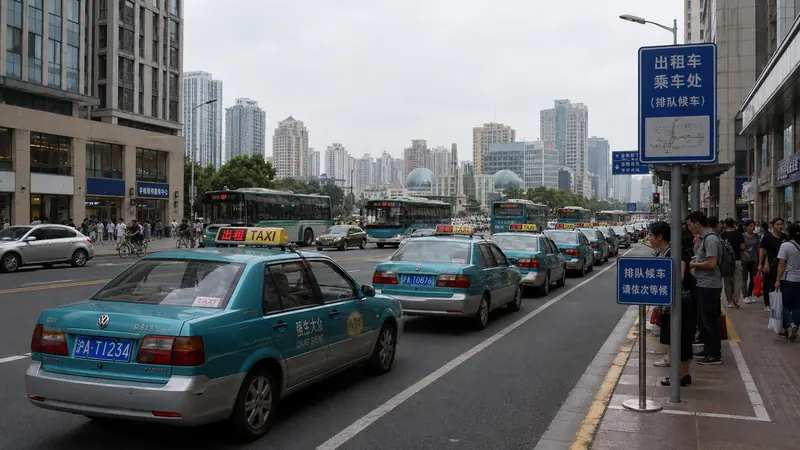

Default city stack
How city transport works
Chinese cities are enormous, but getting across them is usually simpler than the map suggests.
Daytime
Use the metro for traffic-proof city travel.
Doorstep
Use Didi ride-hailing inside Alipay or WeChat for door-to-door trips.
Backup
Use street taxis when your phone, signal, or app payment fails.
Traveler setup
Add a navigation app, a working payment setup, and a screenshot of your hotel address in Chinese, and you can move around Beijing, Shanghai, Chengdu, Xi'an, Guangzhou, Shenzhen, and most major Chinese cities without speaking Chinese.
China City Transport: Fast Answer
The city-transport stack
Pick by luggage, time, and phone reliability.
Daytime without luggage: take the metro. It is cheap, traffic-proof, and signed in English in major cities.
Luggage, rain, heat, late night, or a hotel far from a station: use Didi through Alipay or WeChat.
Phone dead, no data, or app payment blocked: go to an official taxi queue and show your Chinese address.
Map layer
Amap (高德地图) or Apple Maps for metro, bus, walking, and pickup planning.
Payment layer
Alipay or WeChat ride codes are the first mobile option to try in many cities, and they also handle most Didi rides. Because transit ride codes are city-specific and often use post-pay authorization, foreign-card-linked accounts can fail at setup or deduction; keep a ticket, service center, cash, or supported contactless-card fallback.
Offline layer
A Chinese hotel-address screenshot solves most taxi, Didi pickup, and lost-walking problems.
Setup links
Use the navigation, Alipay, and WeChat guides before your first rushed transfer.
For most independent travelers, the smoothest setup is Amap (高德地图) or Apple Maps + Alipay + WeChat. If you have not set those up yet, start with our China navigation apps guide, Alipay for foreigners guide, and WeChat for foreigners guide. For payment backup planning, also read the credit and debit cards in China guide; card acceptance, app linking, and direct metro-gate support vary by city and card issuer.
Choose Metro, Didi, or Taxi
🚇Metro
Use it for: central districts, rush hour, museums, food streets, train-station links, and low-cost daily hops.
Watch for: last-train times, crowded platforms, and long walks between station exits.
🚕Didi
Use it for: luggage, rain, late-night returns, families, hotel doorsteps, and places away from metro stations.
Watch for: confusing pickup points at malls, airports, and high-speed rail stations.
🚖Street Taxi
Use it for: official taxi queues, dead phone situations, weak data, or app payment failures.
Watch for: language friction, flat-fare offers, and private-car touts around arrivals halls.
The hotel-address habit
Before your first outing, save your hotel name, address, and phone number in Chinese. Screenshot it and keep it offline. That one image solves most taxi, Didi pickup, and lost-walking problems.
Metro: Tickets, Gates, and Transfers
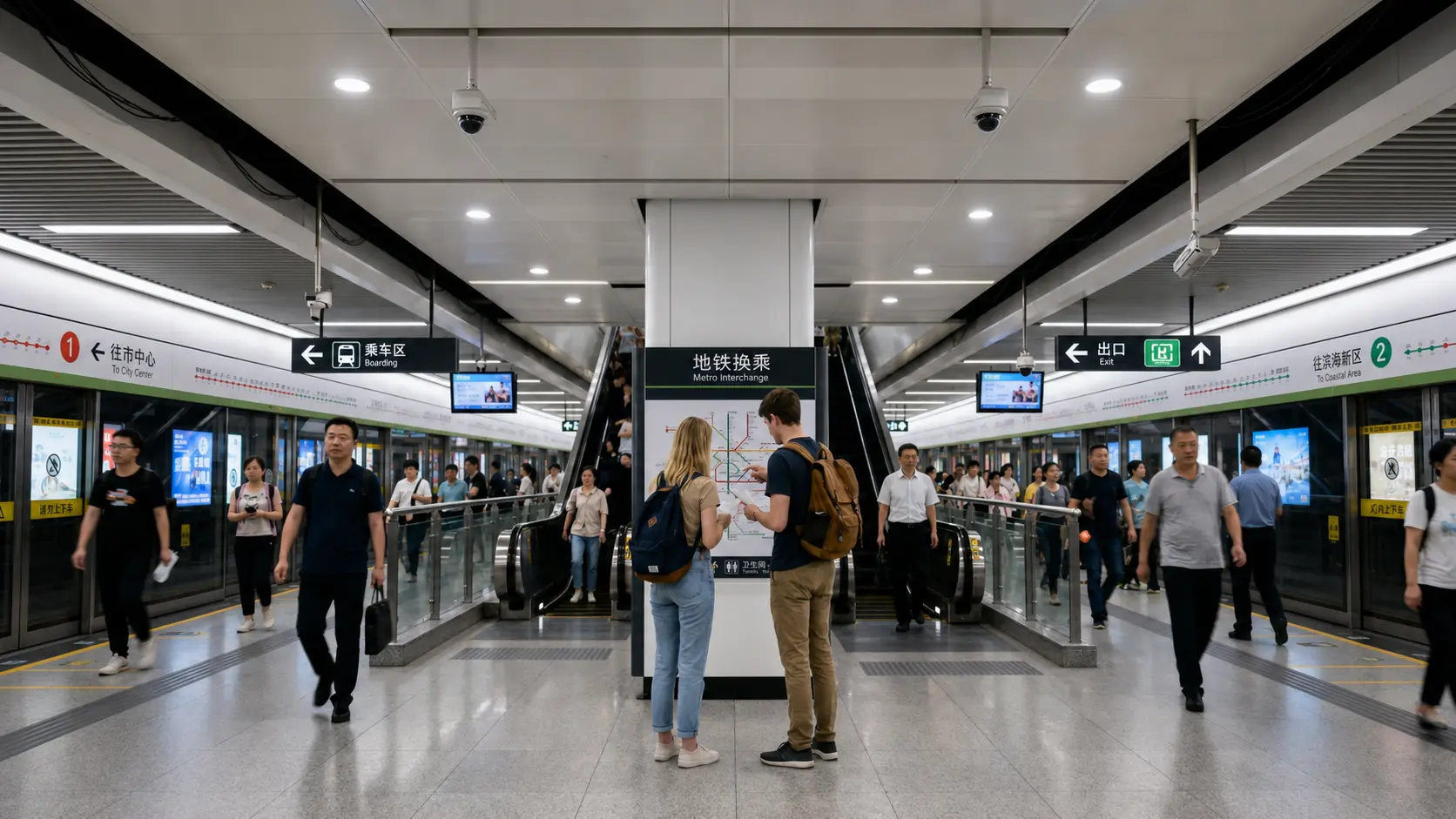
Read signs first
Line color, line number, direction, and exit letter matter more than announcements.
Why metro works
Tier-1 cities like Beijing (北京), Shanghai (上海), Guangzhou (广州), and Shenzhen (深圳) have dense metro networks that reach most major attractions and transport hubs.
Tier-2 cities like Chengdu (成都), Hangzhou (杭州), Wuhan (武汉), and Xi'an (西安) are also easy to navigate by metro.
Decision points are visual
Read the line color, line number, station name, direction, and exit letter instead of trying to understand every announcement.
Use this flow for your first few metro rides:
- Check the route- Use Amap or Apple Maps. Screenshot the line color, start station, end station, and platform direction.
- Enter the right station- Note the exit letter you eventually need; large stations can span several blocks.
- Clear security- Put bags on the X-ray belt and be ready for a quick drink check if carrying a bottle.
- Pay for the ride- Use a single-trip ticket, transit card, local metro QR code, or city-supported contactless bank card.
- Find the platform- Match the line color and terminal-station direction before boarding.
- Tap out and choose the exit- Scan or tap again at the exit gate, then follow the exit letter closest to your destination.
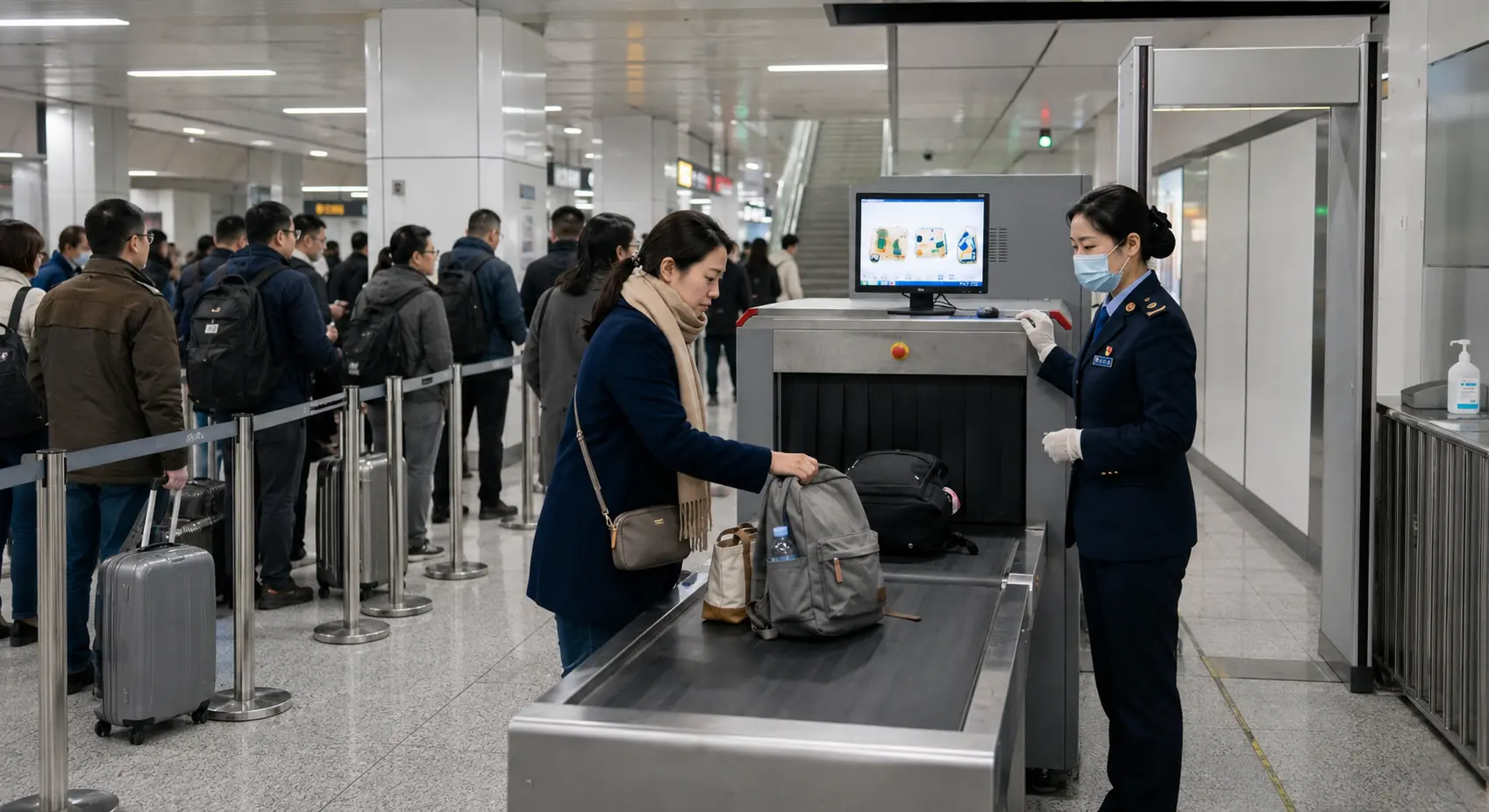
Security checkpoint
Every Chinese metro station has a security checkpoint. Put bags on the X-ray belt, keep walking when staff waves you through, and expect occasional drink checks.
Water bottles
If you carry a water bottle, staff may ask you to take a sip.
Restricted items
Avoid flammable items such as certain aerosol sprays; rules vary by city, but security screening itself is usually fast.
Choose your ticket method by city and backup needs:
🎫Single-trip ticket
Best for one-off rides. Use the vending machine, switch to English, choose the destination, and pay with small cash or a QR scan.
💳Transit card
Useful as a backup if you do not want to open a new ride code in every city, if your phone battery is weak, or if you are managing several riders. Buy one at the service center; many cities charge a refundable deposit of around ¥20.
📱Mobile QR code
Usually the fastest if it opens successfully. Activate the local metro ride code inside Alipay or WeChat, then scan at entry and exit gates; test it before a rushed airport, train-station, or family transfer.
Contactless bank-card gates are city-specific
Some major cities now let riders tap a supported bank card directly at metro gates, but this is not a nationwide rule. Beijing's urban rail network supports overseas Visa and Mastercard contactless cards at fare gates; Shanghai began a full-network trial on June 28, 2025 for UnionPay, Visa, Mastercard, American Express, JCB chip/contactless cards, eligible phone Pay wallets, and digital RMB hard wallets. Look for the card or contactless logo at the gate, keep Alipay, WeChat, or a ticket as backup, and make sure the card supports small contactless transactions with enough balance or credit.
One card, phone wallet, or metro QR code normally equals one paying rider. If two adults and one fare-paying child are traveling together, prepare three separate payment methods or buy tickets; you normally cannot tap the same card twice in a row for two people. If a child qualifies for the local free-ride rule, follow station staff instructions; otherwise use a separate ticket or payment method.
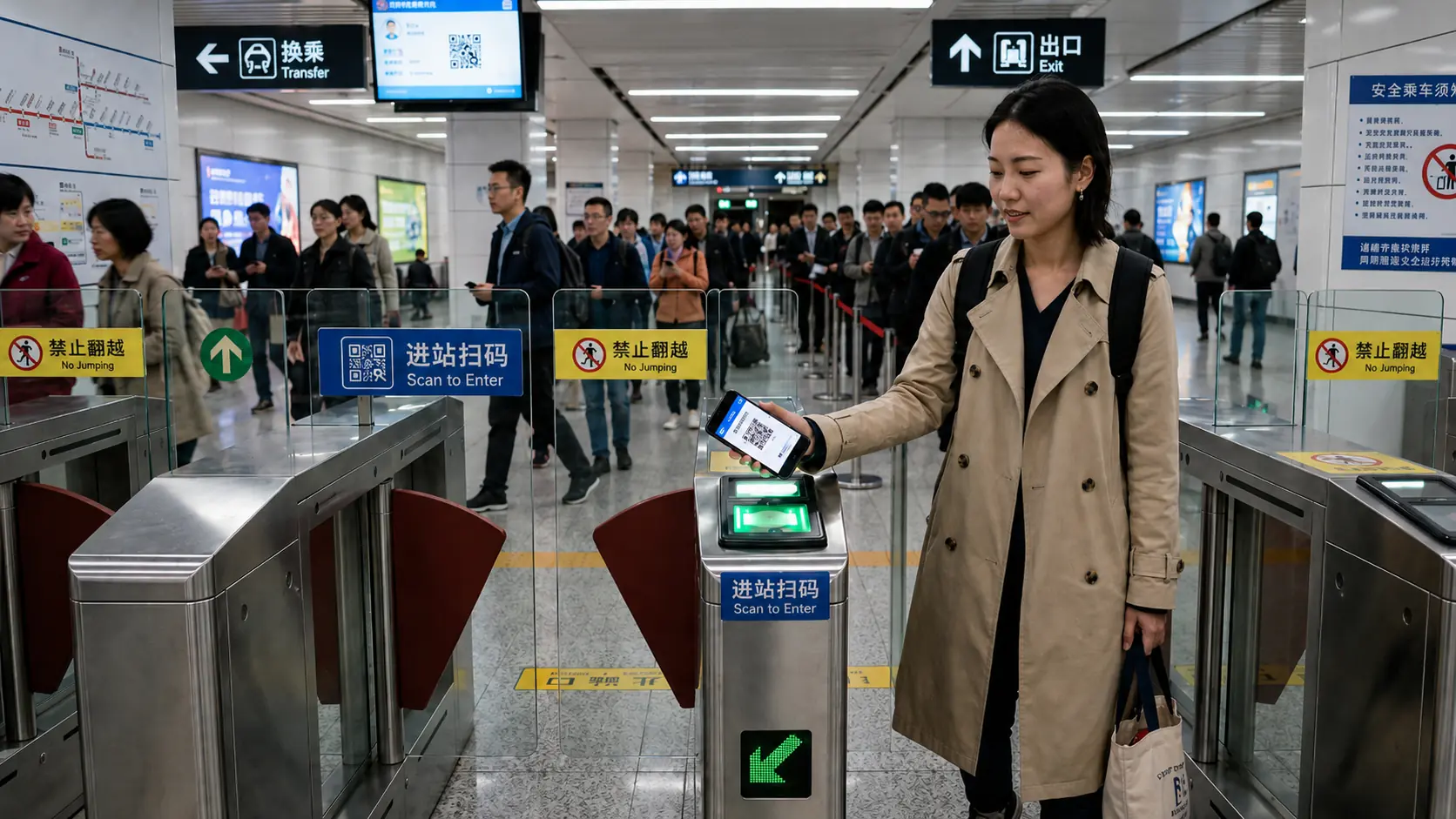
Gate and transfer rhythm
At the gate: tap the card, scan the QR code, or insert the token, then walk through promptly.
For transfers: follow Transfer (换乘) signs inside the paid area.
For exits: scan or tap again, then look up at the exit board and match your exit letter to the street, mall, museum, hotel, or landmark you need.
iPhone shortcut: Apple Wallet transit card
Apple Wallet supports transit cards for China mainland, including Beijing, Shanghai, and China T-Union options, but this is different from directly tapping a foreign Visa or Mastercard in every city. Apple says China mainland transit-card setup needs a China UnionPay credit or debit card in Wallet, and China T-Union or Shanghai transit cards may charge a refundable RMB 20 deposit. If setup fails, use Alipay, WeChat, a ticket, or a city-supported contactless bank card instead.
¥Fares and hours
Guangzhou and Shenzhen commonly start around ¥2; Beijing and Shanghai commonly start around ¥3. Cross-district rides often land around ¥5-10. Most lines run from roughly 6:00 AM to late evening, but always check the last train by line and direction.
🧳Crowds and luggage
Rush hours, roughly 7:30-9:30 and 17:00-19:00, can be packed in major cities. Large suitcases are allowed, but Didi is usually better after flights or train arrivals.
Didi Ride-Hailing in Alipay or WeChat
Door-to-door rail
Didi is the most useful door-to-door option for foreign travelers in Chinese cities. The easiest path is usually not the standalone app, but the Didi mini program inside Alipay (支付宝) or WeChat (微信), especially if you already linked an international bank card for payments.
Still, app payments can fail because of card-linking, phone verification, SMS delivery, or risk checks. Set up both wallets before arrival, keep small RMB notes, and know where the official taxi queue is.
Screenshot-level help
For screenshot-level detail, use the Didi section in our Alipay guide or the ride-hailing section in our WeChat guide.
- Open the mini program- In Alipay, tap Transport or search 滴滴出行. In WeChat, search 滴滴出行.
- Enter the destination- Chinese names are most reliable. Paste the address, ask hotel staff to send it, or drop a pin.
- Choose the vehicle- Express for normal trips, Premier for luggage, Taxi if app cars are slow.
- Match the car- Check the license plate, car model, and driver details before getting in.
- Pay in the app- The fare charges to Alipay or WeChat after the ride. If payment fails, settle the balance before booking again.
快Express (快车)
The default budget ride. Good for most city trips when you have normal bags and do not need extra space.
优Premier (优享)
Roomier and more comfortable. Best for airport bags, family trips, or longer cross-city rides; often about 30-50% more than Express.
的Taxi (出租车)
Hails a licensed city taxi through the app. Useful when app cars are slow or when you may need cash fallback in the car.
Pickup point discipline
At malls, airports, train stations, and large hotel complexes, move to a clear pickup point before booking: exit letter, gate number, hotel lobby entrance, or signed ride-hailing zone. If the driver calls, answer once, then switch to in-app text so translation can help.
Use trip sharing for late-night rides, keep the route visible, and know that emergency features connect to local police number 110.
Street Taxis and Scam Checks
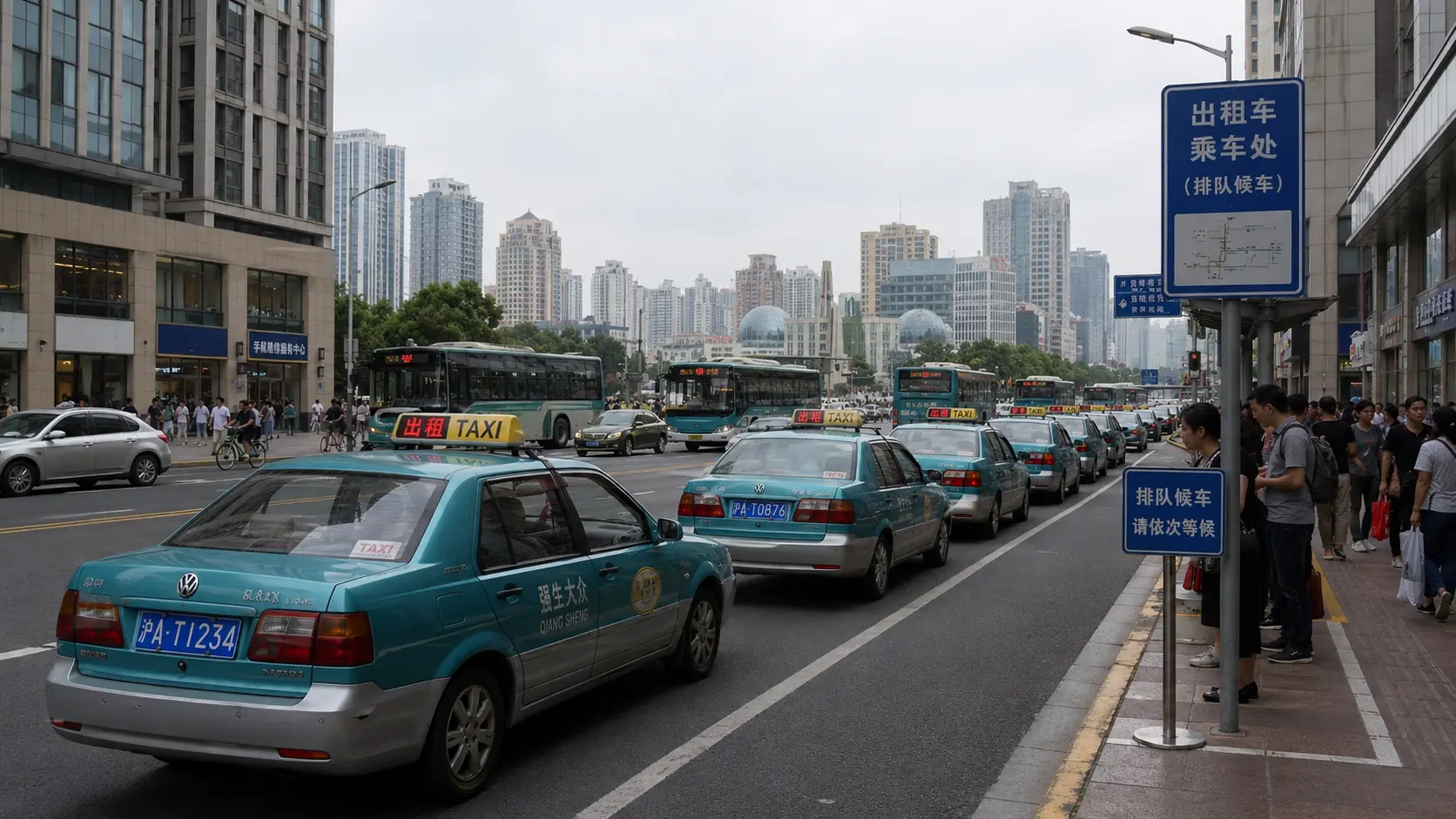
Queue beats curbside hailing
At airports, stations, and large hotels, start with the signed official queue.
Backup tool, not first plan
Street taxis still matter, but treat them as a backup tool rather than your first plan.
When you may need one
Your phone dies, data is unstable, ride-hailing wait times are long, or you are already at an official airport, train-station, or hotel taxi queue.
Tradeoff
Taxis do not require an app, but they require more communication.
空Find a real taxi
An available taxi usually has its roof light on and may display 空车 (vacant). Taxi stands are more reliable than waving from the curb in large cities.
📍Show a Chinese address
Show the driver the Chinese address and phone number, not just an English hotel name. Keep a translation app ready for short phrases.
表Meter only
Make sure the driver starts the meter. If the meter is "broken" or the driver quotes a flat fare, leave and find another cab.
¥Payment backup
Carry small cash notes such as ¥10, ¥20, and ¥50. Alipay and WeChat Pay are common; international cards almost never work directly.
Use the official queue
Watch especially for airport and station touts. Anyone approaching you inside arrivals saying "Taxi?" is usually not the official queue. Follow the overhead Taxi signs instead.
Airport and Train Station Transfers
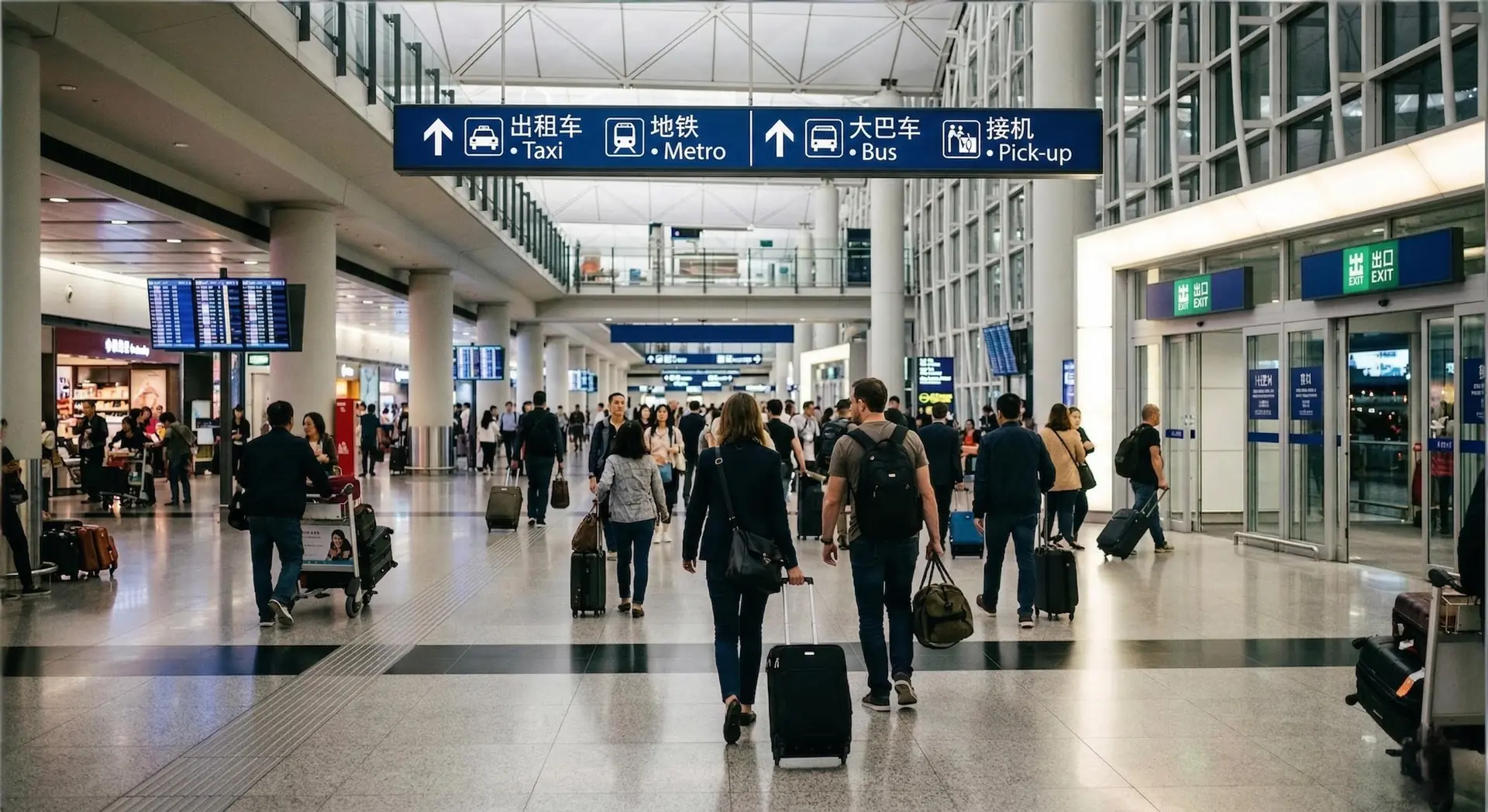
Follow the signs first
Taxi, metro, and bus exits are signed overhead; choose your transfer after you know which route is actually open.
First transfer pressure
The airport-to-hotel or station-to-hotel leg is where most first-time stress happens: luggage, jet lag, crowds, and a phone that may not yet be online.
First move: get connected.
If your eSIM or local SIM is working: open your map and payment app immediately.
If not: try airport Wi-Fi, but remember that captive portals, SMS checks, APN settings, or app risk controls can block maps and payments.
For mobile data setup, see the China internet access guide; if your connection is already failing, use the China internet troubleshooting guide or switch to the official taxi queue.
🚕Most arrivals
Use Didi through Alipay or WeChat. Choose Premier if you have large suitcases, children, or a long ride into the city.
🚇Light luggage
Use metro or airport express when the line is direct, you arrive before last train, and your hotel is close to a station.
🌙Late night
Assume metro and buses may be closed. Use ride-hailing or the official taxi queue, and ignore private-car touts in arrivals.
🧳Train station
High-speed rail stations usually connect to metro lines, but ride-hailing is easier if you have heavy luggage or a distant hotel.
Ride-hailing
Best balance
- ✓Door-to-door and easiest with luggage
- —Pickup zones can take a few minutes to find
~¥80-300+
Major airport to central hotel
Metro / Express
Cheapest fast route
- ✓Good with light luggage before last train
- ✗Poor after midnight or with heavy bags
¥3-55
Regular metro cheaper
Express higher
Shuttle Bus
Fixed downtown routes
- —Can be good value if the stop matches your hotel area
- ✗Less convenient if the final walk is long
~¥20-40
Useful when metro does not fit
Prices vary by city, airport, distance, traffic, and time of day. Use these as planning ranges, not fare promises.
Airport transfer fares swing by city, airport, traffic, and time of day. For broader planning bands across taxis, metro, airport express routes, and daily transport budgets, cross-check the China price guide.
Buses and Shared Bikes
🚌City buses
Cheap, often around ¥2-3, and useful where metro lines do not reach. Harder for visitors because stop names, announcements, and route changes are mostly Chinese.
Use Amap (高德地图), keep GPS open, and activate the local bus ride code in Alipay or WeChat.
🚲Shared bikes and e-bikes
Best for the last mile from a metro station to a hotel, park, waterfront, or nearby attraction. Common brands include Meituan Bike (美团单车), Hellobike (哈啰单车), and Didi Bike / Qingju (青桔单车).
Rides often start around ¥2 for the first 30 minutes. Shared e-bikes are also common in many smaller and midsize cities, but helmet availability, no-ride zones, parking corrals, and local rules vary more than with pedal bikes. Use them only for short, low-risk local hops, park in allowed zones, and see the China shared bikes guide for full setup.
When Transport Plans Fail
🔋Low battery
Switch to metro if it is still running, or go to an official taxi queue. Keep your hotel address screenshot offline and carry small RMB notes.
📶No data
Try station, airport, hotel, or mall Wi-Fi, but do not depend on it for payment or ride-hailing. If a captive portal, SMS check, or app risk control blocks you, use the station map, ask staff, or take an official taxi.
📍Bad pickup point
Move to a clearer landmark: hotel entrance, station exit letter, mall gate number, or signed pickup zone. Message that landmark to the driver.
💳Payment fails
Try the other payment app, settle any unpaid Didi balance, or switch to a licensed taxi where cash may work. Recheck your Alipay, WeChat, or card setup later.
🚇Metro too crowded
Wait one train, move toward the front or rear of the platform, or switch to Didi if you have luggage. On public holidays, add buffer time.
🌧Weather turns
Rain and extreme heat quickly push everyone into ride-hailing. Book earlier than you think, or move to a hotel, mall, or station entrance with a clear pickup zone.
Frequently Asked Questions
No for most visitor use cases. You can book rides through the Didi (滴滴出行) mini program inside Alipay or WeChat. Use those setup guides before arrival if you want screenshot walkthroughs.
Sources checked for this guide
- Payment and transport-app access for overseas visitors: State Council payment service guide
- Beijing Subway overseas bank-card fare-gate support: Beijing official overseas-card metro gate support
- Apple Wallet transit card support in China mainland: Apple Support China transit cards
- Shanghai Metro full-network bank-card and digital RMB hard-wallet gate trial from June 28, 2025: CCTV / The Paper Shanghai Metro gate trial report
- Urban rail scale and 2024 operating statistics: China.org.cn urban rail report
Beyond This Guide
City transport is only one piece of the China travel toolkit. These guides help you connect the rest:
- China Navigation Apps: Amap, Maps.me & Apple Maps - set up the map apps that power metro, bus, and walking routes.
- Alipay for Foreigners - full setup, payments, and Didi ride-hailing walkthrough.
- WeChat for Foreigners - setup, payments, ride-hailing, messaging, and mini programs.
- Credit & Debit Cards in China - how cards fit beside Alipay, WeChat Pay, cash, and city-specific contactless options.
- China Internet Troubleshooting - what to do when captive portals, APN settings, roaming, or SMS checks block maps and ride-hailing.
- China Price Guide - realistic transport, food, hotel, and ticket price bands.
- China Train Tickets: 12306 & Trip.com - book intercity high-speed rail step by step.
- Essential China Travel Apps - the complete install checklist.
- Translation Apps: Baidu, Youdao & Google - your fallback when language becomes the barrier.
© gochinafreely.com — Original guide by Go China Freely.