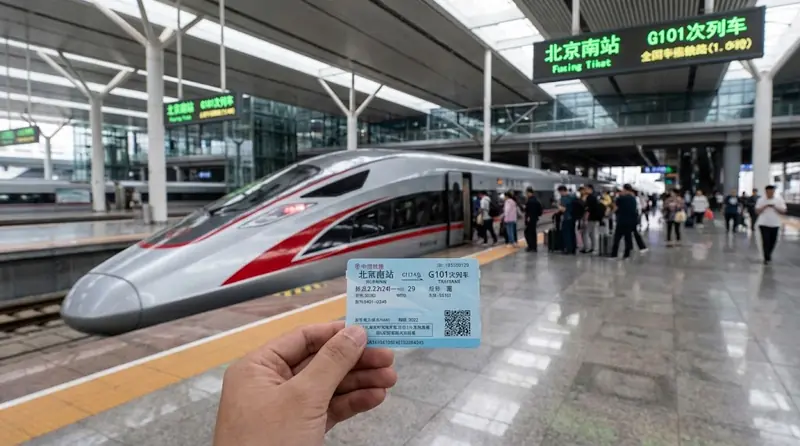
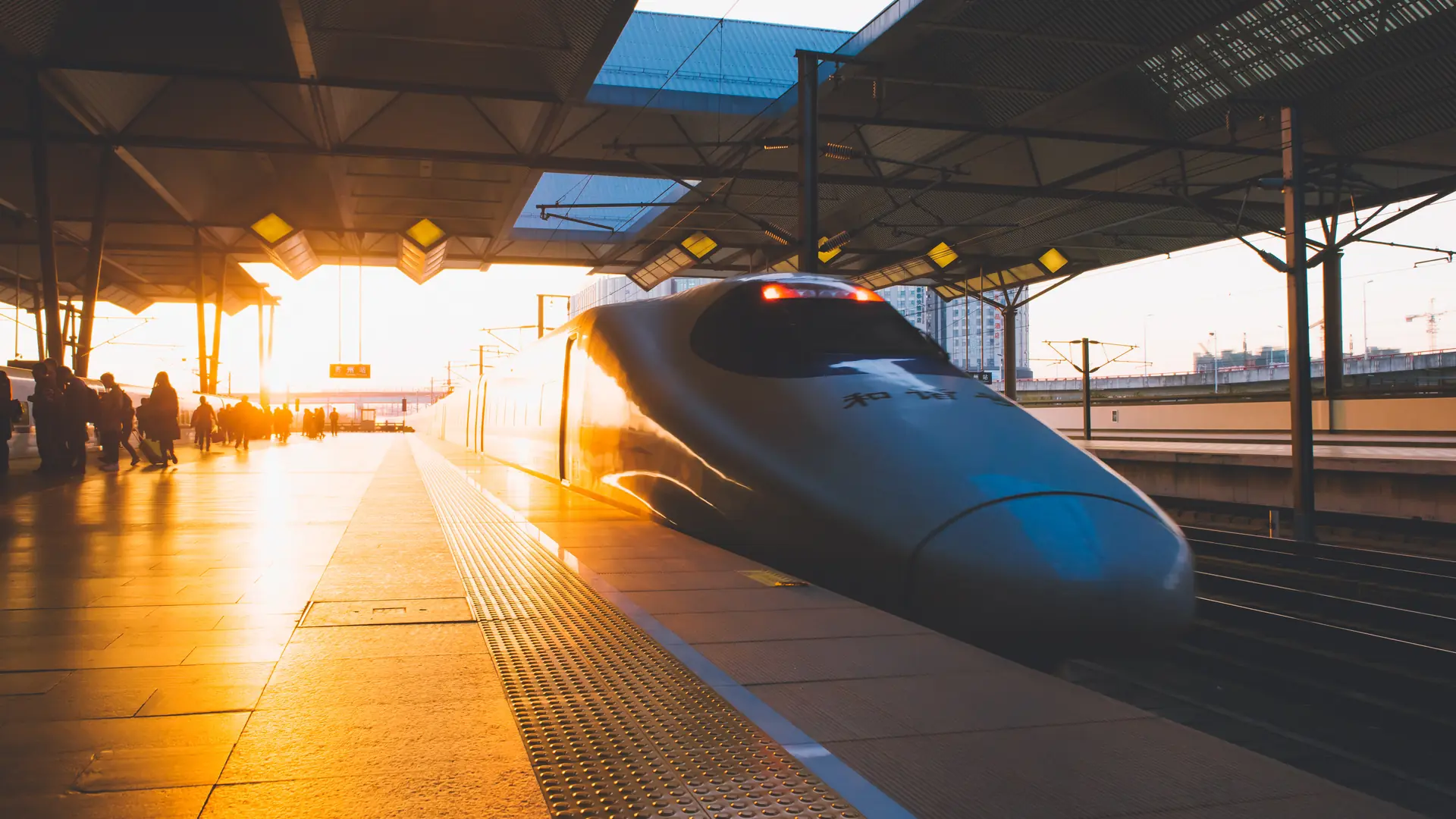
China's high-speed rail network now exceeds 50,000 km of dedicated lines, with G-trains running up to 350 km/h. For independent travelers, it is usually the cleanest way to move between major cities: station security is quicker than airport security, most big stations connect to the metro, and you carry your bags straight on board. This guide picks up where ticket booking ends — which route is worth riding, which seat to choose, and what to do from station entrance to final exit.
Best rail use case
Rail-day rhythm
Buffer
Arrive 30-45 minutes early for ordinary trips; use about 60 minutes for first-timers, holidays, or mega-stations.
Document
Foreign passports work, but staffed lanes are the backup when auto-gates cannot scan your document.
Bags
There is no checked-luggage step. Bags pass security, then ride in the carriage with you.
Decision
Choose rail over flying when the train keeps the door-to-door day simpler.
What this guide covers
Routes, seats, boarding, luggage, transfers, facilities, and arrival fallbacks.
China High-Speed Rail: Fast Answer
50,000+ km
High-Speed Lines
350 km/h
Top Operating Speed
30-45 min
Normal Station Buffer
China operates the world's largest high-speed rail network. By the end of 2025, total railway mileage reached about 165,000 km, with high-speed rail lines exceeding 50,000 km. The practical result for visitors is simple: many China city pairs work better by train than by plane.
⏱️Fast Door to Door
Arrive about 30-45 minutes early for ordinary domestic high-speed trips. First-timers, holiday travelers, and mega-stations such as Beijing South or Shanghai Hongqiao should allow about 60 minutes.
🚇Metro-Linked Stations
Many high-speed stations connect directly to local metro lines, so the last mile is often easier than an airport transfer. Always check the full station name before booking.
🧳Carry-On Travel
There is no checked-luggage step. Your bags pass station security, then travel with you in the carriage, overhead rack, or end-of-car luggage area.
📶Use Mobile Data
4G/5G coverage is usually strong along main routes, but onboard WiFi is not dependable. A China-ready SIM or eSIM matters more than train WiFi.
🛂Passport Backup
Foreign passports work for railway travel, but auto-gate support varies by station. Keep enough time for a staffed lane if the scanner rejects your document.
🧭Train Over Plane
Choose rail for most city pairs under 5-6 hours. Consider flying only when the rail ride is very long, the station is far from your hotel, or a direct flight saves a full day.
Best Tourist Routes by Train
Use these as planning anchors, not fixed timetables. Journey times and second-class fares are 2026 reference ranges, so confirm the exact train on 12306 or Trip.com before booking.
Beijing — Shanghai
1,318 km · ~4h18m · ¥553
China's busiest trunk line with 40+ daily G-trains plus overnight D-trains — departures every 15–30 minutes during peak hours. Stops include Jinan (济南) and Nanjing (南京), both worth a break.
Shanghai — Hangzhou
~200 km · ~45 min · ¥58–95
Departures every 10–15 minutes from Shanghai Hongqiao (虹桥站). Step off at Hangzhou East and take the metro straight to West Lake.
Beijing — Xi'an
~1,200 km · ~4.5h · ¥515.5
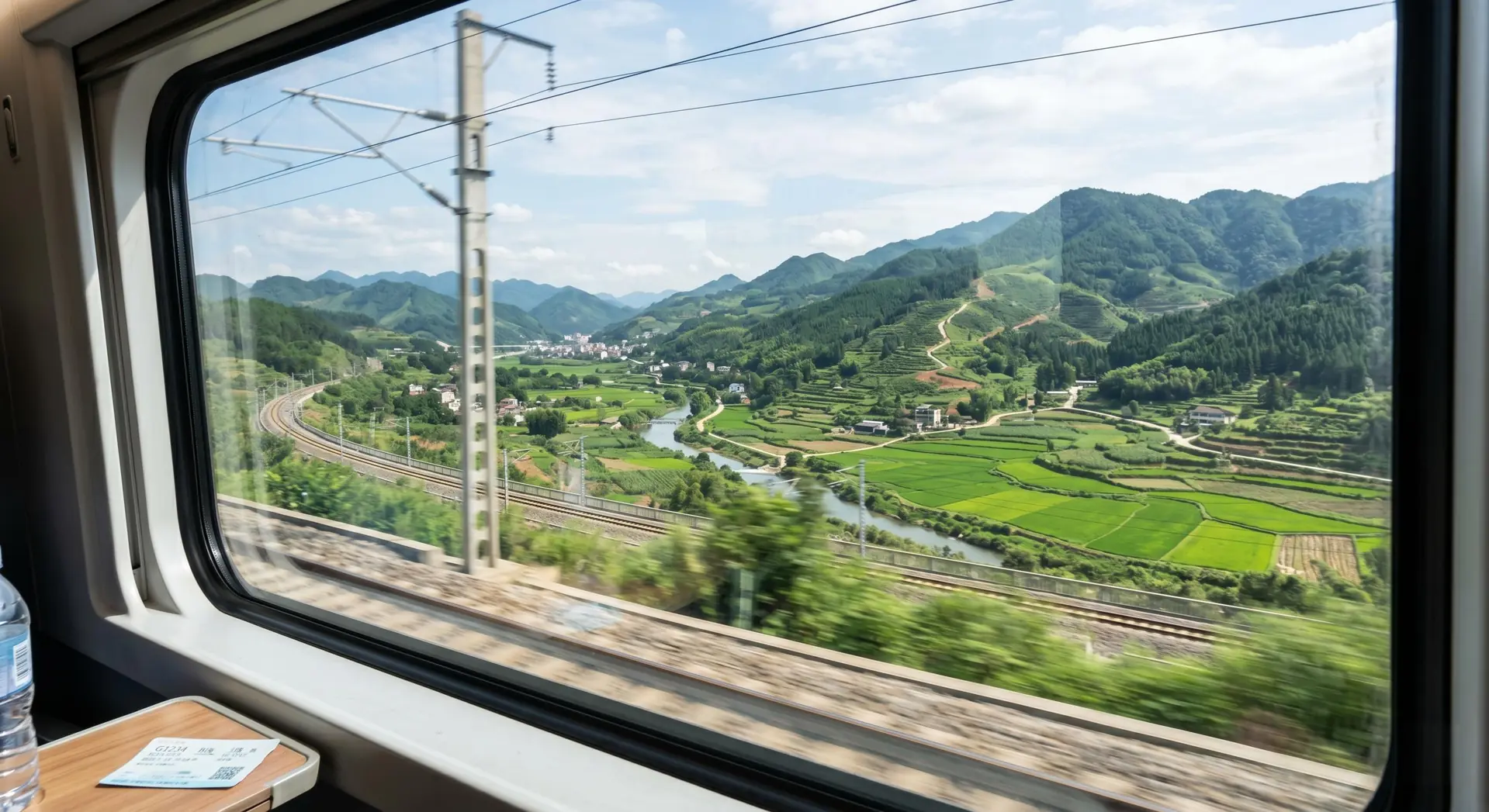
The landscape shifts from the flat North China Plain into the gully-carved loess plateau — watch the terrain transform through your window.
Chengdu — Chongqing
~300 km · ~1h · ¥90–175
An ultra-frequent shuttle between two hotpot capitals. D-trains around ¥90, G-trains ¥130–175. Eat Sichuan-style hotpot in Chengdu, then ride an hour to try Chongqing's oilier, spicier version.
Guangzhou — Shenzhen — Hong Kong
GZ→SZ ~30 min · SZ→HK ~20 min
The only cross-boundary high-speed line. West Kowloon (西九龙站) uses co-location clearance, so both mainland and Hong Kong immigration happen inside the same station. Allow 45-60 minutes for the station process, and longer around holidays.
Kunming — Dali — Lijiang
KM→Dali ~2h · KM→LJ ~3.5h
The western Yunnan EMU / D-train corridor connects Kunming, Dali, and Lijiang in a slower, more scenic style than a trunk G-train line: about 2 hours to Dali and 3.5-4 hours to Lijiang, crossing the Yunnan Plateau past terraced fields, gorges, and distant snow peaks. Kunming-Dali second class ¥145, Kunming-Lijiang ¥182.
Xi'an — Chengdu
~660 km · ~3.5h · ¥263
Dozens of tunnels under the Qinling Mountains (秦岭) — flashing between pitch-dark tunnel and sudden daylight valley views. The ride itself is part of the experience.
Lanzhou — Xining
~200 km · ~1h · ¥58
The Silk Road gateway: from Xining continue to Qinghai Lake (青海湖), Zhangye Danxia (张掖丹霞), and other northwest highlights.
Shanghai — Huangshan
~447 km · ~2.5–3.5h · ¥191
Take the train to Huangshan North (黄山北站), then a 1-hour bus to the scenic area. Pairs the Yellow Mountains with Hongcun (宏村), a UNESCO-listed Hui-style village — ideal for a 2–3 day side trip.
Beijing — Harbin
~1,240 km · ~5.5h · ¥500–550
Stops in Shenyang (沈阳) and Changchun (长春). A winter favorite — Harbin's Ice and Snow Festival (Dec–Feb) is Asia's largest ice sculpture exhibition.
Changsha — Zhangjiajie
~2.5–3h · ~¥150
The train ends at Zhangjiajie West (张家界西站), with shuttle buses to Zhangjiajie National Forest Park — the landscape that inspired the floating mountains in Avatar.
Chosen your route? Check China train times and ticket prices on Trip.com(affiliate link · may earn commission, no extra cost). Enter your travel date and exact departure and arrival stations, then compare the final fare and any service fees. For the official 12306 option and help with passport details or ticket issuance, follow our China train booking guide.
Seat Classes and Sleepers
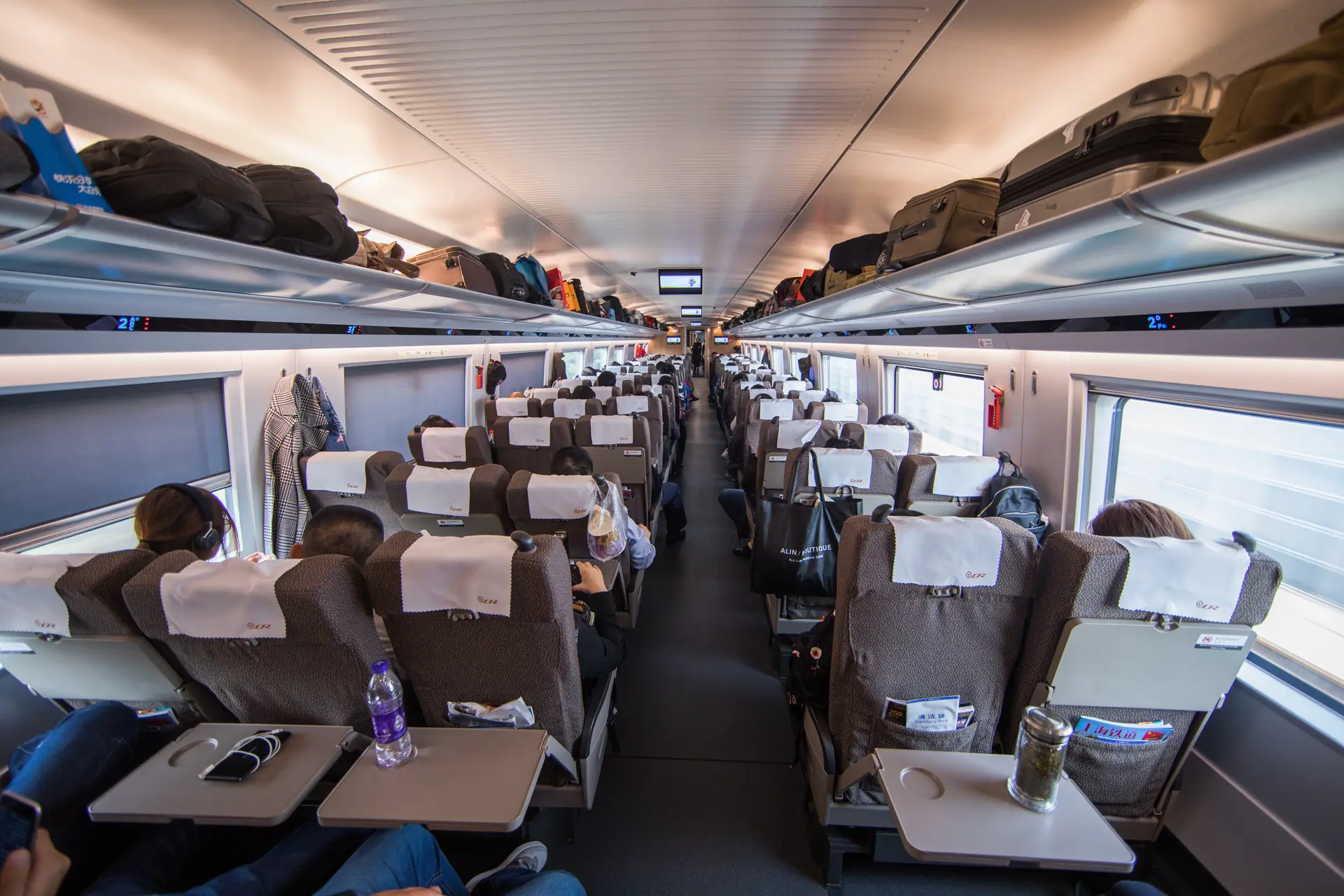
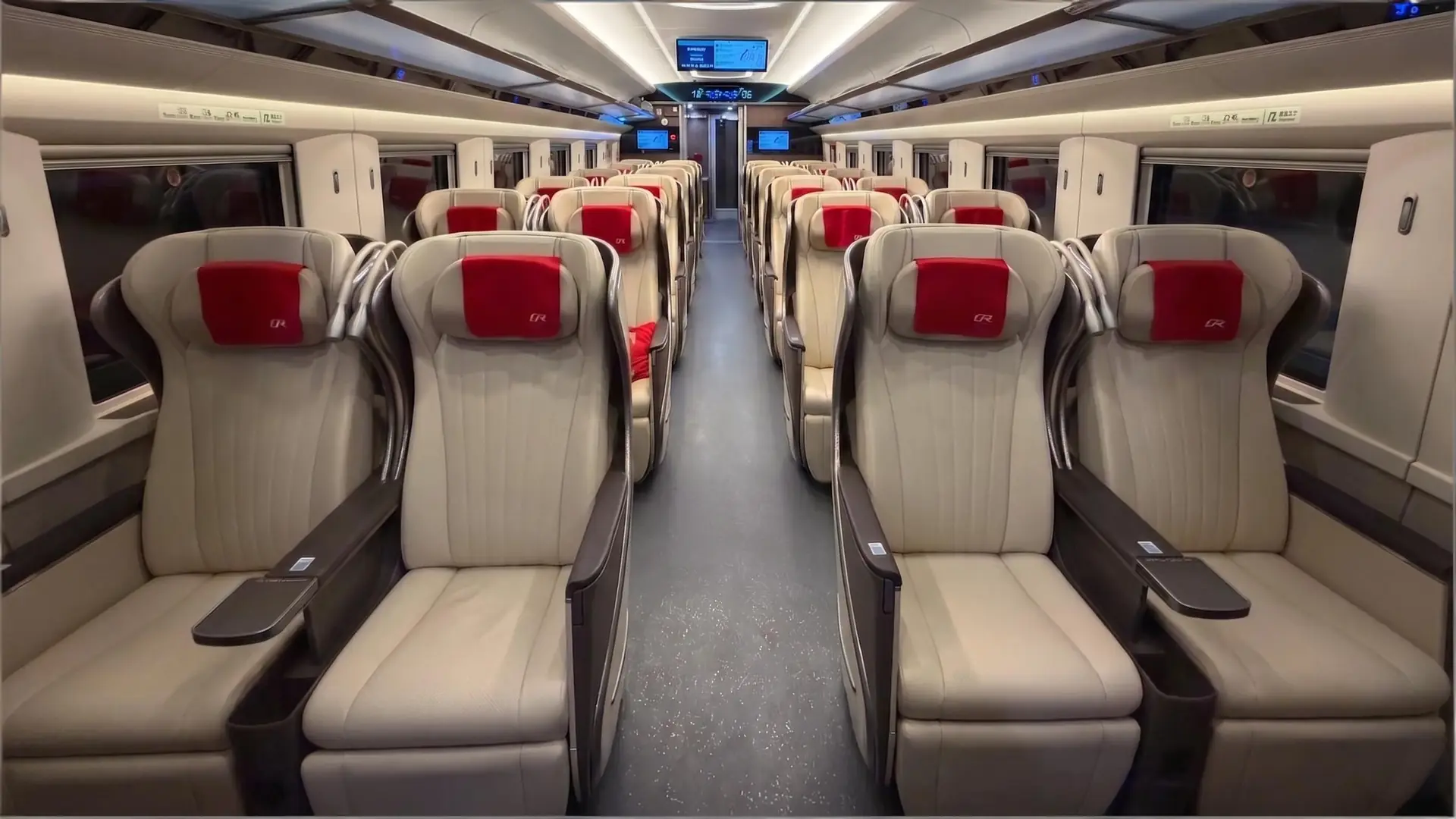
High-speed trains offer three main seat classes plus occasional superior-class and sleeper products. Prices and comfort differ significantly — seat layout, outlet placement, and amenities can also vary between Fuxing Hao (复兴号) and Hexie Hao (和谐号) models.
← swipe to compare all options →
Second Class
Standard choice
- ✓70–80% of carriages
- ✓Recline, tray, footrest
- —Power: 2 outlets per row (Fuxing Hao) — varies on Hexie Hao
- ✓Quiet car option on some G-trains
Base fare
3+2 layout
Pitch ~1,020 mm
First Class
Worth it for 5h+ rides
- ✓15–20% wider than second class
- ✓Larger recline angle
- ✓Own outlet + USB (Fuxing Hao)
- ✗No free meals
~1.6x base
2+2 layout
Pitch ~1,160 mm
~58 cm wide
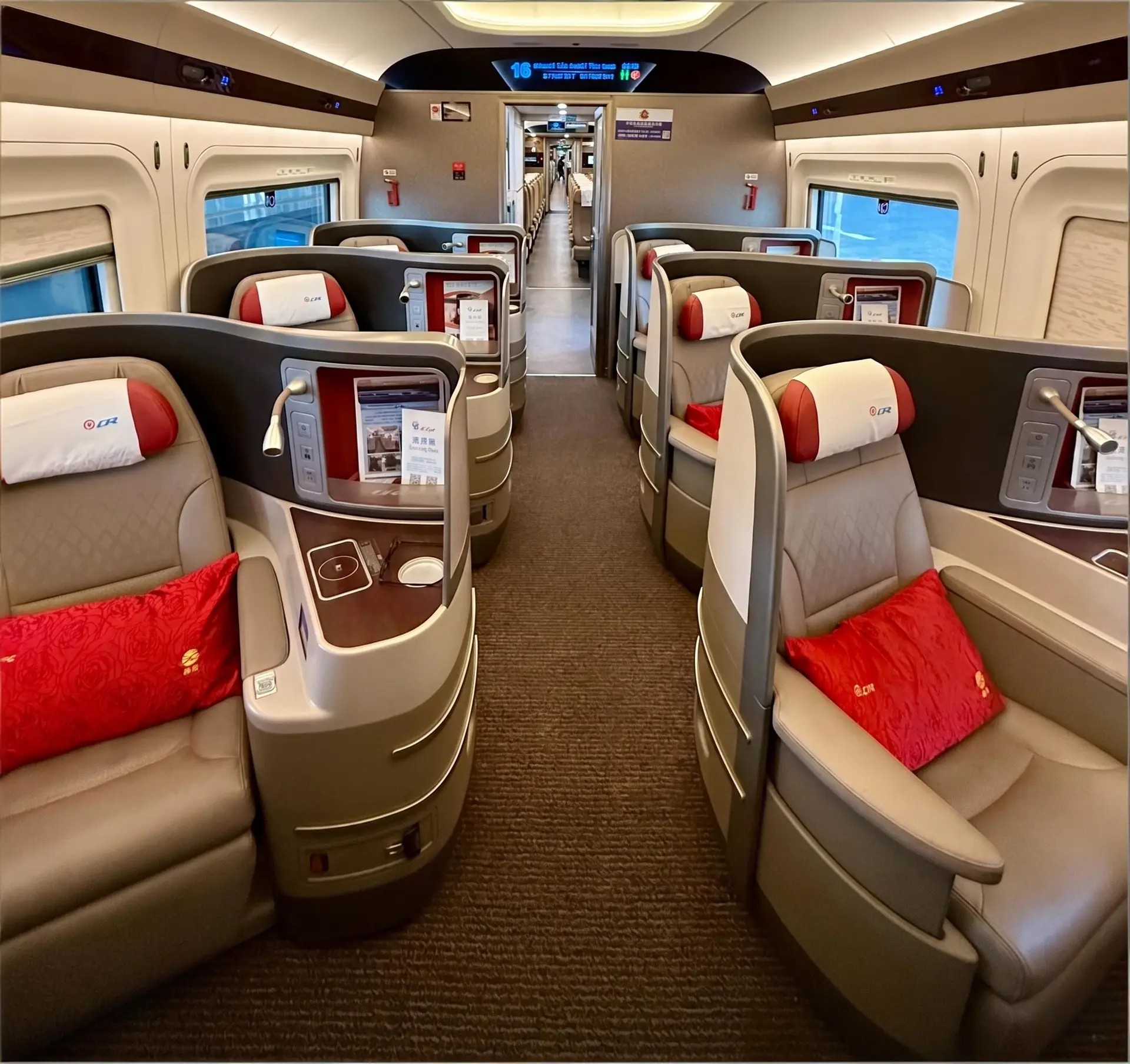
Business Class
Select G-trains only
- ✓Full lie-flat seat + pillow + blanket
- ✓Free meal + coffee + hot drinks
- ✓Station VIP lounge access
- —Some models have entertainment screens
~3x base
2+1 or 1+1 layout
180-degree lie-flat
Prices are approximate multiples of second-class fare on the same route. Exact layout and amenities vary by train model.
Superior Class
A mid-tier between business and first class, found only on certain Hexie Hao models (CRH380, CRH3C). Layout is 2+1 (three seats per row), generous pitch, 220V outlets and some USB ports. Priced above first class but below business — decent value when available.
High-Speed Sleeper
Some overnight D-train services (such as Beijing West to Shenzhen North, D903) offer sleeper carriages in two formats:
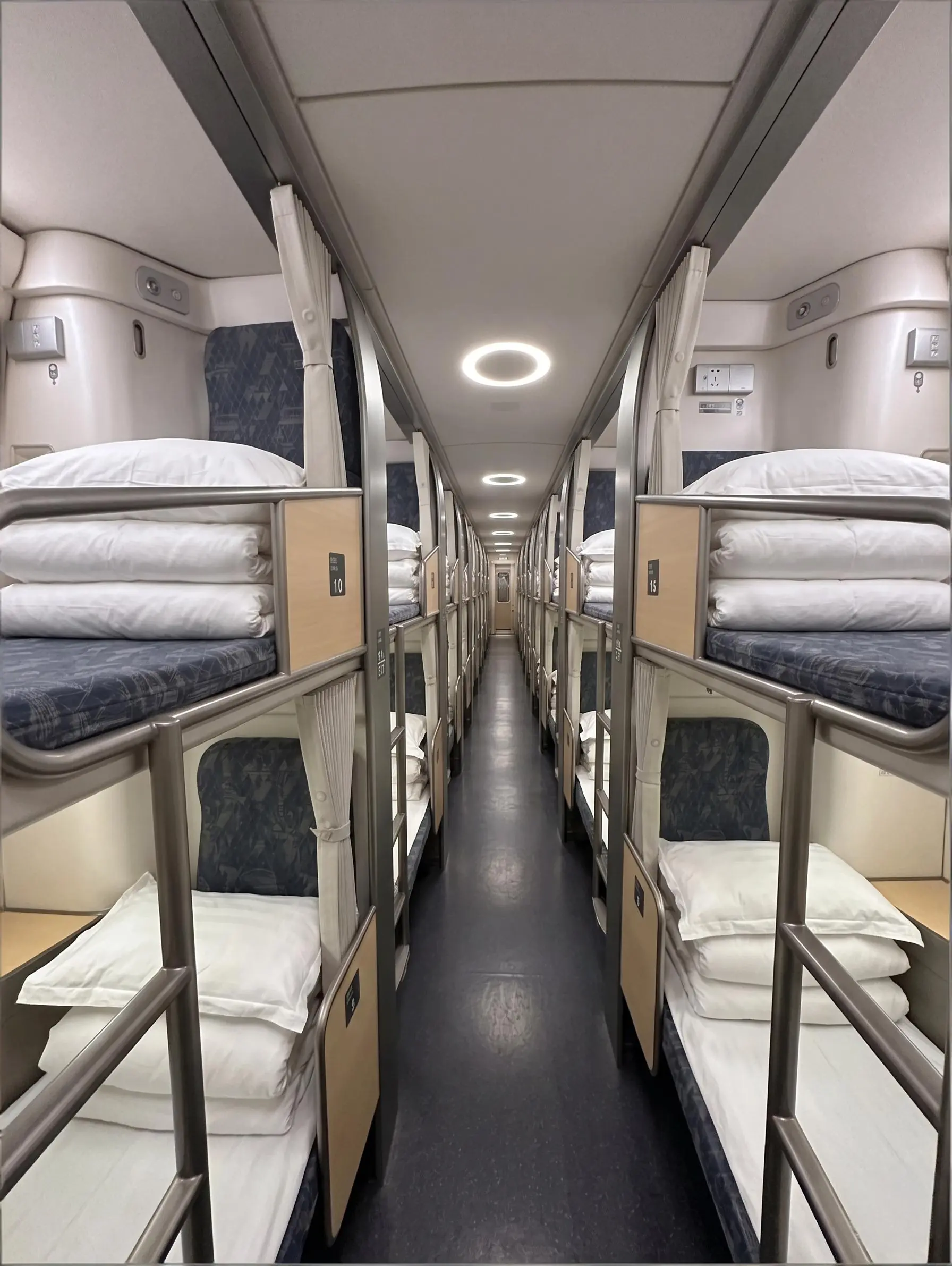
Longitudinal berths: aligned with the train's direction, often with upper and lower bunks on both sides. Facilities vary by trainset; expect a mattress and bedding, then check the exact train for outlets, lights, curtains, or sliding doors.
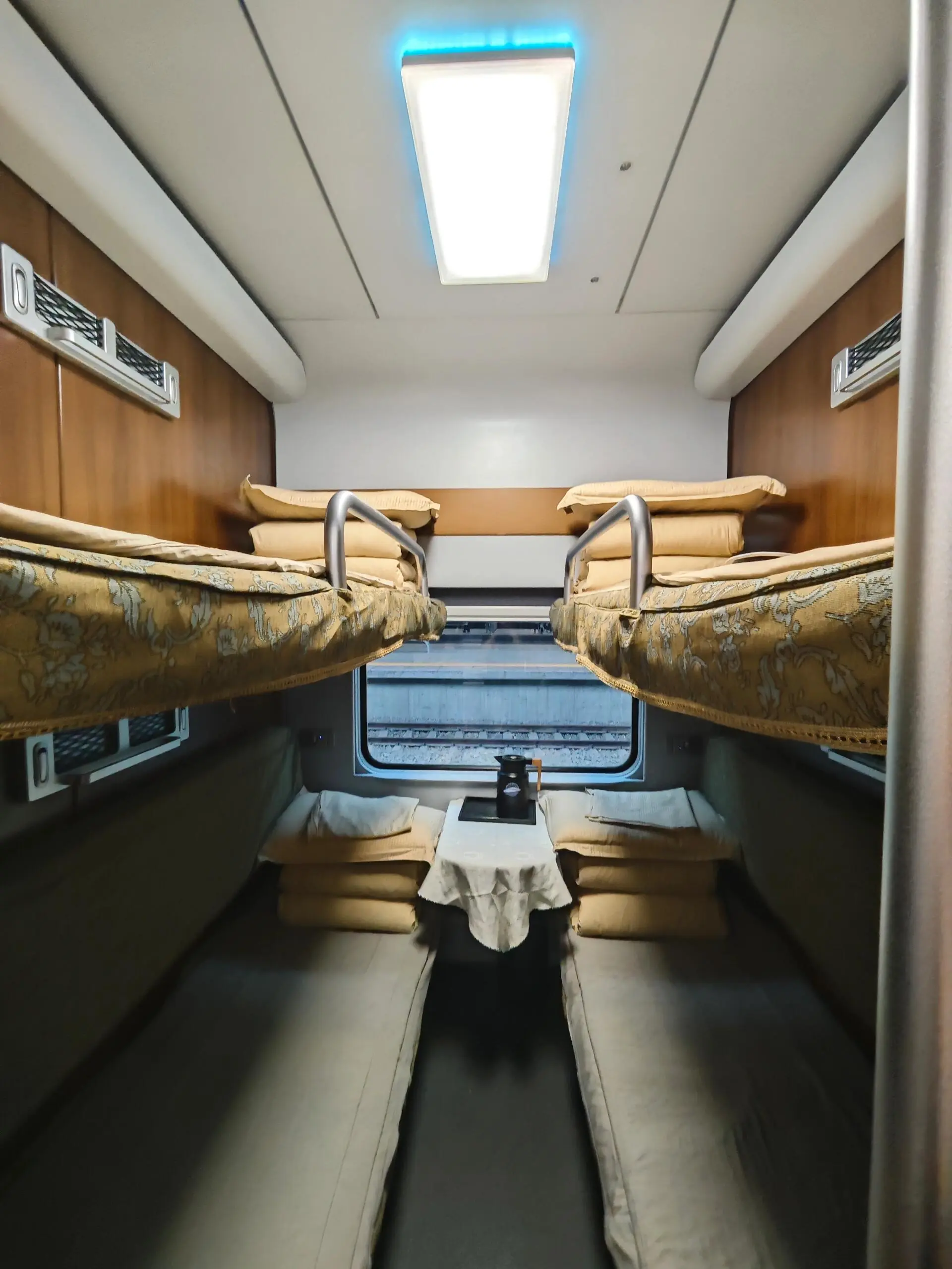
Transverse berths: perpendicular to the direction of travel, often arranged in 2- or 4-person compartments. Expect a padded mattress, pillow, and blanket, but do not assume every photo-visible berth has the same privacy or charging setup.
Sleepers work well for "save a hotel night" routes — board around 8–9 PM, wake up in a new city.
Seat Selection Tips
Choose Your Seat Letter
A and F are window seats — pick these for views. C and D are aisle seats — easier to get in and out. B only exists in second class (the middle of the 3-seat block) — avoid if possible. Traveling as a pair? Pick D/F (the 2-seat side). Traveling with kids? The last row of second class has extra luggage space behind the seats.
Boarding Step by Step
- Arrive at the Station- 30-45 min early
- Security Screening- 5-10 min
- Find the Waiting Hall- Check departure boards
- Ticket Check- 15-20 min before departure
- Board and Find Your Seat- Trains stop 2-5 min only
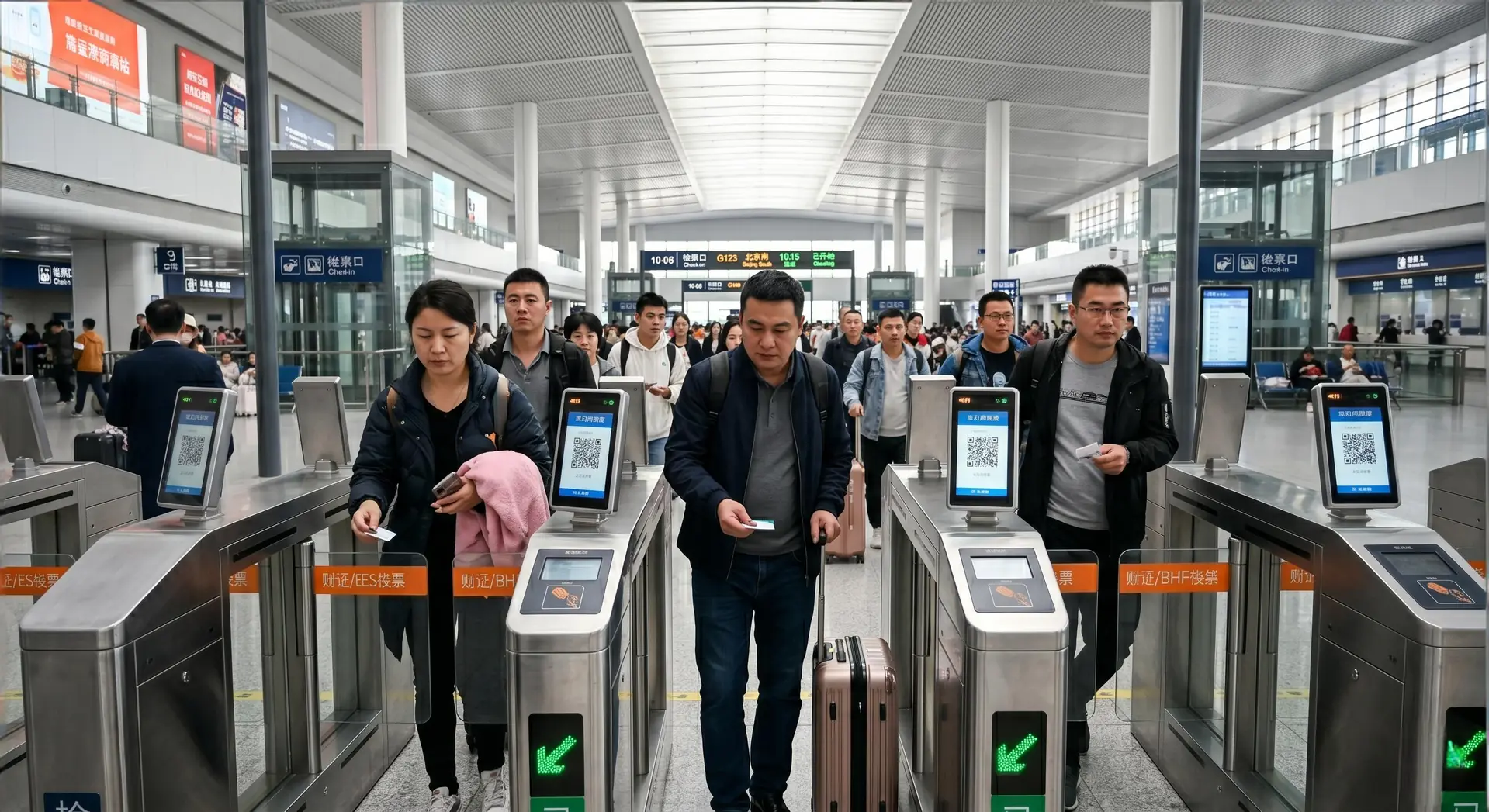
Arrive and clear security
30-45 minutes early is enough — no 2-hour airport buffer. First-timers, holiday travelers, or anyone at a mega-station (Beijing South, Shanghai Hongqiao) should budget 60 minutes. Follow "进站口" or "Entrance"; most signed entrances can get you inside, but the nearest one to your metro exit or waiting area saves a long walk.
All passengers and bags go through security: bags through X-ray, you through a metal detector. Laptops, cameras, and chargers are fine within normal railway limits. Security is usually 5-10 minutes; peak queues can reach 15-20.
Waiting hall and ticket check
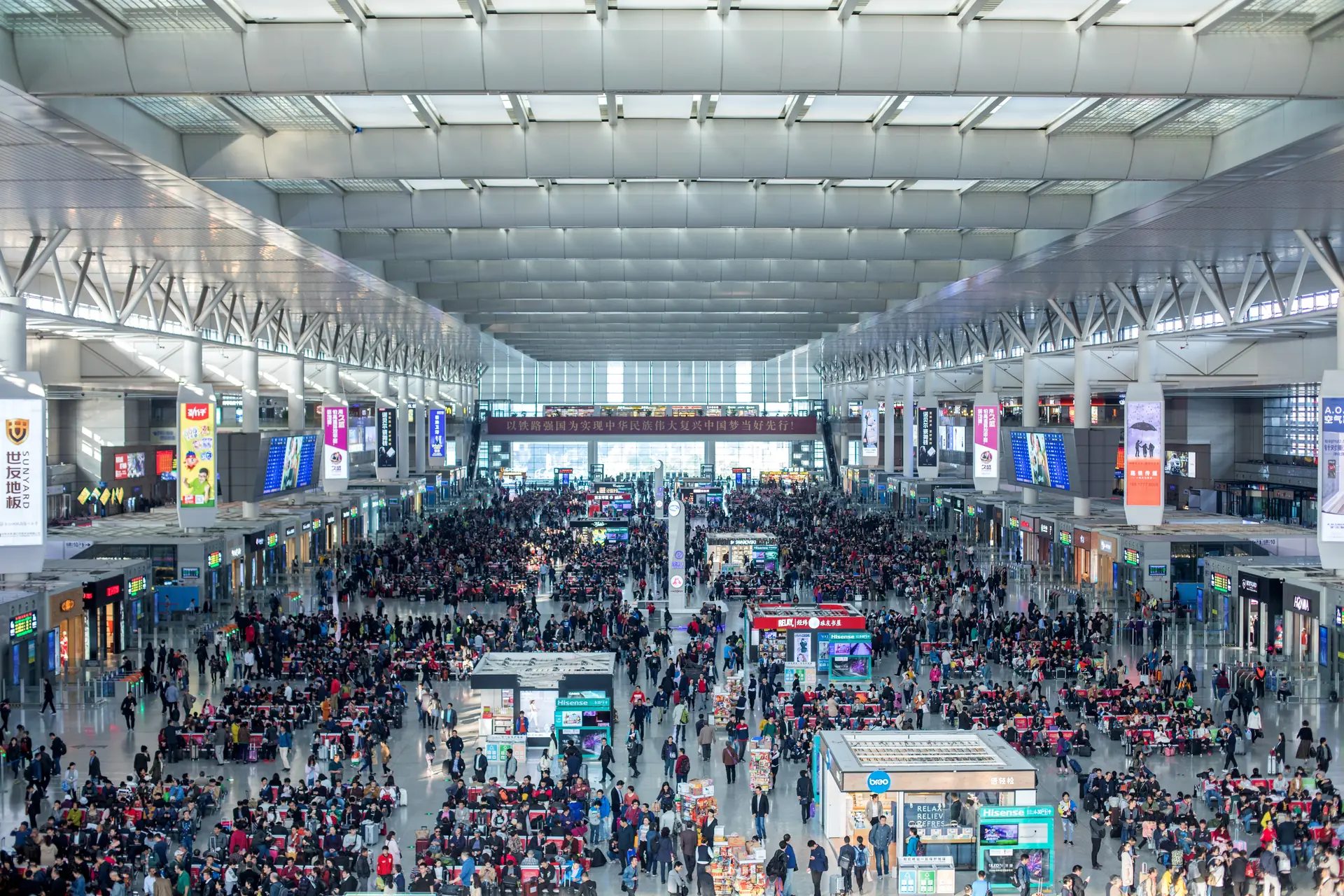
After security, use the electronic boards to find your train number (e.g. G1234), waiting area (e.g. Zone B3), boarding status, and final destination. Follow signs to the assigned area and sit down.
Boarding starts about 15-20 minutes before departure when the screen switches to "now boarding" (正在检票). Passport auto-gates (blue gates): open to the photo page and place it flat on the scanner. Passport support varies, so use the staffed lane if the gate cannot read your document.
Board and find your seat
Platform floors have markings showing where each carriage will stop. Find your carriage number on your ticket and stand at the matching floor marking. Trains stop for only 2-5 minutes — be in position before it pulls in. Board and look for your seat number + letter (e.g. 06A = row 6, seat A), printed above the overhead luggage racks. Glance behind you before reclining to avoid hitting the passenger behind.
Luggage and Security Rules
High-speed trains have no checked luggage — everything you bring must fit with you on board.
Size and Weight Limits
- Weight Limit
- 20 kg
- Size Limit (L+W+H)
- 130 cm (G/D/C high-speed)
- Weight Limit
- 10 kg
- Size Limit (L+W+H)
- Same as above
- Weight Limit
- 35 kg
- Size Limit (L+W+H)
- Same as above
- Weight Limit
- 20 kg
- Size Limit (L+W+H)
- 160 cm
The official EMU limit is strict on paper, but the real traveler problem is usually storage, not a tape measure at the gate. A 24-inch suitcase is the most comfortable default. A 26- or 28-inch case is common in real life, but it can be awkward on a full train, during holidays, or in older carriages with tighter racks.
Where to Store Luggage
Overhead racks
Best for backpacks and smaller suitcases. A 24-inch case is usually the smoothest size; larger cases depend on rack model, neighboring passengers, and how full the train is.
End-of-carriage luggage areas
Many high-speed carriages have large-item areas at one or both ends, but space is first come, first served. Board early if you have a bigger case, and use these areas only when available.
Under your seat
Fits a small backpack or soft bag.
Best Luggage Setup
24-inch or smaller suitcase + daypack is still the easiest setup, but it does not guarantee space on a full train. If you must bring a larger case, board early, look for the end-of-carriage luggage area, and keep valuables with you rather than on the overhead rack.
Security Restrictions
- Controlled knives, flammable or explosive materials, alcohol over 70% ABV, unsealed or unlabeled alcohol, and other dangerous items are not allowed.
- Do not pack pocket knives, fruit knives, craft blades, or scissors in your day bag; many ordinary sharp items are blocked at station security even when they are not weapons.
- Power banks must have clear capacity markings and must not exceed 100Wh. Treat unmarked or swollen batteries as likely to be refused.
- Alcohol from 24% to 70% ABV must be sealed and labeled, with total volume up to 3,000ml per person. Alcohol above 70% ABV is not allowed.
- Sprays and gels are restricted by type and container size: non-pressure perfume, spray, or gel is generally limited to 100ml each and one per type; pressure aerosols such as mousse, hairspray, insecticide, or air freshener are generally limited to 150ml each, one per type, and 600ml total.
Food, Power and Onboard Facilities
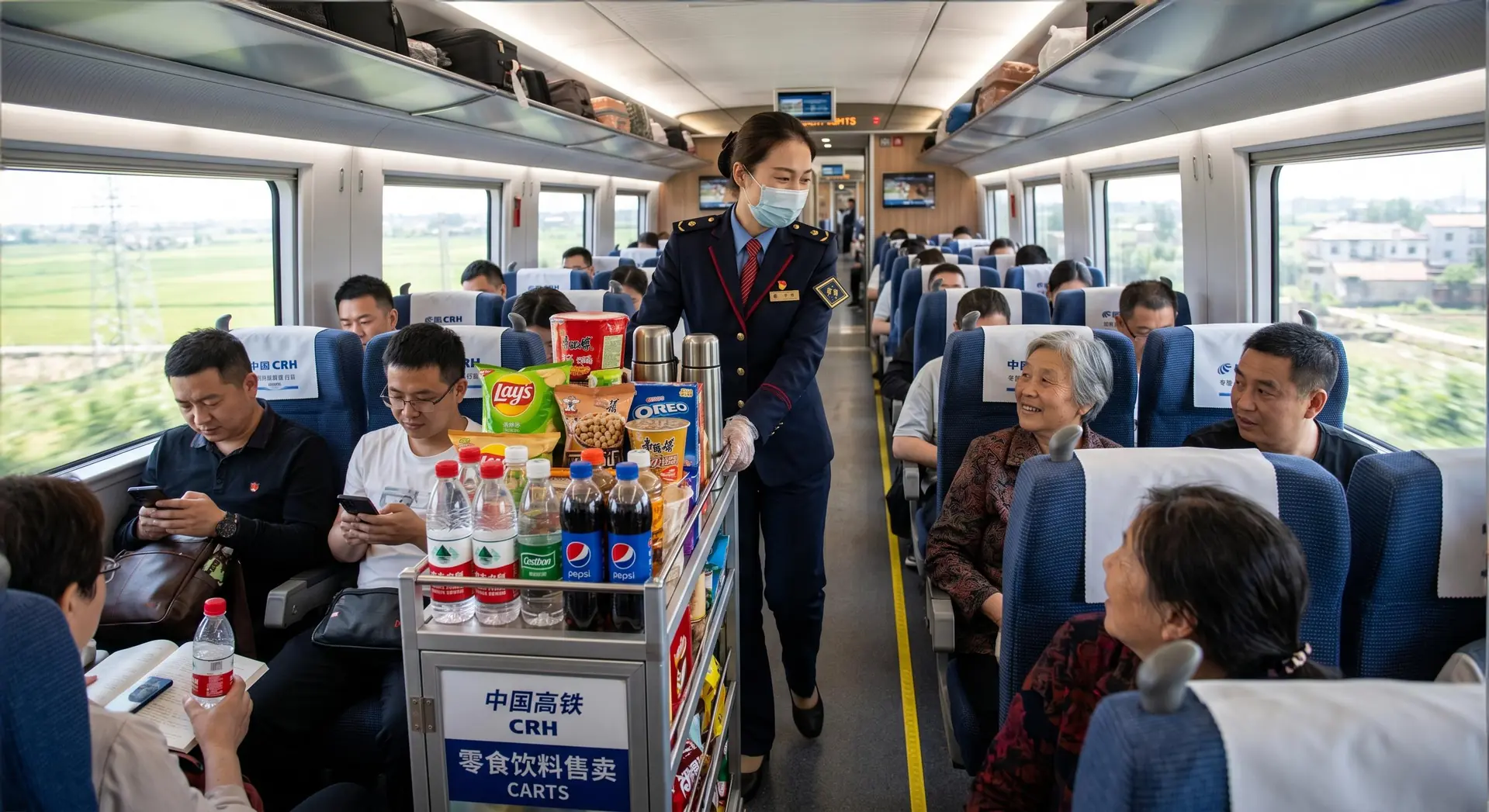
Food options
Dining or food-service car/counter: usually near the middle of the train, but the car number varies by trainset; check the carriage map, onboard signs, or ask staff. Trolley service: snacks, drinks, boxed meals ¥15-45. Mobile ordering: scan QR at your seat for delivery at the next stop (needs Alipay/WeChat Pay). Bring your own: the most practical — buy at the station before boarding. Avoid strong-smelling food in high-speed carriages.
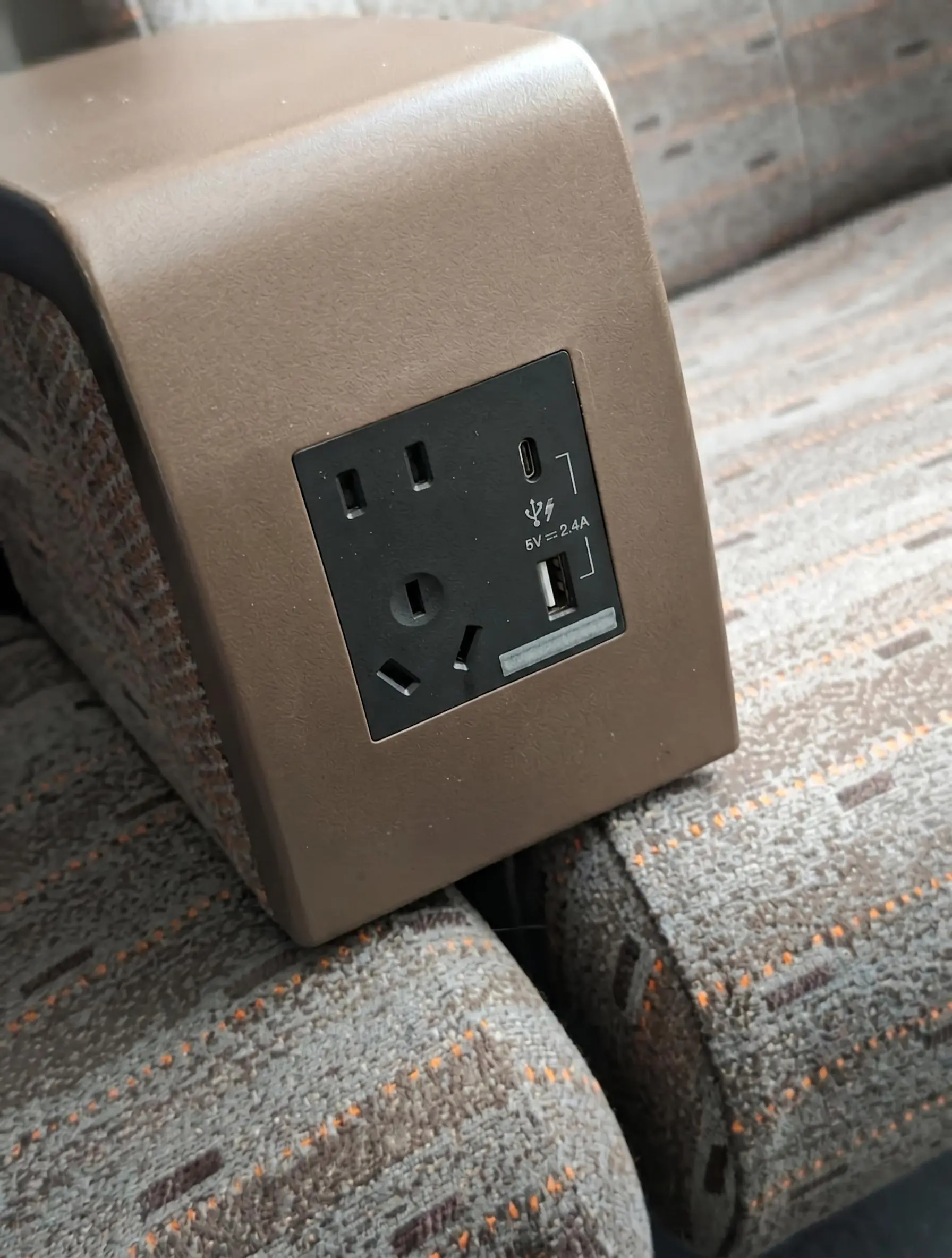
Power outlets
Every class has 220V outlets (see seat comparison above for details by class). Plugs are the Chinese 2-pin/3-pin standard — bring a multi-port USB charger and a Chinese-standard adapter so one outlet can charge multiple devices.
WiFi and signal
Most trains do not have reliable WiFi. Some newer Fuxing Hao services advertise WiFi, but speeds are slow. Your own mobile data is the only dependable option — 4G/5G coverage runs along nearly every route, with brief blackouts in long tunnels.
Hot water
Most high-speed trainsets have hot water dispensers (开水器) near carriage ends or between cars, but the exact location varies. Bring your own cup for tea or instant noodles and follow onboard signs.
Restrooms
Most high-speed trainsets have toilets near carriage ends or between cars; toilet type varies by model and can include sit-down or squat options. Bring tissues, follow onboard signs, and expect restrooms to lock 5-10 minutes before the final destination.
Language help
Announcements in both Chinese and English. Attendants speak some basic English. For anything more complex, have a translation app ready — see our translation app guide.
Transfers and Connections
Same-Station Transfer
- ✓Min. transfer time: 45-60 min
- ✓Some stations have in-station transfer; if not, exit and re-enter with security
- ✓Actual process: ~15-20 min only in the best case
Follow station transfer signs first
Cross-Station Transfer
- ✓Min. transfer time: 2+ hours
- ✓Must travel across the city
- ✓Check distance on Amap beforehand
Metro or taxi between different stations
Many Chinese cities have 2–4 train stations (see our station name guide). Always confirm the full station name on your ticket before booking connections.
Rail + Flight Combos
Station-Airport Proximity
A few cities have high-speed stations and airports in close proximity — useful for itineraries that mix flying and rail. Shanghai Hongqiao Station ↔ Hongqiao Airport T2: same hub, roughly 10-20 minutes on foot depending on baggage. For Hongqiao T1, use metro, shuttle, or taxi and allow more time. Chengdu East → Tianfu Airport: metro about 1.5 hours. Guangzhou South → Baiyun Airport: metro about 1 hour.
Arriving, Exiting and Lost Items
The train's PA system announces your destination 5–10 minutes before arrival in both Chinese and English. The carriage display screen also shows the next stop.
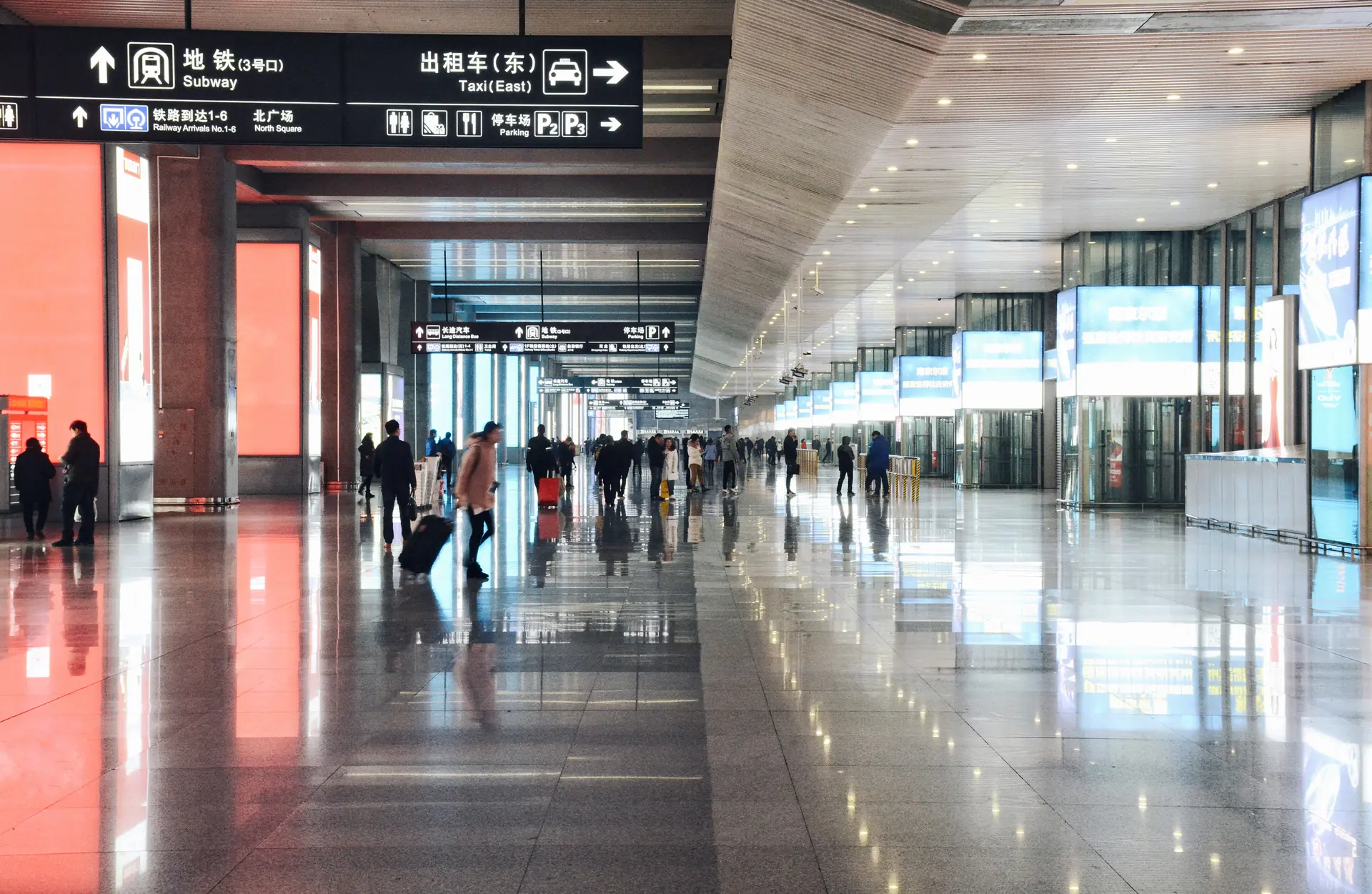
Exit signs and gates
Follow "出口 / Exit" signs after stepping off the train. Scan your passport at the exit gates (same process as boarding) or use the staffed lane. Then follow signs for "地铁 / Metro," "出租车 / Taxi," or "公交 / Bus."
Taxis
Use the official taxi queue and ignore drivers soliciting passengers inside the station. Keep your hotel address in Chinese and watch the route in Amap or Didi; if something goes wrong, save the plate number, payment record, and route screenshot so your hotel or station staff can help you complain later.
Ride-hailing (Didi)
Set pickup to "[Station Name] ride-hailing pickup point" (网约车上客点). Follow in-station signs for "网约车."
Lost Something on the Train
- Tell station staff immediately — service desk near the exit gates
- Use the 12306 app or website lost-item channel if you can access it.
- Give staff the train number, carriage, seat, arrival station, time, item description, and a photo if you have one.
- Do not assume recovery is guaranteed; act before leaving the station if the item matters.
Common Mistakes and Fallbacks
Wrong Station
Major cities often have 3–4 stations — names differ by one word but locations are completely different. Always check the full station name on your ticket, not just the city. See our station name guide.
Passport Not Verified
If you buy through your own 12306 account, finish passenger / real-name verification before booking. At the station, use the original passport tied to the issued ticket; if the scanner fails, use the staffed lane. Trip.com or counter tickets still depend on the passport tied to the e-ticket, not on your 12306 account status alone.
Oversized Luggage
A 28-inch case is awkward on Chinese high-speed trains even when it passes through the station. Travel smaller when possible; if you bring a larger case, board early and use end-of-car luggage areas only if available.
No Offline Maps
Phone signal drops in tunnels. Download Maps.me offline packs and save Chinese station / hotel names; use Amap for live China routing when signal returns. Do not rely on Google Maps for mainland transit. See our China navigation apps guide.
Missed Your Stop
Find a train attendant immediately. They can arrange for you to get off at the next stop and take a return train at no extra charge (subject to availability). Do not exit and try to buy a new ticket on your own.
Missed Your Train
Gates close a few minutes before departure. Go to staff or the 12306 counter/app quickly. Same-day changes after departure are fee-free if seats exist; next-day or later changes use the current 12306 fee tiers. Check your exact ticket before buying a new one.
Smoking Ban — Including E-Cigarettes
All high-speed trains are strictly no-smoking — smoke detectors are installed in every carriage and restroom, including for e-cigarettes. Triggering one can force an emergency brake. Penalties: ¥500–2,000 fine (typical penalty ¥1,000–2,000), and serious cases result in a 180-day ban from buying high-speed train tickets.
Frequently Asked Questions
Many large stations have passport scanners, but support varies. Try the passport gate if staff direct you there; otherwise use the staffed lane. The name and passport number must match the ticket exactly, and first-timers should leave backup time.
Sources checked for this guide
- Official 2025 China railway operating statistics for total network length and high-speed rail mileage.: State Council railway statistics
- China Railway November 2026 announcement and Q&A checked for the November 25, 2026 effective date and conventional passenger-train renumbering (Z/N/V replacing Z/T/K).: China Railway Nov 25, 2026 effective-date notice and China Railway Nov 2026 train-numbering Q&A
- 12306 English FAQ checked for e-ticket ID use, passenger verification, child tickets, luggage limits, and refund/change basics.: 12306 passenger FAQ
- National railway prohibited and restricted items catalog checked for alcohol, sharp items, sprays, aerosols, power banks, and security-screening limits.: Railway restricted-items catalog
- Hong Kong West Kowloon high-speed rail departure process checked for passport and station-process timing caveats on cross-boundary services.: MTR West Kowloon process guide
- MTR train-facilities page checked as a trainset-specific facility example, not as a mainland-wide car-number rule.: MTR high-speed train facilities
More China Rail & Transport Guides
High-speed rail is one layer of the China transport stack. Use these next when you need tickets, station-name decoding, city transfer planning, or app setup:
- China Train Types & Station Names Guide — decode G/D/C and the new Z/N/V conventional train prefixes, plus station naming rules so you never show up at the wrong station
- How to Book China Train Tickets: 12306 & Trip.com — step-by-step booking on your phone, including passport verification, seat selection, changes, and refunds
- China Navigation Apps: Amap, Maps.me & Apple Maps — set up live China routing and offline map backups before rail days
- City Transport Guide: Metro, Taxi & Didi — what to do after you step off the train
- Essential Travel Apps Toolkit — set up 12306, Amap, and other must-haves before you fly
© gochinafreely.com — Original guide by Go China Freely.