
Payment choice
Checkout
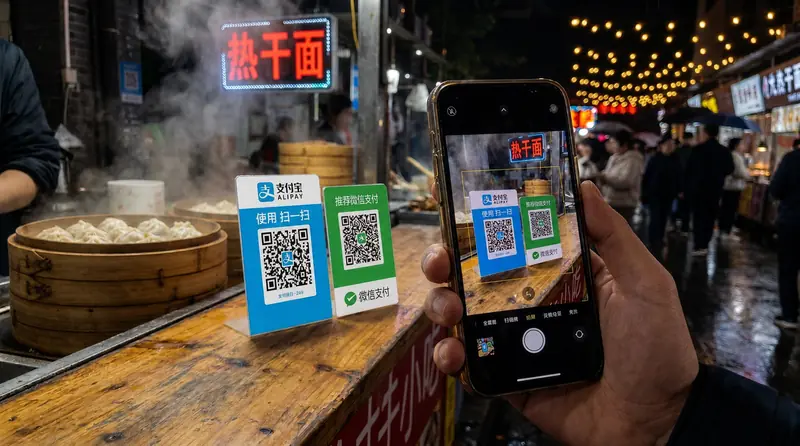
Hotels, chains, and larger restaurants often support both; small stalls may show only WeChat.
Transit
City ride codes vary, so test the local service before a rushed gate.
Contacts
When the chat is in WeChat, follow the formal QR, mini program, or counter flow they give you.
Which app should tourists prioritize?
Almost every China travel checklist says to install Alipay (支付宝) and WeChat Pay (微信支付). The more useful question is what happens at a checkout counter, metro gate, restaurant table QR, or hotel lobby when you have two icons on your phone and only a few seconds to choose.
If you can only make one app work before landing, start with Alipay: it is usually the cleaner first setup for a foreign visitor who needs a standalone wallet. But in daily China scenes, WeChat Pay is not just a backup. Restaurant table QR ordering, small-vendor WeChat codes, food-delivery chats, and local mini programs often make WeChat the natural first tap. This page is the decision layer: which app should you try first in a real travel situation?
First wallet
Alipay if you are new and need one clean setup before arrival.
Local-life rail
WeChat Pay for table QR menus, small stalls, chats, and local mini programs.
Alipay vs WeChat Pay: Fast Answer
Best staging order
Use both if you can, but give them different jobs. Set up Alipay first if you are new to China payment apps and want a clean standalone wallet for everyday QR payments, Didi, and app-based services. Open WeChat Pay first for restaurant table QR ordering, small-vendor WeChat codes, WeChat chats, food delivery, and local mini-program flows. At a counter, the displayed logo, aggregate QR, or mini-program checkout beats any general rule.
This is a choice guide, not the setup manual. Live passport checks, account verification, linked-card fees, limits, unsupported personal-transfer flows, and failed-payment fallback live in the mobile-payment overview linked near the end.
Alipay
first setup
local-life QR
Scene
decides the first tap
- Set up Alipay first if you want the simplest first wallet before arrival.
- Prioritize WeChat Pay for restaurant table QR menus, small-vendor WeChat codes, food delivery chats, and local mini-program checkout flows.
- At hotels, chains, and larger restaurants, both wallets or an aggregate QR often work; use whatever the counter or screen presents.
Where App Coverage Overlaps
Shared checkout surface
Hotels, larger restaurants, malls, and chain stores commonly support both wallets, sometimes through one aggregate QR or a scanner that accepts either Pay code. Street stalls and tiny shops are more uneven: many still show a WeChat personal or merchant code first, while some show both. In overlap moments, use the code or scanner the merchant presents.
Shared uncertainty
Coverage is not only about brand. Merchant QR type, personal versus merchant collection, city service, account state, card issuer, and mini-program workflow can decide what works in that exact moment. Treat the first app as a practical starting point, not a loyalty pledge.
- If a merchant displays only one wallet logo or QR flow, use that app first.
- If the task starts from a restaurant table QR, WeChat chat, small-vendor WeChat code, or WeChat mini program, use WeChat Pay first through the supported checkout screen.
- If the task starts as Didi, a city service, or a standalone Alipay-marked utility screen, try Alipay first.
- Use Pay when you are paying. Collect or Receive is for receiving money and can lead you into unsupported personal-transfer style flows.
- Security and setup details still matter, but they belong in the dedicated setup and mobile-payment guides.
Key Differences for Tourists
← swipe to compare all options →
Alipay (支付宝)
Payment-and-utility wallet
- ✓Good first wallet if you are new to China payment apps
- ✓Often easier to think of as wallet plus travel utilities
- —Still depends on per-city transit services and live app verification
- —Foreign cards can be limited for transfers, red packets, wealth, insurance, and other non-purchase services
Clear wallet access
strong travel and city-service tools
WeChat Pay (微信支付)
Payment inside WeChat
- ✓Best when hotels, friends, guides, vendors, or restaurants use WeChat
- ✓Useful for delivery notes, group chats, and local mini-program checkout links
- —Fresh accounts, linked-card fees, and promotional waivers can differ by user and date
Table QR menus
small-vendor codes
mini programs
local coordination
| Trip situation | Usually easier first | Why it matters |
|---|---|---|
| Counter or sticker QR | Displayed app/logo | Hotels, larger restaurants, malls, and chains often accept both Alipay and WeChat Pay. If a stall shows only a WeChat code, start there; if the code is personal-transfer style and your foreign-card wallet cannot pay, ask for an Alipay or merchant QR, or use cash. |
| Hotel, guide, or local contact coordination | WeChat for communication; payment follows the formal flow | People often add you on WeChat first, but that does not mean you should send a casual transfer. Use the hotel's counter QR, booking platform, invoice-linked request, or supported mini-program checkout; hotel deposits and registration still follow hotel rules. |
| Metro and bus QR codes | Depends by city or card tap | There is no single nationwide ride code. Open the correct city service, or use overseas-card contactless entry where the local system supports it. |
| Restaurant table QR menus and delivery notes | Often WeChat first | In China, WeChat table ordering is extremely common. Some table codes open Alipay, Meituan, or a venue system, but if the QR opens a WeChat mini program, stay in WeChat Pay and use the supported checkout, not a direct rider transfer or red packet. |
| Small-vendor personal collection QR | Try WeChat if that is the only code; keep backup | Many small vendors use a WeChat collection code. Foreign-card wallets commonly restrict personal transfers, red packets, and receive/collect flows, so if WeChat cannot pay, ask for an Alipay or merchant QR, use cash, or move to a staffed counter. |
| Train tickets, hotels, and attractions | Payment app is secondary | 12306 ID checks, hotel passport registration, deposits, and staffed ticket-window rules can matter more than wallet choice. |
| First app does not fit the flow | The other app | Some QR codes, mini programs, or service pages simply expect the other wallet. |
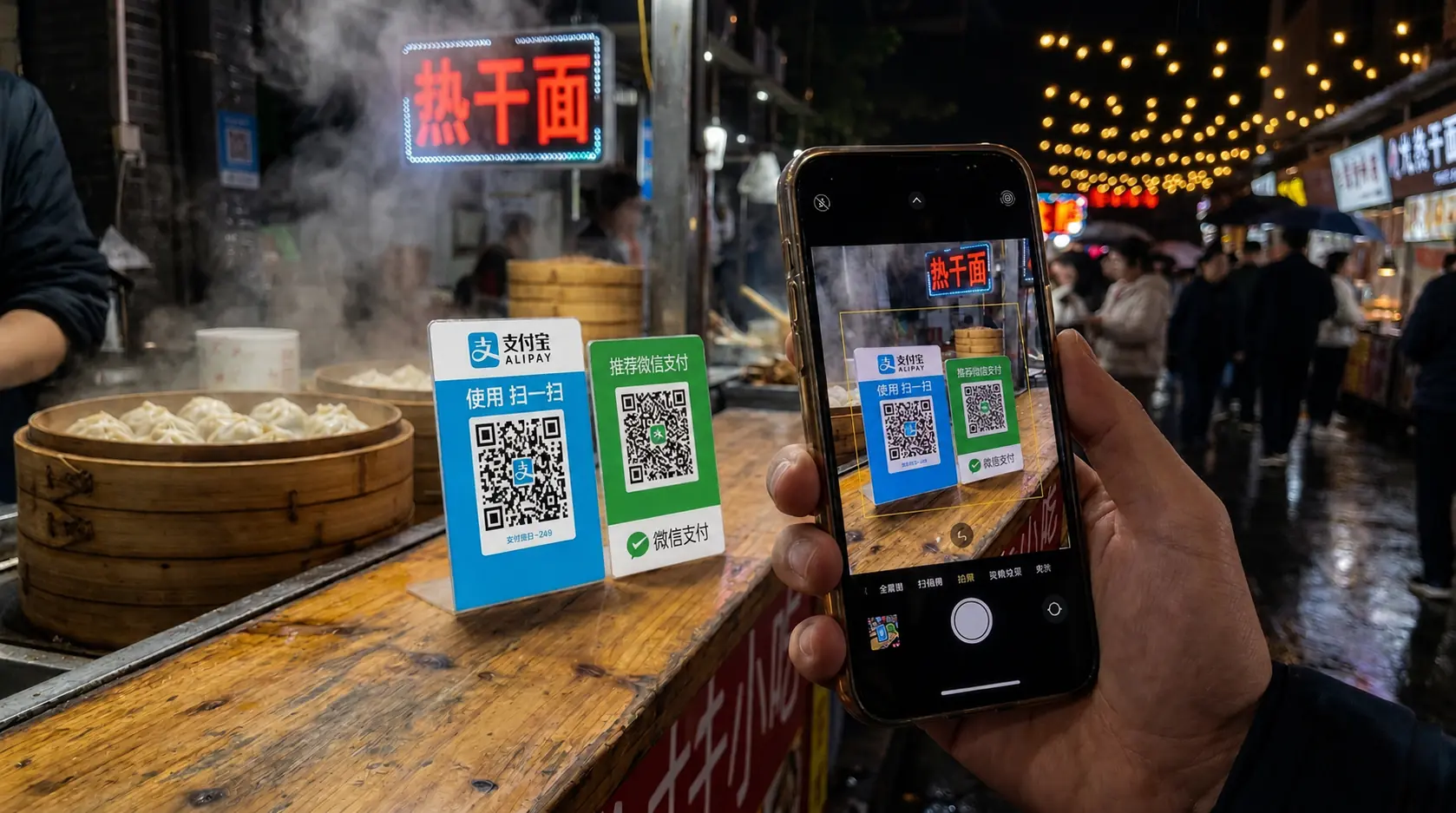
Dual and single codes: bigger counters often support both wallets, while small stalls may show only one code, often WeChat.
Choose Alipay First When
Best fit
Choose Alipay first for setup and standalone payment tasks: normal cashier QR payments, Didi, supported city services, and app-based utilities that do not begin inside WeChat. For a first-time visitor who is new to both ecosystems, Alipay is still usually the cleaner first wallet to make work before arrival.
Use our Alipay for foreigners in China guide when you need the button-by-button setup flow, screenshot rhythm, transit notes, fee pointers, and Didi examples.
- You are completely new to both apps and want one wallet working quickly.
- Your first city days rely on cashier QR checkout, Didi (滴滴出行), and supported city services; for transit, use the local ride code or overseas-card tap where available.
- WeChat signup asks for friend assist or extra checks and you need a fallback before landing.
- You prefer a wallet-plus-services mental model: cards, Pay code, utilities, then mini programs.
- You are using mainland Alipay. AlipayHK and Alipay+ partner wallets are related but separate products, and live eligibility can differ.
Choose WeChat Pay First
Best fit
Choose WeChat Pay first when the scene feels like local life: restaurant table QR ordering, small-vendor WeChat collection codes, hotel or guide chat coordination, food delivery, group plans, and WeChat mini programs. WeChat (微信) is where many people coordinate in China, and in restaurants especially, table QR ordering through WeChat is often the normal path.
Use our WeChat in China for foreigners guide for account setup, WeChat Pay, chat translation, mini programs, and the places where WeChat does more than just pay.
- You already use WeChat daily and can keep the account secure.
- You expect to message hotels, guides, drivers, vendors, restaurants, or local contacts.
- You need restaurant table QR ordering, food delivery, small-stall WeChat codes, or local mini-program checkout.
- Still add Alipay as the cleaner first setup or second rail, especially if your WeChat account is new or verification feels fragile.
Use Both Apps Together
- Use WeChat Pay for table QR menus, small-vendor WeChat codes, hotel messages, vendor chats, group plans, restaurant mini programs, or supported delivery checkout.
- Use Alipay when the payment is part of a standalone task: supported transit service, ride-hailing, tourist-service tab, or Alipay-marked cashier QR.
- Use the app already on screen when the flow begins inside a QR menu, mini program, ticket window, aggregate QR, or local service page.
- Keep both icons visible so switching feels normal, not like a failure; use Pay when paying, not Collect or Receive.
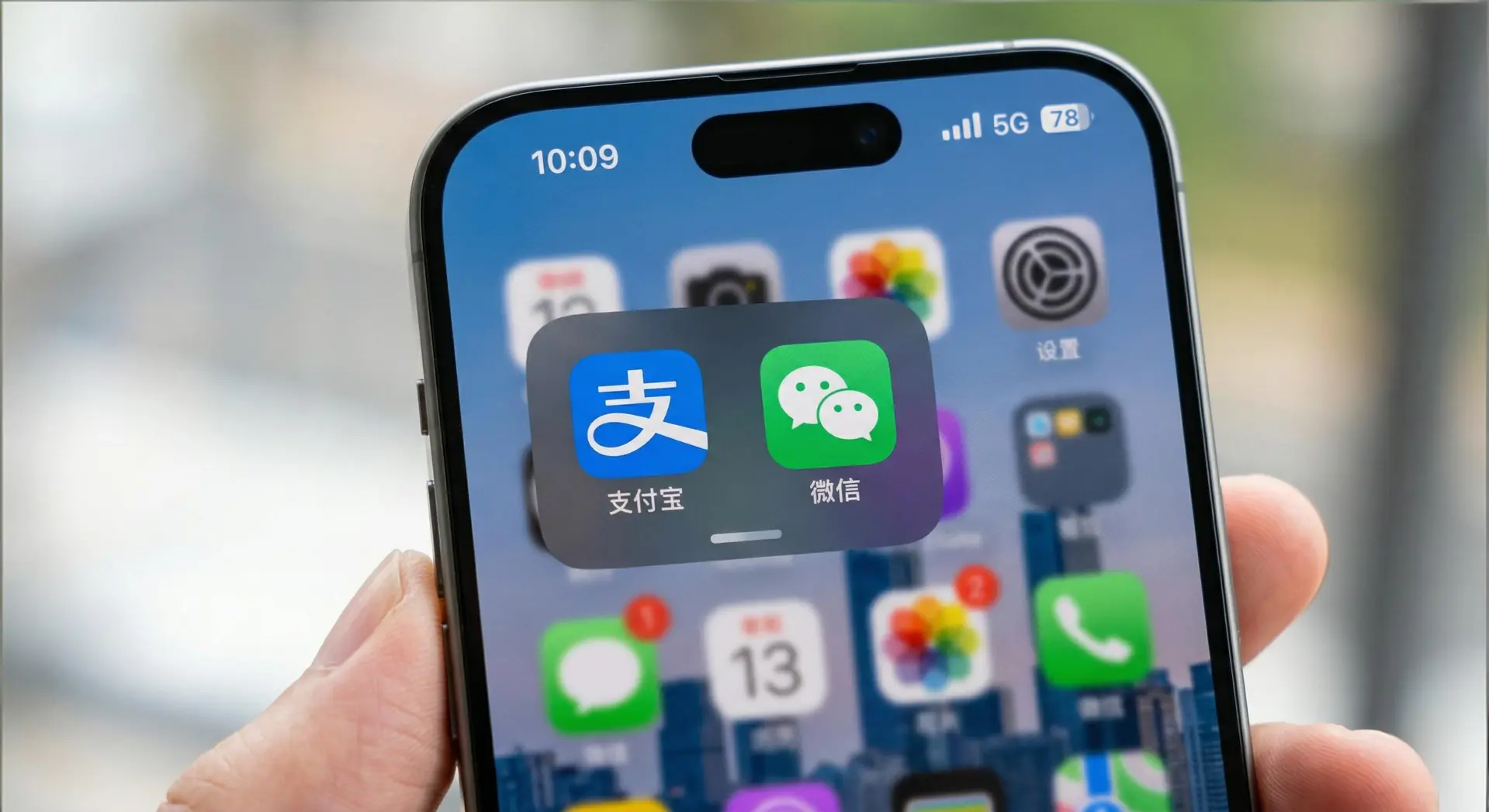
Pin both apps on your first home screen. A realistic city day can switch from an Alipay city service, to WeChat hotel chat, to Alipay ride-hailing, to a WeChat table QR, then back to whichever wallet matches the merchant or aggregate QR flow.
The goal is not to prove one app is better. The goal is to make the first tap obvious: first setup or standalone wallet task, start with Alipay; restaurant table QR, small-vendor WeChat code, or communication-style task, start with WeChat Pay.
When App Choice Changes
The merchant flow wins
A restaurant table QR, hotel message, delivery note, stall code, aggregate QR, or local service page may force the decision for you. If the screen opens inside WeChat, continue with WeChat Pay. If it opens inside Alipay or a payment-first service, stay with Alipay. If the screen looks like a personal transfer, red packet, or Receive/Collect flow, ask for a merchant checkout path, another wallet code, or cash backup. This comparison article will not repeat bind-card screenshots, so use the dedicated guides when you need setup detail:
If one path is not smooth, switch
China payment usually works quickly when you use the right QR or mini program. If the first path is not smooth, do not make the counter wait while you troubleshoot deeply; switch context quickly:
- If the issue is a WeChat mini program, try the same task in Alipay only if the merchant offers that path.
- If the issue is a generic cashier QR, open the other wallet's Pay code and try once.
- If both apps are not smooth, stop retrying at the counter and use the broader fallback ladder in the mobile-payment overview.
- Fix account, card, or network problems later, away from the queue.
For fees, card binding, phone-number checks, cash amounts, and the full failed-payment sequence, use China mobile payments: Alipay & WeChat Pay.
Limits that override app choice
Fees and limits: small linked-card payments are often treated more gently, while larger payments can show platform fees unless the live screen or a current promotion says otherwise. Your card issuer may also charge foreign-exchange fees.
Transit: ride codes are city-specific. Alipay or WeChat ride codes are often the easiest reusable tourist habit, while Beijing and some other large-city systems also support overseas-card tap where station signage and rules allow it.
ID and counters: train tickets, hotel check-in, attraction entry, and deposits can still depend on passport registration, real-name ticketing, staffed counters, or physical card/cash backup.
Alipay vs WeChat Pay FAQ
For a short city trip, Alipay alone can cover many ordinary purchases if it is set up well. Two apps are better because WeChat is common for restaurant table QR ordering, small-vendor codes, local chats, and mini programs, while Alipay remains a clean first wallet for standalone payments.
Sources checked for this guide
- State Council payment guide for overseas visitors: mobile payments, international-card linkage, cash/card context, and visitor payment limits
- Alipay+ Chinese mainland payment guide: Alipay International Version, partner wallets, Pay versus Scan flows, identity checks, limits, and unsupported financial services
- Tencent inbound payment service upgrade: 2026 Weixin Pay international-wallet support, first-time international-card fee waiver campaign, and multilingual guidance
- State Council WLC China payment and stay guide: bank-card options, partner wallets, transport payment notes, and accommodation registration context
- Beijing Subway overseas-card tap-and-go update: UnionPay, Mastercard, Visa, JCB, and American Express network coverage across Beijing urban rail
- 12306 China Railway English FAQ: real-name ticketing, passport use, ID verification, and official ticketing channels
- WeChat Help Center international-card setup article: live Weixin Pay card setup, limits, fees, and unsupported feature notes
Beyond This Guide
This guide decides which payment app to try first in common travel scenes. Use these next if you need the setup, fee, card, or cash layer behind that decision:
- China mobile payments overview - setup, QR checkout, fees, limits, safety, and failure fallback.
- Alipay for foreigners - button-by-button setup, QR pay, transit, Didi, and mini programs.
- WeChat for foreigners - WeChat Pay, chat, translation, contacts, and mini programs.
- Foreign cards in China - where physical cards still work and how to avoid POS surprises.
- RMB & ATMs - how much cash to carry and where to get it.
If you want a calm pre-trip plan for which app to open first in each city, transit system, hotel, and restaurant scenario, we can recommend a setup that matches your route without booking tickets or moving money for you.
© gochinafreely.com — Original guide by Go China Freely.