China Laws for Tourists: Fast Rules
Practical travel information, not legal advice
This guide is a traveler-facing checklist, not legal advice. Laws, enforcement, and local procedures can change. For serious police, customs, visa, accident, detention, controlled-medication, or court issues, contact local authorities, your embassy or consulate, and a qualified lawyer.
Start with the core principle: Chinese law applies to everyone inside China, regardless of nationality. The system is based on codified statutes rather than jury trials, and legal processes can move very differently from common-law countries.
Your passport helps identify you; it does not exempt you. Minor incidents are often handled as administrative penalties, while serious cases enter the criminal system. Criminal detention can run up to 37 days before arrest approval in the ordinary public-security timeline, but that is not the whole case length; investigation, prosecution, trial, and detention can continue much longer.
⚖️Law applies equally
Chinese Criminal Law states that the law applies to crimes committed inside China. For tourists, that means local rules control even when something is legal at home.
🧾Administrative vs. criminal
Smoking violations, minor public-order issues, some traffic fines, and small registration problems may be administrative. Drugs, smuggling, serious damage, assault, or national-security issues can become criminal.
☎️Consular help has limits
Your consulate can visit, help contact family, and share lawyer lists. It cannot pay fines, overrule police, intervene in court, or get you released because you are foreign.
Save these before you fly
Save your passport photo page, visa or entry stamp, hotel address in Chinese, travel insurance hotline, and your embassy or consulate's 24-hour emergency number. If your phone is lost or you are questioned, those details are much easier to show than to reconstruct.
Visa Stay and Activity Limits
Your visa, visa-free entry, or transit entry does not only decide whether you may enter China. It also controls how long you may stay and what you may do while you are there. For entry routes, day-counting, and visa-free limits, start with the China visa guide.
Do not overstay
Check the permitted stay on your visa, visa-free route, or entry record. Leave before it ends, and build in buffer if trains, flights, illness, or weather could delay you.
Match the activity
Tourist, visa-free, and transit stays are not permission to work, teach, perform, guide groups, take paid gigs, or do media and commercial shoots that need approval.
Ask before it becomes late
If you may need more time, call 12367 or ask the local exit-entry office before your stay expires. Extensions are not automatic and can take time.
Registration: The 24-Hour Rule
China's Exit and Entry Administration Law requires foreigners staying in hotels to be registered by the hotel, and foreigners staying outside hotels to register with the local public security organ within 24 hours of arrival. For hotel-specific check-in rules, see the China hotel check-in guide.
Hotel stays
What happens
Hotels handle this automatically. At check-in, the front desk scans your passport and reports your stay to the Public Security Bureau.
What to save
Ask whether the hotel can give or show the Temporary Accommodation Registration Form (临时住宿登记表), then photograph or save it if available. You may need proof of registration for visa extensions, some government services, or local identity checks.
Non-hotel stays
Who must act
If you stay with friends, in a rented apartment, or in any non-hotel accommodation, you or the person hosting you must complete registration within 24 hours.
The on-site process often takes about 15-30 minutes once you are at the correct police station, but finding the right station can take longer.
Classic police-station documents
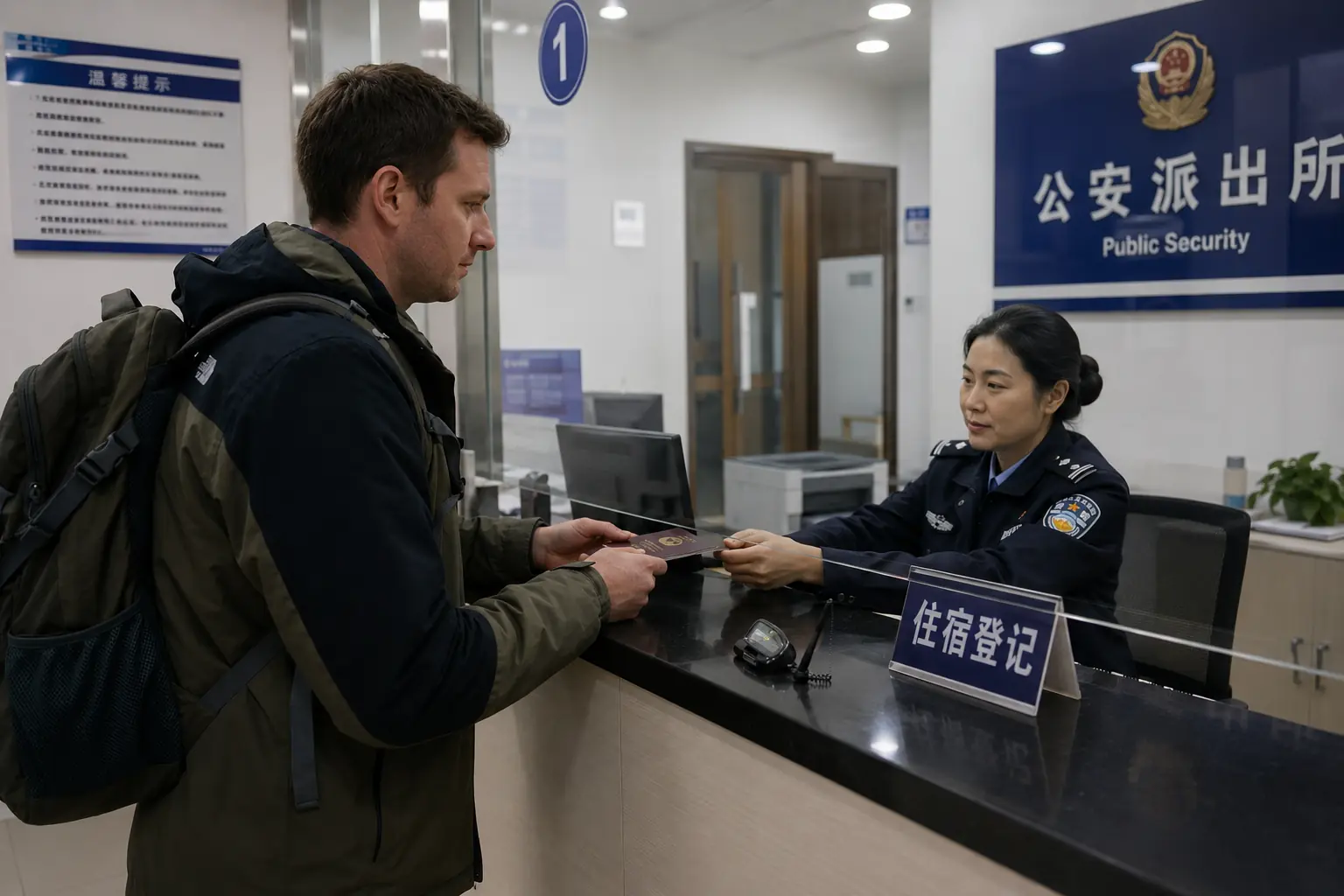
Visual takeaway: registration feels automatic at standard hotels; for any private or non-hotel stay, decide who owns the step before arrival.
Hotel path
Hotels usually solve this for you; private stays do not.
Private-stay path
For apartments, friends' homes, and many homestays, confirm who will register you before arrival.
Nationwide online filing
Since September 21, 2026, online registration via NIA 12367 is available nationwide for non-hotel stays, though the 24-hour deadline still applies.
Online registration for non-hotel stays
Nationwide rollout
After a March 20, 2026 pilot in seven provincial-level regions (Hebei, Liaoning, Zhejiang, Hubei, Guangxi, Chongqing, and Sichuan), the National Immigration Administration expanded online accommodation registration for foreigners staying outside hotels nationwide on September 21, 2026.
Digital registration carries the same legal effect as in-person police-station filing, while commercial hotels continue to submit guest registrations at check-in.
Channels
Official channels include the NIA Government Service Platform (s.nia.gov.cn), the NIA 12367 app, NIA 12367 WeChat mini program (移民局12367), and Alipay mini program.
For a first registration at a private address, expect the host to help because the system may need residence details you do not know.
Keep the offline backup in mind
If the app flow, identity check, or address entry does not confirm online, use the local police-station route or ask the host or local exit-entry office for help before the 24-hour window closes.
Penalties and re-registration
If registration is missed
Foreigners or hosts who fail to register can receive a warning and may be fined.
Practical rule
For ordinary tourists, re-register each new hotel or private address. Long-term residents returning to a registered self-owned or habitual residence may have exceptions, but short-stay visitors should not rely on them without local confirmation.
Example route
Beijing for 3 nights, then Shanghai for 4, then Hangzhou for 2 means three registrations. Hotels handle each stay automatically; private accommodation does not.
Hard Red Lines in China
Most tourist mistakes end with a warning, a fine, or embarrassment. The items below are different: they can lead to detention, deportation, criminal prosecution, or a long-term immigration problem.
Drugs: absolute zero tolerance
China maintains strict control over narcotic drugs, psychotropic substances, synthetic cannabinoids, and many drug-related chemicals. This includes marijuana, CBD products, synthetic cannabis, and medically prescribed cannabis products that may be legal elsewhere.
- Drug use can lead to fines, administrative detention, and deportation or a future visa problem.
- Drug possession can become a criminal case depending on substance and quantity.
- Drug trafficking, smuggling, transport, or manufacturing is treated extremely seriously, with severe criminal penalties including capital punishment for major trafficking cases.
- A positive test can still be trouble even if use happened outside China. Avoid carrying cannabis, CBD, edibles, vape cartridges, or unknown pills into the country.
Critical reminder
Legal in Canada, Thailand, parts of the United States, or under a medical prescription does not mean legal in China.
Cultural relics and protected places
Protected places are not props
China's Cultural Relics Protection Law (文物保护法) and site rules are not decorative. Do not climb, scratch, carve, graffiti, touch, remove, or damage relics, temple objects, museum displays, Great Wall bricks, ancient buildings, or protected natural features.
Antiques need paperwork
If you buy anything sold as an antique, ask whether it needs a Cultural Relics Export Permit (文物出境许可证). Most tourist-market "antiques" are modern reproductions, but if customs classifies an item as a genuine protected relic and you lack documentation, it may be confiscated and you may be fined.
Public order, gambling and smoking
🔇Public order
Loud disturbances, quarreling, fighting, harassing staff, or blocking public transport can draw police or security intervention. Stay especially calm in stations, airports, metro cars, hotels, and nightlife areas.
🎲Gambling
Outside Macau, gambling is illegal, including online betting. Do not use a VPN to access overseas gambling sites while physically in mainland China.
🚭Smoking bans
Beijing, Shanghai, Shenzhen, and many indoor public spaces enforce smoking bans. Follow No Smoking (禁止吸烟) signs in restaurants, malls, hotels, airports, trains, and stations.
Internet, VPNs and Online Behavior
China's internet environment blocks or restricts services such as Google, YouTube, Facebook, Instagram, WhatsApp, and some news or cloud tools. Many tourists prepare a VPN, roaming plan, or eSIM before arrival.
VPNs: the tourist reality
Tourist reality
China regulates unauthorized VPN services. In practice, enforcement against short-term foreign tourists using a VPN privately for Gmail, maps, or family messages is not the same as enforcement against commercial VPN operators, illegal online activity, gambling, or public promotion of circumvention tools.
Still not consequence-free
That does not make VPN use consequence-free in every situation. Keep it boring:
- Rely first on international roaming, a travel eSIM, and local Chinese apps for maps, payments, bookings, and urgent communication.
- Set up roaming, a travel eSIM, backup messaging, and any VPN you independently choose before you land.
- If you choose to use a VPN, understand that VPN services are regulated or restricted and may not be lawful in every situation.
- Do not use a VPN for gambling, illegal content, political organizing, or teaching others how to bypass controls.
- Never make one VPN your only map, payment, or emergency communication path.
Safer access options
Lowest-friction access
International roaming through a foreign SIM or many travel eSIMs often routes traffic outside mainland filtering, so Google, WhatsApp, and other overseas services may work without a VPN. This is usually the lowest-friction option for short trips.
Local app stack
For a fuller setup, pair it with Chinese apps that work locally: Alipay or WeChat Pay for payments, AMap or Apple Maps for navigation, Trip.com or 12306 for trains, and a translation app for staff conversations.
Online comments still count
Posting from inside China still counts
Official visitor guidance reminds foreigners to comply with Chinese laws and regulations when posting online in China. For ordinary tourists, the practical rule is simple: do not post threats, rumors, harassment, doxxing, gambling links, drug content, or sensitive claims about public security incidents while in the country.
Photography, Filming and Drones
Most places in China are easy to photograph: food streets, gardens, architecture, landscapes, and regular tourist sites. The risk comes from sensitive sites, signs, restricted airport areas, and drone flights.
Military and defense facilities
Do not document protected zones
China's 2025 regulations on important military-industrial facilities prohibit unauthorized entry into protection zones and prohibit photography, video, audio recording, sketching, or written documentation of protected areas.
They cover facilities used for research, production, testing, storage, archives, data centers, communications, observation, specialized ports, dedicated rail lines, and other defense-related sites.
Airport restricted areas
Where to avoid cameras
Ordinary terminal, gate, and family travel photos are normal. The risky areas are security-screening equipment, immigration and customs counters, staff-only passages, apron operations, military-looking areas, and any place with a no-photo sign.
If security intervenes
If security asks you to delete a photo or stop filming, comply calmly.
General photography rules
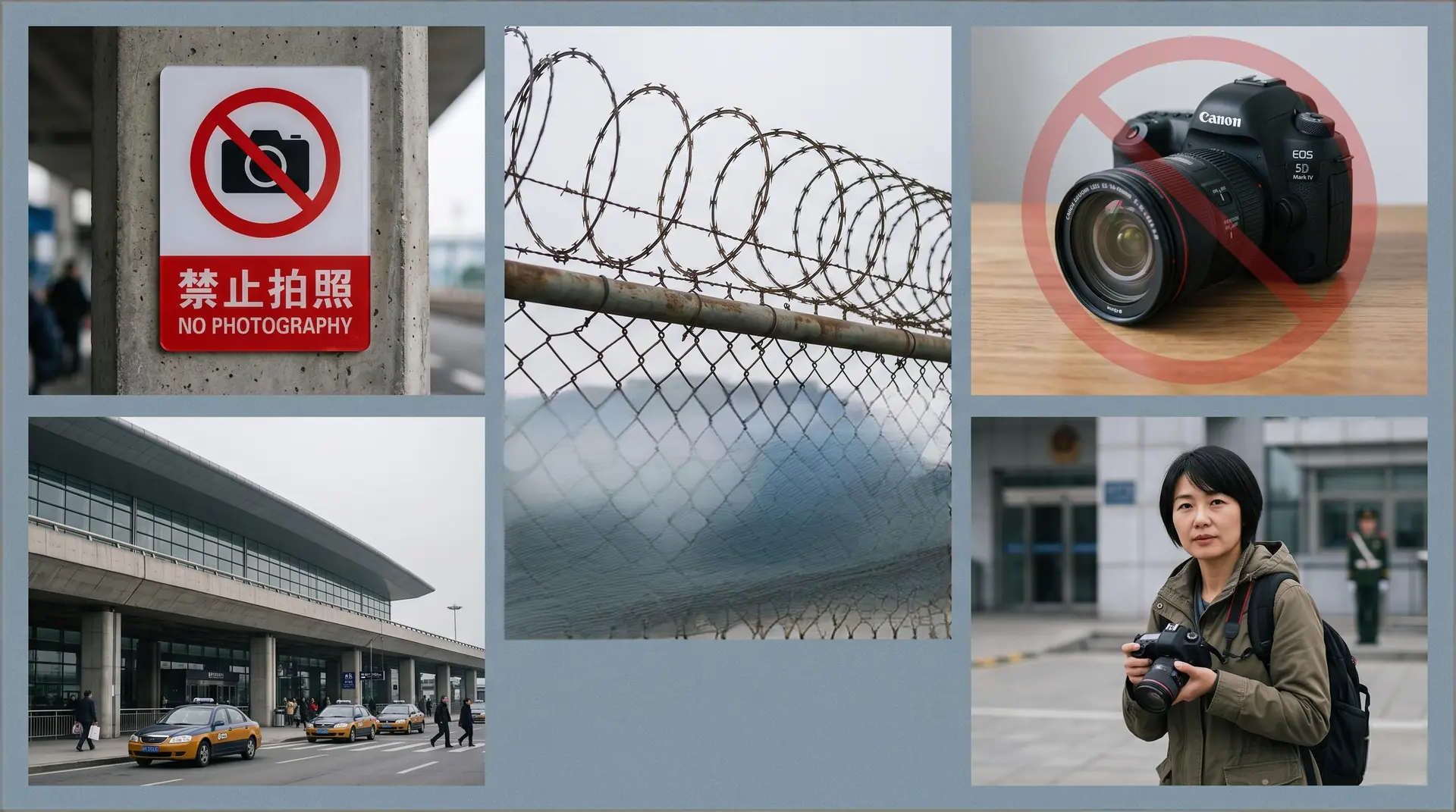
A sign is enough reason to stop. The safest tourist habit is to lower the camera first and ask later. This is especially true near military facilities, government compounds, airports, ports, border crossings, transport-security zones, and security checkpoints.
Signs decide
See a No Photography (禁止拍照) sign? Stop and put your camera away.
Sensitive places
Avoid photographing military sites, police operations, courts, prisons, border facilities, and security checkpoints.
People
Ask before photographing locals, especially children.
Museums
Museums often allow flash-free photography, but individual galleries can ban it.
Restricted-region note
A valid China visa does not mean every region is open for independent travel. The Tibet Autonomous Region requires a special permit, and border areas, some Tibetan areas, Xinjiang security zones, military or industrial zones, ports, and checkpoints may have extra rules or photo bans. Confirm route-specific permits before booking remote or border itineraries.
Drone rules for tourists
Controls are strict
China has some of the world's strictest drone controls, and rules have tightened further. CAAC real-name registration has long applied to civil UAVs of 250g and above, and mandatory national standards on real-name registration, activation, and operation identification took effect on May 1, 2026.
Practical tourist advice
Do not bring a drone unless aerial work is a core purpose of your trip and you are ready to handle Chinese registration, local restrictions, and no-fly checks.
- Registration and activation requirements may apply before lawful flight, depending on aircraft type and current implementation.
- Common restrictions include airport zones, urban built-up areas, crowds, events, scenic areas, border areas, and sensitive facilities.
- Do not fly over crowds, stations, airports, police activity, military facilities, government compounds, or protected heritage sites.
- Registration is not permission to fly. You may also need local airspace permission, scenic-area approval, event clearance, or other permits.
- If you must fly, verify the current CAAC/UOM process, local rules, and military, airport, border, and scenic-area no-fly zones before packing the drone.
Driving, Pedestrians and Road Safety
Default tourist answer
For most tourists, the legal answer is easy: do not self-drive in mainland China unless the road trip itself is the point and you have completed the local permit process.
International Driving Permits do not work alone
IDP alone is not enough
Mainland China does not treat an International Driving Permit as a standalone driving credential. To rent and drive legally, you generally need a valid Chinese driver's license or a Chinese provisional/temporary driving permit issued through local traffic-police procedures.
Short-term permit path
Short-term visitors may be able to apply for a provisional driving permit for compact cars with a passport, overseas driver's license, Chinese translation, photos, and other local documents. Some airport and city services make this easier than others, but it is still paperwork-heavy for a normal holiday.
Better tourist alternatives
Didi (滴滴出行)
China's main ride-hailing app, available through its own app and often through Alipay or WeChat.
Private car with driver
Useful for day trips, families, late-night arrivals, remote areas, or scenic routes.
High-speed rail + metro
The best default for city-to-city and city-center travel.
If an accident happens
Do not turn a crash into a legal problem
Stop safely, call police, and contact the insurer, rental company, or driver platform. Do not leave the scene, do not sign or settle anything you do not understand, and keep photos, location details, witness information, and hospital or police records. For injury, passport retention, or serious dispute, contact your insurer, consulate, and a lawyer.
Pedestrian traffic rules
Chinese road behavior can surprise first-timers even when the law looks familiar:
Right turn on red
Vehicles may turn right without stopping unless signs or signals prohibit it. Watch for turning cars even when your pedestrian light is green.
Electric scooters (电瓶车)
Silent, fast, and common on sidewalks, bike lanes, and crosswalk edges.
Jaywalking
Some cities fine pedestrians for red-light crossings, often around ¥20-50; cities including Shenzhen and Hangzhou have used facial-recognition displays for enforcement.
For more road-trip and driver alternatives, see Driving in China. For street-level safety context, see our tourist safety and scams guide.
Customs, Antiques and Medicines
Customs rules are less about catching normal tourists and more about declarations, controlled goods, and items that should not cross the border. When in doubt, choose the red channel or ask customs staff.
Declare thresholds on entry
🚬Tobacco
Declare at 400 cigarettes, 100 cigars, or 500g loose tobacco. Personal-use quantities only.
🍷Alcohol
Declare at 1.5 liters of drinks with 12% ABV or above. If you exceed the line, declare rather than guessing.
💵Cash
Cash rules are threshold-based and direction-specific. Treat ¥20,000 RMB and foreign currency around US$5,000 equivalent as check-or-declare points; if near or above them, use the red channel or ask Customs.
Prohibited or risky items
Weapons and lookalikes
Weapons, ammunition, replica firearms, and weapon-like items.
Controlled substances
Drugs, cannabis, CBD products, synthetic cannabinoids, and psychoactive substances.
Food, plants, and animals
Fresh meat, fruit, seeds, live animals, and many plant or animal products.
Prescription medicines
Prescription medications containing controlled ingredients need proper documentation. Stimulant ADHD medicines such as amphetamine-based products, some sedatives, opioid painkillers, psychotropics, codeine, ephedrine-like compounds, injectables, and high-quantity supplies require extra checking. Carry medicines in original packaging with a doctor's note or prescription, and confirm active ingredients before travel with official sources, your embassy, or a travel clinic. See China travel vaccines, insurance, and meds for the health-prep version.
Export restrictions
Cultural relics
Age alone is not the whole test. Anything sold as an antique, archaeological object, old manuscript, old coin, religious object, or cultural relic may need paperwork. Ask the seller for export documentation and avoid taking items of uncertain origin out of China.
Large amounts of cash
Declare amounts above the threshold.
Wildlife and TCM ingredients
Tiger bone, musk, ivory, rare animal products, and CITES-protected items can create serious customs problems.

Visual cue: use the chart as a screening prompt, then ask Customs before crossing the line.
Declaration lines
Customs thresholds are declaration lines, not packing goals.
Check before flying
If you carry cash, alcohol, tobacco, medicine, antiques, seeds, food, or animal products, check before flying.
Use the safest sentence
The safest sentence is: I am not sure; can I declare this?
If Police or Customs Stop You
Most checks are routine
Most interactions are routine: passport checks at hotels, security checks in stations, customs questions, or a staff member asking you to stop photographing.
Keep the issue small
Stay calm, keep answers factual, and do not turn a small issue into a confrontation.
Emergency numbers
| Number | Purpose | English support |
|---|---|---|
| 110 | Police (报警) | Available in major cities; limited elsewhere |
| 120 | Ambulance (急救) | Limited English |
| 119 | Fire (火警) | Limited English |
| 12345 | Government service hotline (政务服务便民热线) | Some cities offer English |
| 12367 | Immigration service hotline | Useful for visa, entry-exit, and registration questions |
If you are questioned or detained
- Stay calm and cooperate; resistance makes the situation worse.
- Ask for consular access if you are detained; this is your right under the Vienna Convention on Consular Relations.
- Ask for a lawyer if the matter is serious or you do not understand the accusation.
- Consular notification is clearest when China recognizes you as a foreign national who entered on that passport. Dual nationality, China-issued travel documents, or historic or ethnic nationality claims can complicate access.
- Do not sign documents you do not understand; request translation or wait for legal/consular support when possible.
- Record details afterward if safe: time, place, officer badge numbers, documents shown, and stated reason.
Administrative vs. criminal detention
Administrative detention
Administrative detention is usually tied to public-order violations and is capped differently from criminal detention.
Criminal detention
Criminal detention is much more serious. The 37-day point is only the ordinary public-security timeline before arrest approval, not the end of the case. After formal arrest, investigation, prosecution, trial, and detention can continue much longer. If police describe the matter as criminal, prioritize lawyer and consular contact immediately.
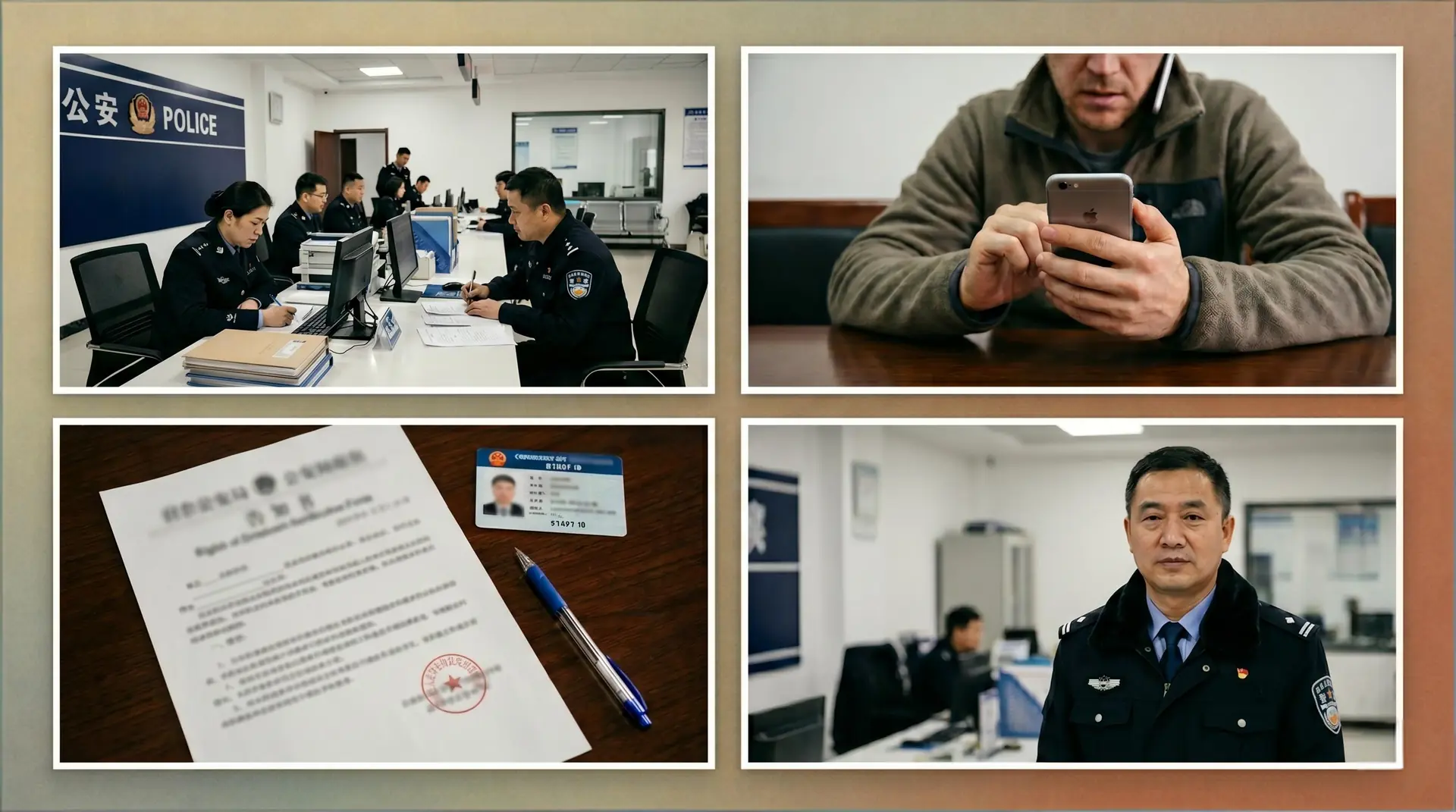
Visual cue: read the process from routine checks toward serious wording, then escalate calmly.
Calm clarity
Your best move is calm clarity. Show passport details, hotel address, and travel purpose.
If it becomes serious
If the situation moves beyond a routine question, ask for consular access and legal help before signing anything you do not understand.
Keep the sequence straight
Routine passport checks, customs questions, administrative detention, and criminal detention are different situations. The more serious the wording sounds, the more important translation, lawyer access, and consular contact become.
Frequently Asked Questions
There are no widely documented tourist cases for ordinary personal VPN use, but VPN services are regulated and illegal activity stays illegal. The safer setup is international roaming or a travel eSIM for key overseas services, plus local Chinese apps for maps, payments, and transport.
Sources checked for this guide
- U.S. State Department China travel page checked for visa overstay, passport carry, activity limits, drones, medicine restrictions, detention, dual-nationality, traffic accident, Tibet permit, and consular-access caveats: U.S. State Department China travel information
- U.S. State Department arrest and detention guidance checked for consular-help limits and the legal-advice boundary: U.S. State Department arrest or detention abroad
- National Immigration Administration announcement expanding online accommodation registration for foreigners in non-hotel stays nationwide from September 21, 2026: NIA nationwide online accommodation registration notice
- National Immigration Administration policy interpretation on online accommodation registration for foreigners in non-hotel residences and Article 39 background: NIA March 2026 pilot interpretation and Article 39 summary
- China Customs passenger clearance guide for declaration channels, tobacco, alcohol, and cash thresholds: China Customs passenger clearance guide
- CAAC English notice on civil UAV real-name registration rules from 2017: CAAC UAV real-name registration background
- CAAC English notice on mandatory UAV registration, activation, and operation-identification standards effective May 1, 2026: CAAC 2026 mandatory UAV standards
- State Council and CMC summary of regulations protecting important military-industrial facilities: military-industrial facility protection rules
- NPC English Criminal Law text covering equal application of law and drug-crime penalties: PRC Criminal Law English text
- NPC English Anti-Drug Law text covering legal liability for drug-related acts: PRC Anti-Drug Law English text
- Official China guide for foreigners working and living in China, including registration, emergency numbers, driving permits, ride-hailing, and social-media compliance reminders: official China visitor and expat services guide
Beyond This Guide
Laws and regulations are only one layer of a smooth China trip. Use these next-step guides to turn the rules into a practical travel setup:
- Tourist Safety & Common Scams -- street-level safety, scams, transport caution, and daily risk management.
- Sensitive Topics & Conversation Etiquette in China -- everyday cultural awareness and social boundaries for respectful conversations.
- China Visa Guide -- entry routes, visa-free rules, transit limits, and stay-duration basics.
- China Hotel Check-In for Foreigners -- passport registration, hotel refusal risks, and non-hotel registration details.
- Driving in China -- rental-car limits, temporary permits, private drivers, and safer alternatives.
- Emergency Assistance & Insurance Claims -- what to do after illness, theft, accidents, lost documents, or police reports.
- VPN for China Travel -- how to prepare internet access before arrival.
- Air Quality & AQI Guide -- reading AQI, choosing masks, and planning around pollution days.
© gochinafreely.com — Original guide by Go China Freely.