Emergency numbers
120
Medical / ambulance
Serious symptoms or injury.
119
Fire / rescue
Fire, smoke, rescue, trapped people.
110
Police
Crime, threat, serious dispute.
122
Traffic accident
Use 110 if routing is unclear.
Emergency stack
Why claims stall
Wrong call order
The live response line enters too late.
No case / claim number
Later emails and documents become hard to match.
Missing hospital papers
Invoices, itemized bills, and diagnosis records are hard to recover after checkout.
How to use this guide
China is generally safe for independent travelers, but a medical emergency or serious accident can still turn confusing fast.
The biggest risk is often not the treatment itself; it is a broken workflow: wrong call order, no insurer reference, missing invoices, or documents photographed too late.
Use this guide as a practical response sequence for China: who to call first, when the insurer enters the picture, what records to request, and how to keep a claim from stalling.
Boundary: this guide is practical travel information, not medical, legal, or insurance advice. In an emergency, contact local emergency services first; for passport or legal issues, contact your embassy or consulate; for coverage and claim decisions, contact your insurer.
Before departure, check your policy's emergency-evacuation, outpatient, and hospital-deposit wording, and pack personal prescription medicines in original labeled containers with a doctor's note.
First call
Local emergency services handle immediate danger.
Second call
Insurer assistance opens the case and records advice.
Claim proof
Hospital, police, pharmacy, and payment records need to stay readable.
China Emergency Help: Fast Rules
Layer 1 - live response
Insurer assistance helps organize the next step.
Emergency assistance and travel insurance are related, but they are not the same thing.
Insurer emergency assistance is the live response line after immediate danger is handled: facility routing questions, transfer support, whether your policy and the facility support guarantee-of-payment or direct billing (直付), and what documents to collect.
Layer 2 - later review
Claim review checks whether your proof matches the policy.
Claim review happens later and checks whether your timeline, records, and policy terms match.
That is why the live case / reference / claim number, assistance advice, and document trail matter before the formal claim starts.
Main failure pattern
Claim problems often come from ordinary workflow gaps: not calling assistance early enough, no case / reference / claim number, missing itemized billing, or a timeline that looks unclear weeks later.
Stabilize first
For life-threatening symptoms, serious injury, fire, crime, or traffic danger, call local emergency services before arguing with policy wording.
Open the case
After immediate safety is handled, contact your insurer's 24/7 assistance line and record the case / reference / claim number, advice, facility name, and time.
Collect paper
Ask for official invoices, itemized bills, outpatient or emergency records, diagnosis notes, prescriptions, test reports, and accident records while you are still at the hospital or police desk.
Shared call sequence
Make sure your travel companion knows the same call sequence.
Pressure rule
In emergencies, clarity beats memory.
Before your trip
Save these in one offline-accessible folder:
Policy PDF and policy number
Saved offline as screenshots and files.
24/7 emergency assistance hotline
Saved as a phone contact and written in your shared trip notes.
Key exclusions reviewed
Pre-existing conditions, high-risk activities, alcohol-related incidents, deductibles, and caps.
Payment path confirmed
Know whether your plan supports direct billing, guarantee-of-payment, reimbursement only, or a network-first process.
Emergency Numbers and Call Order
For immediate danger in mainland China, use local emergency services first. Do not wait for an overseas insurer to answer if someone needs urgent care or police help.
Call order
Local emergency services first.
For immediate danger in mainland China, use local emergency services first. Do not wait for an overseas insurer to answer if someone needs urgent care or police help.
If communication breaks down
If you cannot communicate clearly, show the address in Chinese, use hotel staff or a local bystander, and keep your location pinned in a map app.
For a 120 call, give the Chinese address, entrance or landmark, key symptoms or injury, and a reachable phone number. If you are in a hotel, station, mall, attraction, or restaurant, ask staff to describe the entrance and send someone to meet the ambulance at the gate or nearest junction.
| Service | Number | Chinese Name | Use it for |
|---|---|---|---|
| Medical emergency | 120 | 急救中心 | Ambulance dispatch and urgent medical help. |
| Police | 110 | 报警 | Crime, immediate personal safety, serious disputes, or help directing other emergency channels. |
| Fire | 119 | 火警 | Fire, smoke, gas hazards, collapse, rescue, or trapped-person situations. |
| Traffic accident | 122 | 交通事故报警 | Road accidents and traffic-police reporting; if unsure, call 110 and ask for traffic-police guidance; call 120 immediately if anyone is injured. |
| Public service hotline | 12345 | 政务服务便民热线 | Non-emergency city-service questions or complaints; not a substitute for 110, 119, 120, or 122. |
| Maritime search and rescue | 12395 | 海上搜救 | Boat, ferry, island, or coastal-water emergencies; follow crew or scenic-area staff instructions and use 110 for routing help if unsure. |
English support varies by city
Do not assume English support is identical nationwide. Shanghai official guidance says 110 has foreign-language support and 119/120 have English support, but elsewhere you should prepare the address in Chinese, symptoms or injuries, nearby landmark, hotel phone number, and translation-app text.
Right emergency service first, insurer second
Use the right local emergency service first: 120 for medical or ambulance help, 119 for fire or rescue, 110 for police or crime, and 122 or 110 for traffic accidents. Call 120 too if anyone is injured. For 120, state the Chinese address, nearby landmark, patient's condition, and contact phone number; after the call, guide the ambulance to the entrance. At the hospital, expect payment or a deposit request even when you have insurance. After immediate safety is handled, contact your insurer's 24/7 assistance hotline with your policy number, symptoms, city, hospital name (医院名称), and case / reference / claim number if one has already been opened.
Care Path and Backup Contacts
In major Chinese cities, travelers usually face two care pathways: public emergency departments (急诊科) and international clinics or international hospital departments.
Public hospitals often have broader acute-care capacity and lower costs; international services usually offer smoother language support but higher pricing.
For severe pain, chest pain, suspected stroke, heavy bleeding, serious trauma, unconsciousness, breathing difficulty, or fast-worsening symptoms, do not detour to a language-friendly clinic first. Call 120 or go to the nearest emergency department. Use international clinics or private/international departments for stable, language-sensitive, non-critical problems.
Two care pathways
In major Chinese cities, travelers usually face two care pathways: public emergency departments (急诊科) and international clinics or international hospital departments.
How to choose
Public hospitals usually have stronger acute-care coverage; international services are better for stable cases where language support, billing clarity, and appointment comfort matter more than speed.
Choose by urgency first
- Severe or fast-worsening - call 120 or use the nearest emergency department; do not lose time searching for an English-speaking clinic.
- Stable but language-sensitive - international clinic, private hospital, or international/VIP outpatient lane when available.
- Stable and budget-first - standard public outpatient care, with Chinese-first desks and longer waits.
Ask assistance to confirm the path
From an insurance perspective, the key question is whether the facility and treatment path fit your policy definitions: emergency, referral, network, approved provider, pre-authorization, or reimbursement-only.
If possible, ask assistance staff to confirm the recommended facility and record the advice.
Expect pay-first or deposit requests
Even with travel insurance, hospitals, clinics, and ambulance staff often ask for payment at the point of service, and admission or private/international facilities commonly request a deposit. Keep a working card or mobile-pay backup, ask whether direct billing or guarantee-of-payment is possible, and collect official invoices, itemized bills, outpatient/ER records, diagnosis records, and payment slips before leaving.
At large Tier-3 public hospitals in major cities, ask for the international medical department (国际医疗部) or VIP clinic when you need English support; carry your original passport for registration and expect to settle bills at the cashier desk before lab tests or pharmacy pickup.
Keep the same record in three places
Wallet or phone case, phone notes, and a shared trip chat.
Consular backup
Embassies and consulates can provide limited coordination such as replacement travel documents, family contact, and lists of local lawyers, translators, or medical providers.
They normally do not translate for you, choose treatment, negotiate hospital bills, or pay medical bills. Treat consular support as backup coordination, not as your primary payment solution.
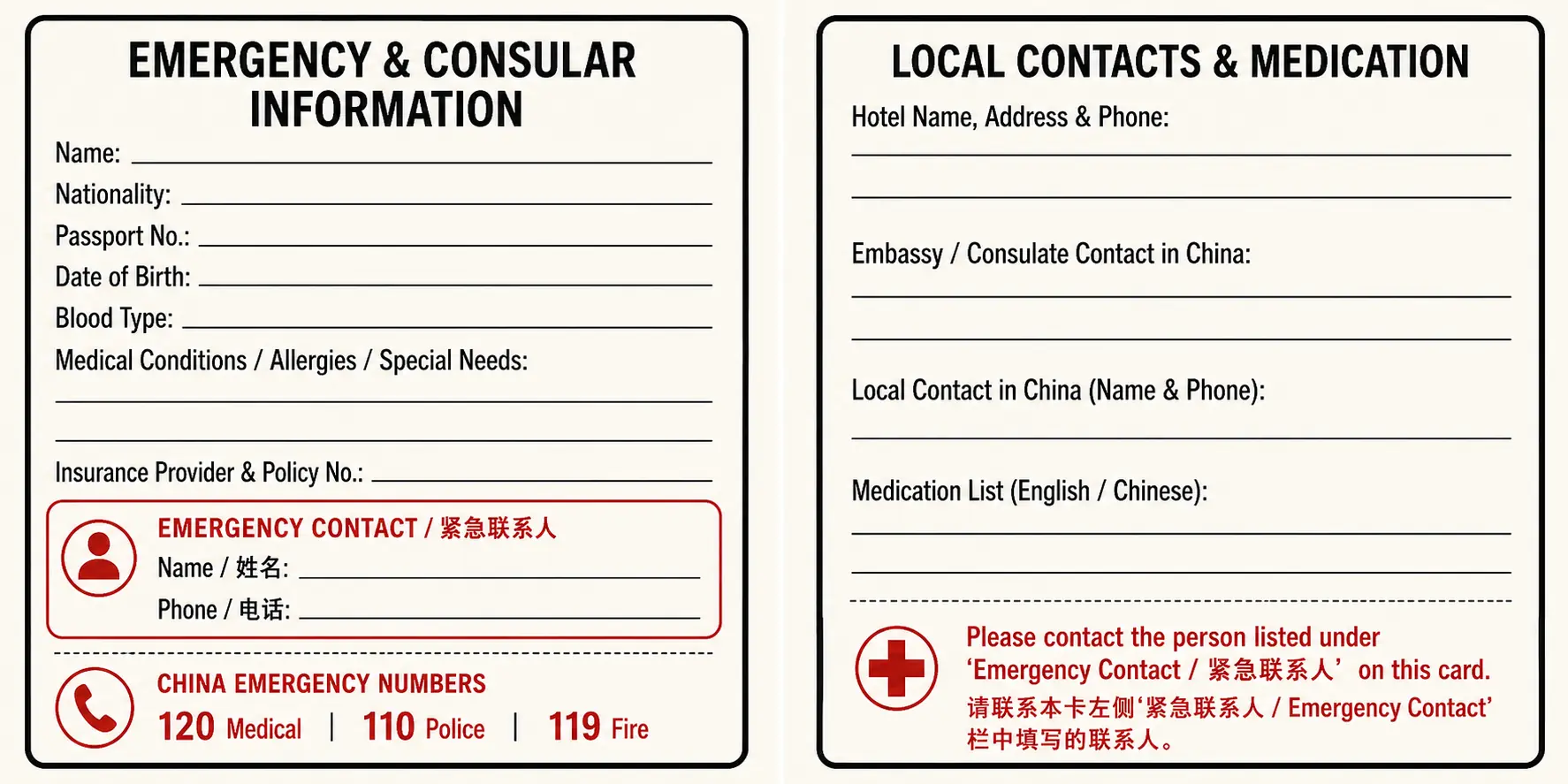
Emergency information card
Carry a simple emergency information card in your wallet or phone case.
On the card: name, nationality, major allergies (过敏), key conditions, current medication, emergency contact, hotel name, local contact number, and insurer assistance hotline. Blood type (血型) is optional; hospitals still test before transfusion.
Keep full passport number, passport scan, and policy number in offline phone files and a shared trip chat instead of printing every sensitive detail on a card that can be lost.
Insurance hotline
If your policy includes SOS or emergency assistance, save that hotline as a separate favorite contact. Keep the same information in your phone notes and in a shared trip chat so a companion can act if you cannot.
Travel Insurance Claim Workflow
Before you start
The workflow below is practical guidance for common travel scenarios in China. Your final claim outcome always depends on your exact policy wording, assistance records, and insurer review standards, so confirm key requirements with your insurer before and during submission.
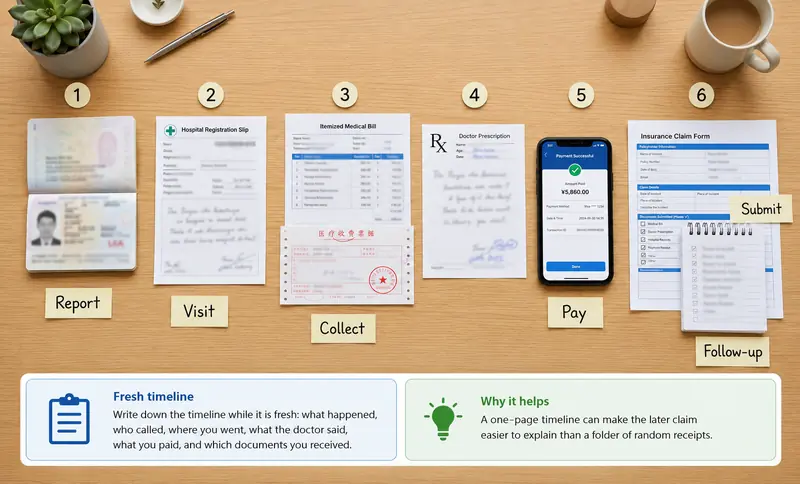
- Open a case- call your insurer or assistance provider and keep the case / reference / claim number
- Seek care- keep registration slips, outpatient/ER records, diagnosis notes, and reports
- Ask for invoices- request official invoice, itemized billing, and payment slips before leaving
- Photograph everything- make hospital header, patient name, and date visible, but keep originals too
- Organize by timeline- incident, call, visit, test, pharmacy, discharge, submission
- Submit on time- use the insurer portal or email before the policy deadline
- Reply under the same case- send extra documents with the reference or claim number attached
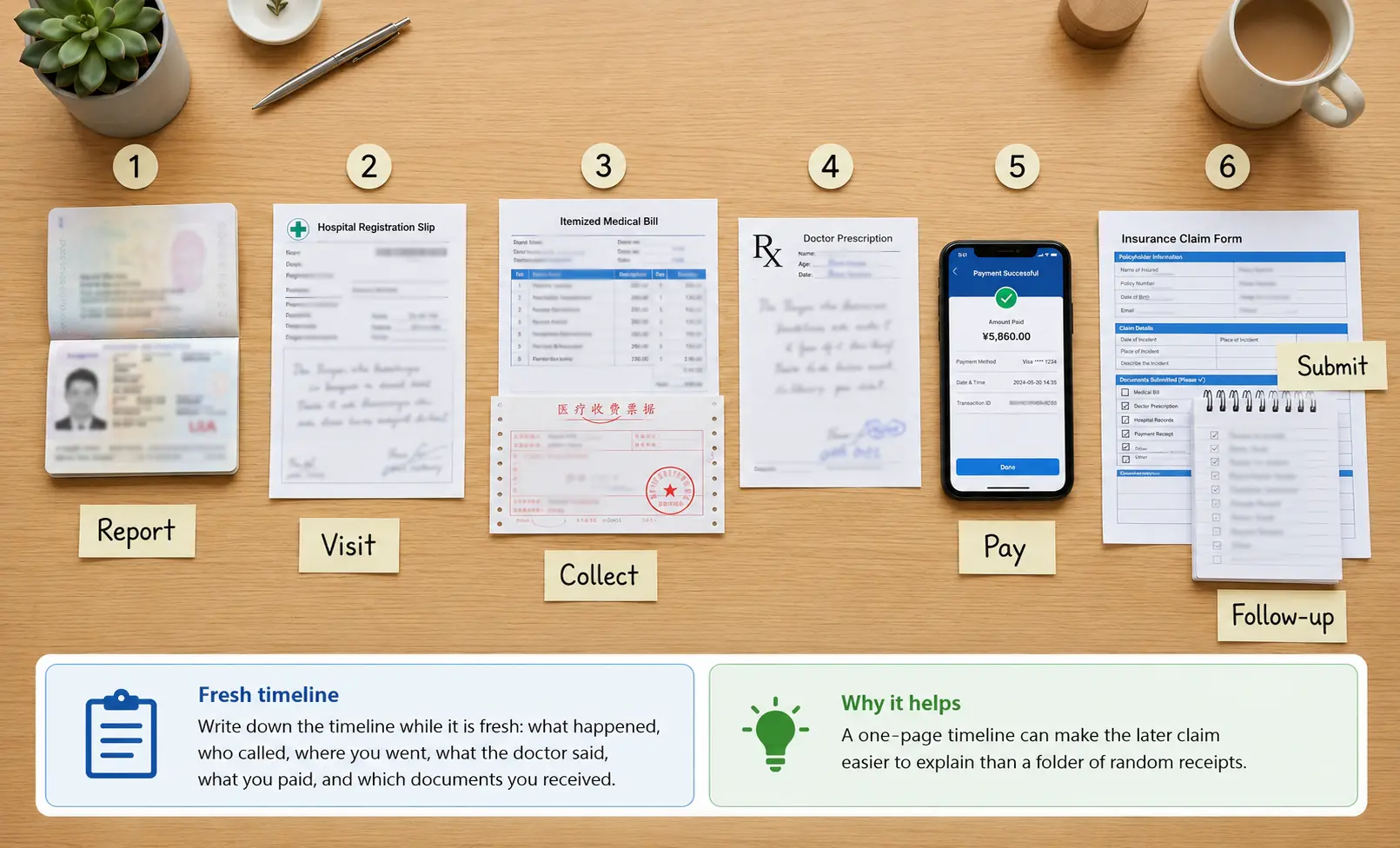
Fresh timeline
Write down the timeline while it is fresh: what happened, who called, where you went, what the doctor said, what you paid, and which documents you received.
Why it helps
A one-page timeline can make the later claim easier to explain than a folder of random receipts.
Claim Documents That Matter
Common rejection triggers
Common rejection triggers are often "almost complete" files. The receipt exists, but the diagnosis statement is missing. The total invoice exists, but the itemized bill is missing. A pharmacy receipt exists, but no related prescription or doctor record explains why the medicine was needed.
✓Core medical papers
Ask for the official invoice (发票), itemized bill (费用清单), outpatient/ER medical record (门急诊病历/病历), diagnosis certificate or statement (诊断证明), prescriptions (处方), medication names (药名), test results, imaging reports, and discharge summary (出院小结) if admitted.
!Common weak spots
Watch for timeline conflicts, missing patient names, unclear hospital headers, blurry photos, untranslated abbreviations, or documents split across multiple payment windows.
Some scenarios need additional evidence:
- Traffic incidents - police or accident responsibility report (事故认定书) in addition to medical bills and diagnosis documents.
- Card-linked insurance - proof that the eligible flight, hotel, or trip purchase was paid with the covered card.
- Inpatient claims - discharge summary, daily charge breakdown, related tests, prescriptions, and receipts.
Chinese originals
Submit Chinese originals cleanly first, then add an English explanation or certified translation if your insurer requests it. Do not translate by deleting the original; keep scans of the Chinese documents clean and complete.
Photo everything on the same day
Do not wait until you return home to organize claim documents. Photograph every hospital document on the day you receive it: receipts, medical records, diagnosis statements, prescriptions, test results, medicine labels, and payment slips. Include the hospital header and date in every shot. Photos are backup; keep original paper receipts, stamped documents, and payment slips until the claim is closed unless your insurer confirms they are not needed. Missing a single document often costs weeks in follow-up.
Coverage Gaps Before You Buy
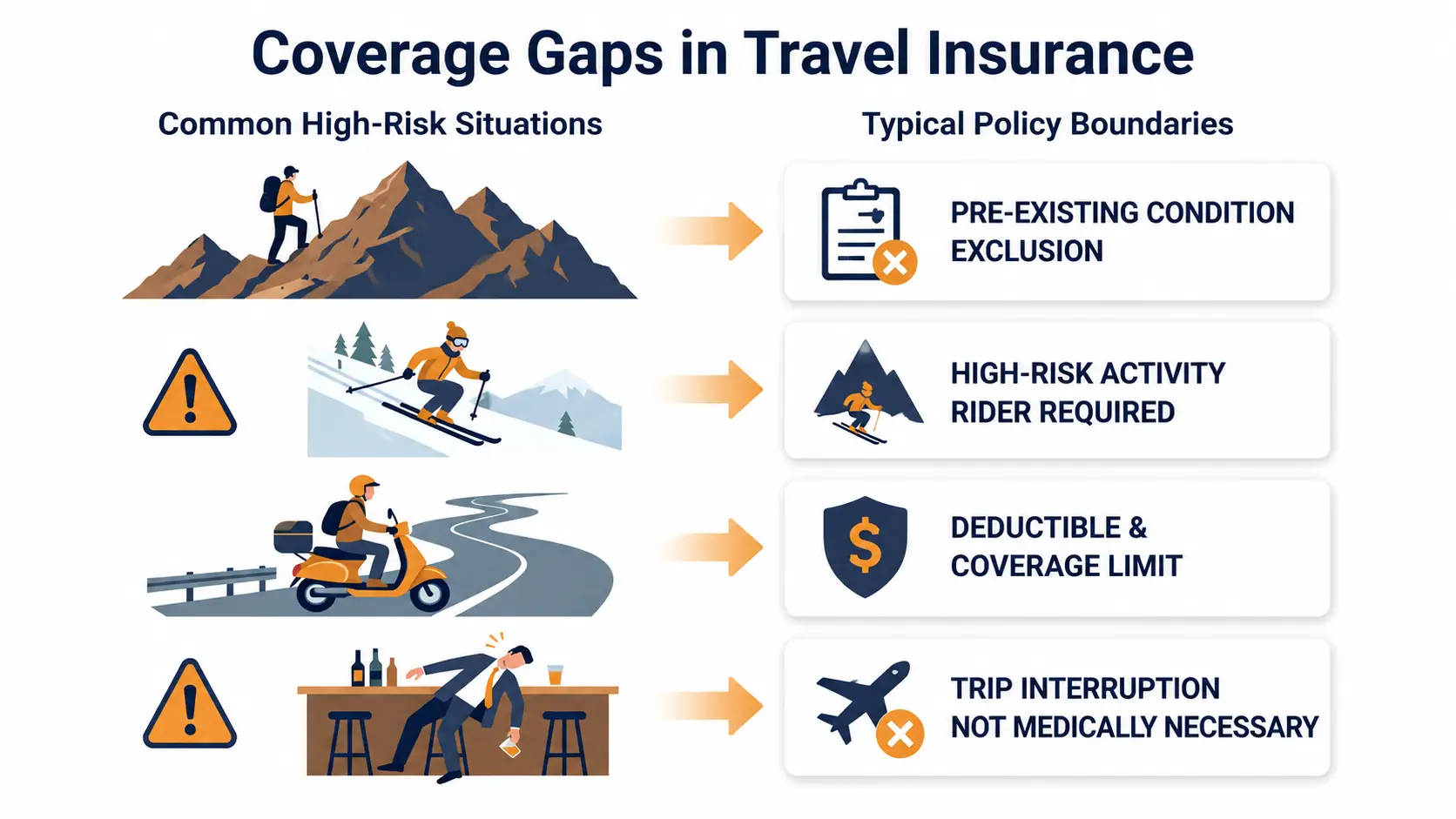
These are the most common dispute zones in travel-insurance claim review — check each clause in your policy wording before departure:
Read these clauses before departure
- Pre-existing conditions - flare-up versus new condition can change the claim result.
- High-risk activities - hiking, skiing, diving, motorbike use, altitude routes, and off-road transport often need riders or written confirmation.
- Alcohol-related incidents - many policies reduce or deny coverage when intoxication is involved.
- Pregnancy-related complications - gestational week, emergency definition, and newborn care rules matter.
- Trip interruption - medical necessity is different from a personal decision to stop traveling.
Confirm in writing
If your trip involves any high-risk category, confirm coverage in writing with your insurer before departure.
If you choose a premium plan, confirm exact medical-necessity and pre-authorization conditions for evacuation.
Instead of focusing on brand names alone, compare policy structure:
- Pre-existing condition handling - covered, excluded, limited, or covered only after a waiver?
- Emergency evacuation and repatriation - what triggers it, who approves it, and what is the cap?
- 24/7 English support availability - phone only, or chat/email too?
- Direct billing or reimbursement-only - can the insurer pay the hospital directly, or do you pay first?
- Deductible, payout caps, and exclusions - the fine print that matters most in a serious case.
Claim Timelines and Follow-Up
No universal clock
There is no universal industry-wide T+2 or T+7 service-level standard. Processing speed varies by insurer, case complexity, local paperwork, document completeness, and whether extra review is needed.
This is not "chasing"; it prevents your case from stalling silently. Keep all insurer messages, hospital receipts, bank-card payment records, and translation notes together until the case is closed.
Use this follow-up rhythm:
- Within 24 hours of care - open or update the case, photograph documents, and organize the timeline.
- After 2-3 working days - confirm your documents were received and are readable.
- After 7-10 working days - confirm substantive review has started if the portal is quiet.
- When extra files are requested - respond within 24 hours where possible and keep the same case / reference / claim number in every email.
If Your Passport Is Lost or Stolen
Passport loss is both a police-report problem and a travel-document problem. Start with official channels, then keep the paper trail for your insurer.
First actions
- Report it to police or PSB - go to the nearest police station or Public Security Bureau and request a written incident report.
- Contact your embassy or consulate - ask about an emergency passport or emergency travel document for your nationality.
- Follow Chinese exit rules - if required, follow Exit-Entry Administration instructions for visa, stay, or exit procedures before leaving China.
Keep for the claim file
Save the police or PSB report, embassy or consulate receipt, replacement-document record, travel-disruption receipts, and any insurer case / reference / claim number.
For prevention steps and theft-response basics, pair this with our tourist safety and scams guide.
Frequently Asked Questions
For life-threatening medical symptoms or serious injury, call 120 first. For fire, crime, or traffic danger, use 119, 110, or 122/110 as appropriate, and call 120 too if anyone is injured. After immediate safety is handled, contact your insurer's 24/7 assistance line to align hospital routing, direct-billing questions, transfer support, and claim records.
Sources Checked
Emergency and claim guidance reviewed
- China emergency-service numbers for ambulance, fire, police, traffic police, and maritime search and rescue: GOV.UK China getting help
- Beijing official emergency numbers and 120/110/119/122 use cases: Beijing Municipal Government emergency numbers
- Shanghai official emergency hotline notes, including 110 foreign-language support and 119/120 English support: Shanghai Municipal Government emergency hotlines
- China government guidance on 12345 hotline coordination with 110, 119, 120, 122, and utility hotlines: State Council / gov.cn 12345 hotline guidance
- U.S. State Department reminder that the U.S. government does not pay medical bills abroad: U.S. State Department China travel advisory
- Consular support abroad and traveler responsibility for hospital and related expenses: U.S. State Department medical care abroad
- Travel insurance, medical evacuation, reimbursement, and paying upfront abroad: CDC Yellow Book travel insurance guidance
- China healthcare access, emergency care context, and traveler-health planning background: CDC Travelers Health China page
Beyond This Guide
Emergency help is a response plan, not something to improvise when your phone battery is low and everyone is stressed. Continue with pre-trip health preparations, doctors and pharmacies in China, food safety and drinking water, and traveling with seniors, kids, and pregnant travelers.
For broader safety context, pair this with the tourist safety and scams guide.
If your trip includes medical risk factors, language barriers, remote routes, or uncertain insurance coverage, we can plan a calmer response path and guide you through what to prepare before you travel.
We do not sell insurance, choose policies for you, book medical appointments, buy medicine, or handle money on your behalf.
© gochinafreely.com — Original guide by Go China Freely.