China hotel check-in for foreigners is usually simple if you arrive with your original passport: the hotel scans your passport, verifies your visa or entry stamp, and submits your accommodation registration through its local public-security workflow. Private stays are different: you or your host normally need to complete temporary accommodation registration within 24 hours. The main planning risk is a small hotel, guesthouse, or private rental that has not handled foreign-passport registration smoothly, so this guide explains the normal desk flow, deposits, the 24-hour rule, and what to do if check-in is refused.
Executive Summary
Fast answer
At a legitimate hotel, your passport scan at check-in normally completes the accommodation registration for you. Keep your passport original handy and do not rely on a photocopy.
Biggest risk
Mainstream hotels usually handle foreign passports. Confirm ahead for small guesthouses, cheap independent hotels, unmanned properties, private rentals, and county or scenic-area stays.
Private stays
If you stay with friends or in a private rental, you or your host must register within 24 hours. Since September 21, 2026, online registration via NIA 12367 is available nationwide.
Chinese Hotel Check-In Process
Most foreign guests in China go through the same core sequence at the front desk. The legal part is not optional: the hotel has to register your stay and submit the accommodation data through its local public-security workflow.
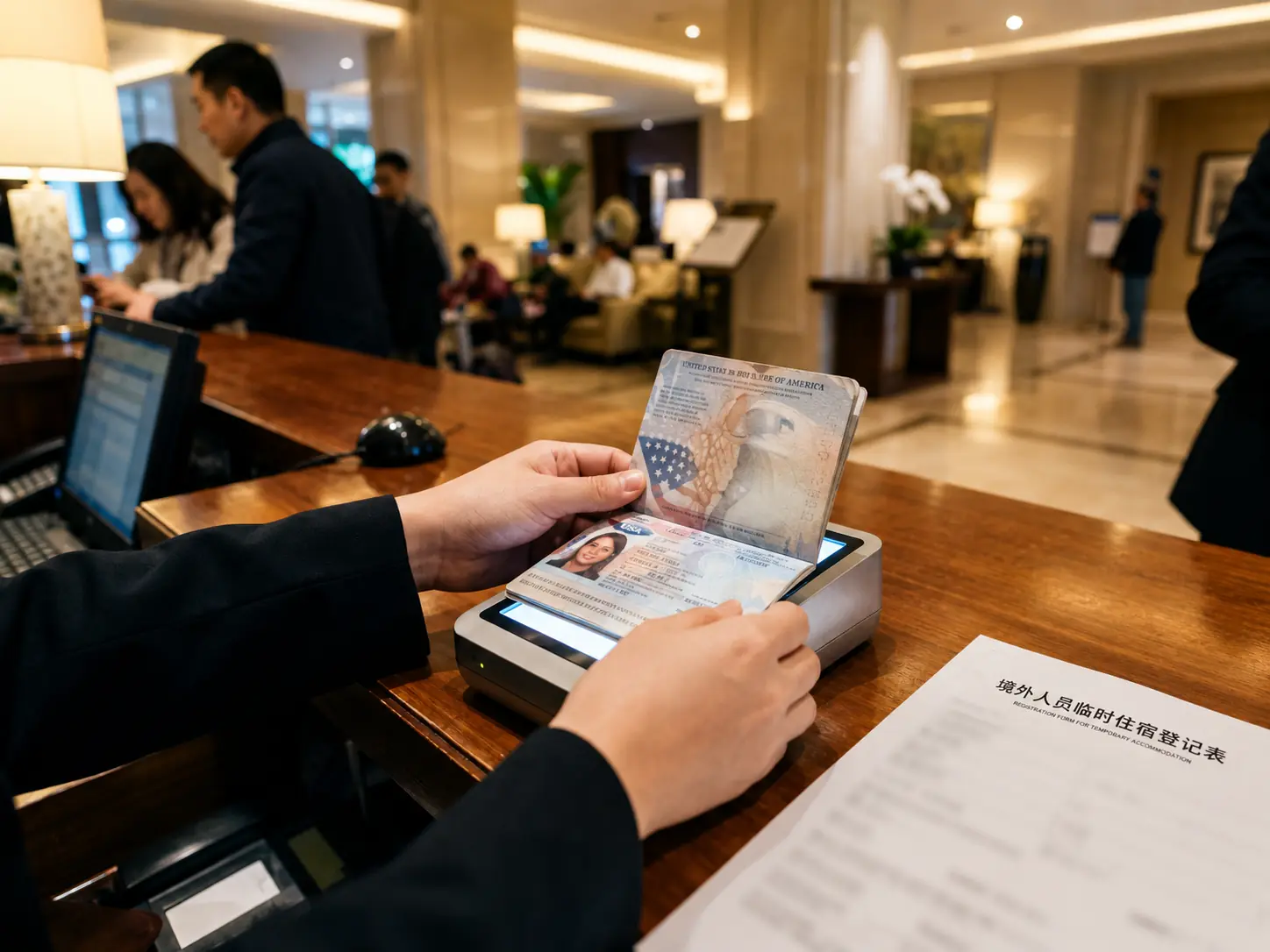
What the desk is doing: the receptionist checks your passport photo page, visa or entry-stamp page, nationality, entry date, and permitted stay. If your visa has expired or your visa-free stay has run out, the hotel cannot legally check you in.
How long it takes: at a major chain, scanning and data entry can take only a few minutes. At a small hotel where staff rarely process foreign passports, expect pauses, translation apps, and a manager or platform support check.
- Hand over passport- Original passport only. Staff check the photo page plus visa or entry stamp.
- PSB registration entry- Passport number, nationality, visa type, entry date, and stay details go into the hotel registration system.
- Pay deposit- Alipay or WeChat Pay pre-authorization, card hold, or cash depending on hotel tier.
- Get room key- Key card, Wi-Fi, breakfast hours, elevator access, and checkout time are usually explained here.
Check-in timing
Standard check-in is 14:00, but the real rhythm depends on season, housekeeping, and arrival time.
Off-season
Weekday rooms are often available by 13:00 or even 12:00.
Peak season
National Day and Chinese New Year can mean waiting for housekeeping even at 14:00.
Late night
Hotels with 24-hour front desks check you in immediately, though some charge a half-day rate and policies vary.
Questions at the desk
Beyond passport details, staff sometimes ask about your itinerary, next destination, or departure flight. None of this is mandatory, but cooperating keeps things moving.
Language shortcut
If there's a language barrier, type your answers on your phone and show the screen — most front desks have translation apps handy.
Passport handling is routine
At check-in, front desk staff may briefly scan, photocopy, or enter your passport details. That is normal in China. They normally return your passport after registration is done; do not leave your original passport with the hotel overnight or until checkout.
Back up your documents
Before leaving your hotel each day, keep phone photos of your passport photo page, visa page, and most recent entry stamp. If your passport is lost or stolen, these backups speed up the replacement process at your embassy and the local PSB.
Why Hotels Refuse Foreign Guests
This is the moment that can still catch travelers off guard: you've booked a room on an app, walk up to the front desk, and hear "we don't accept foreign guests" or "we can't register a foreign passport."
Usually a registration-workflow problem, not a room problem.
Mainstream hotels usually handle foreign passports. Problems are more likely at small guesthouses, low-price independent hotels, unmanned properties, or scenic-area stays where staff, systems, or platform settings have not handled foreign guests smoothly.
Legal workflow
Under Article 39 of China's Exit-Entry Administration Law (出入境管理法), every hotel accommodating foreigners must register and submit foreign guests' accommodation data to the local PSB.
Chinese IDs
For Chinese citizens, an ID card scan completes this in seconds.
Foreign passports
Foreign passports often need extra manual entry or a different registration screen. Staff who rarely see them may not know the workflow or may need manager help.
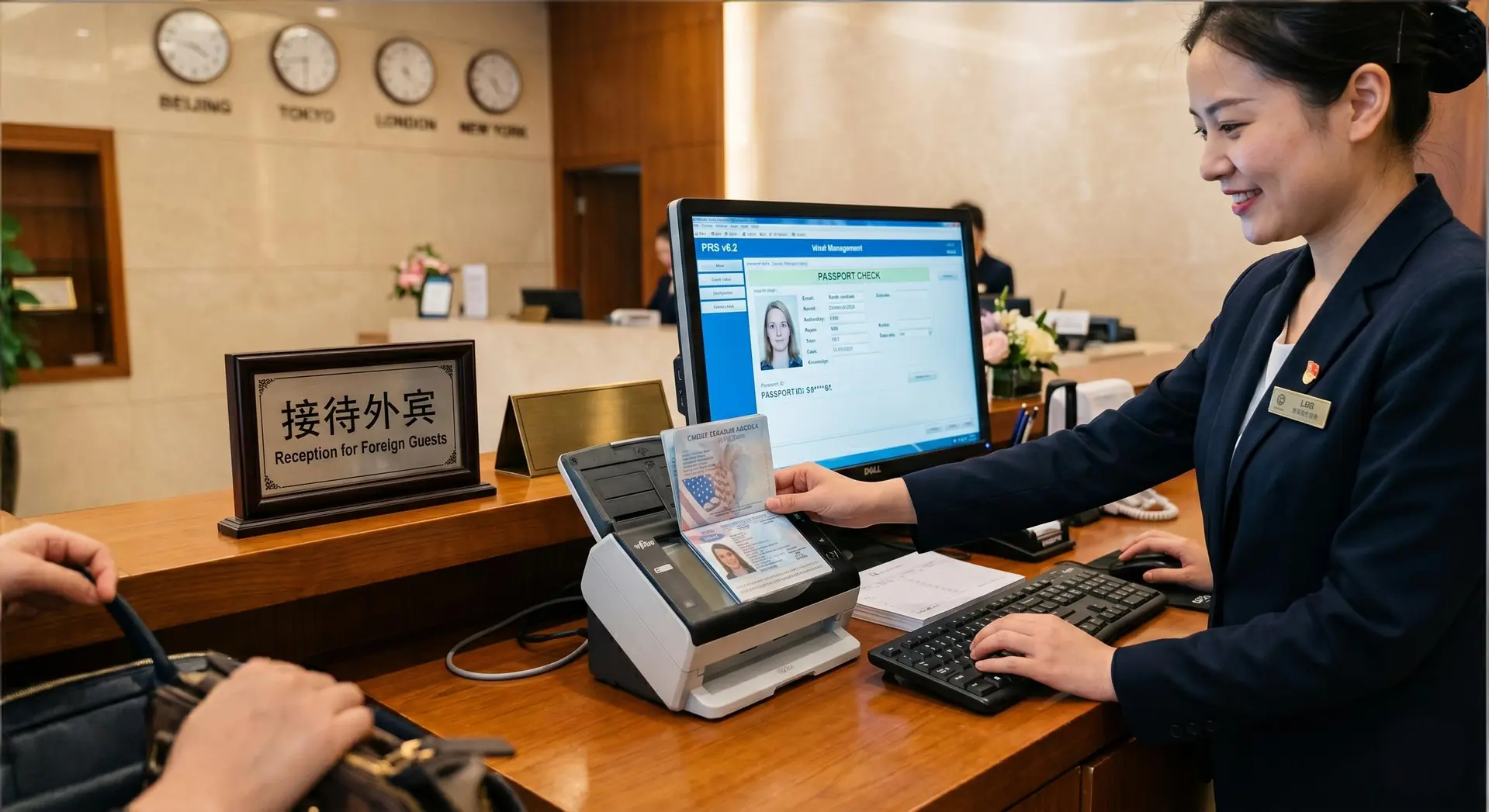
Staff reality
The issue is often training, system access, or a platform listing that was never checked against the hotel's real registration ability.
July 2024 policy shift
National guidance
A national circular from the Ministry of Commerce and six other departments said local departments and booking platforms should not restrict accommodation operators from receiving foreign guests based on qualification requirements.
No-foreigner claims
Platforms and operators are also prohibited from illegally advertising that they do not accept foreign guests.
Uneven enforcement
This is a step in the right direction, but execution remains uneven. In Beijing, Shanghai, Guangzhou, Shenzhen, and other major tourist cities, mainstream chain and star-rated hotels are usually fine. Confirm ahead for small independent hotels, guesthouses, apartments, county towns, and scenic-area stays.
How to confirm a hotel accepts foreigners
Choose international chains (Marriott, Hilton, IHG, Accor) or established Chinese chains like Atour (亚朵), JI Hotel (全季), Home Inn (如家), or Hanting (汉庭) — their standardized systems usually handle foreign passports.
For small independent hotels, guesthouses, apartments, and county or scenic-area stays: contact the property directly before booking. If you don't speak Chinese, use Trip.com's in-app chat — their China-based support team can call the hotel and confirm in real time.
Check recent reviews for keywords like "foreigner," "passport," or "check-in" to see if other international travelers stayed successfully.
What to do if you're refused
Stay calm — the front desk staff are usually just as uncomfortable.
Ask the front desk to recommend a nearby hotel that can register foreign passports; local staff usually know which properties can handle it.
If you booked through Trip.com, contact their customer service immediately — they have a China-based team for real-time assistance.
As a last resort: walk to the nearest international chain hotel and check in directly.
Before arrival, choose a hotel booking platform that lets you verify foreign-passport acceptance, message the property, and keep a usable record of its reply.
Still choosing a hotel? Compare hotels and room prices on Trip.com(affiliate link · may earn commission, no extra cost). Enter your city and dates, check recent guest reviews and cancellation terms, and confirm any foreign-passport or late-arrival questions with the exact property before paying. A booking confirmation alone does not guarantee check-in.
Accommodation Registration: Hotels vs. 24-Hour Non-Hotel Rule
This is the rule foreign travelers overlook most often — and the one most likely to cause problems later.
The legal basis: Article 39 of the Exit-Entry Administration Law states that hotels must register foreign guests' accommodation information and submit it to the local public security authority. For non-hotel stays, the foreigner or the host must register with the local PSB within 24 hours of arrival.
Hotel stays
Check-in normally covers registration
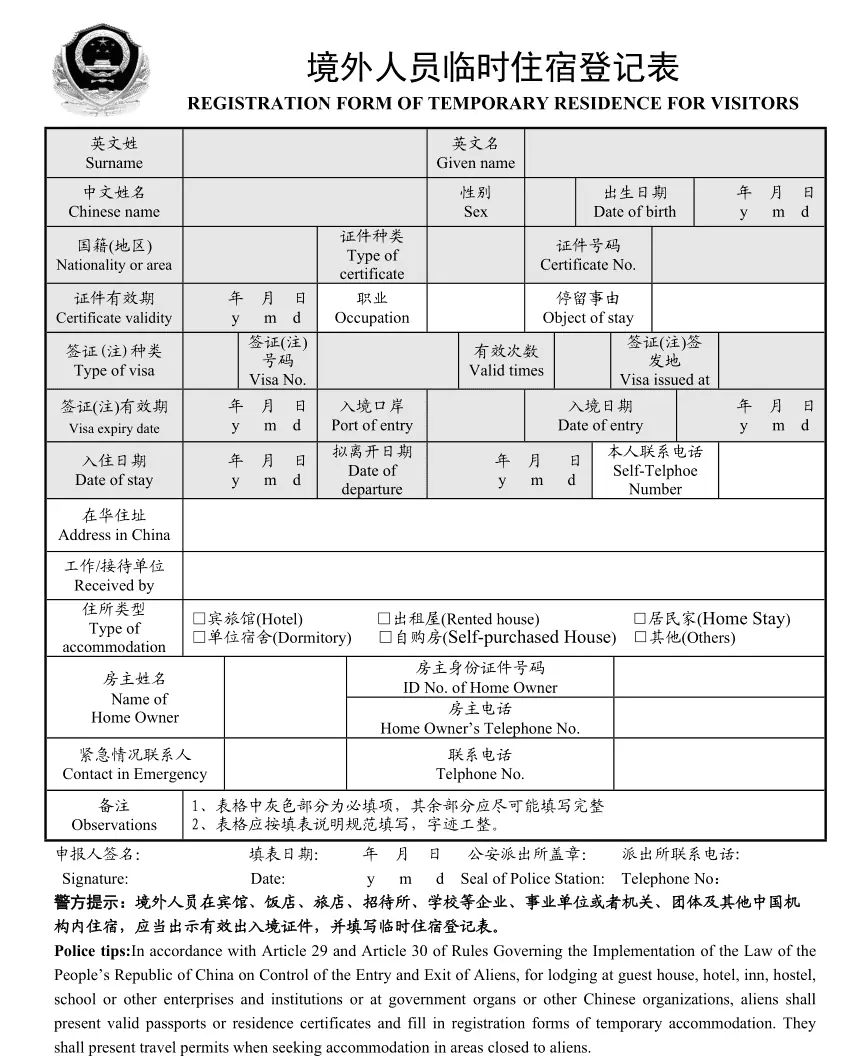
If you're staying at a legitimate hotel that accepts foreigners, the passport scan at check-in is normally the accommodation registration. Some hotels give you a Temporary Accommodation Registration Form (境外人员临时住宿登记表), while others keep it digital.
If you receive paper proof, keep a phone photo
Ordinary tourists rarely need to show this during a normal trip. If the hotel gives you paper or digital proof, take a phone photo and keep it with your passport photos.
For visa extensions or stay changes: local immigration officers may review your registration history.
For private-stay follow-up: it helps if a host, police station, or platform asks what was registered.
For lost-passport cases: accommodation records can help reconstruct where you stayed.
Re-register every time you change cities
Registration follows where you stay. Hotels handle this automatically at each new hotel. For non-hotel stays, register each new address within 24 hours online via NIA 12367 or in person with your host at the local police station.
Penalties and practical risk
Hotels
Up to ¥5,000 fine per unregistered foreign guest.
Individuals
A warning or fine up to ¥2,000 for failing to register on time.
In practice
Most short hotel stays are handled quietly by the hotel. The risk rises with private stays, long stays, visa extensions, or any situation where officials review your accommodation history.
Private Stays and Registration
If you're staying at a friend's apartment, a private rental, or any non-hotel accommodation, the registration requirement doesn't disappear — it just shifts from the hotel to you (or your host).
Traditional method
Police-station registration
Go with your host to the nearest police station (派出所) if online registration is not available. Straightforward cases can be quick, but requirements vary by city, neighborhood, and station, so ask the host to call ahead.
September 2026 nationwide rollout
Online registration nationwide
Following a March 20, 2026 pilot in seven provincial-level regions (Hebei, Liaoning, Zhejiang, Hubei, Guangxi, Chongqing, and Sichuan), the National Immigration Administration expanded online accommodation registration for foreigners staying outside hotels nationwide on September 21, 2026.
You or your host can register free through:
Legal effect
The online route carries the same legal effect as in-person registration, and the offline police-station channel remains available. Complete identity verification, submit passport and address details, and save the accepted digital record.
First-time address help
For a first registration at a private residence, ask your host to help enter the exact local address and property details so the submission matches public-security records.
Offline backup
Keep a screenshot of your accepted digital proof. If the online submission fails or cannot match the address, ask your host to call 12367 or visit the local police station before the 24-hour window closes.
Airbnb in China: Airbnb shut down its mainland China operations on July 30, 2022. Alternatives include Tujia (途家) and Xiaozhu (小猪), but many listings are set up for domestic Chinese ID bookings. Before paying, confirm whether the host has hosted foreign guests before and whether they will help with police-station or online registration. If the answer is vague, book a normal hotel instead.
Hotel Security and Room Safety
Chinese hotels can feel more security-heavy than hotels in some Western countries. This is not targeted at foreigners — every guest goes through the same real-name and public-area security setup.
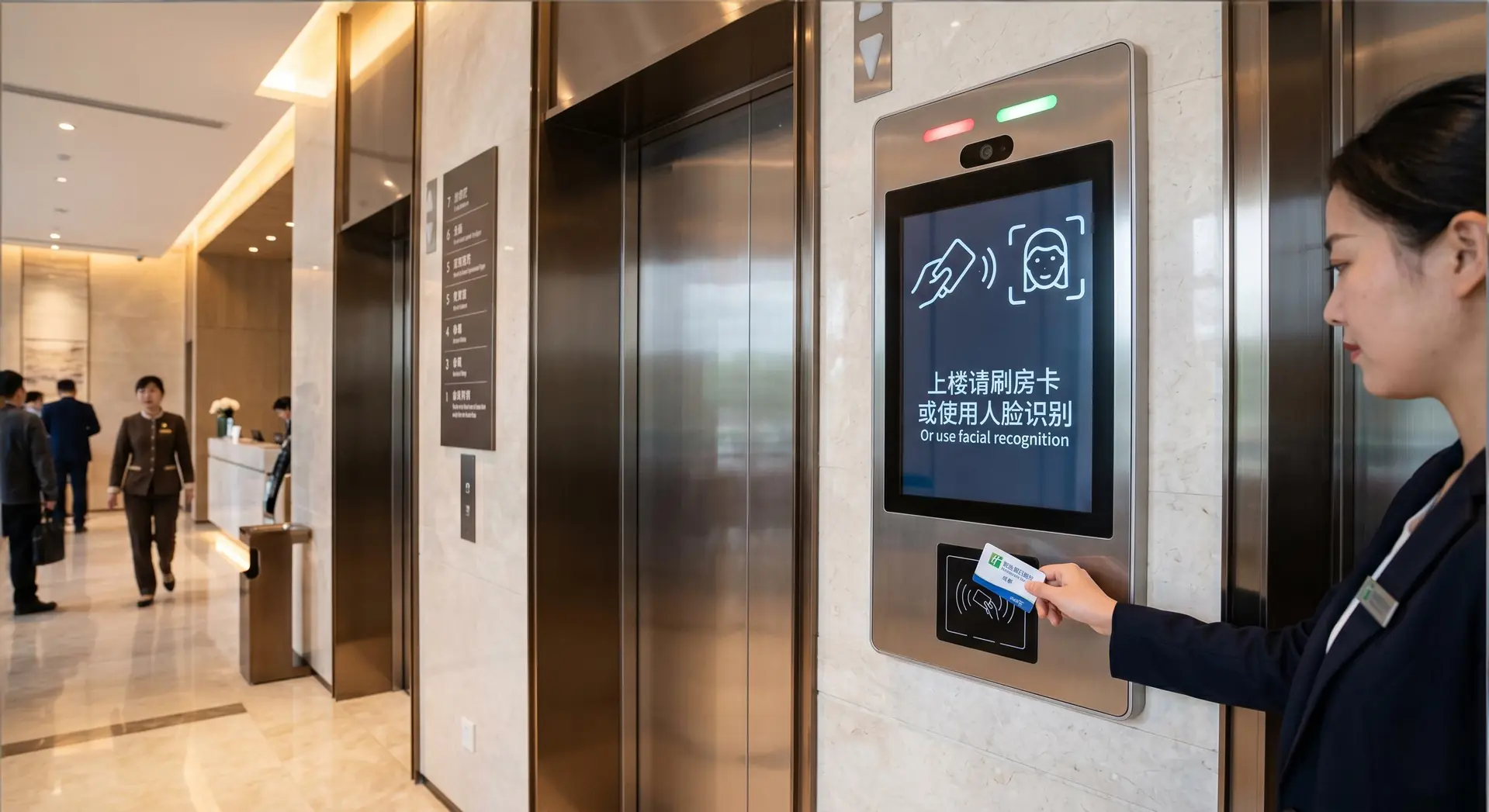
Elevator access control: Most mid-range and upscale Chinese hotels require your room key card to operate the elevator — you can only press the button for your own floor. Some hotels use facial recognition for elevator access. Budget chains like Home Inn (如家) and Hanting (汉庭) are increasingly adopting this system too.
Corridor and common area surveillance: Nearly all Chinese hotels have 24-hour CCTV cameras in hallways, lobbies, and elevator areas. Treat this as standard public-area security, not something aimed at foreign guests. There are no cameras inside guest rooms — if you discover a hidden camera in your room, it's illegal and should be reported to the front desk and police immediately.
24-hour front desk
Standard chain, mid-range, and upscale hotels normally have round-the-clock front desk staffing. Small guesthouses, apartments, and unmanned hotels can be different, so confirm late-night check-in before booking.
One person, one ID
Chinese hotels strictly enforce real-name registration — one valid ID per guest. You can't check in multiple people with a single passport. This stems from China's identity verification system and ensures every guest has a record in the PSB system.
Common concerns and straight answers:
🛂Passport Data Goes to PSB
Yes — this is a legal requirement. All hotel guests, Chinese and foreign alike, have their accommodation information reported through the public-security system.
🎥Hallway CCTV Is Standard
Corridor and lobby cameras are for theft prevention and emergencies. Footage is managed by hotel security and is usually reviewed only when something goes wrong.
🔐Guest Data Has Legal Protection
China's Personal Information Protection Law (个人信息保护法) requires hotels to protect guest data. For travelers, the practical point is simple: passport registration is standard, but the hotel should not use your details for unrelated purposes.
Room safety
In-room safes are uncommon at budget hotels. For passports, spare cash, and valuables, use the in-room safe if available or ask the front desk about storage. China's hotel security environment is generally orderly, but use the same common-sense care you would anywhere.
First thing to do in your room
Spend 30 seconds checking the emergency exit map on the back of your door. Locate the nearest stairwell and fire exit. You'll typically see fire extinguishers and smoke detectors in the hallway. Some upscale hotels provide emergency flashlights and escape ropes in the closet — worth noting if you're on a high floor.
Watch out for suspiciously cheap third-party bookings
If someone (usually on Taobao or WeChat) offers to book your hotel at far below market price, be cautious — they may use a Chinese ID instead of your passport for the reservation and registration. When you arrive, your passport won't match the system, and you could be refused check-in with no refund. Use Trip.com or the hotel's official channel with your own passport details, and verify acceptance before paying.
Avoid Unlicensed Guesthouses
Never stay at unlicensed guesthouses (黑旅馆) — these are unregistered properties without a business license or PSB authorization. They cannot complete your police registration, offer no legal guest protections, and may pose safety risks. If a place isn't listed on any major booking platform and has no visible business license at the front desk, walk away.
Chinese Hotel Room Basics
Before diving into deposits and payments, here's what to expect inside a Chinese hotel room — some things will be a welcome surprise, others you'll want to bring yourself.
🫖Electric Kettle & Free Water
Hot water is standard in China, so almost every hotel room has an electric kettle and complimentary bottled water, usually 2 bottles per day. Disposable slippers and toiletries are common, but bring your own toothbrush.
🔌Power: 220V, Bring an Adapter
China uses 220V/50Hz with national-standard three-prong and two-prong flat outlets. US and UK plugs won't fit — bring a universal adapter. Mid-range hotels usually have USB ports at the bedside.
📶Wi-Fi May Need a Chinese Number
Nearly every hotel offers free Wi-Fi, but some networks require a Chinese phone number for verification. No Chinese number? Ask the front desk to connect you or provide a guest password.
💰No Tipping Culture
China has no tipping tradition. Hotel staff don't expect tips. If a bellhop carries heavy luggage, ¥10–20 is a kind gesture but absolutely not required.
🚰Don't Drink the Tap Water
Hotel tap water is not safe to drink — even in five-star hotels. Use the free bottled water or boil water with the in-room kettle.
🍫Minibar: 2–3x Store Prices
Room snacks and drinks are almost always charged at 2–3x convenience store prices. The front desk will inventory minibar consumption at checkout.
Deposits, Payments, and Checkout
← swipe to compare all options →
Budget Hotels
Home Inn · Hanting · 7 Days Inn
- ✓Alipay, WeChat Pay, cash, or UnionPay usually works.
- —Deposit via mobile pay often releases fastest at checkout.
¥200–300
Cash or mobile pay common
International cards may fail
Mid-Range Hotels
Atour · JI Hotel · Vienna
- ✓Visa and Mastercard support is more common than at budget chains.
- ✓Alipay or WeChat Pay pre-authorization freezes funds instead of charging them.
¥300–500
Best all-rounder
Card support more likely
Upscale Hotels
Marriott · Hilton · InterContinental
- ✓International cards, mobile pay, and sometimes Apple Pay are supported.
- —Credit card holds can take 1–7 business days to release.
¥500–1k
Most flexible payment stack
Holds can linger
Deposit ranges vary by city, room type, booking channel, and holiday period.
Fastest deposit path
Cash deposits require a room inspection at checkout, usually a 15–30 minute wait. Mobile pay pre-authorization is the clear winner for speed.
Checkout rhythm
12:00 noon
Standard checkout time. Late checkout until 14:00 may be available depending on occupancy; overstaying by 1–2 hours without approval may incur a 50% room charge.
5–10 minutes
Room inspection: staff check the room after you leave.
Refund timing
Alipay/WeChat Pay releases instantly; credit card holds take 1–7 business days; cash is returned on the spot.
Common deductions
Digital Hotel Check-In Options
Chinese hotels are among the most digitized in the world, especially in tier-1 and "new tier-1" cities.
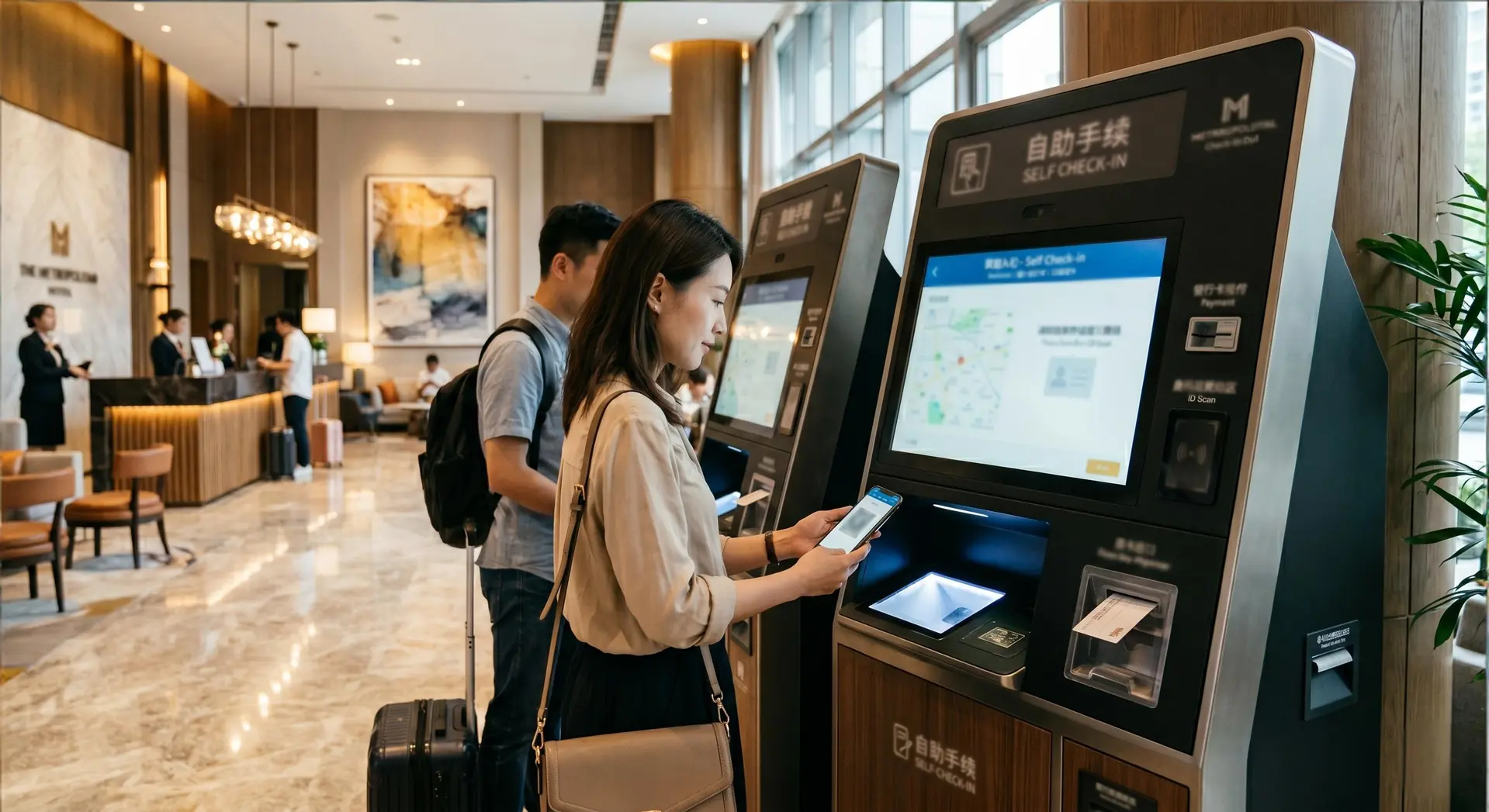
Self-service kiosks appear at chains like Atour (亚朵), JI Hotel (全季), and select Marriott properties. When the kiosk supports your document, the flow can be: scan passport → facial recognition → select room → pay deposit via QR → machine dispenses key card.
The catch: these kiosks are optimized for Chinese ID cards. Foreign-passport OCR can be hit-or-miss depending on the machine model and your passport's country of issue. If the machine can't read your passport, it'll route you to the front desk.
Alipay "Credit Stay" (信用住)
If your Sesame Credit (芝麻信用) score in Alipay meets a certain threshold, you can enjoy deposit-free check-in with automatic payment after checkout. This service is widespread among Chinese travelers but largely inaccessible to foreign tourists due to the credit-score barrier.
Trip.com "Flash Check-In" (闪住)
For some hotels booked through Trip.com, pre-arrival passport and selfie upload can speed up check-in. Still bring your original passport and expect the front desk to verify it if the hotel requires an on-site check.
Smart rooms
Some mid-range and upscale hotels feature voice-controlled systems, typically Tmall Genie 天猫精灵 or Xiaodu 小度, for lights, curtains, and air conditioning. These systems almost exclusively support Chinese — if you don't speak the language, just use the physical switches instead. WeChat mini program door locks are also available at some hotels.
Check-In Problems and Fixes
🛂Passport Validity Under 6 Months
China has no explicit rule requiring 6 months of passport validity for hotel check-in, but some front desk staff apply airline or visa norms by habit. Show your valid visa or entry stamp to prove you're legally in the country. If the front desk insists, try another hotel.
📝Booking Name Mismatch
If a friend or travel agency booked for you, the name in the system may not exactly match your passport. Show the booking confirmation plus your passport. If needed, ask the person who booked to contact the hotel and correct the name.
🌙Late-Night Arrival
Most standard hotels have 24-hour front desks, but small guesthouses, apartments, or unmanned hotels may not staff overnight. Confirm late-night availability when booking and put your arrival time in the booking notes.
👥Two Guests, One Passport
China's real-name system requires every guest to present their own ID. If your travel partner forgot their passport, the hotel technically cannot register the second person. Best practice: everyone carries their own original passport.
🏨Hotel Overbooked
During National Day Golden Week, Chinese New Year, and other peak periods, overbooking or system delays can happen. Show your booking confirmation, ask for an equivalent room or comparable nearby hotel, and contact your booking platform immediately.
💬No Shared Language
Show your passport and booking confirmation first, then use a translation app. If the front desk still cannot process your stay, ask them to write the reason in Chinese so your booking platform can help.
Useful front-desk phrases:
Show these phrases at the front desk (save them on your phone in advance):
| English | Chinese | Pinyin | Say It Like… |
|---|---|---|---|
| I have a reservation | 我有预订 | wǒ yǒu yùdìng | woh yoh yoo-ding |
| Do you have a room available? | 请问有空房吗 | qǐngwèn yǒu kōngfáng ma | ching-wen yoh kong-fung mah |
| Here's my passport | 我的护照在这里 | wǒ de hùzhào zài zhèlǐ | woh duh hoo-jow zai juh-lee |
| Can I use a credit card? | 能用信用卡吗 | néng yòng xìnyòngkǎ ma | nung yong shin-yong-kah mah |
| Check out | 退房 | tuìfáng | tway-fung |
| Please call a taxi for me | 请帮我叫出租车 | qǐng bāng wǒ jiào chūzūchē | ching bung woh jow choo-zoo-chuh |
Hotel Check-In FAQ
Legally, foreigners should carry their passport or another valid ID at all times. In practice, a photocopy of your passport photo page and visa page plus a phone photo is usually sufficient for daily activities. However, checking into hotels, buying train tickets, and entering certain attractions require the original passport.
Sources checked for this guide
- National Immigration Administration accommodation-registration guidance checked for Article 39, hotel vs non-hotel registration, penalties, and the rule that non-hotel stays must register within 24 hours.: NIA accommodation registration rules
- National Immigration Administration notice checked for the September 21, 2026 nationwide expansion of online accommodation registration for foreign non-hotel stays via NIA 12367.: NIA nationwide online registration notice (Sept 2026)
- National Immigration Administration / State Council announcement checked for the March 20, 2026 seven-region online pilot background.: March 2026 online registration pilot
- State Council / Xinhua accommodation guidance checked for the July 2024 circular on foreign-traveler accommodation, qualification restrictions, and illegal no-foreign-guest advertising.: 2024 accommodation guidance
- National Immigration Administration 2025 statistics checked for foreign-visitor crossings and visa-free entry figures used in the opening context.: 2025 NIA travel statistics
Beyond This Guide
Hotel check-in is just one piece of the accommodation puzzle. Between choosing the right hotel type, finding platforms that actually verify foreign-guest policies, and setting up Chinese payment apps, there's plenty more to sort out before your trip.
Related guides:
- China Accommodation Guide: Hotels, Hostels & Apartments — the full picture of accommodation types, from luxury chains to youth hostels
- Trip.com App for China Travel — broader booking workflow for hotels, flights, trains, and attraction tickets in one English-friendly app
- Mobile Payments in China: Alipay & WeChat Pay — set up before you arrive to make hotel deposits seamless
- China Visa Guide — visa requirements that affect your hotel registration
© gochinafreely.com — Original guide by Go China Freely.