Tea House programme
WestK lists the long-run programme and current ticket terms; other productions use their own event pages. See booking checks
First-visit decisions
Cantonese Opera: Lingnan Heritage
Cantonese opera is a centuries-old form of Chinese theatre shaped in the Cantonese-speaking south. You do not need the full history before the curtain rises, but three layers explain what you are seeing: a cross-regional theatrical inheritance, a distinctly Lingnan performance language, and a living Hong Kong tradition.
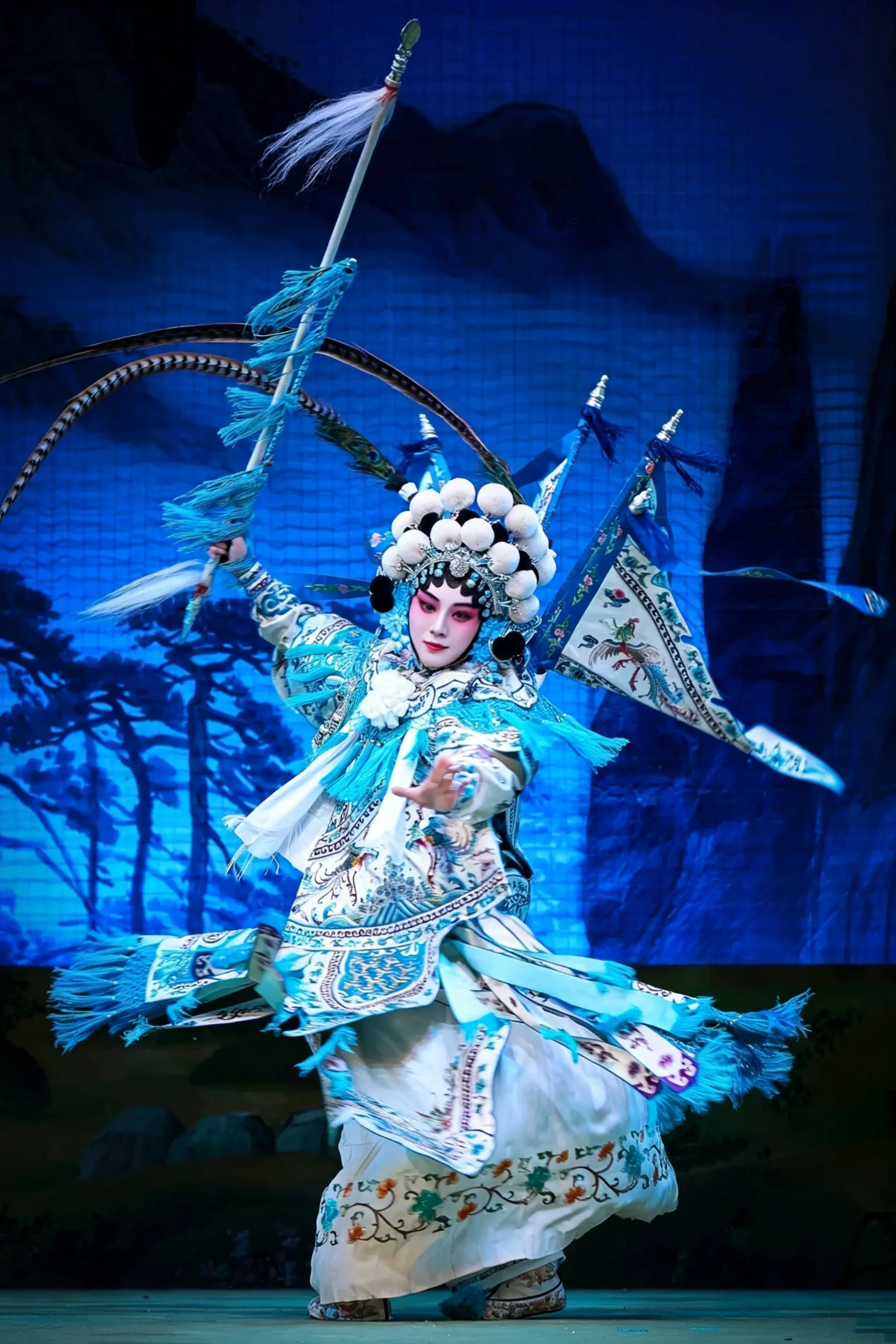
Full costume and headdress — each element helps establish character and status
A southern theatre language
Song, speech, movement and martial arts carry the story together
Histories commonly trace the form's roots to theatre traditions that moved south around the late Southern Song period and mixed with Pearl River Delta music. During the Ming era, several vocal systems circulated through Lingnan; by the late Qing, Cantonese had replaced the older stage language and become central to the form.
Ming era
Foshan (佛山) became an important base; the Qionghua Guild Hall (琼花会馆) organised professional performers.
1854
After performer Li Wenmao (李文茂) joined an uprising, the Qing authorities suppressed troupes and destroyed the guild hall.
2006
Cantonese opera entered China's first national intangible-cultural-heritage list.
2009
UNESCO added it to the Representative List of the Intangible Cultural Heritage of Humanity.
Do not read it as Peking opera in another dialect
Cantonese opera
Voice: Cantonese, whose pitch contours shape the melodic line. Music: may incorporate Southern Tunes (南音), wooden-fish songs (木鱼) and dragon-boat chanting. Movement: southern martial traditions favour compact, close-range action.
Peking opera
Voice: northern stage speech. Music: is organised around established melodic systems. Movement: often foregrounds long weapons, high kicks and broad acrobatic lines.
The point is not that one form is more expressive than another. Cantonese opera's particular combination of tonal singing, Lingnan embroidery, percussion and southern martial vocabulary makes it inseparable from Guangdong, Guangxi, Hong Kong and Macao. In Hong Kong, it is both public entertainment and a ritual art still performed at community festivals.
A Quick Stage Decoder
Treat the stage as a visual language rather than a puzzle you must translate. Costume, headdress, face paint, props and stylised movement give you an early read; the surtitles and programme notes then confirm the details. These are useful first-look cues, not rules that every production applies identically.
Role Types
Four silhouettes you can recognise before the first line lands
Civil-martial male lead (文武生)
A leading male role that may move between refined singing and martial display — from fan and formal bearing to armour, spear and acrobatics.
Female lead (花旦)
A major female-role category. Different subtypes range from dignified young women to warrior characters; sleeve work and eye technique often carry the emotion.
Clown (丑生)
A comic or satirical role, often signalled by a white patch around the nose. Martial clowns can place humour inside demanding physical sequences.
Painted face (净)
Bold face patterns establish a forceful personality. Familiar figures include the red-faced Guan Yu (关羽), black-faced Bao Zheng (包拯) and white-faced Cao Cao (曹操).
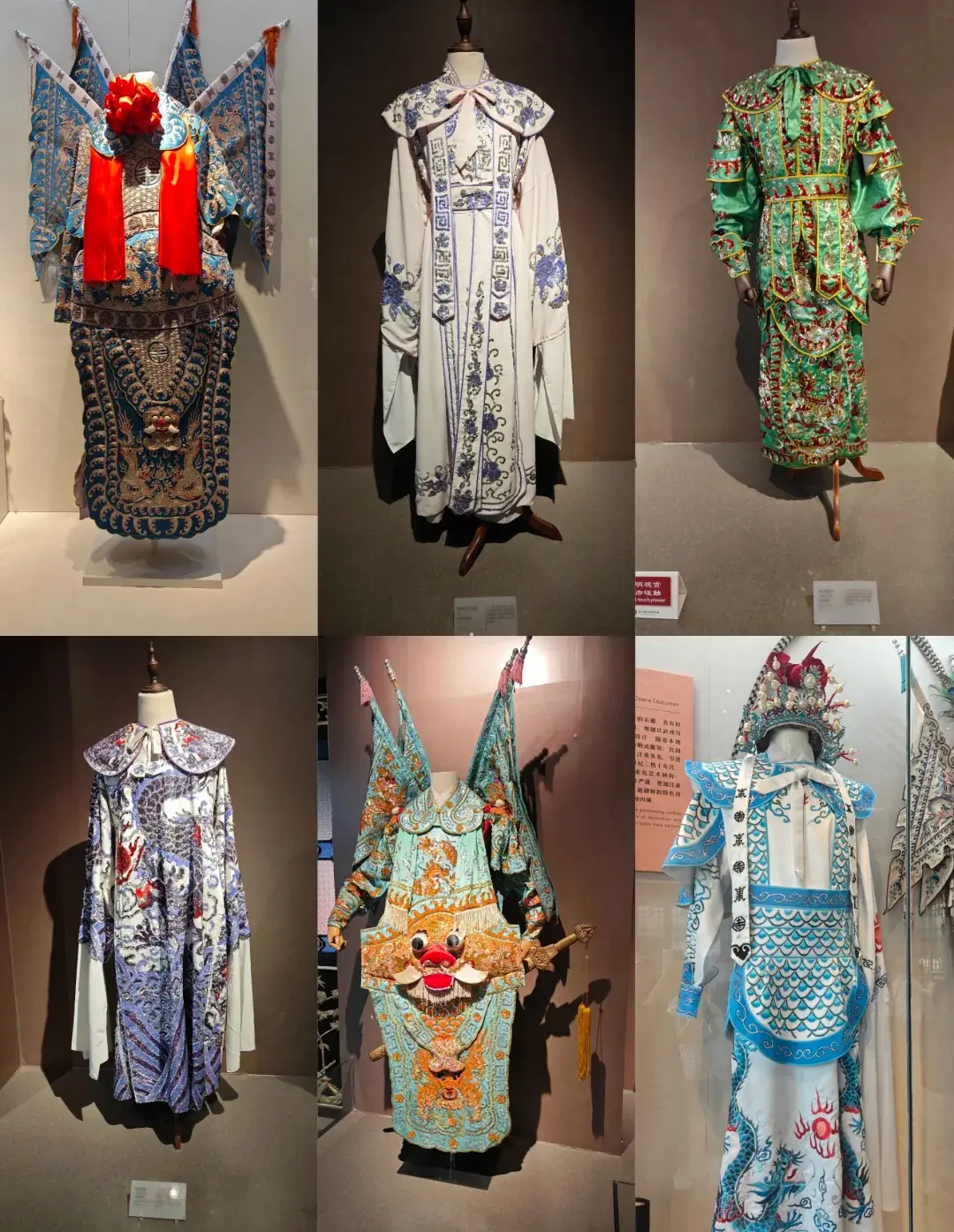
Colour, cut and headdress work together; no single cue should be read alone
Costume Color
Use colour as a clue, then check the character
Productions vary, but traditional shorthand often links red with loyalty or courage, yellow with imperial status, black with an upright or forceful nature, white with cunning, blue or green with fierce outsiders, and pink or pastel tones with youthful female characters.
The costume shape, face pattern, headdress and the action on stage are stronger evidence than colour alone.
Suggestive Stage
A few objects can become an entire world
One table and two chairs may stand in for a palace, a home or a mountain pass. Watch for the repeated physical vocabulary:
- Horse
- riding crop + circling
- Door
- a measured two-hand push
- Stairs
- lifted, deliberate steps
- Night
- feeling through darkness on a lit stage
- Marching army
- a small ensemble, flags and acrobatics imply a much larger force
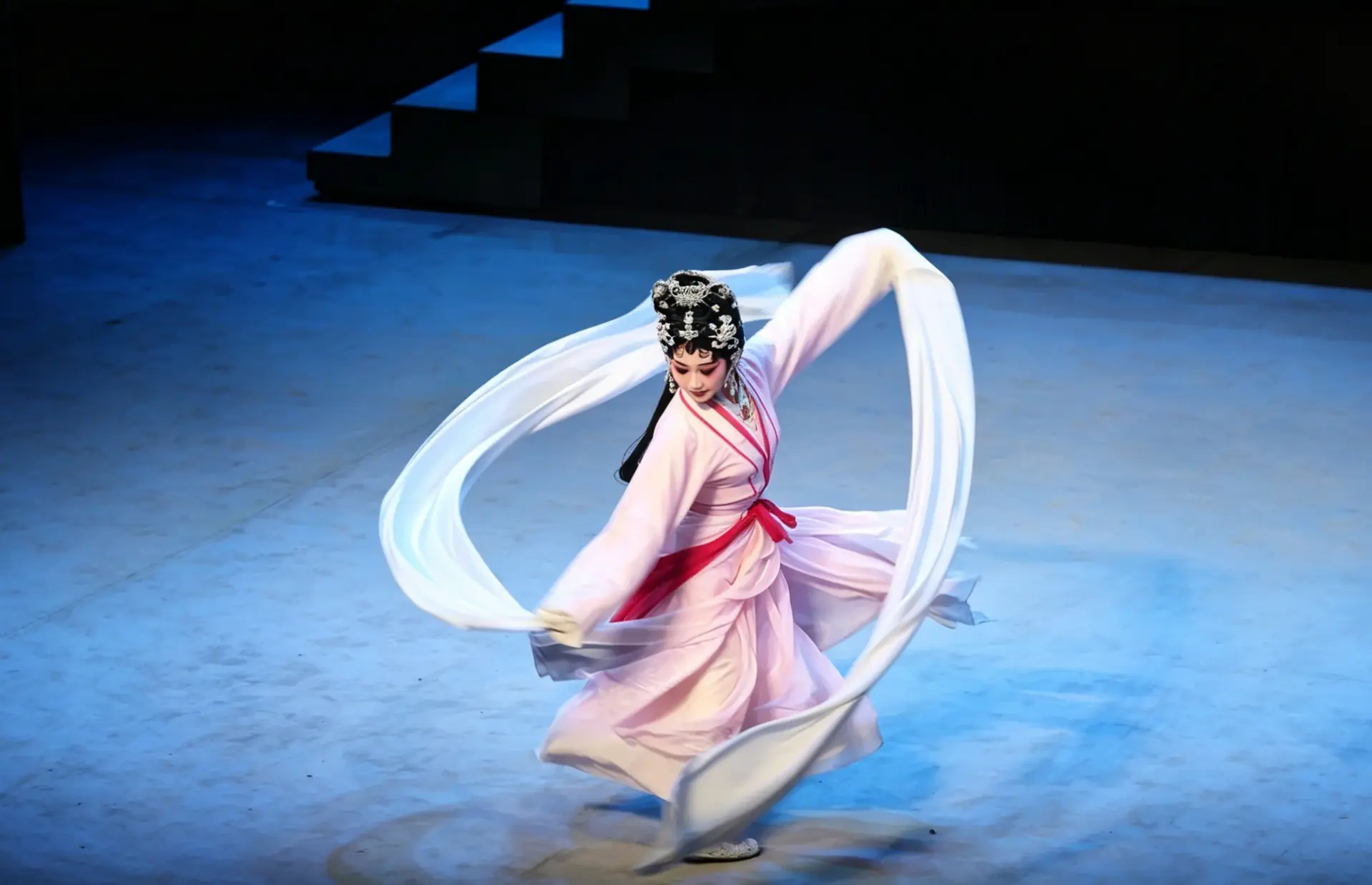
Water sleeves turn emotion into a visible arc, spiral or snap
Watch the sleeves: water sleeves (水袖) extend the costume into motion. A skilled performer can send the silk into arcs, spirals or sharp snaps to express joy, grief, anger or surprise while maintaining the vocal line.
What to Watch First
For a first visit, visual clarity matters more than prestige. Martial plays (武戏) and movement-led scenes (做工戏) let combat, acrobatics and gesture carry the action; singing-led plays (唱功戏) ask more of the surtitles and your patience with a long narrative.
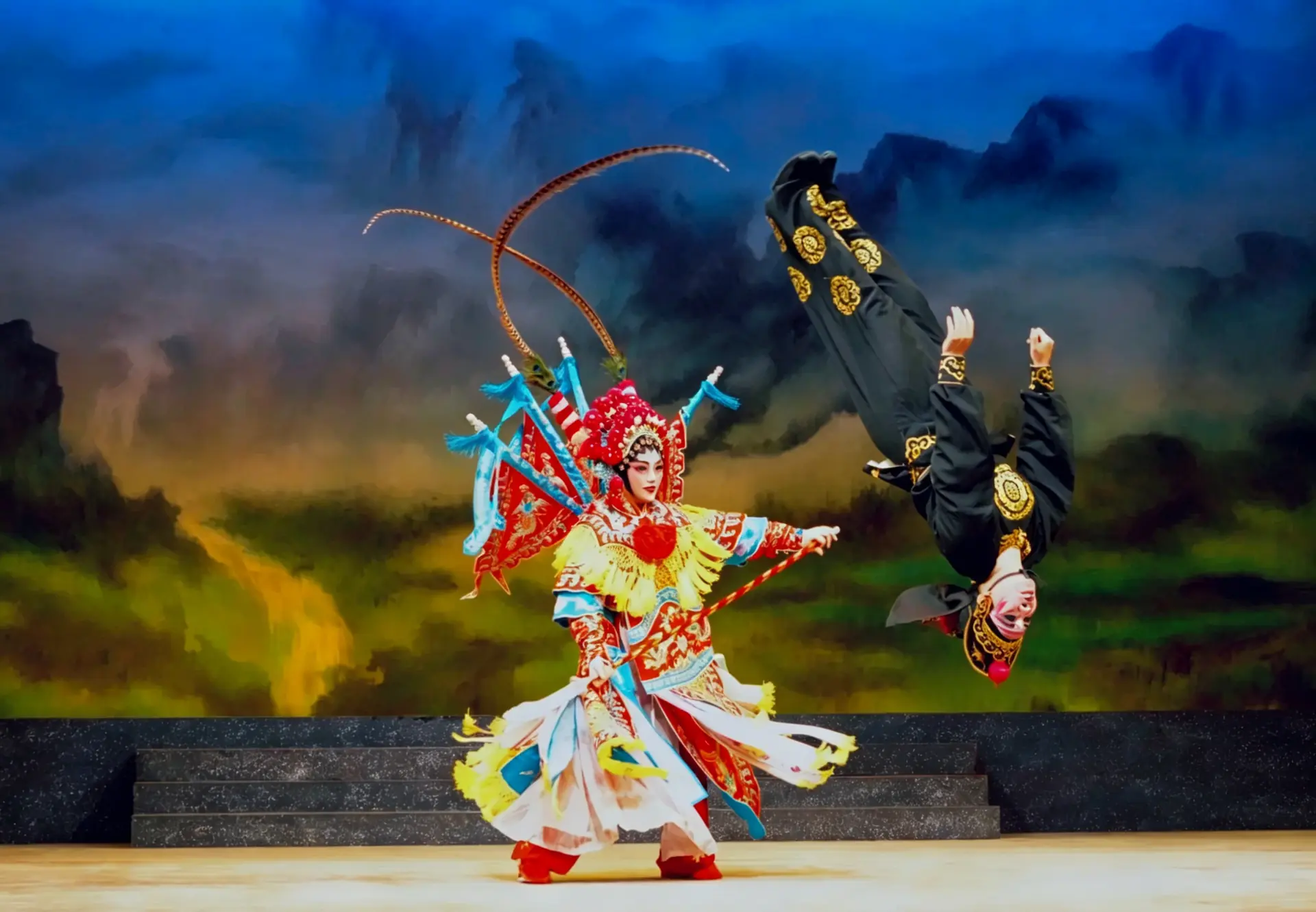
Martial excerpts create the clearest visual entry point
Best first-show path
Choose an excerpt programme with at least one martial scene
An excerpts evening (折子戏) samples selected scenes instead of asking you to follow one full-length story. The Tea House Theatre's narrated 90-minute programme is built for this kind of introduction; its exact line-up changes, so read the current repertoire before buying.
If you want a named story
Princess Changping (帝女花)
The last Ming princess and her husband choose death over surrender; the closing “Fragrant Sacrifice” is a major tragic set piece.
Choose for history and tragedy
The Purple Hairpin (紫钗记)
A Tang-era romance between scholar Li Yi (李益) and Huo Xiaoyu (霍小玉), with lyrical singing and richly detailed costumes.
Choose for romance and visual detail
The Drunken Beauty Strikes the Prince (醉打金枝)
Prince Consort Guo Ai (郭暧) and Princess Shengping (升平公主) quarrel in a quick-moving comedy that creates room for clowning and satire.
Choose for a lighter evening
The named classics are repertoire, not a promise that all three are running now. If none appears on your date, use the same decision rule: excerpt format first, visible movement second, surtitles third.
Xiqu Centre: Hong Kong's Landmark
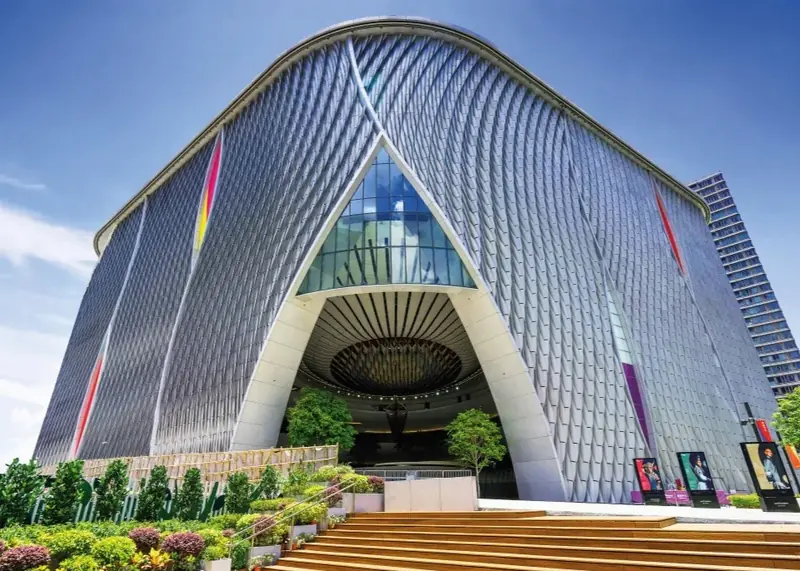
The Xiqu Centre (戏曲中心) (Google | Amap) is the clearest one-stop choice for a first Cantonese-opera visit: a landmark building, two very different theatres and current English-accessible programming under one roof.

The Xiqu Centre's lantern-inspired silhouette marks the eastern gateway to West Kowloon
Opened January 2019
A lantern-shaped gateway built around Chinese opera
It was the West Kowloon Cultural District's first completed performing-arts venue. Bing Thom Architects, now Revery Architecture, designed it with Ronald Lu & Partners; from the ground-level atrium, the raised theatre volume creates the impression of a glowing lantern floating above the public space.
88 Austin Road West, Tsim Sha Tsui, Kowloon
1,075
Grand Theatre seats
200 max
Tea House seats
10:00–22:30
Centre hours
10:00–21:00
Ticket office
Two theatres, two levels of commitment
The Grand Theatre hosts full-scale productions whose running time and ticket price depend on the work. The Tea House Theatre is purpose-built for the 90-minute narrated programme with the Tea House Rising Stars Troupe, tea and dim sum.
Facilities without a separate attraction day
The public atrium can host exhibitions and installations; eight studios support rehearsal and training, while the canopy plaza is used for occasional community programmes.
Guided tours and learning programmes remain useful for architecture, costumes, props and backstage context, but languages, access and dates change. Treat the current WestK event listing — not an old fixed weekly schedule — as the decision point.
Tea House Theatre
This is the Xiqu Centre's most approachable product, not simply its smaller room. The ticket combines a narrated selection of Cantonese-opera excerpts, songs and instrumental music with Chinese tea and dim sum in an intimate theatre.
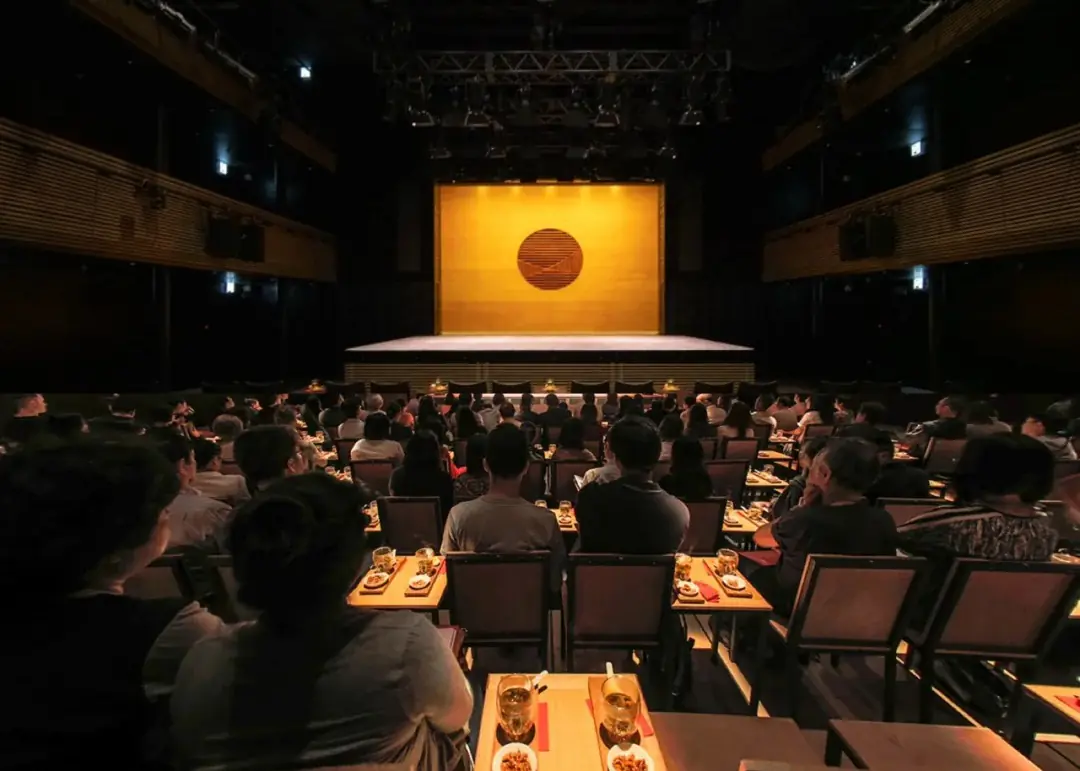
A maximum of 200 seats keeps facial expression and hand gesture visible
The complete product
90 minutes, one narrated sampler, tea and dim sum
The Tea House Rising Stars Troupe performs a changing sequence of classic excerpts and music. The performance and narration are in Cantonese, with Chinese and English surtitles, so first-time visitors can follow both the story and the moderator's context.
Current long-run schedule
- Friday
- 19:30
- Saturday
- 14:30 / 17:30
- Sunday
- 14:30
Current ticket scan
HK$300
stalls
HK$342
balcony
HK$780
family
Family package: two standard and two concession stalls tickets. Included: performance, tea and dim sum. Ask the venue before purchase if you have dietary restrictions; a specific alternative is not guaranteed by the standard ticket description.
WestK's concession rules cover eligible seniors aged 60+, people with disabilities and one companion, CSSA recipients and full-time students; proof is checked at admission. Confirm the current event's exact eligibility before paying, especially when using the family package.
Grand Theatre and Other Venues
Do not treat every famous name in an old Hong Kong guide as a venue you can still book. The useful split is between places that can host a show now and theatres whose current value is historical or dependent on a reopening notice.
Current choices
Grand Theatre (大剧院)
The Xiqu Centre's 1,075-seat main stage has advanced production systems and multilingual surtitles for supported performances. It hosts full-length productions, visiting stars, festival programmes and Chinese Opera Festival events.
Price and running time vary by production
Bamboo theatres (戏棚)
Temporary bamboo-and-rope stages appear around community festivals such as Lunar New Year, Tin Hau celebrations and the Hungry Ghost Festival. Expect an open-air, informal atmosphere, no air conditioning and spectators moving in and out.
Seasonal — verify the festival programme
Closed or awaiting a current status check
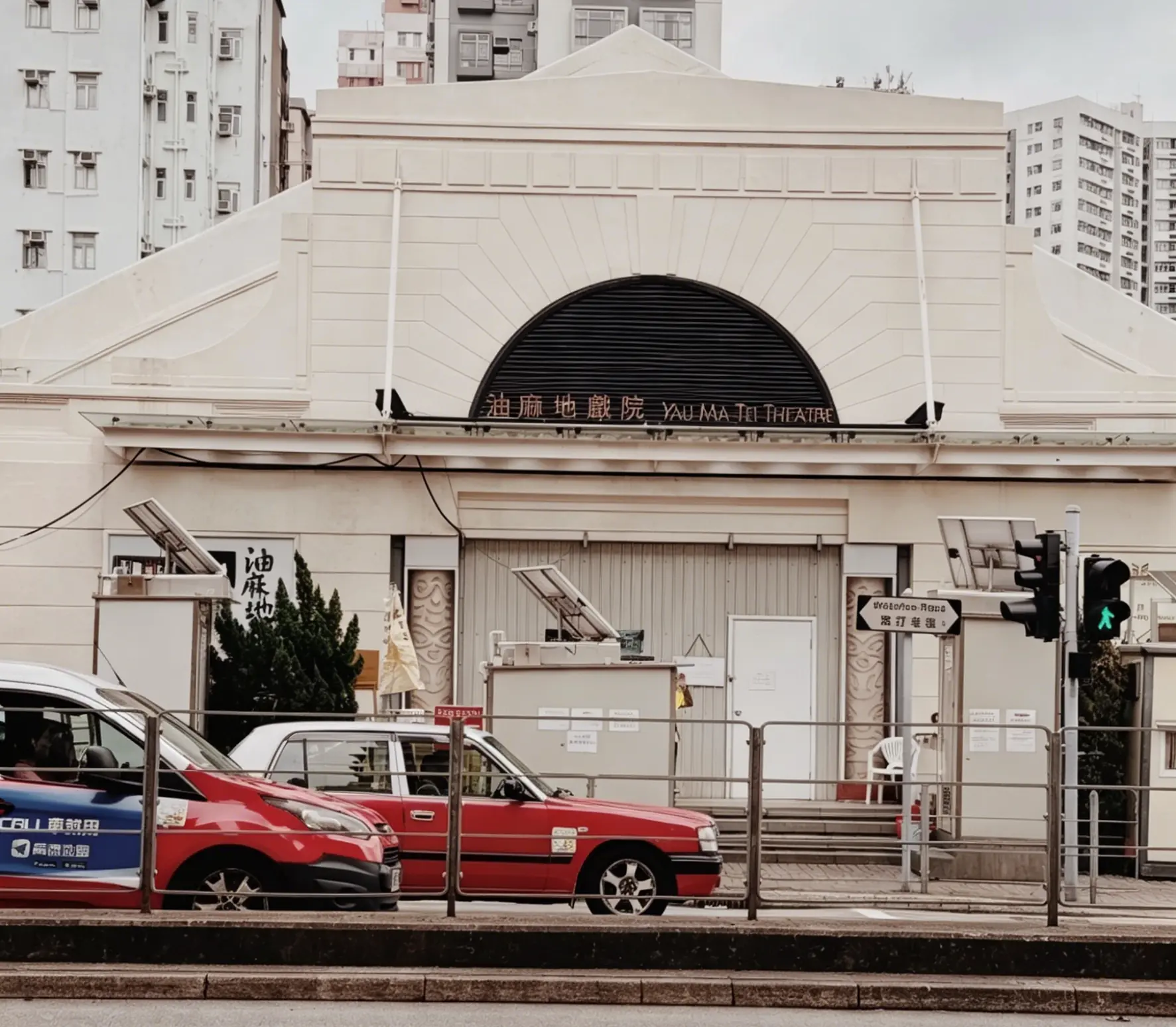
Yau Ma Tei Theatre is under Phase 2 works; check LCSD before treating it as a show option
Yau Ma Tei Theatre (油麻地戏院) (Google | Amap)
Built in 1930, it is Kowloon's only surviving pre-war theatre, with a red-brick façade and Art Deco detailing. It reopened in 2012 as a 300-seat Cantonese-opera venue, then closed in September 2022 for Phase 2 works. Until LCSD posts a reopening notice and live programme, it is not a current-show option.
Sunbeam Theatre (新光戏院) — closed
The North Point institution opened in 1972 and survived repeated demolition threats before closing in March 2025 after more than five decades. Its final-night crowds remain an important marker of Cantonese opera's community place, but it is no longer a booking option.
Tickets and Booking
Start with the official event page, not a generic venue search. It tells you whether you are buying the long-run Tea House experience, a production-specific Grand Theatre performance or a festival event with different rules.
VenueTea House Theatre
PriceHK$300 stalls / HK$342 balcony
Verify90 minutes; tea and dim sum included
VenueTea House family package
PriceHK$780
VerifyTwo standard + two concession stalls tickets
VenueGrand Theatre
PriceProduction-specific
VerifyExact cast, duration, surtitles and refund terms
VenueYau Ma Tei Theatre
PriceNo current ticket
VerifyClosed for Phase 2 works until an LCSD reopening notice
VenueBamboo theatre
PriceFestival-specific; often free
VerifyDate, weather cover, seating and any community fee
Official purchase flow
1 · Open the exact WestK event
The long-run Tea House programme is sold through the WestK website. Other productions may use a different named ticketing route shown on their event page.
2 · Match date, theatre and language
Check the performance time, seat area, surtitles, concession eligibility and collection method before payment.
3 · Use a staffed fallback if needed
Xiqu Centre Ticket Office: 10:00–21:00 daily. WestK phone booking: (852) 2200 0022, 10:00–21:00.
Trip.com and other English-language listings may show selected performances, but treat them as a comparison surface: match the exact production, supplier and refund terms against the venue event page before paying.
Recheck the live listing
The Tea House figures above are the current long-run programme terms, not permanent venue prices. Casts, excerpts, showtimes, concession availability and production-specific ticket rules can change.
Making the Most of Your Visit
The easiest way to enjoy the evening is to follow the performance's real sequence rather than memorise etiquette in advance.
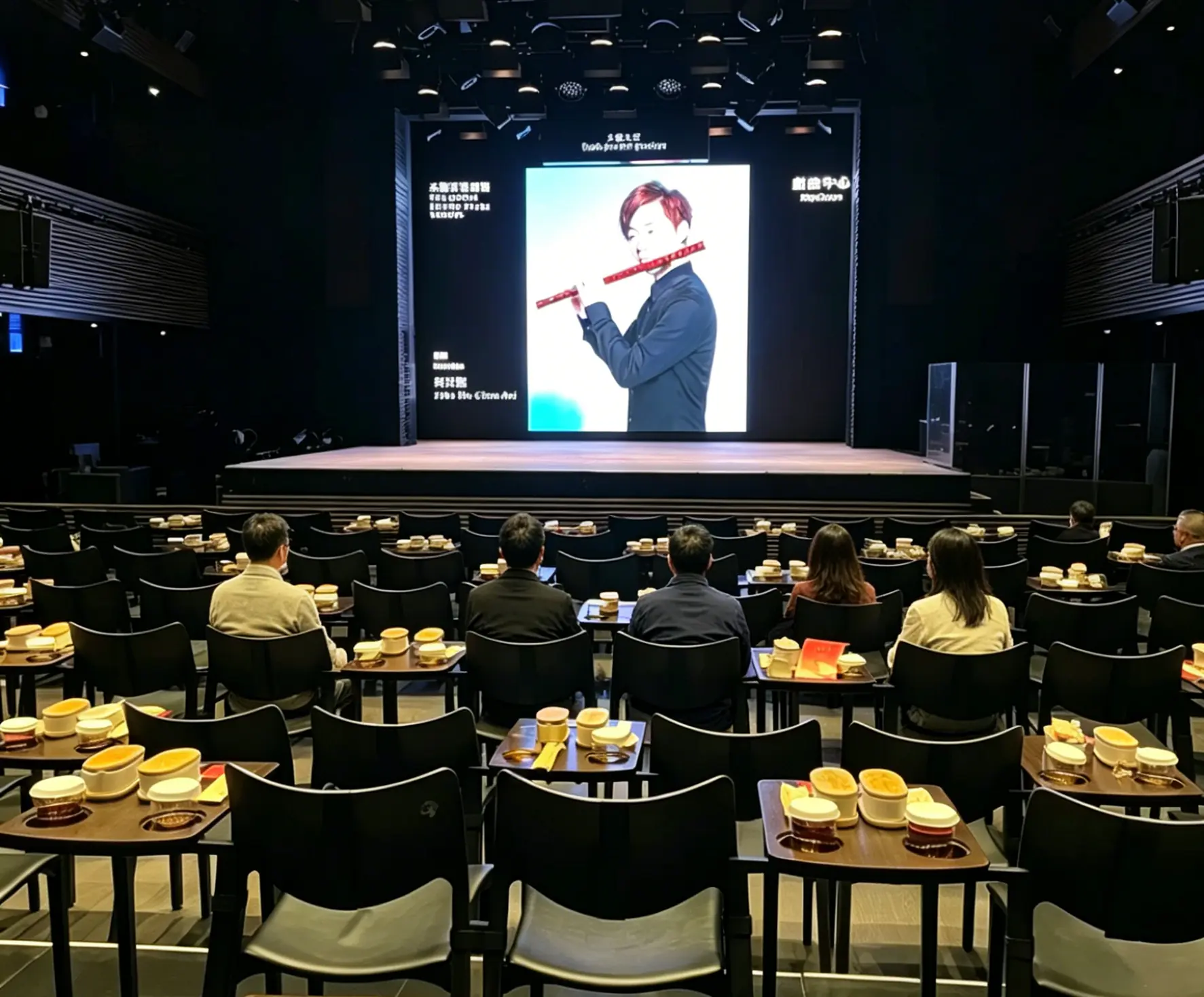
Follow the room: experienced audience members make the applause points easy to read
Before the curtain
Arrive 30 minutes early and orient yourself once
Check the lobby programme board and any bilingual synopsis, find your surtitles sightline, and look through whatever free atrium exhibition is running. Tea House narration is in Cantonese; the Chinese and English surtitles carry the explanation.
1 · Follow the craft
Do not chase every sung word. Watch hands, eyes, footwork and sleeves; then use the surtitles to place the scene.
2 · Listen for momentum
Drums and percussion accelerate tension; slower passages open space for lyrical singing and gesture.
3 · Read entrances
When a new character enters, read costume, face and movement together. In martial scenes, notice the compact, close-range southern vocabulary.
4 · Applaud with the room
Vocal peaks, a clean backflip, a difficult sleeve throw or a held pose are natural applause points. Regulars may call “Good!” (好); when unsure, follow the audience.
Clothing: there is no formal dress code; neat casual clothes are fine.
Photography: follow the specific announcement and staff. Keep flash, bright screens and recording off unless explicitly allowed.
Beyond the Stage
If the performance leaves you wanting context, choose one follow-up rather than trying to stack several “opera experiences” into the same day. Availability is programme-led, so the useful question is what is actually scheduled on your dates.
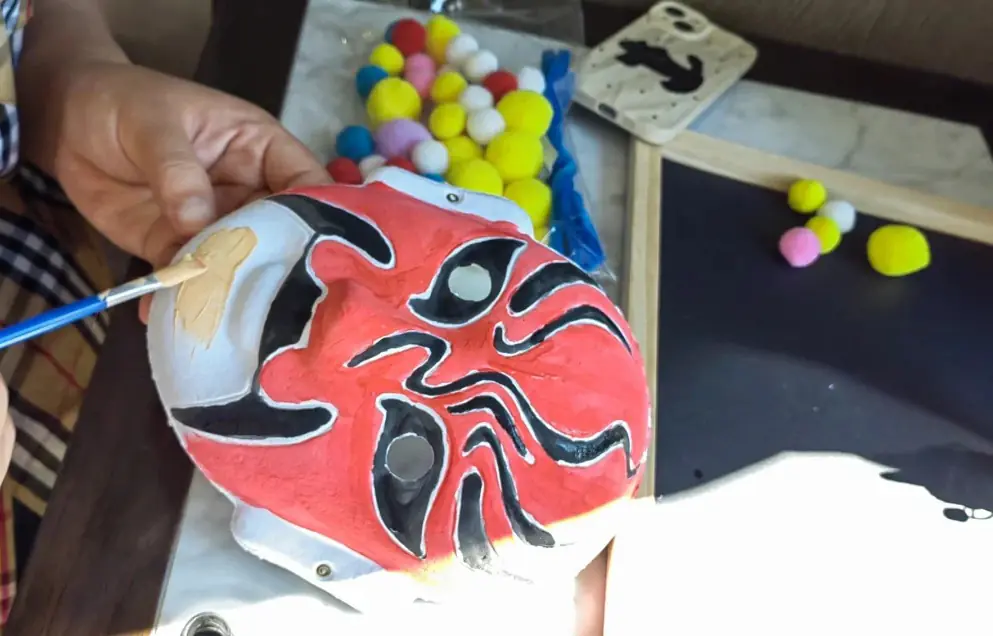
Face-painting belongs to a scheduled workshop, not the standard performance ticket
Face-painting workshop
Turn the colour code into a hands-on souvenir
Participants paint a traditional face pattern (脸谱) on a blank mask, using colour and line to suggest character. Past sessions have often taken about 45 minutes, with older examples around HK$100–200 per person; treat both figures as context, not a current standard price or duration.
Costume and makeup session
Some scheduled experiences add full costume, headdress, face paint and a professional photo. Older examples have been around HK$300–500, but inclusions and current prices vary too much to plan without a live listing.
West Kowloon cultural walk
For a no-workshop option, continue from the Xiqu Centre to M+ Museum, Hong Kong Palace Museum and the Art Park waterfront promenade. Together they make a practical half-day cultural route.
If WestK lists a current architecture, costume or backstage programme, compare its language, access level and timing with your show. Old tour schedules are background only.
Frequently Asked Questions
No. Costume, face paint, gesture, percussion and martial movement carry much of the action. The current Tea House programme is performed and narrated in Cantonese with Chinese and English surtitles; check the exact language support for any other production.
Sources checked for this guide
- Cantonese opera form, cultural role, 2006 national-list entry and 2009 UNESCO inscription: Hong Kong Intangible Cultural Heritage Office — Cantonese Opera
- Representative List status and regional transmission: UNESCO — Yueju Opera
- Current Tea House schedule, prices, family package, inclusions and surtitles: WestK Performing Arts Season 2025–26
- July 2026 programme identity, 90-minute format and changing repertoire: WestK Tea House Theatre Experience 2026–27 house programme
- Austin Exit E connection and current accessible arrival path: WestK Xiqu Centre Access Guide, June 2026
- Grand Theatre and Tea House capacities: WestK Xiqu Centre venue scale
- Yau Ma Tei Theatre closure and Phase 2 works: LCSD — Yau Ma Tei Theatre introduction
- Sunbeam Theatre closure context: Hong Kong Government statement on Sunbeam Theatre
Beyond This Guide
Cantonese opera is one thread in Hong Kong's cultural fabric. Pair it with the West Kowloon museums, a Tsim Sha Tsui evening walk or a day exploring Kowloon's neighbourhoods.
More things to do in Hong Kong:
- Tai Kwun: Complete Visitor's Guide — heritage arts complex in Central
- M+ Museum Guide — Asia's largest visual culture museum, next door
- Hong Kong Palace Museum — Chinese art and imperial treasures
- Temple Street Night Market — Kowloon's most famous night market
© gochinafreely.com — Original guide by Go China Freely.