Hours & tickets
Basic tickets are ¥60 for adults, ¥50 for eligible students, and ¥30 for visitors age 60-69. Age 70+ and children at or below 1.4 m enter free under the official rules. See full ticket details
Good to know
A Brewery Born in a German Colony

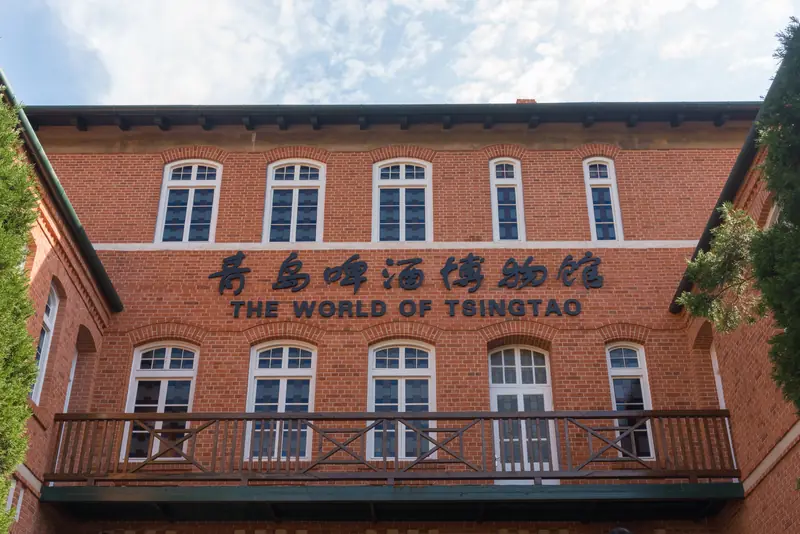
The 1903 brewery still stands on Dengzhou Road — red brick, German engineering, now a museum with free beer.
Original brewery · 1903
A colonial brewery that became a global Chinese beer brand
Founded: German and British merchants built the brewery in 1903 in their newly seized colonial territory on China's coast.
Brewing base: spring water from Mount Lao (崂山), imported malt and hops, and German brewing law.
Today: the red-brick factory still stands on Dengzhou Road, converted into a museum where every ticket includes two glasses of fresh beer you can't buy anywhere else.
The 1903 foundation
In 1898, Germany forced a lease on Jiaozhou Bay (胶州湾), turning Qingdao into its Far Eastern outpost. The colonists brought urban planning, European architecture, and an unshakeable need for beer. On August 15, 1903, German and British investors founded Germania-Brauerei Tsingtao Co., Ltd. (日耳曼啤酒公司青岛股份有限公司) on Dengzhou Road — the direct ancestor of today's Tsingtao Brewery.
Why Qingdao worked for brewing
Three things made Qingdao the perfect brewing location: a port with direct export shipping lanes, a cool coastal climate ideal for fermentation, and exceptionally clean spring water from nearby Mount Lao. Brewmasters brought equipment and ingredients from Germany and brewed strictly according to the Reinheitsgebot (German Beer Purity Law). The first batches were made primarily for German troops and foreign residents stationed in the colony.
From contested ownership to museum landmark
After World War I, Japan took over. After World War II, the brewery returned to Chinese control. Through nationalization, reform, and globalization, Tsingtao Beer grew from a colonial microbrewery into one of China's most recognized brands abroad — the green bottle on nearly every Chinese restaurant table in America, Europe, and Southeast Asia.
The original 1903 brick-and-stone factory building still stands on Dengzhou Road. In 2003, on Tsingtao's centennial, it was converted into the Tsingtao Beer Museum (青岛啤酒博物馆) — now a national first-class museum and AAAA tourist attraction.
Three Zones — History, Brewing, and Fun
The museum is divided into Hall A (century-long history), Hall B (brewing process), and an interactive experience zone. The visit follows a one-way route through all three, in order.
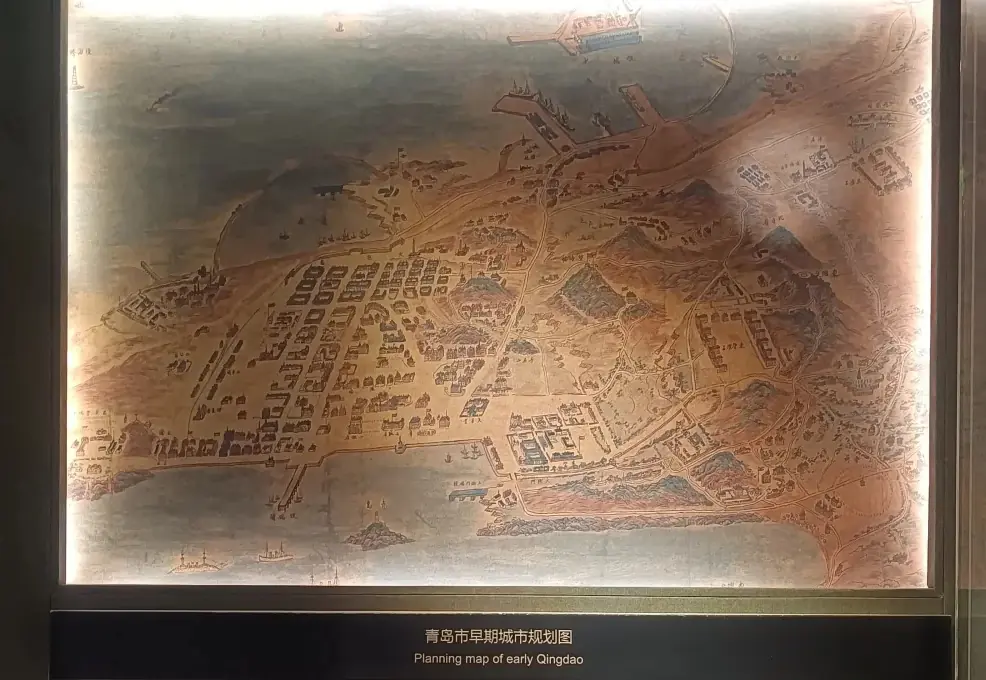
Zone 1 · Start with the objects and documents
Hall A — A Century of Brand History
Objects: vintage photographs, founding documents, and personal belongings of early German brewmasters.
Brand trail: beer bottles spanning every era and advertising posters trace the journey from colonial startup to global export.
Newer layer: a holographic projection gallery recreates the early 20th-century brewing workshop in light and shadow.
What to slow down for
For foreign visitors, the most fascinating parts are the colonial-era details: original recipe records with German annotations, the 1903 business license, early export advertisements for European markets. You can see exactly how this bottle of beer connects to a complicated piece of colonial history.
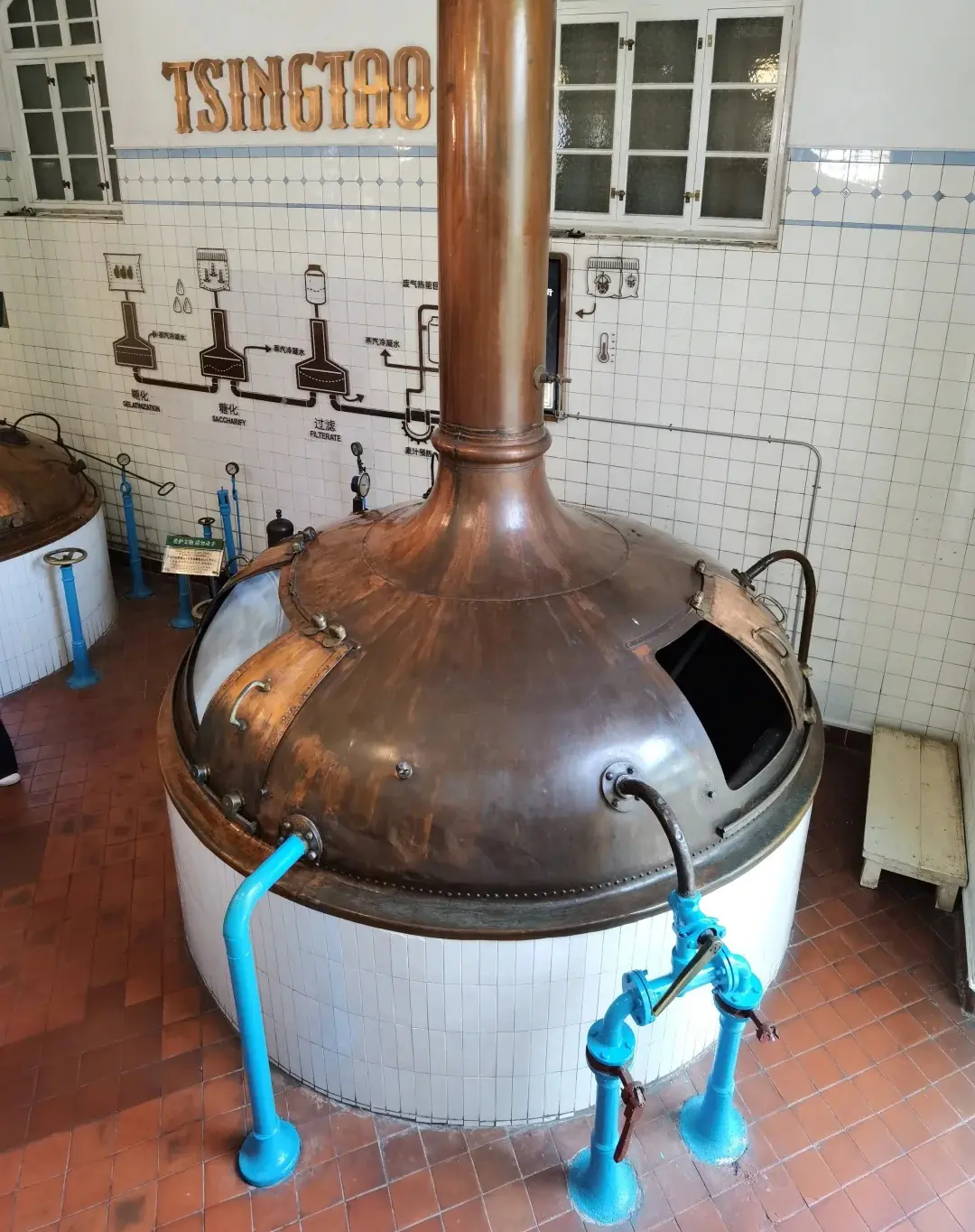
Zone 2 · Follow production from malt to bottle
Hall B — The Brewing Process End to End
Hall B is where things get technical. You can see an entire set of century-old German brewing equipment — copper mash kettles, old fermentation tanks, wooden barrels — sitting right next to a modern production line still in operation. The contrast is striking.
The process
Malt crushing → mashing → boiling → cooling → fermentation → filtration → bottling. Each stage has real equipment and explanatory panels. You can even touch raw malt and hops samples and smell the aroma of fermenting wort.
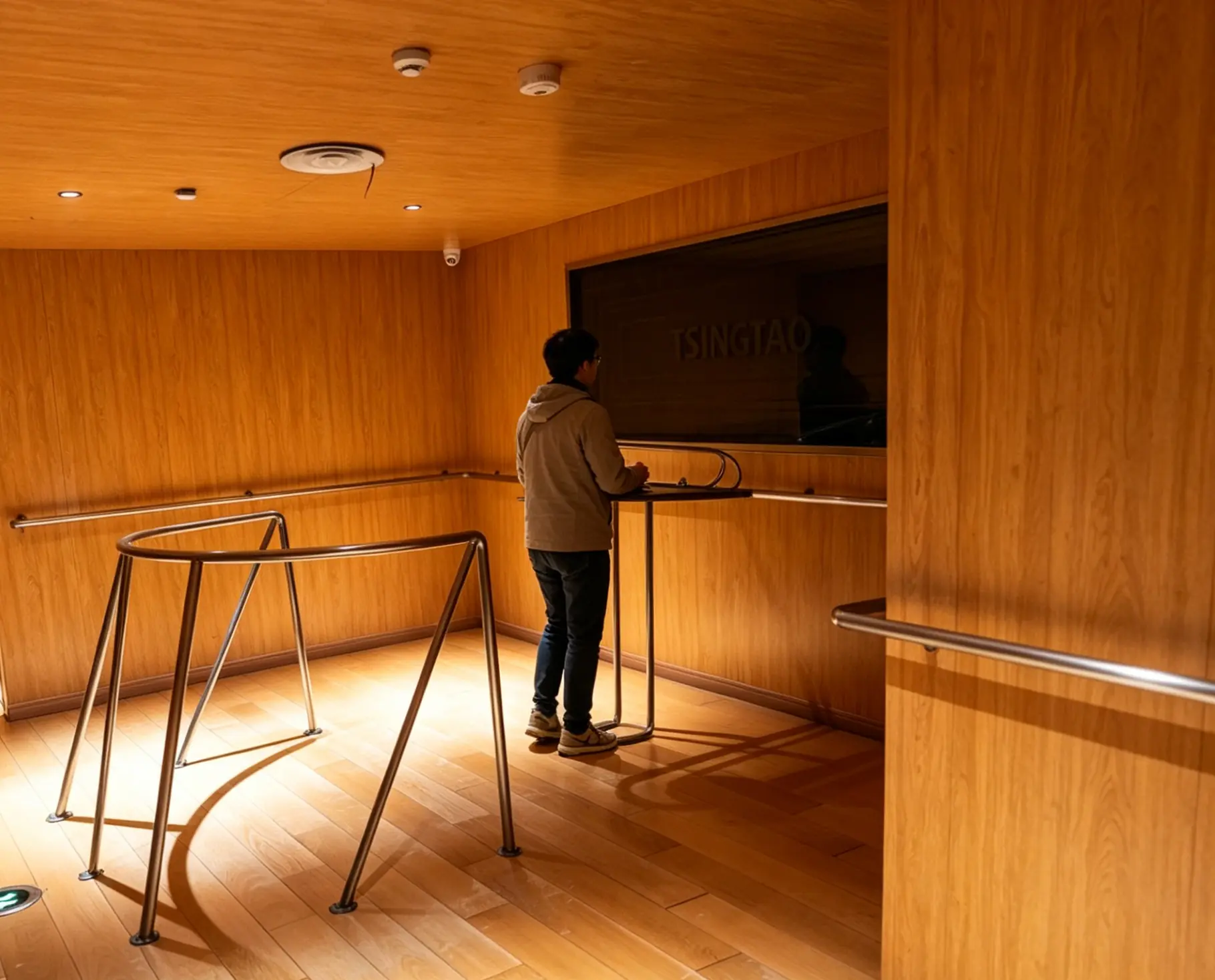
Zone 3 · Finish with the playful experiences
Interactive Zone — Drunk House and VR Brewing
After the two main halls, the interactive zone is the most relaxed and entertaining part of the visit.
Drunk House: The museum's most popular interactive stop uses a tilted floor and leaning walls to simulate intoxication through physical disorientation. You stagger involuntarily the moment you step inside — no actual drinking required.
VR Brewing: Put on a headset and virtually operate the full brewing process from ingredient selection through fermentation and bottling.
AR Interactions: Scan exhibits with your phone to trigger augmented reality animations.
Holographic Light Show: A large-scale projection recreating century-old brewery scenes.
Two Free Beers with Every Ticket
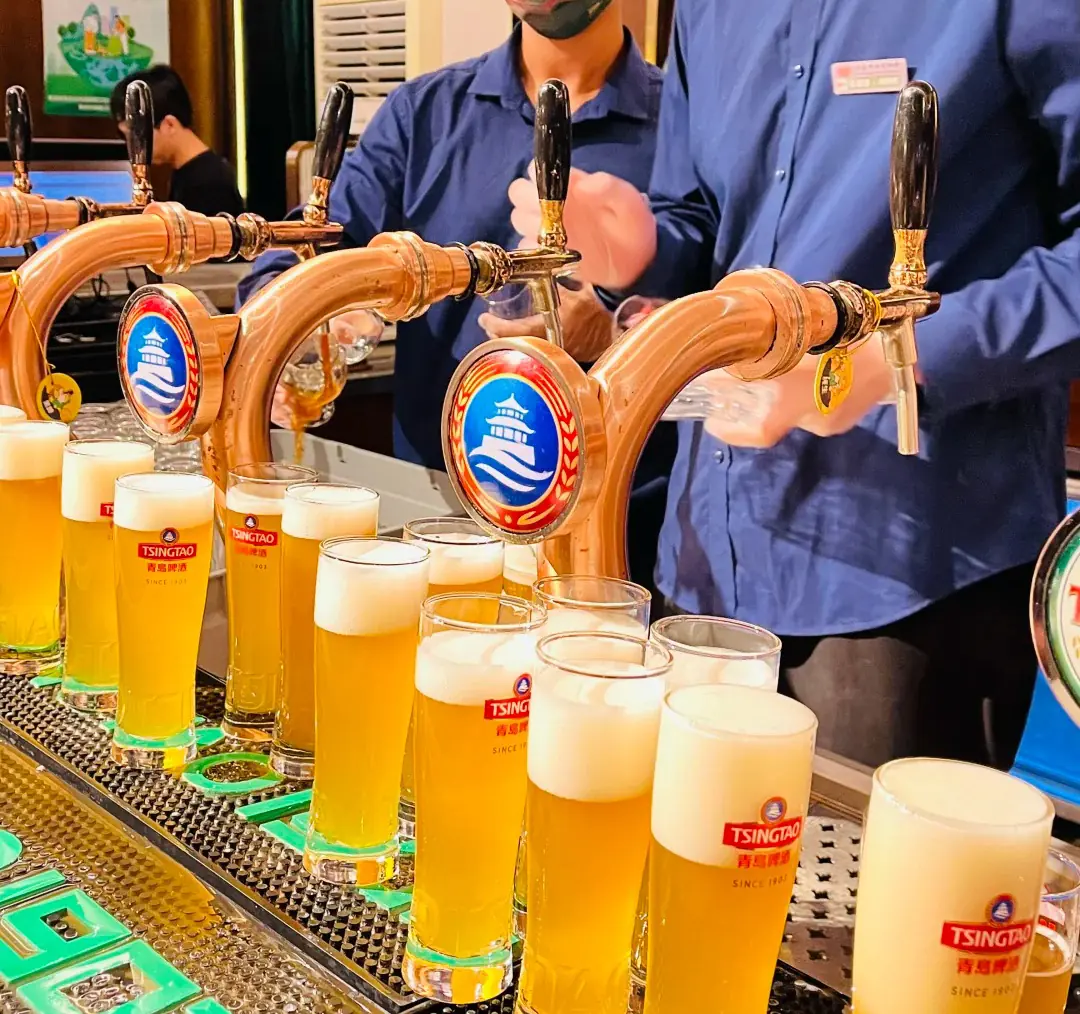
The yuanjiang (wort beer) — unfiltered, unpasteurized, only available at the brewery. This is the one to savor.
Included along the one-way route
Two pours and beer-flavored peanuts — no extra charge
This is the Tsingtao Beer Museum's best surprise: every ticket includes two complimentary beers and a pack of beer-flavored peanuts — no extra charge.
For beer lovers, the yuanjiang is the highlight. It retains the full yeast and protein character, producing a rich, malty flavour completely different from the bottled Tsingtao you find in supermarkets.
1 · Yuanjiang (原浆)
Tasting stations are built into the visit route at two points. First, you'll try a glass of yuanjiang (原浆, unfiltered wort beer) — an unpasteurized, unfiltered draft only available at the brewery, never sold in stores.
2 · Chunsheng (纯生)
Then, near the exit, you'll taste a glass of chunsheng (纯生, pure draft) — micro-filtered but not heat-treated, with a cleaner, crisper finish.
Continue at the 1903 Café Bar
Next to the tasting area, the 1903 Café Bar serves German-style roast pork knuckle, sausages, and craft IPAs — a good place to sit down and keep drinking after your tour.
Tickets, Hours, and Seasonal Tips
Use the two tables together: first confirm the ticket category, then match the date to the correct closing time. Summer gives you the longest evening, while the shoulder seasons trade shorter hours for fewer crowds.
Admission
- Basic admission
- ¥60
- Basic admission
- ¥50
- Basic admission
- ¥30
- Basic admission
- Free
- Basic admission
- Free with the required ID
- Basic admission
- ¥30
Every ticket includes: one yuanjiang (wort beer) + one chunsheng (draft beer) + one pack of beer peanuts.
Opening Hours
- Opening hours
- 8:30 – 17:30
- Last entry
- 16:30
- Opening hours
- 8:00 – 18:30
- Last entry
- 17:30
- Opening hours
- 7:30 – 19:30
- Last entry
- 18:30
- Opening hours
- 8:00 – 18:30
- Last entry
- 17:30
- Opening hours
- 8:30 – 17:30
- Last entry
- 16:30
Choose between late hours and lighter crowds
Summer (July–August) is Qingdao's peak travel season. The museum stays open until 19:30, with last entry at 18:30, so an afternoon visit can still flow into Beer Street. The Qingdao International Beer Festival usually makes this the city's busiest beer period. For comfortable weather and fewer crowds, May–June or September–October is the sweet spot.
Getting to the Tsingtao Beer Museum
Metro · recommended
Take Line 2 to Lijin Road Station (利津路站), Exit C. Walk about 700 meters to the museum. Alternatively, take Line 1 to Taidong Station (台东站), Exit E — about a 1 km walk.
Bus · closest stop
Routes 205, 217, 221, and 604 stop at "Qingdao Beer Museum" (青岛啤酒博物馆) station, right at the entrance. Routes 1, 3, 4, 11, 15, and 25 stop at "Taidong" (台东) station nearby.
From Qingdao Railway Station / Zhanqiao Pier: Taxi about 15 minutes, ¥15–20.
From Qingdao Jiaodong Airport: Taxi or metro about 45 minutes.
Show this screen to your driver · 出示给司机看
去青岛啤酒博物馆,登州路56号。
Tsingtao Beer Museum, No. 56 Dengzhou Road, please.
Nearest Metro: Lijin Road (利津路站), Line 2, Exit C — 700m walk.
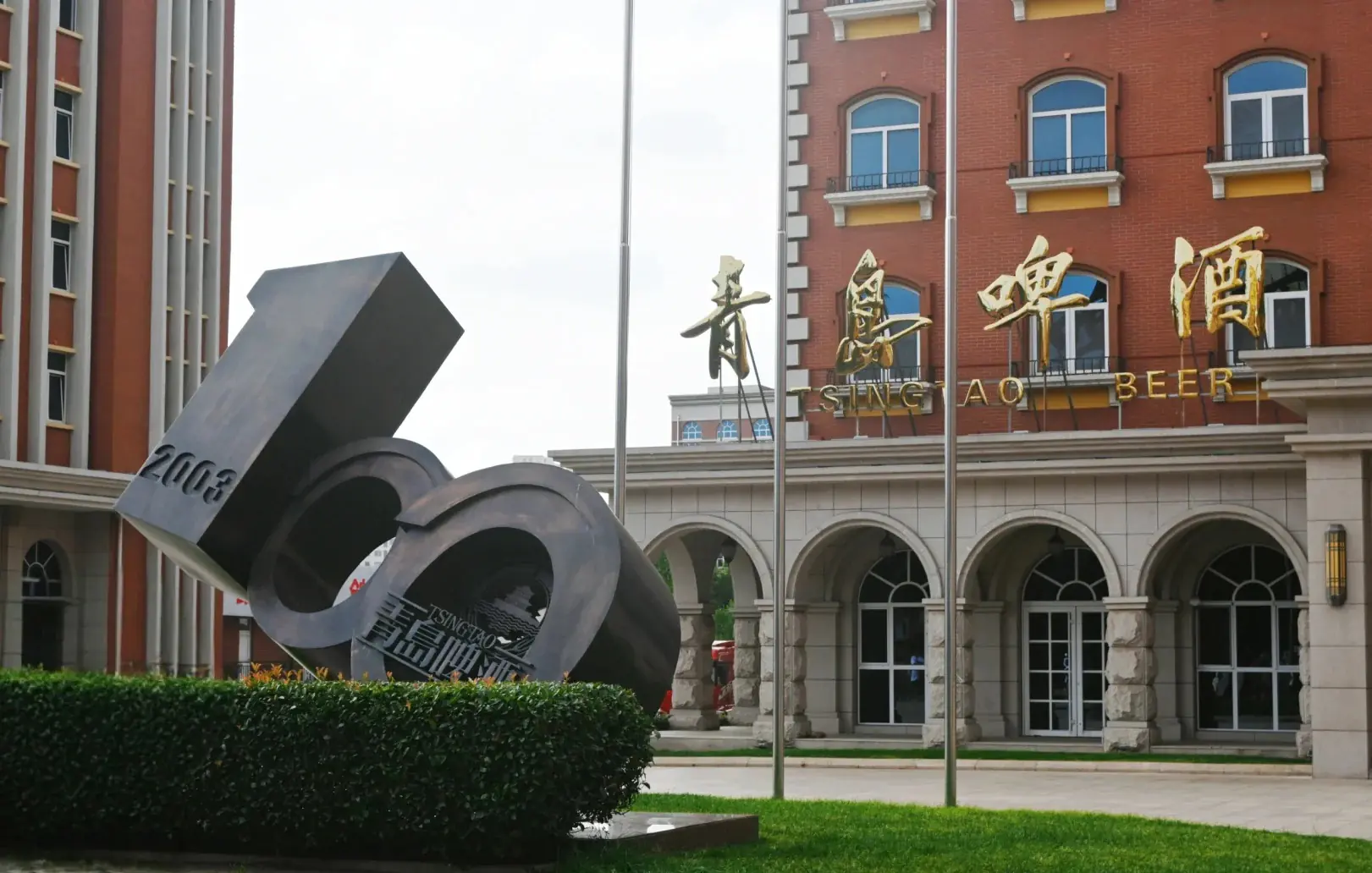
The museum entrance on Dengzhou Road — Beer Street starts right outside.
The museum is at No. 56 Dengzhou Road (登州路56号), Shibei District. Step out the exit and you're standing on Beer Street.
Dengzhou Road Beer Street After Your Visit
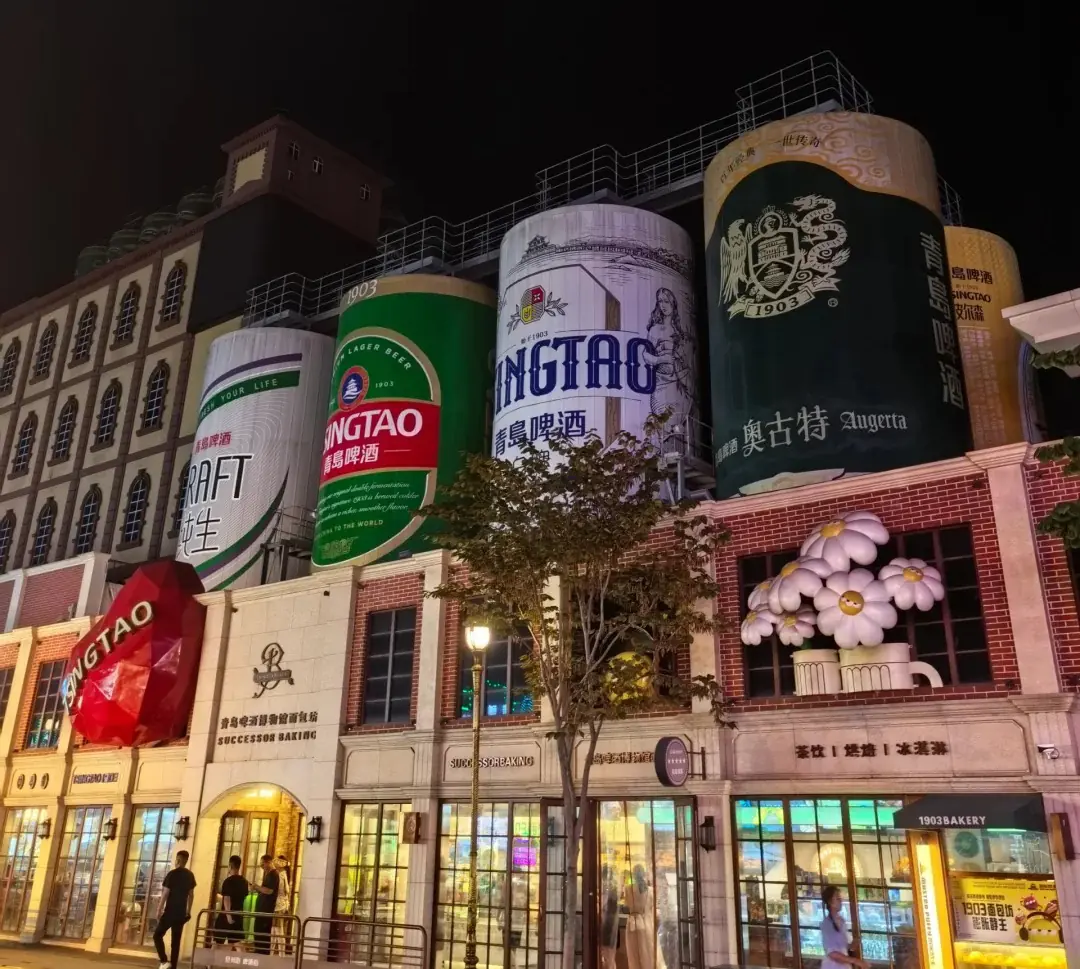
Summer nights on Beer Street — neon signs, sizzling barbecue, and bag beer sold by weight.
Try the Qingdao-specific bag beer
The street is lined with open-air food stalls, craft beer bars, seafood barbecue stands, and beer retail shops. The most uniquely Qingdao experience is bag beer (袋装啤酒) — fresh draft poured into plastic bags and sold by weight, like buying soy milk from a street vendor. A jin (about 500ml) usually costs ¥10–15. It's a street scene you won't find anywhere else in China.
Stay for the atmosphere or switch styles
Both ends of the street have craft beer bars — if you've had enough industrial lager, try some of Qingdao's emerging local craft brands.
Summer evenings are when Beer Street comes alive: neon signs light up, barbecue grills line the sidewalks, and the sound of clinking mugs fills the air. Even if you don't drink, the atmosphere alone is worth a walk.
Practical Tips for Your Visit
Follow the one-way route
Best visiting order: Hall A (history) → Hall B (brewing) → Interactive Zone → Tasting → exit to Beer Street. It's designed this way — just follow the crowd.
Choose the souvenir before leaving
Souvenirs: The gift shop near the exit sells museum-exclusive packaged Tsingtao beer, beer chocolate, and beer ice cream. The standout item is a personalized custom beer — your photo printed on the bottle label, making a one-of-a-kind souvenir.
Drink the yuanjiang on site
Wort beer can't leave: The yuanjiang (wort beer) from the tasting must be consumed on-site — its shelf life is extremely short. If you want beer to take home, buy the bottled or canned versions.
The visit still works without alcohol
Non-drinkers welcome: Even if you don't drink at all, the industrial heritage, colonial history, Drunk House, and VR experience are worth the ticket price alone. You can swap your beer for the included beer peanuts at the tasting station.
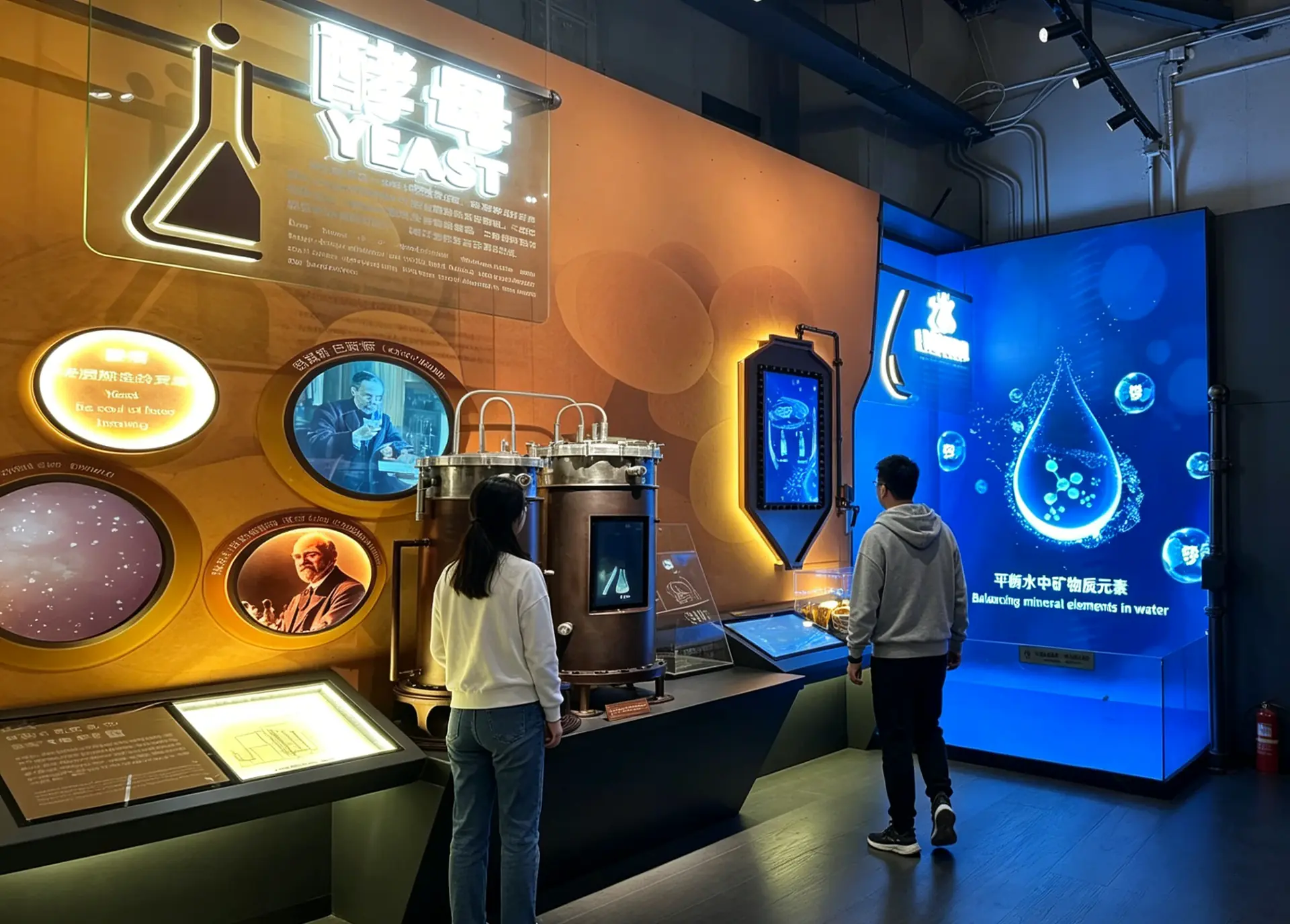
Allow 1–2 hours for the museum, then head outside to Beer Street for the full experience.
Time budget
Museum visit or half-day beer district
Recommended duration: The museum takes 1–2 hours. Add the beer tasting and Dengzhou Road Beer Street, and you've got a solid half-day.
Yes. Every ticket includes one glass of yuanjiang (unfiltered wort beer), one glass of chunsheng (filtered draft), and a pack of beer-flavored peanuts — no extra charge.
Sources checked for this guide
- Current official visitor notice checked for seasonal opening windows, last-entry times, eligibility rules, reservation channels and visitor-service phone: Tsingtao Beer Museum visitor notice
- Current official ticket page checked for the basic adult, student and senior tickets, included tastings, free-entry categories and reservation notes: Tsingtao Beer Museum ticket information
- Qingdao government museum profile checked for the 2003 opening, Dengzhou Road location, three visitor zones, historic brewing equipment and modern production-line context: Qingdao government museum profile
Beyond This Guide
Qingdao has far more than beer — its German Quarter architecture, golden sand beaches, seafood markets, and the forested trails of Mount Lao make it one of China's most underrated coastal cities.
© gochinafreely.com — Original guide by Go China Freely.