Hours & access
Plan the visit
Four Centuries of Ink and Stone
A living calligraphy street
Step below the South Gate and into four centuries of ink, paper, and stone
Shuyuanmen (书院门) is more than another souvenir street: it is one of Xi'an's clearest places to see calligraphy and literati culture still being practiced and sold.

1609
Guanzhong Academy founded
570 m
South Gate to Stele Forest
100+ shops
Commonly described street scale
What you notice first
Turn the corner below the South Gate's (南门) arrow tower and a 570-meter stone-paved street opens up — brushes dangling from shopfronts, scrolls unfurling in doorways, and the faint scent of ink and pine soot.
In a quiet corner, a craftsman may be carving a visitor's name in seal script onto a thumb-sized stone. The entrance archway is the visual threshold; beyond it, the shops continue all the way toward the Stele Forest Museum.
The academy created the market
Shuyuanmen takes its name from the Guanzhong Academy (关中书院), founded here in 1609 during the Ming Dynasty. It became Shaanxi's leading academy and drew scholars from neighboring provinces across northwest China.
Where there were students, there were brushes, ink, paper, and ink stones; a street of stationery shops grew up to serve them, and the trade remains four hundred years later.
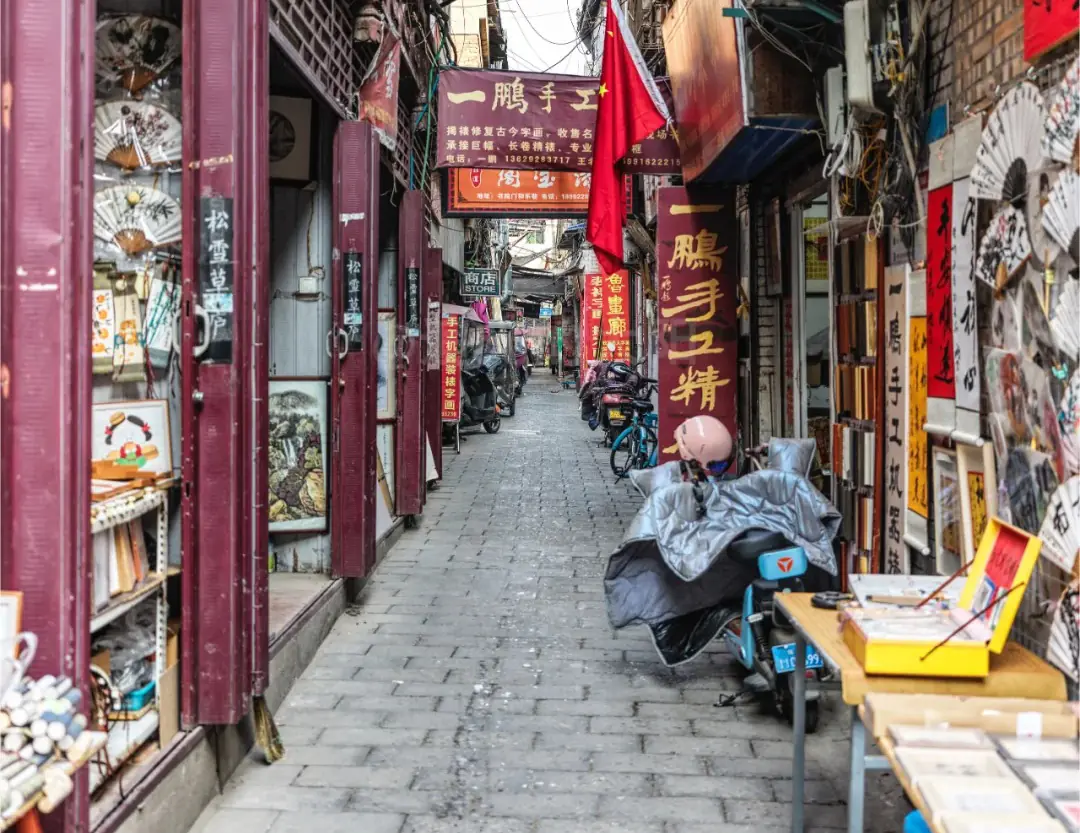
Step through the entrance archway and the street unfolds toward the museum: brush shops, scroll galleries, seal carvers, and ink-stone dealers share one continuous pedestrian route.
The craft still happens in view
Today the street runs from the South Gate city wall toward the Stele Forest Museum (碑林博物馆) and is commonly described as being lined with more than a hundred shops.
Alongside mass-market souvenirs, some workshops still make core products in view: you may see a calligrapher write a scroll, a seal carver chisel a name into stone, or a painter compose a landscape, then take the finished piece home.
Why it is worth the stop: for travelers unfamiliar with Chinese calligraphy, this is a rare chance to buy something made by a person rather than simply pulled from factory stock. Pair it with the Stele Forest Museum and the visit becomes a distinctive Xi'an sequence: see the originals, then compare the reproductions.
Getting to Shuyuanmen
Arrival decision
Use the South Gate as your landmark, then approach from the route you are already on
Metro — easiest for most visitors
Line 2Ride to Yongning Gate (永宁门) station and use Exit D1. From there, walk east along the city wall for about 10 minutes to the Shuyuanmen entrance archway. If D1 is temporarily closed, follow current station signage to the nearest open exit.
From Bell or Drum Tower
Walk south along South Avenue (南大街) from the Bell Tower (钟楼) for about 15 minutes, then continue through the South Gate archway. From the Muslim Quarter near the Drum Tower, this is a natural onward walk.
After the city wall
Descend at South Gate (永宁门) after cycling or walking the wall. The street entrance is at the base of the wall's east side, under three minutes away on foot.
Show this screen to your driver · 出示给司机看
请到书院门
Please go to Shuyuanmen Cultural Street
Natural half-day sequence: Shuyuanmen, the South Gate city wall, and the Stele Forest Museum form a compact three-in-one route.
Hours, Layout & Best Time to Visit
Operating plan
Use the staffed shop window, then walk the street once from end to end
Hours and visit length
Street
Ungated public street; independent shops close
Shop hours
~09:00-19:00; some close at 18:00 in winter
Craft workshops
~10:00-18:00 for seal carving and custom calligraphy
Entry
Free
Suggested visit
1-2 hours; add half a day with the Stele Forest Museum
The district's broad visitor listing extends to around 22:00, but these practical windows are when the greatest number of independent shops and craft desks are likely to be staffed.
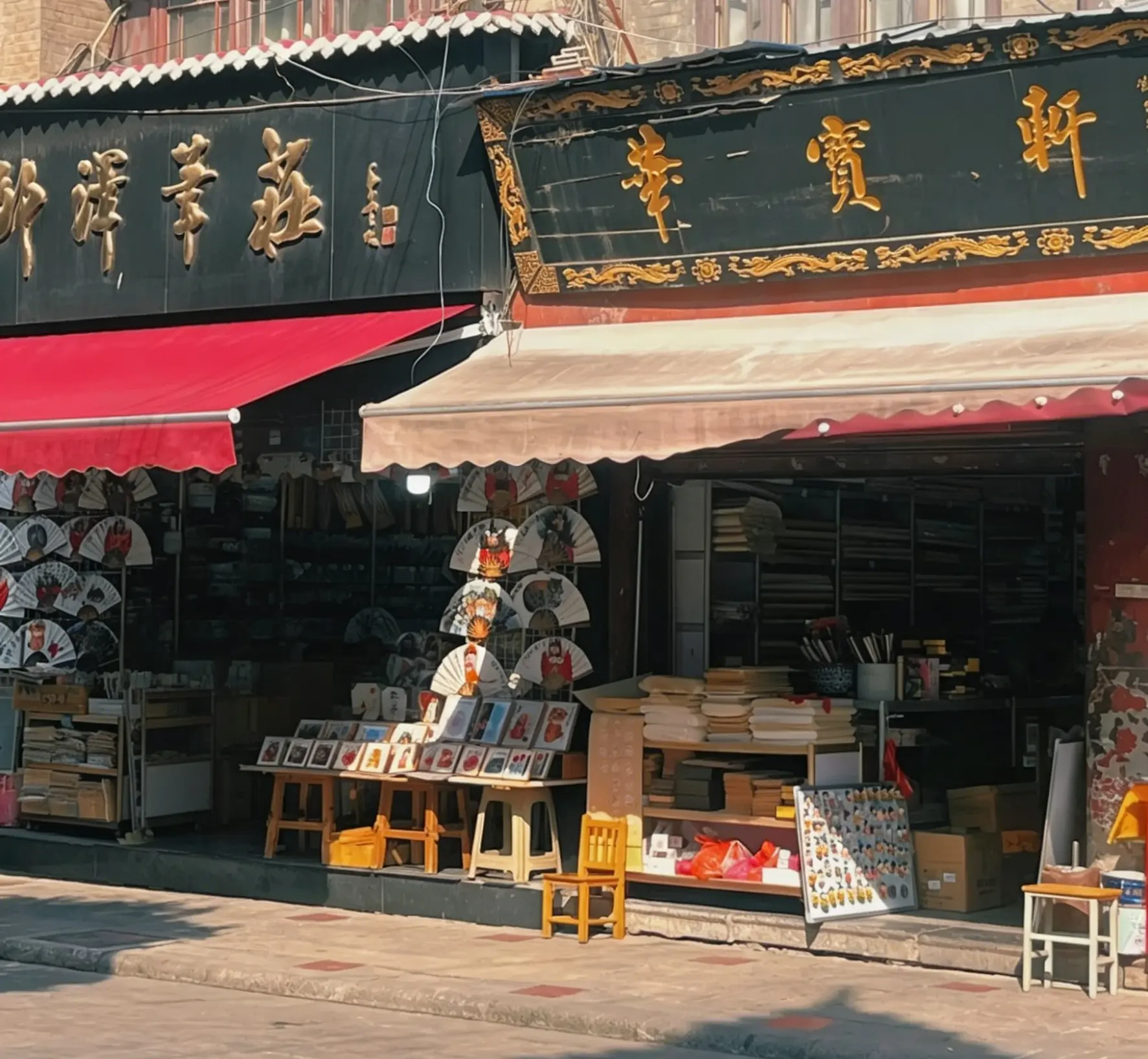
Walk toward the Stele Forest
Shuyuanmen is a straight, 570-meter pedestrian street running from the South Gate wall to the Stele Forest Museum. Enter through the South Gate archway and walk the full length; the deeper you go, the more specialized the shops become and the more measured the prices tend to be.
Best staffed and photographed
Weekday afternoons, 14:00-17:00: fewer visitors, good light, and some craft desks are more likely to be staffed.
A quieter alternative
Around 10:00, some calligraphers and painters are more relaxed and may be happy to chat or demonstrate.
Read the street in five rough zones
Entrance section
Tourist souvenirs, postcards, miniatures
Near the archway; busiest and most tourist-oriented
Middle section
Brushes, ink, paper, and ink stones
The core specialist-shopping zone
Side shops, mid-street
Custom name seals and seal carving
Possible live carving when a workshop is active
Upper-middle section
Paintings, calligraphy scrolls, stele rubbings
The strongest chance of live artist demonstrations
Far end
Antiques, old books, folk crafts
Near the Stele Forest; quieter and good for browsing
Holiday boundary: avoid National Day and Labor Day if possible. Regular weekends are manageable.
What to Buy at Shuyuanmen
Five product families
Choose by use, then compare material, making time, and price
Shuyuanmen is easiest to shop when you first decide whether you want a working calligraphy tool, a made-to-order keepsake, a wall piece, or a compact folk-art souvenir. The five groups below keep the image, buying logic, price, and quality check together.
Core calligraphy and wall pieces
The Four Treasures of the Study
Best for practical tools or a traditional gift set
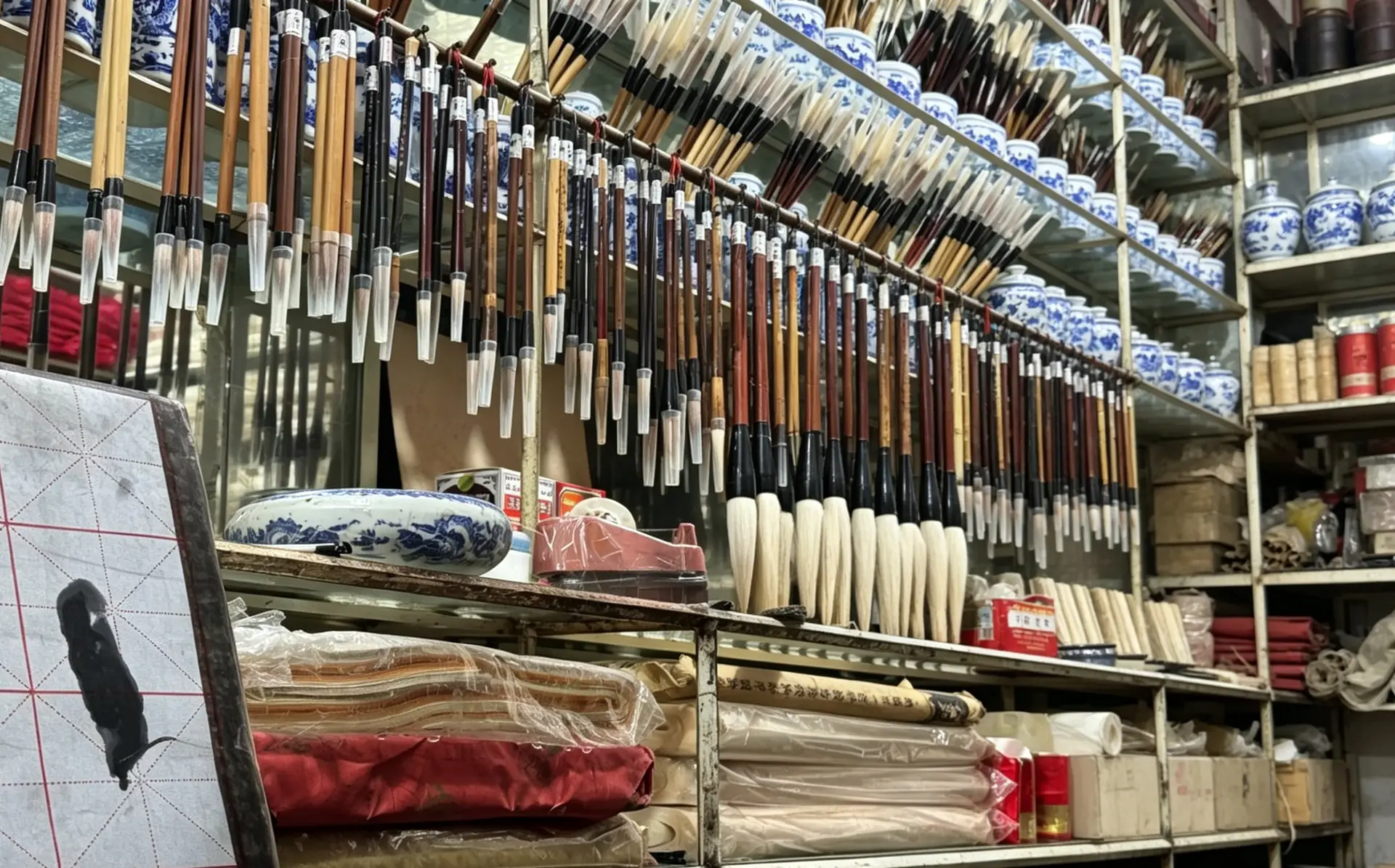
The core tools of Chinese calligraphy are brush, ink, paper, and ink stone. Shuyuanmen is one of Xi'an's easiest places to compare these supplies. Even if you do not practice calligraphy, a quality Chinese-made set can be a traditional gift that is often hard to find outside specialist retailers.
Brushes · ¥15–200+: From student-grade Baiyun to refined professional Huzhou brushes. Dip the tip in water: a good brush converges to one fine point.
Ink · ¥10–100: Ink sticks cost ¥20–100 and are ground on a stone; bottled ink costs ¥10–50 and is easier for beginners.
Xuan paper · ¥10–80 per ~100 sheets: Raw Xuan absorbs quickly for freehand painting; sized Xuan resists bleeding for detailed work. Beginners should buy sized.
Ink stones · ¥30–500+: Duan and She stones are premium and can run into the hundreds or thousands. A small decorative stone at ¥30–80 makes a solid souvenir.
Calligraphy & Paintings
Best for a custom scroll or an expressive wall piece
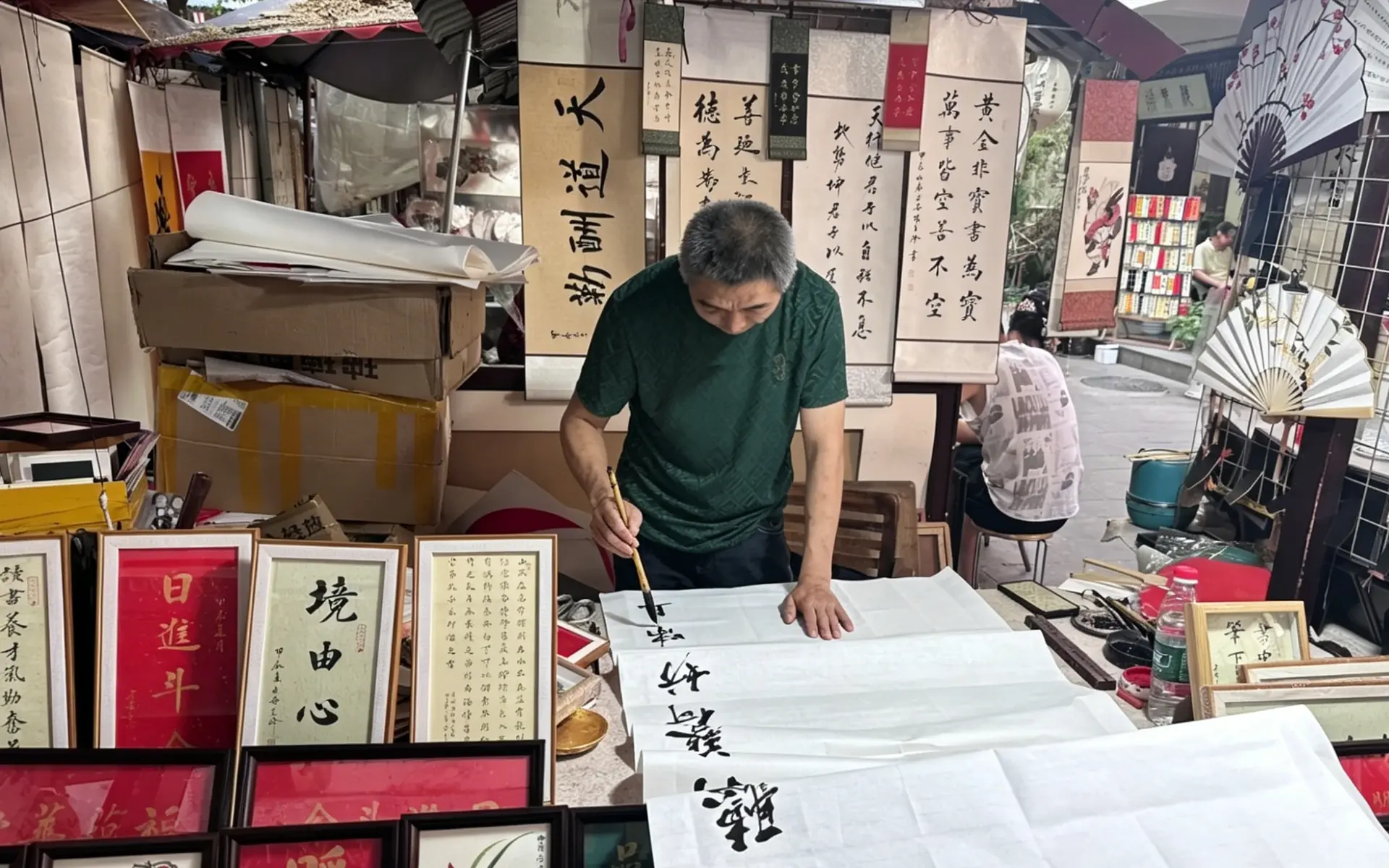
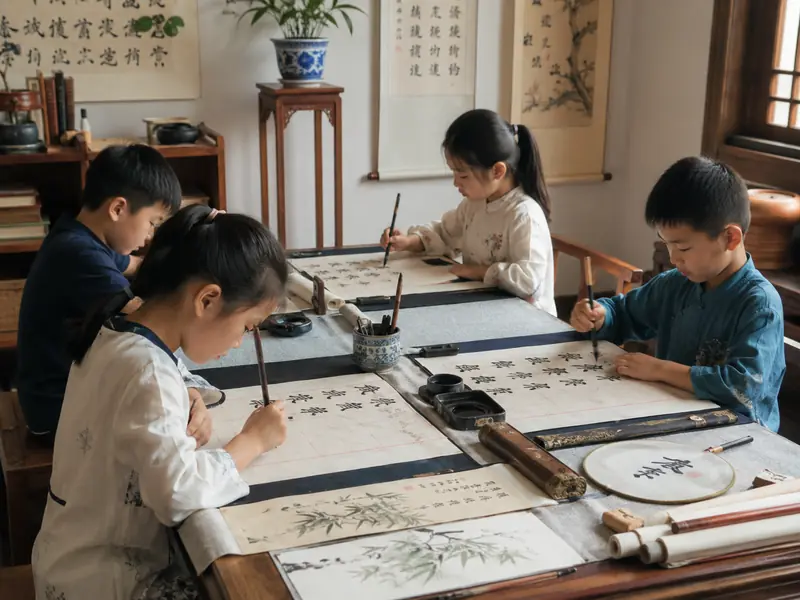
One of Shuyuanmen's most vivid experiences is seeing a calligrapher or painter spread rice paper across a table and work with brush and ink when a workshop is active. You can commission your name, a line of poetry, or an auspicious word, then have it mounted as a scroll.
Custom calligraphy: ¥50–300, depending on size and the calligrapher's reputation.
Pre-made scrolls: ¥30–200; common choices include 福 “fortune,” 寿 “longevity,” and 龙 “dragon.”
Paintings: ¥100–1,000+ for landscapes, flowers, and figures.
How to choose: Watch a calligrapher whose style you like for a few minutes—most enjoy the attention. If the price feels right, a piece commissioned on the spot is more meaningful than a pre-made one.
Made-to-order keepsakes and compact souvenirs
Custom Name Seals
Most personal · allow 20–60 minutes
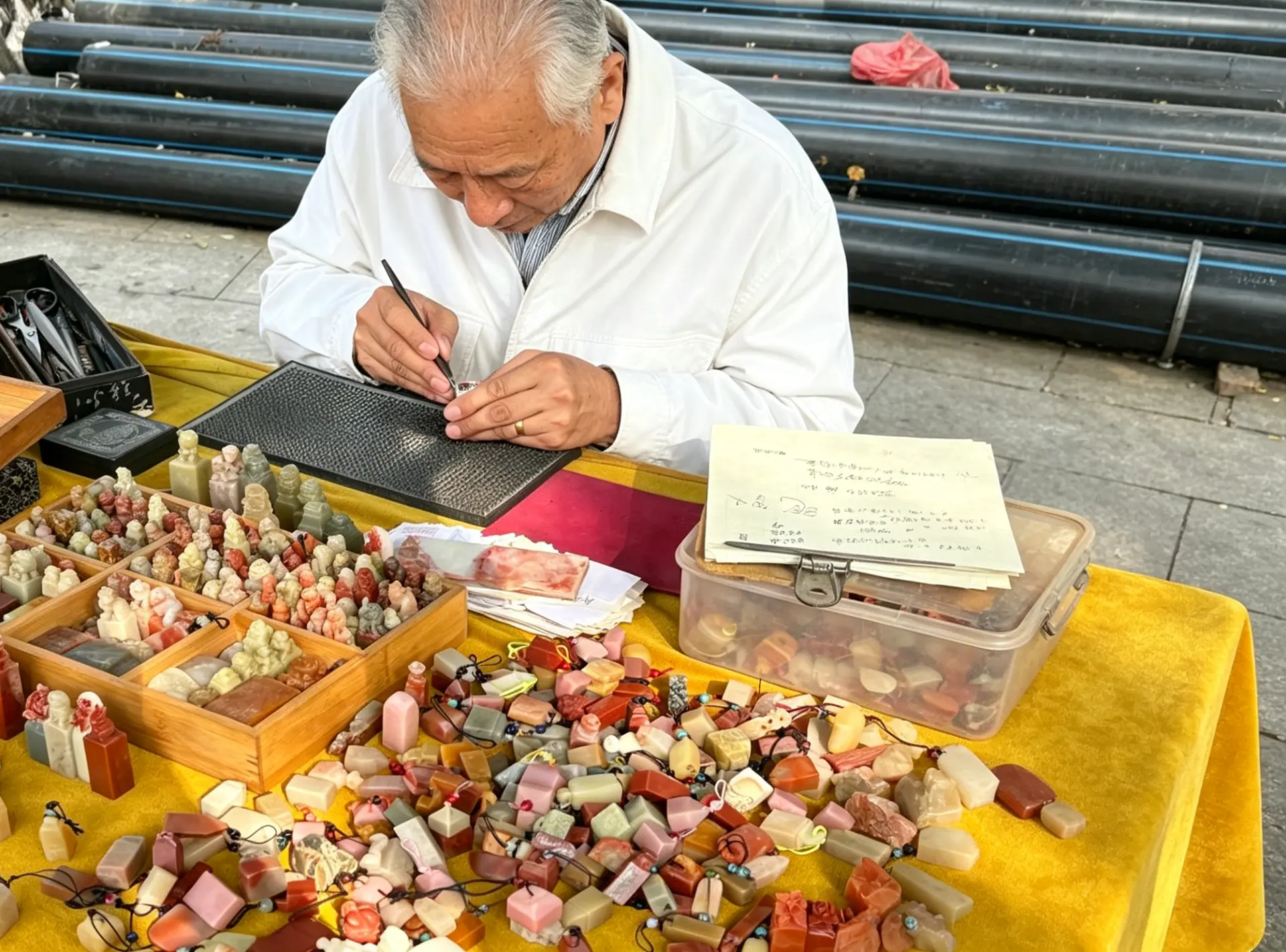
Seal carving (篆刻) is a uniquely Chinese art form: characters are carved into stone to create a personal stamp. For an English name, a craftsman may help choose Chinese characters, ask you to confirm them, and then render those characters in seal script. You watch the one-of-a-kind piece being made.
Stele Rubbings
Best for historic calligraphy as wall art
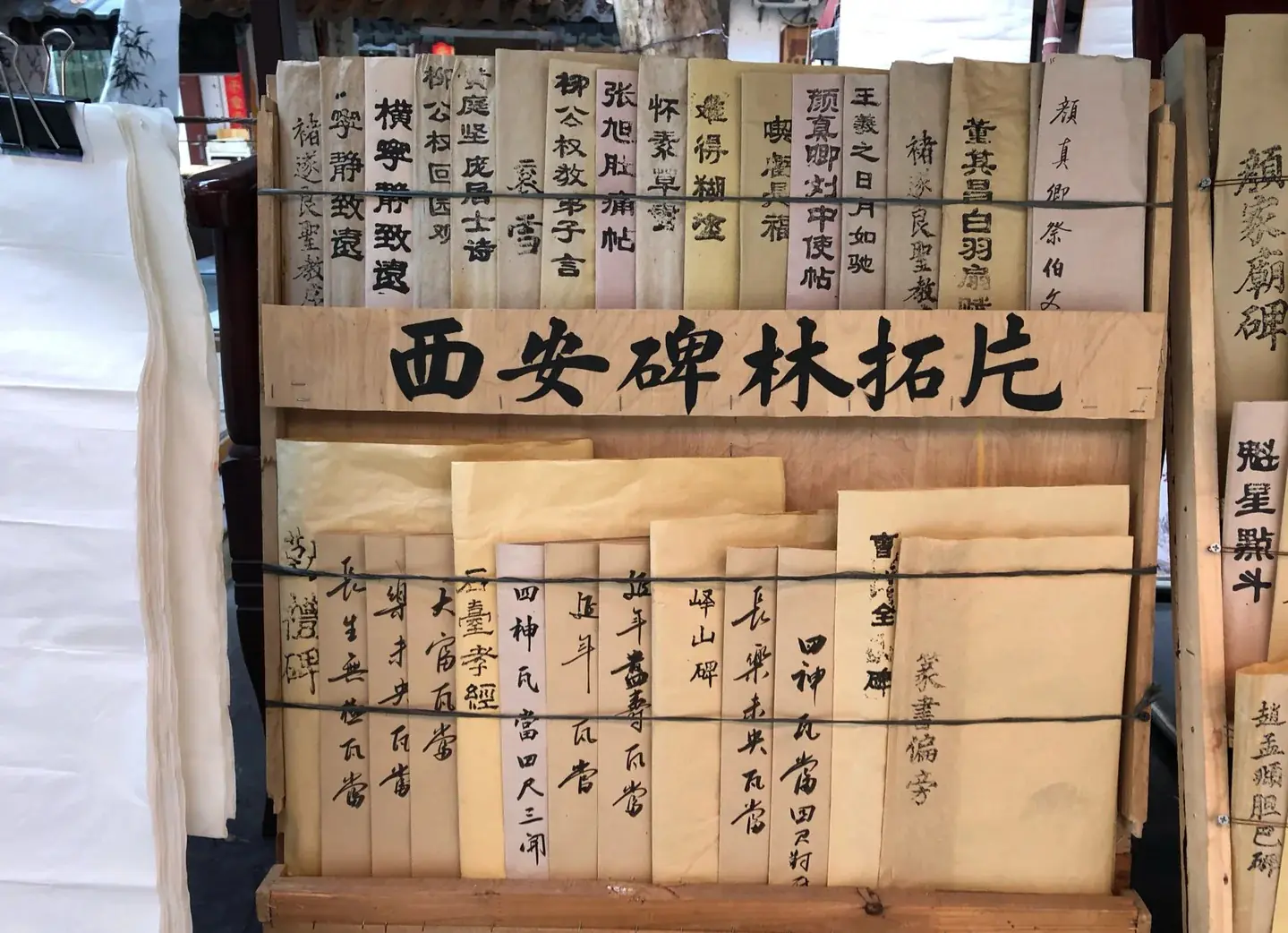
Rubbings are ink-on-paper impressions taken from carved stone steles. The nearby Stele Forest Museum (碑林博物馆) holds thousands of steles spanning the Han to Qing dynasties, and local shops sell reproductions from those stones. The white-on-black result works as striking framed art even if you cannot read Chinese.
Shaanxi Folk Crafts & Souvenirs
Best for a lower-cost, easy-to-carry gift
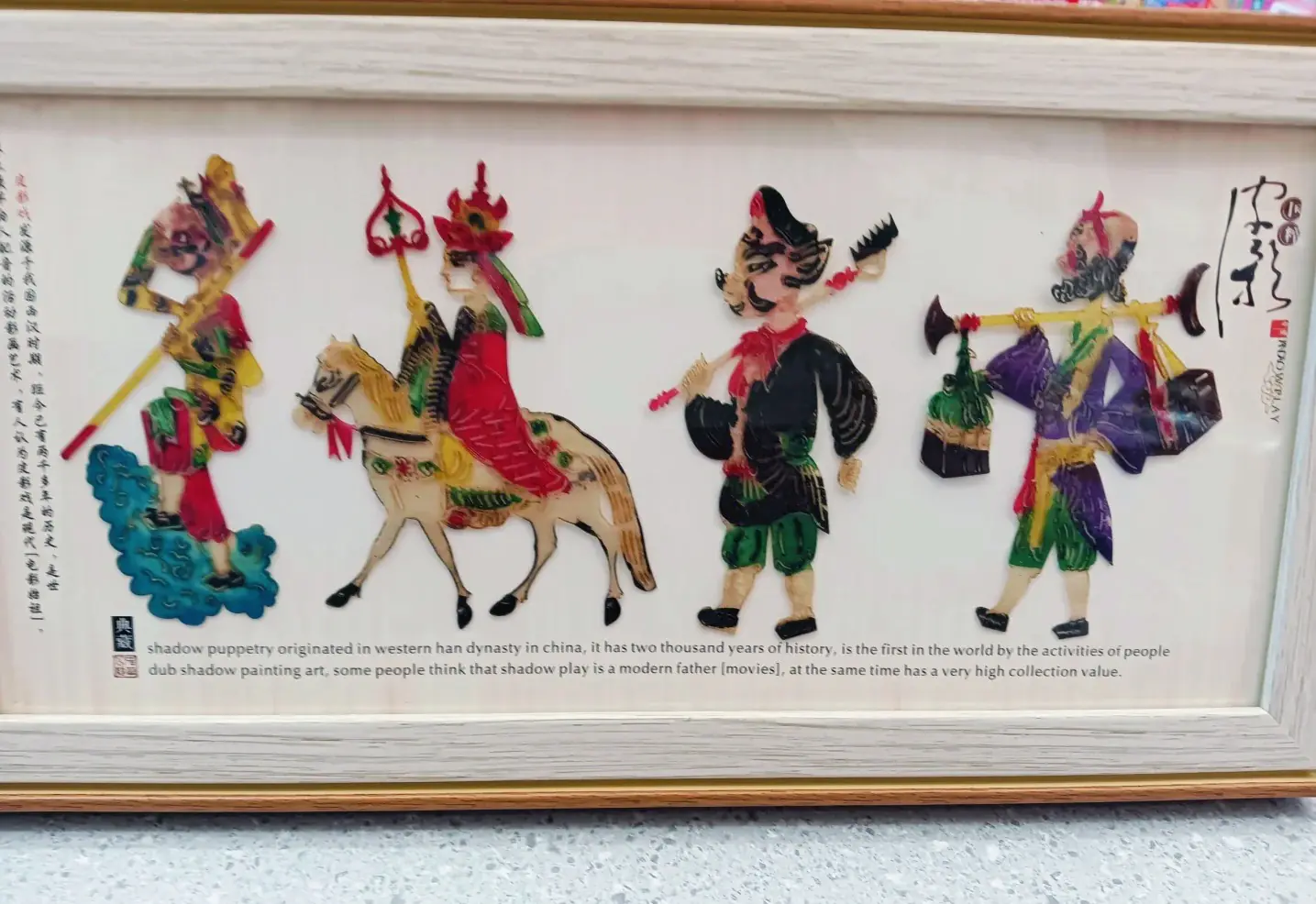
Beyond calligraphy supplies, shops carry paper cuttings, shadow puppets, miniature Terracotta Warriors, and vintage books. Huaxian shadow puppetry is a nationally listed intangible-cultural-heritage representative project, making the tradition especially noteworthy; a souvenir puppet is not automatically certified heritage workmanship.
Price, material, and making-time checks
Custom Name Seals
Price: ¥30–200, depending on stone quality and character count.
Stone: Common Qingtian costs ¥30–80; premium Shoushan costs ¥100–300+.
Turnaround: 20–30 minutes for a simple seal; up to an hour for a complex one.
Stele Rubbings
Price: ¥10–30 for small A4-sized pieces; ¥50–300+ for a large full-stele rubbing.
Commonly reproduced models: Yan Zhenqing's Duobao Pagoda Stele (颜真卿《多宝塔碑》), Liu Gongquan's Xuanmi Pagoda Stele (柳公权《玄秘塔碑》), or Chu Suiliang's Wild Goose Pagoda Preface (褚遂良《雁塔圣教序》)—textbook masterpieces of Chinese calligraphy.
Shaanxi Folk Crafts & Souvenirs
Paper cuttings (剪纸): ¥5–50 for window decorations, zodiac animals, and figure silhouettes.
Shadow puppets (皮影): ¥20–150.
Replica ceramics: ¥15–100 for miniature Terracotta Warriors and Tang sancai figurines.
Old books: ¥10–100+; collectors may find interesting vintage editions.
Before paying: Compare two shops, inspect the material or finish, and allow enough time for anything made to order.
Bargaining & Pricing Guide
Bargaining at Shuyuanmen is far more gentle than at Shanghai's AP Plaza or Beijing's Silk Market. Vendors here sell handcrafted goods with real labor and artistic value. Treat the ranges below as starting heuristics, not promised discounts.
Price before you negotiate
The discount depends on whether you are buying a tool, custom work, or mass-produced stock
🖌️ Calligraphy supplies
Brushes, ink, paper, and stones: a gentle opening range is 10–20% off. Buying multiple items may give you more leverage, but no discount is guaranteed.
✂️ Custom services
Seal carving and commissioned calligraphy: use about 10% only as a restrained starting range.
🎁 Tourist souvenirs
Postcards and fridge magnets near the entrance are usually mass-produced; 20–30% off may be a reasonable opening range, not a promised result.
🎨 Paintings & rubbings
Custom pieces tend to be honestly priced. Pre-made bulk stock has more room for negotiation.
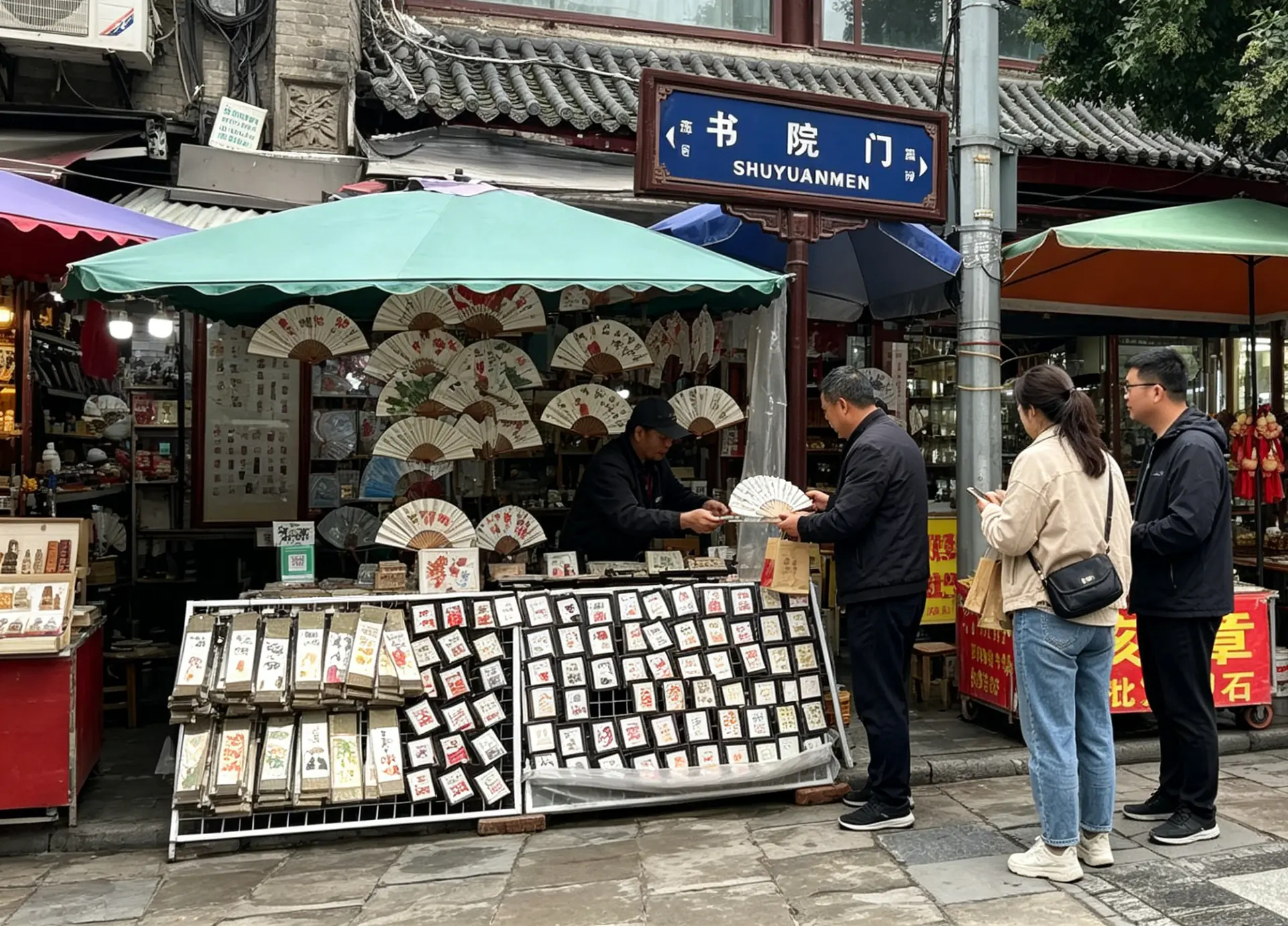
The tone that works
Unlike big-city bargain markets, Shuyuanmen vendors are artisans first and salespeople second. Stay friendly, show genuine interest in the craft, and you will find the prices meet you in the middle.
Pair It with the Stele Forest Museum
Five minutes away
See the original inscriptions first, then shop for a rubbing
Current visit essentials
Admission
Full price ¥85; half price ¥42
Hours
Daily 08:30–19:00
Last entry
Ticket sales and entry close at 17:30
Suggested visit
Allow 1–1.5 hours
Before going: reserve a timed-entry slot through the museum's official channel and recheck any temporary schedule notices.
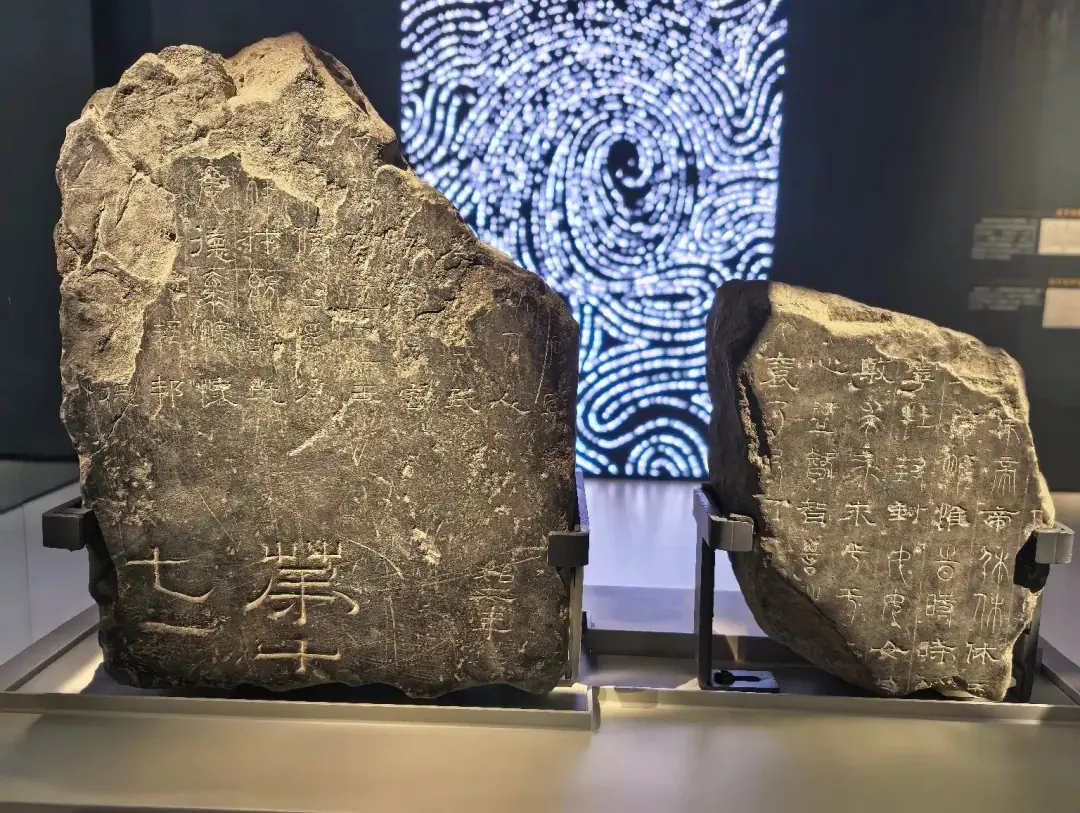
The Stele Forest Museum (碑林博物馆) is roughly five minutes on foot from Shuyuanmen's east end. The museum has reported more than 11,000 objects across its wider holdings, while its current visitor material highlights 4,000+ stone inscriptions spanning the Han through Qing dynasties.
This pairing turns Shuyuanmen from a shopping street into the final step of a museum visit: first learn what the carved stones mean, then compare reproductions and rubbings with context.
Recommended flow · Stele Forest first, then Shuyuanmen
Use the museum's Yan Zhenqing collection context—and any relevant original currently on display—then walk out and compare rubbings of the same calligraphic model at Shuyuanmen. This “see the original, buy the reproduction” loop is something no other Xi'an attraction can offer.
Tips for First-Time Visitors
A quieter, easier visit
Pack for fragile paper, browse before buying, and treat working artists with care
🛍️ Bring a tote bag
Most shops don't provide proper bags, and rice paper and rubbings need protection from folding.
🚶 Walk past the entrance
Hold back 20–30% of your souvenir budget as a comparison buffer until you have checked deeper shops. This is not a measured entrance surcharge or a guaranteed discount.
🤫 Respect the artists
Stay quiet when watching calligraphers or painters work. Ask before taking photos—most will happily agree.
👨👩👧 Family-friendly
The street is flat and pedestrian-oriented, which works well for many families. Use normal urban awareness; kids may enjoy watching seal carving and trying brushes at some shops.
If you want to extend the route
🏯 City wall combo
Cycle or walk the wall at the South Gate (永宁门) → descend → Shuyuanmen → Stele Forest Museum. This fills a solid half-day.
🍜 Add the Muslim Quarter
From Shuyuanmen's west archway, the Drum Tower / Muslim Quarter is about 15 minutes on foot; pace and crossings vary. Plan a morning of cultural shopping plus a lunch of Xi'an street food.
Where to Stay Near Shuyuanmen & the South Gate
Staying inside or right beside the South Gate puts Shuyuanmen, Stele Forest Museum, the City Wall, and the Muslim Quarter within easy walking range so you can drop calligraphy paper and stone seals back at your room without carrying them all day.
Affiliate disclosure: the Trip.com hotel links below are affiliate links; we may earn a commission at no extra cost to you. Check exact metro exit distance, recent foreign-guest reviews, and cancellation terms before booking.
Stay Near Bell Tower & South Gate
Best for walking to Shuyuanmen
Step out to Yongningmen (South Gate), Shuyuanmen, Stele Forest Museum, and the Bell and Drum Towers, with direct Metro Line 2 access to Xi'an North Railway Station.
Booking tip: Hotels just inside or outside Yongningmen Station stay calmer at night than rooms directly on the noisy pedestrian squares around the Muslim Quarter.
Stay Near Giant Wild Goose Pagoda
Best for newer hotels & evening strolls
Wide boulevards, modern international chains, Shaanxi History Museum proximity, and lively evening lights around the pagoda plaza, while Line 2 or 4 brings you straight back to the walled city.
Booking tip: Pick a property near Dayanta or Xiaozhai metro exits to keep rides north to Yongningmen under 20 minutes.
Frequently Asked Questions
Yes, with one important step: a carver may help you choose Chinese characters for an English name, then render those characters as a seal-script design. Confirm the characters and meaning before carving. You can also ask the craftsman to choose a Chinese name for you; either route produces a visually personal souvenir.
Sources checked for this guide
- Street identity and historic district: Shaanxi Government profile, Guanzhong Academy gazetteer, Learning-tradition gazetteer and Xi'an historic-district plan
- Museum visit facts and collection: Beilin visitor reminder, Reopening ticket notice and Beilin official site
- Materials and heritage scope: CNIPA · Xuan paper and ICH China · Huaxian shadow puppetry
- Qualified secondary checks: Xi'an metro exit directory and Shuyuanmen destination guide
Beyond This Guide
Shuyuanmen sits at the heart of Xi'an's ancient quarter — within walking distance of the city wall, the Stele Forest, and the Muslim Quarter's food stalls. Whether you're after a custom name seal, a calligraphy lesson in stone, or just a quieter side of Xi'an away from the Terracotta Warriors crowds, this street delivers something no mall or online store can replicate.
Continue planning Xi'an:
- Xi'an City Wall: Complete Walking & Cycling Guide — bike the full 14 km loop on top of the wall
- Terracotta Warriors: Visitor's Guide — tickets, transport, and the best route through the pits
- Xi'an Food Guide — biangbiang noodles, roujiamo, and the Muslim Quarter food trail
- Xi'an Travel Guide — complete city hub
© gochinafreely.com — Original guide by Go China Freely.