Entry Windows & Tickets
Hours and bundles change; check before travel. ticket rules below
Visit Rules
Mount Fanjingshan Above the Clouds

2,572 m
Highest Wuling peak
2018
World Heritage listing
1.4B
Years of geology
3,724
Plant species recorded
UNESCO mountain day
A stone pillar, twin temples, and a cloud-sea arrival moment
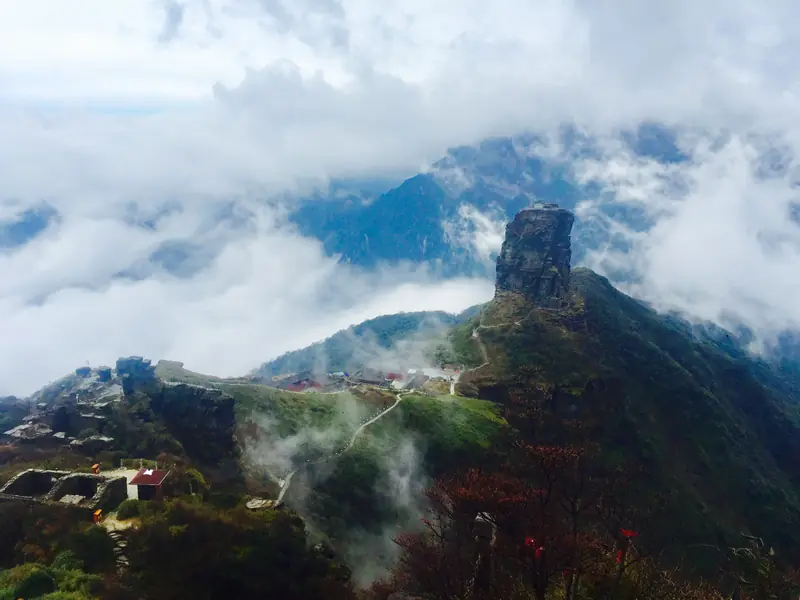
Mount Fanjingshan (梵净山) rises 2,572 meters as the highest peak of the Wuling Mountains — a UNESCO World Heritage Site since 2018, with 1.4 billion years of geological history sculpted into a single stone pillar topped by two temples connected by a bridge over a bottomless gorge.
Most foreign visitors to Guizhou head for Huangguoshu Waterfall or Xijiang Miao Village, but Fanjingshan is the one that genuinely stuns geologists and architects alike.
The arrival moment
From the base, the mountain looks unremarkable. But ride the cable car for 10 minutes to the summit area and you'll find yourself standing above a sea of clouds, facing Red Cloud Golden Summit — a 100-meter stone pillar split by Gold Sword Gorge, topped with twin Buddhist temples connected by a bridge. This isn't Photoshop; this is 1.4 billion years of geology.
Sacred mountain, protected ecology
"Fanjing" means "Pure Land of Brahma": the bodhimanda of Maitreya Buddha, ranked alongside Mount Wutai (五台山), Mount Emei (峨眉山), Mount Putuo (普陀山), and Mount Jiuhua (九华山). Its UNESCO designation is ecological too, protecting one of the best-surviving subtropical primeval forest ecosystems at this latitude, with 2,317 invertebrate species and 450 vertebrate species recorded inside the World Heritage property.
Two Golden Summits, Two Temples
Signature climb
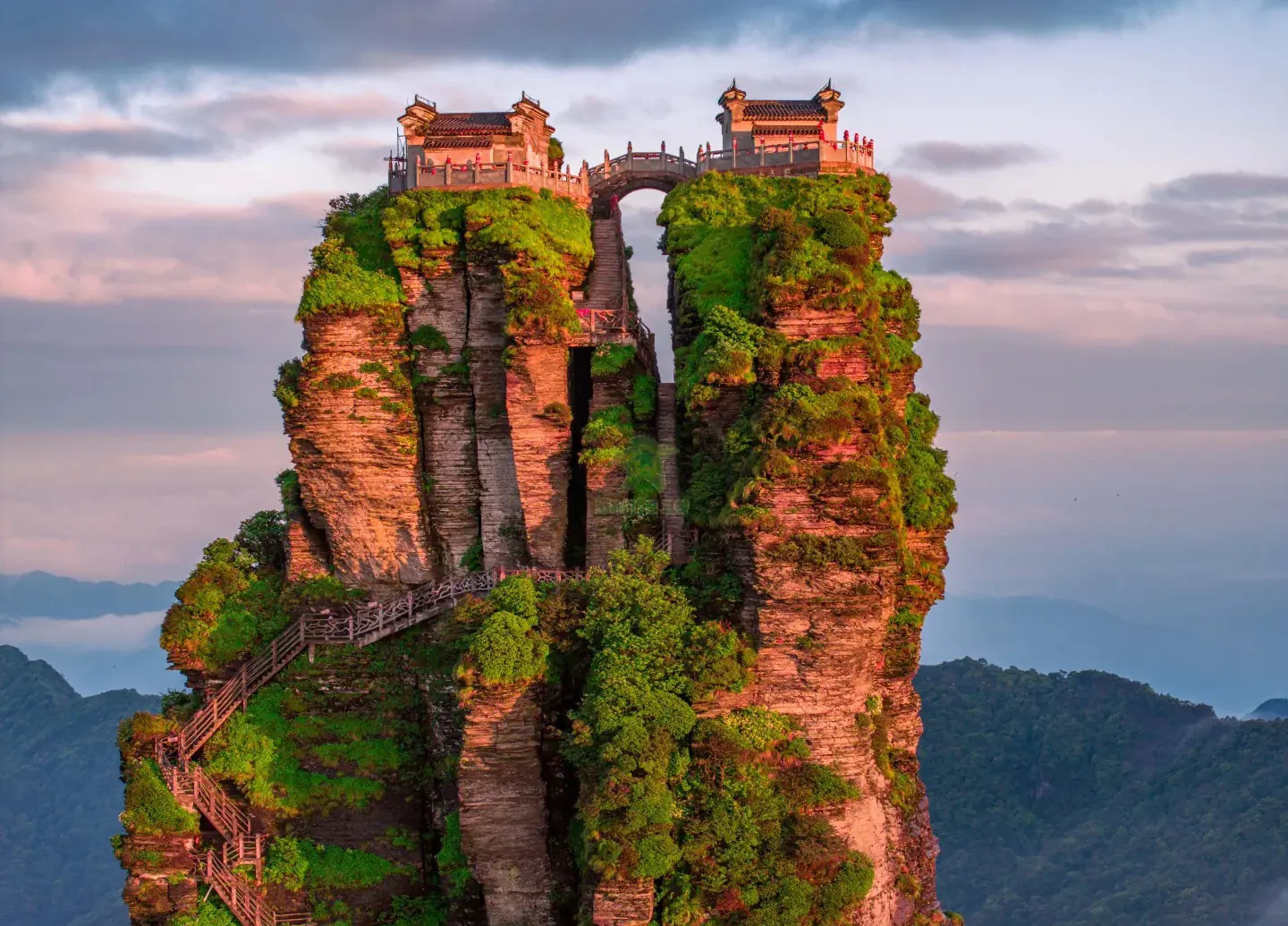
Red Cloud Golden Summit (红云金顶)
2,336 m · twin temples over Gold Sword Gorge
Red Cloud Golden Summit is Fanjingshan's signature landmark: a roughly 100-meter stone pillar split in two by Gold Sword Gorge (金刀峡), with Sakyamuni Hall (释迦殿) on one side, Maitreya Hall (弥勒殿) on the other, and a stone bridge above the chasm.
Climb feel
Grip iron chains, step on iron footholds, and climb nearly vertical rock for about 30-40 minutes from Pudu Square (普渡广场).
Height warning
Narrow sections allow only one person at a time, so anyone with a fear of heights will struggle.
View payoff
Clear days can open mountains for a hundred kilometers; cloud-sea mornings churn below your feet; rare lucky conditions create Buddha's Halo (佛光).
Quieter viewpoint
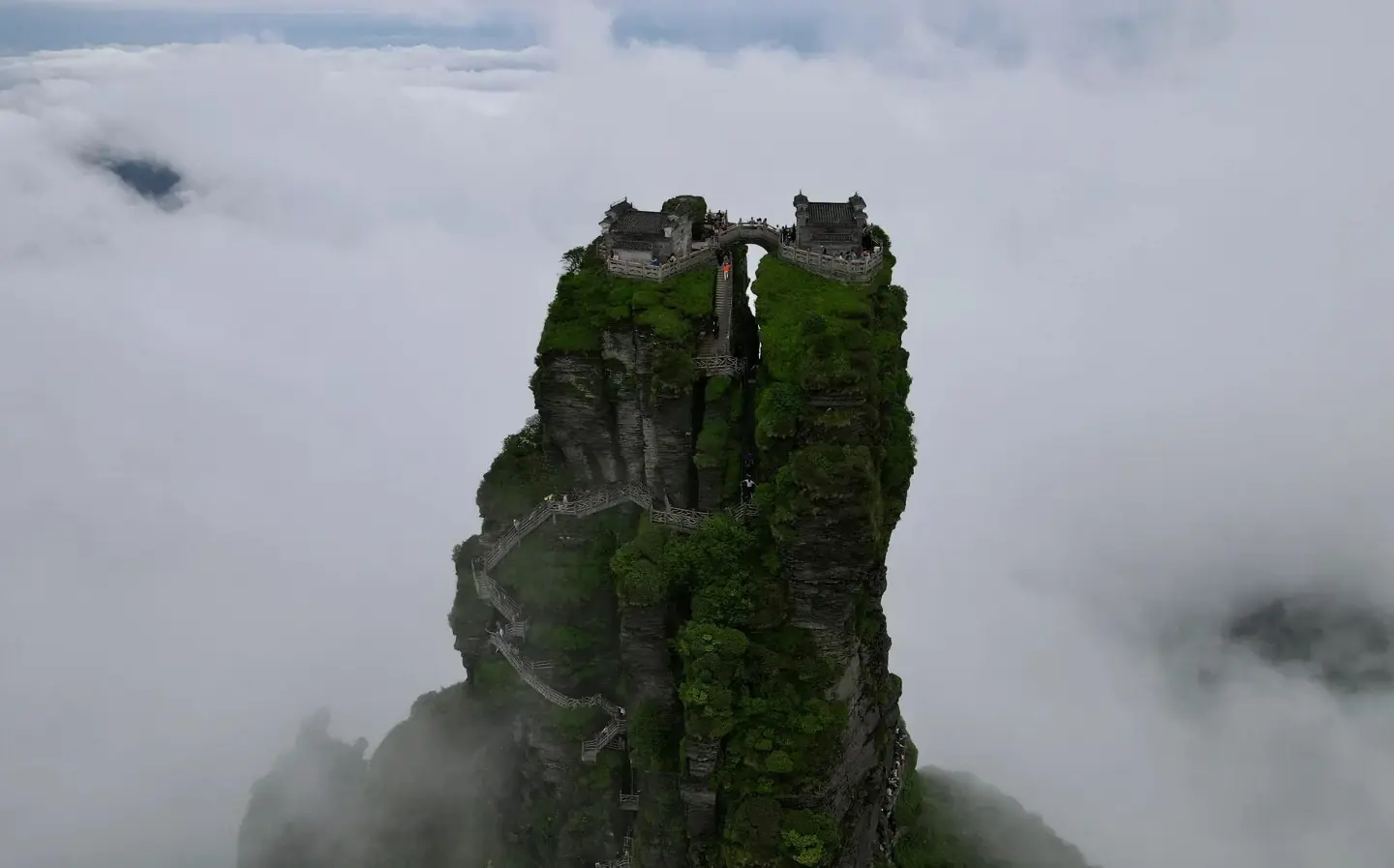
Old Golden Summit (老金顶)
2,494 m · higher, quieter, better for photos
Old Golden Summit is higher than Red Cloud but draws fewer visitors. The climb is shorter, the queues minimal, and the panoramic views are still expansive.
Best use
Photograph the full profile of Red Cloud Golden Summit — stone pillar, twin temples, and Gold Sword Gorge — against rolling cloud seas and distant mountains.
If you only choose one
Red Cloud offers the more unique experience: iron-chain climb, bridge, and twin temples.
If you can do both
Visit Red Cloud first because it is more crowded and may require a climbing reservation, then continue to Old Golden Summit.
Mandatory photo stop
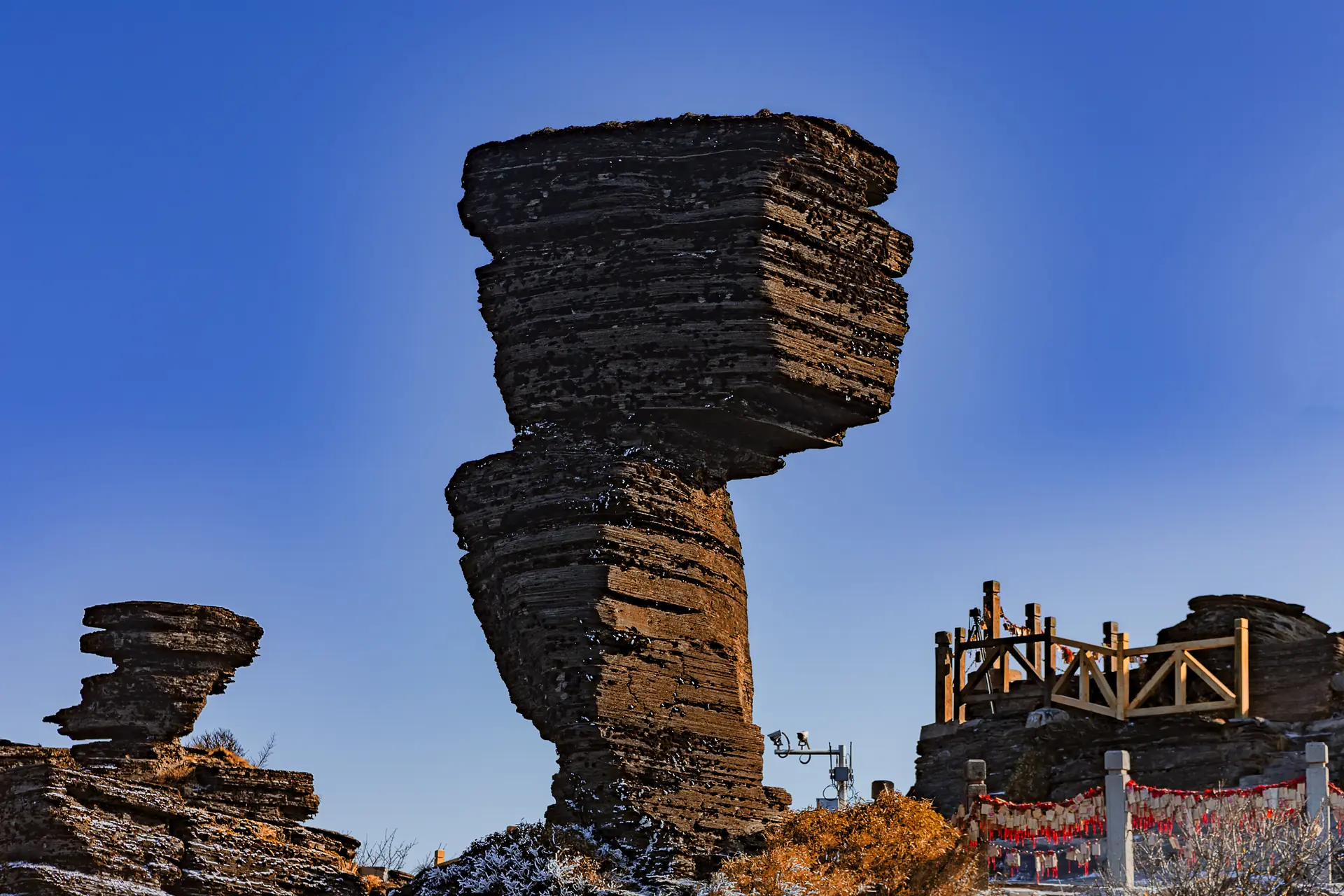
Mushroom Rock (蘑菇石)
Trail landmark between the two summits
Mushroom Rock — also called "Ten Thousand Scrolls" (万卷书) — is Fanjingshan's other icon: a precariously balanced boulder, wider on top than at its base, shaped like a mushroom.
Why it matters
Roughly one billion years of weathering created this formation, now widely regarded as Guizhou's most representative natural landmark.
Where it fits
It sits on the trail between the two Golden Summits, so you can treat it as the natural pause point between the bigger climbs.
Queue Warning
During peak holidays (National Day, May Day), queues for the summit can reach 2–3 hours. The scenic area uses a flow-control system — scan a QR code near Mushroom Rock or Cheng'en Temple (承恩寺) to reserve your climbing slot. Arrive on weekdays and catch the first cable car (before 8:00 AM) to beat the crowds.
Guizhou's Last 850 Golden Monkeys
Endemic species
The mountain is the entire world for this monkey.
Fanjingshan is the only habitat of the Guizhou golden snub-nosed monkey (Rhinopithecus brelichi). Unlike the golden-furred Sichuan snub-nosed monkey most people picture, this species has grey-black fur and a blue-grey face.
The latest local biodiversity update puts the population at about 850 individuals. They live in primeval forest between 1,400 and 2,200 meters elevation and are a Class I protected species in China.
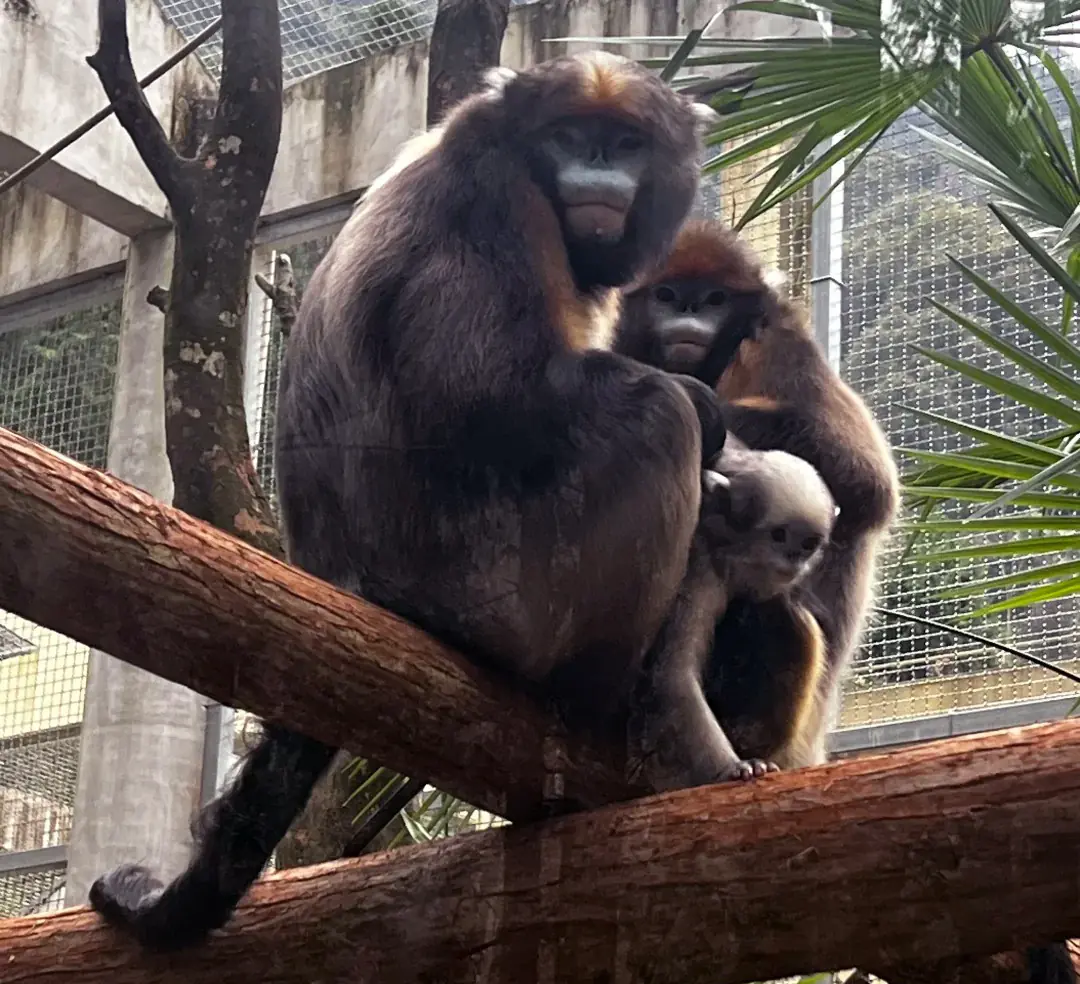
About 850 Guizhou golden snub-nosed monkeys survive worldwide — all of them around Fanjingshan.
~850
Individuals worldwide
1,400-2,200 m
Forest habitat zone
Class I
Protected species
Honest expectations
Regular visitors almost never see these monkeys in the wild. Their habitat is a strictly protected zone closed to the public. The Fanjingshan Ecological Museum inside the scenic area has specimens and documentary footage. If you're a primate enthusiast, manage your expectations — this isn't Chengdu's panda base where sightings are guaranteed.
East Gate or West Gate — Choosing Your Route
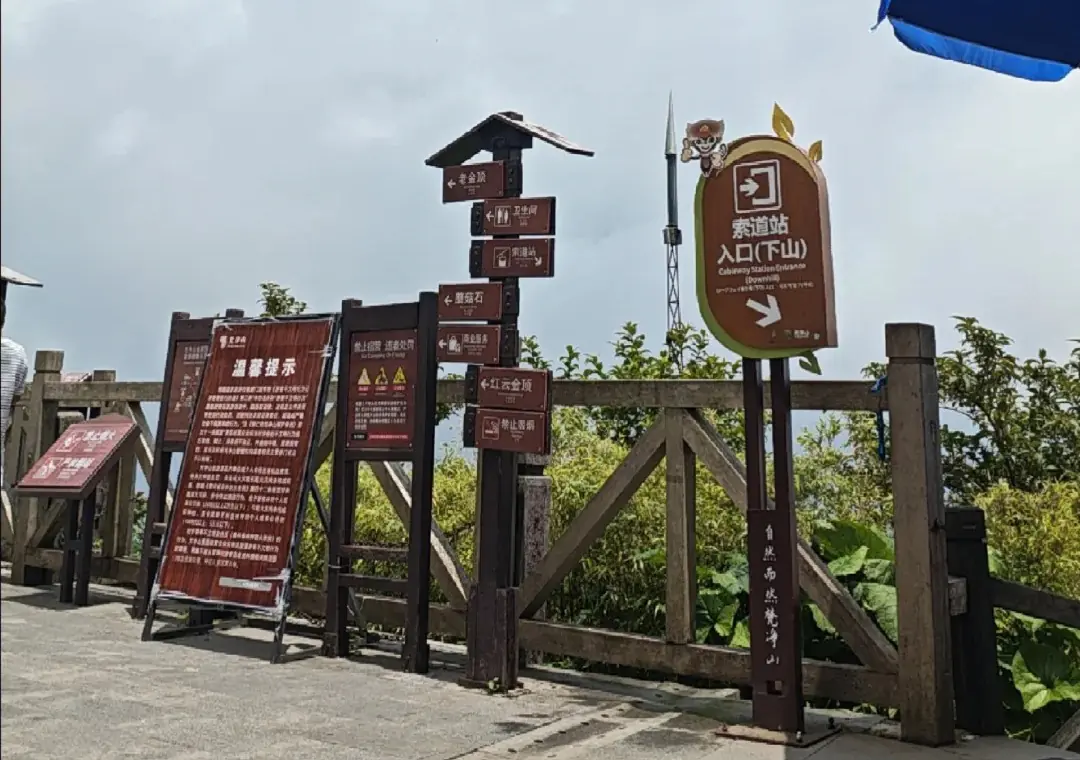
Standard choice
East Gate · Jiangkou side (Google | Amap)
Cable car + boardwalk · advance booking required
Route: sightseeing bus (20 min) → cable car (10 min, about 1,200 m elevation gain) → summit boardwalk.
Walk time: cable car top station to Mushroom Rock takes 40-60 minutes on foot.
Queue risk: peak-season cable car queues can reach 1-2 hours, so first bus and first cable car matter.
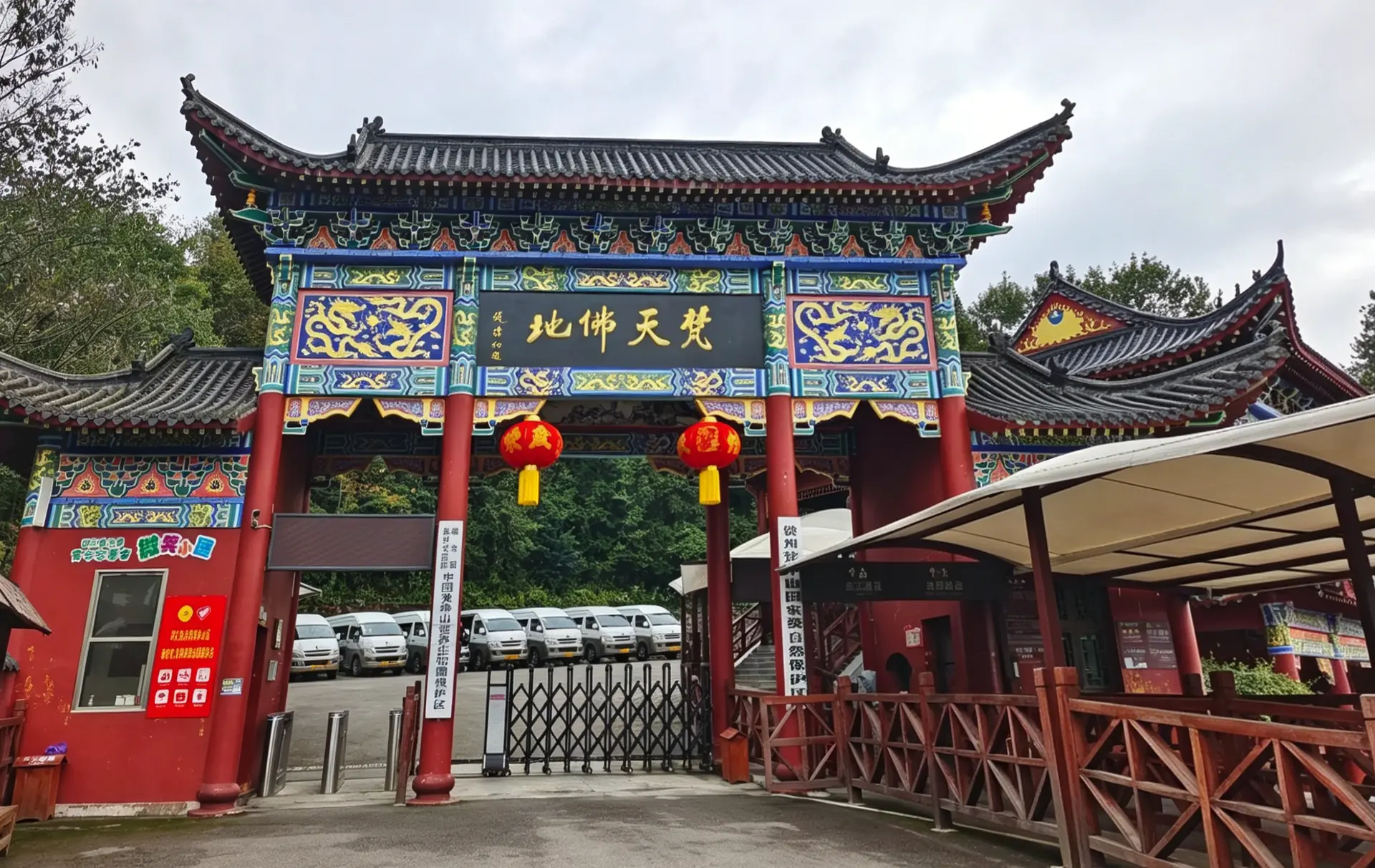
Hiker's choice
West Gate · Yinjiang side (Google | Amap)
6,600 steps · 3-5 hr uphill · no cable car
Route: full hike from Huguo Temple (护国寺) at about 800 m to the summit zone.
Trail feel: subtropical broadleaf and coniferous forests with dramatic vegetation changes.
Ticket pressure: usually fewer visitors, but still check live reservation status before treating it as a backup.
Recommended route combinations
East is the easiest route; West is quieter but requires a real hike and has no cable car.
Standard · 5-6 hours
Itinerary: East Gate → bus → cable car up → Mushroom Rock → Red Cloud Summit → Old Summit → cable car down.
Best for: most visitors.
Challenge · 7-9 hours
Itinerary: West Gate hike up → Mushroom Rock → both summits → East Gate cable car down.
Best for: experienced hikers.
Express · 3-4 hours
Itinerary: East Gate → cable car up → Mushroom Rock + Red Cloud Summit → cable car down.
Best for: short on time.
Critical Time Limits
No hiking up after 14:00; no walking down after 15:00 (must take the cable car) — see full details in Tickets & Booking. This rule is strictly enforced. Start early.
Tickets, Cable Car & Booking Rules
Ticket budget
Plan the entrance, East Gate shuttle, and cable car as separate cost lines.
¥100
Entrance ticket
¥20
East Gate bus RT
¥70 / ¥140
Cable car one-way / RT
Bundles
East Gate bundles are often sold as entrance + sightseeing bus + round-trip cable car; some bundles add insurance or service fees. Confirm the final amount in the booking channel.
Discounts
Students: half price. Seniors 60-69: half price. Seniors 70+ / military / disabled: free entrance, with bus and cable car extra.
Real-name booking and passports
Fanjingshan uses real-name, time-slot reservations through official channels such as the "Fanjingshan Tourism Area" (梵净山旅游区) WeChat account, the "One Code Tour Guizhou" (一码游贵州) mini program, and authorized platforms. The live presale window changes, so check as soon as your travel date appears and choose a specific entry time slot.
Passport holders: use the Visitor Center counter (Google | Amap) rather than relying on self-service machines. Bring your passport and booking confirmation, and arrive at least 30 minutes before your booked time slot.
West Gate tickets are usually less competitive than East Gate tickets, but the official policy still emphasizes real-name reservations. Treat same-day purchase as a backup only after checking live availability.
Regular entry windows
East Gate (Jiangkou)
08:00-15:00
Main entrance; cable car route; holiday notices may open earlier.
West Gate (Yinjiang)
08:00-13:00
Hiking gate; no cable car.
Holiday hours, weather closures, cable car maintenance, and summit safety controls can change the day's route. Confirm via the official site, mini program, or scenic area hotline: 400-997-6999.
Getting to Fanjingshan from Tongren
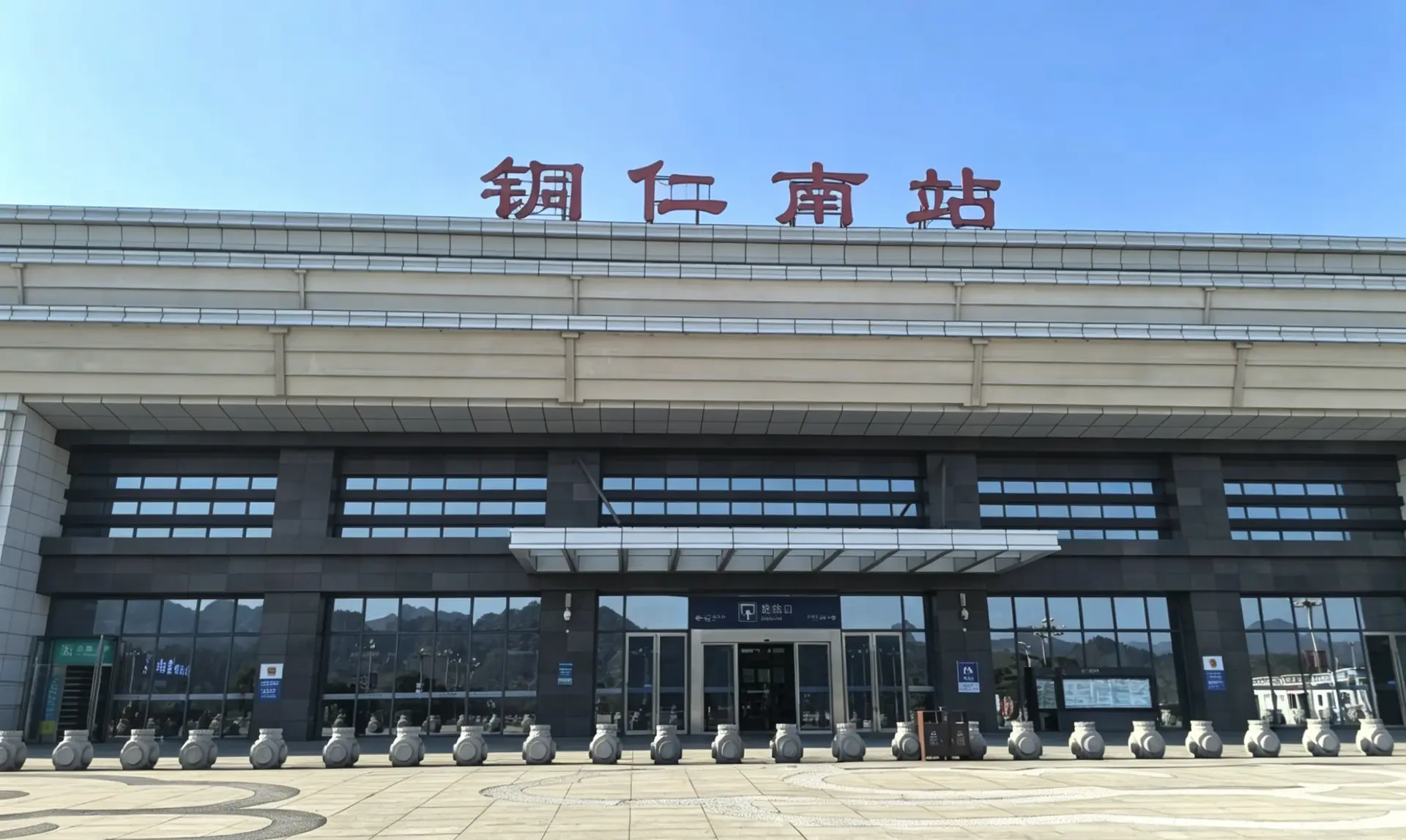
Tongren is the cleanest gateway
Railway station → Jiangkou → East Gate
Fanjingshan sits in Jiangkou County (江口县), Tongren City — about 70 km from downtown Tongren and roughly 4 hours from Guiyang. For independent travelers, the cleanest public route is Tongren South Railway Station to Jiangkou Bus Station, then the scenic-area shuttle to the East Gate.
Fenghuang pairs naturally by car or train transfer, while Guiyang is better treated as an overnight connection rather than a same-day return. The mountain's entry windows are too tight for a rushed long-distance day trip.
Best overnight base
Stay in Jiangkou the night before. It is about 30 km from the East Gate (30-40 min drive), with a good range of hotels at ¥100-300/night. Leave early the next morning to catch the first sightseeing bus and avoid the post-10:00 AM rush.
Guesthouses and farmstays near the scenic area entrance (¥80-200/night) put you within walking distance of the ticket office, though facilities are basic.
Tongren transfer options
HSR + bus · best public route
Route: Tongren South Station (Google | Amap) → Jiangkou Bus Station (Google | Amap) (bus, ~45-80 min) → Fanjingshan shuttle (~30 min).
Duration: about 2 hours. Cost: ¥45 + ¥10-15.
Hired car · simplest door-to-gate option
Route: Tongren city center → East Gate.
Duration: about 1.5 hours. Cost: ¥200-300.
Fenghuang Ancient Town add-on
Fenghuang (凤凰古城) in Hunan is about 150 km from Fanjingshan — roughly 2-2.5 hours by car. You can hire a car directly or take a train to Tongren South and transfer by bus.
The two destinations pair naturally as a classic Guizhou-Hunan route.
Guiyang connection
Guiyang → Tongren South by high-speed rail takes about 1.5-3 hours depending on train type (¥100-200), then transfer by bus to the scenic area.
A same-day round trip from Guiyang is extremely tight — plan for at least 2 days.
Best Seasons and Cloud Sea Strategy
Best Seasons
Season chooser
Spring and autumn are the safest recommendations; summer and winter can still work if you accept the trade-offs.
Spring (Apr-May)
Rhododendron blooms across the 1,800-2,200 m zone — hillsides of red, white, and purple, with comfortable temperatures.
★★★★★
Autumn (Sep-Nov)
Autumn foliage, high visibility, and the best cloud sea probability make this the most reliable season.
★★★★★
Summer (Jun-Aug)
The summit stays cool at 18-25°C, but frequent rain and fog make trails slippery and views less predictable.
★★★☆☆
Winter (Dec-Feb)
Rime ice and frozen waterfalls can be beautiful, with almost no visitors, but transport and trail conditions are more limited.
★★★☆☆
Cloud Sea and Buddha's Halo
Cloud-chasing checklist
Fanjingshan's cloud sea is one of its signature spectacles, but it doesn't appear every day. Treat it as a weather bonus, not a guaranteed view.
Best season
Autumn and winter mornings (October–February), roughly 30–40%.
Weather
Rain or fog the previous day → large overnight temperature drop → calm or light winds at dawn.
Buddha's Halo
Rarer still: your shadow projected onto clouds in a rainbow ring, requiring shaded-side clouds and direct sunlight from behind. Try Red Cloud or Old Golden Summit on a lucky morning.
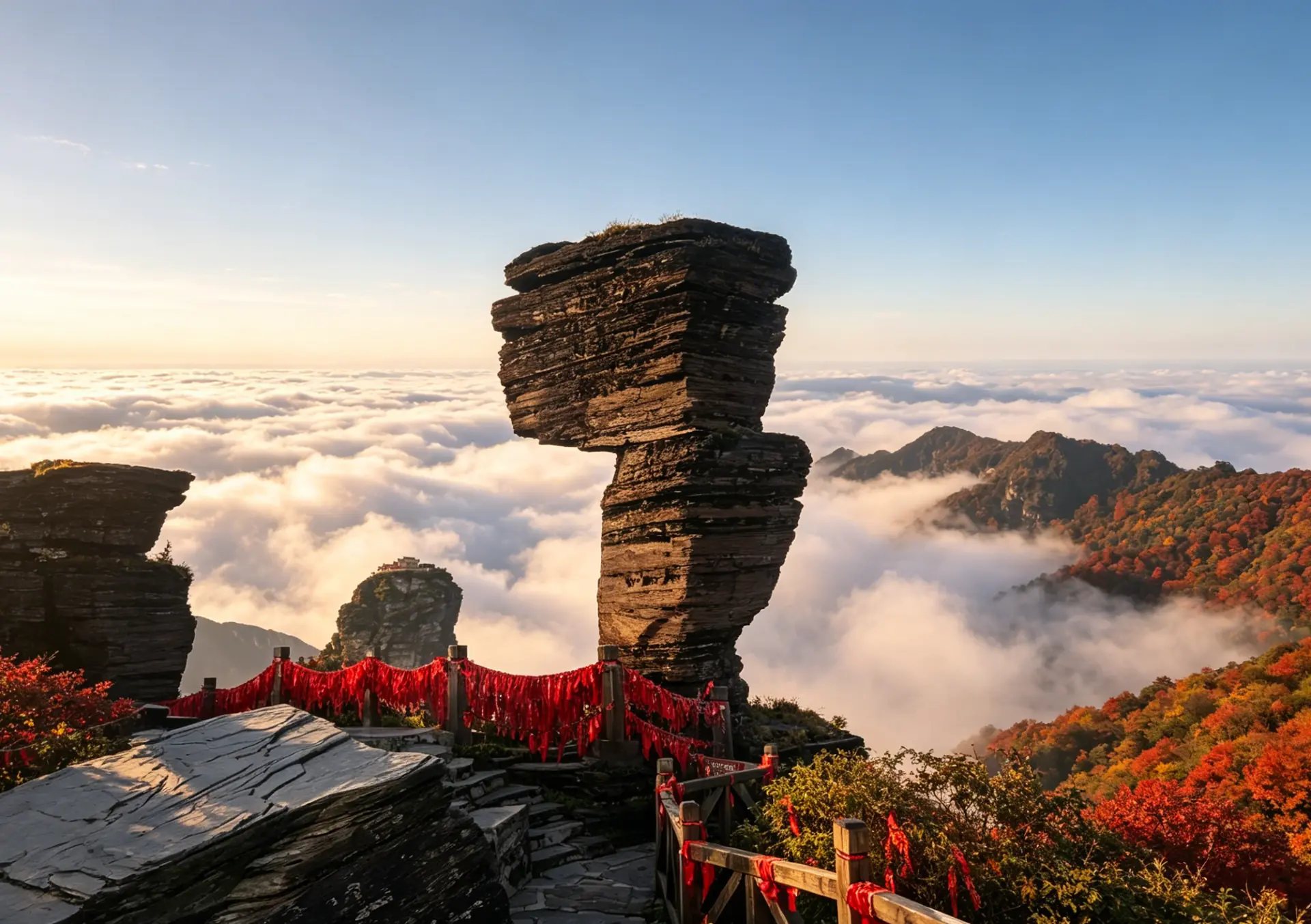
Autumn is Fanjingshan's prime season — red foliage, clear skies, and the highest cloud-sea probability of the year
Cloud-Chasing Strategy
Don't stake your entire trip on the cloud sea. Clear-sky views from the summits are equally spectacular. If you're determined to chase clouds, plan two consecutive days with an early-morning return on day two.
Buddhist Heritage Along the Path
Fanjingshan's identity as the bodhimanda of Maitreya Buddha traces back to the Tang Dynasty. During the Ming Wanli period (1573–1620), the imperial court designated Fanjingshan a "Famous Mountain" and funded large-scale temple construction — at its peak, nearly 50 temples dotted the slopes. Most were destroyed by war and natural disasters, but several key temples survive as reconstructions.
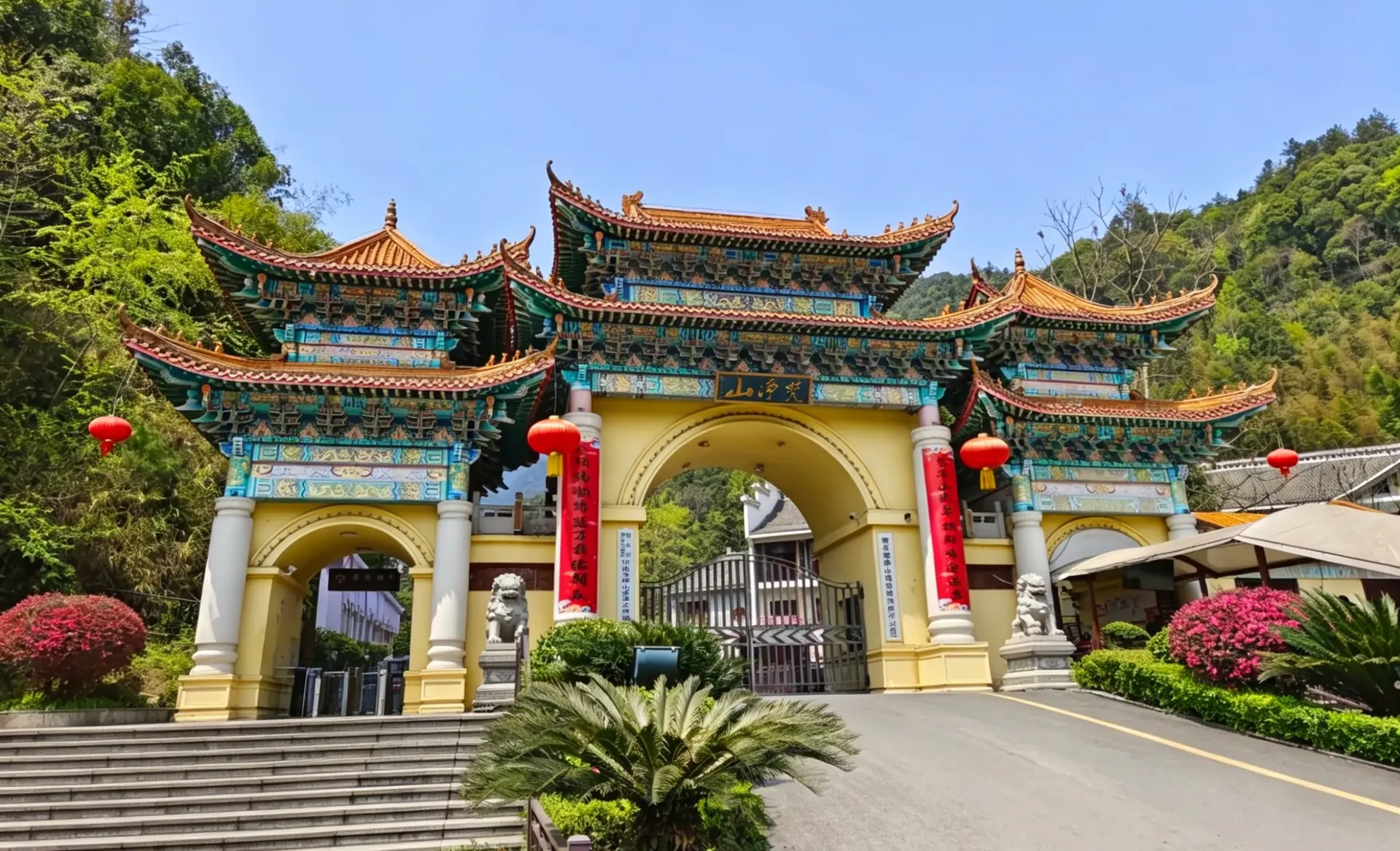
History
Originally built in the early Ming Dynasty, Cheng'en Temple was restored and imperially renamed by the Wanli Emperor in 1618.
Setting
The temple is modest in scale but extraordinary in location: it reportedly sits at the "heart" of a 10,000-meter Sleeping Buddha (万米睡佛) formed by the mountain ridgeline when viewed from a specific angle.
Route role
It also marks the fork between the Old and Red Cloud Golden Summit trails, where most visitors pause briefly at about 2,300 meters.
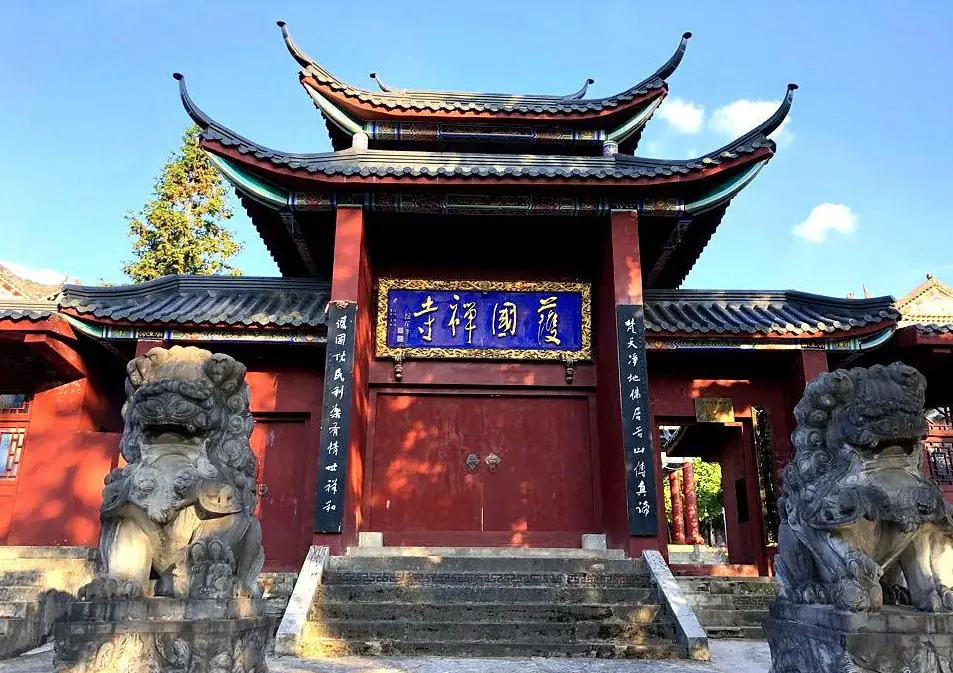
Trail role
Huguo Temple sits at the base of the West Gate route and serves as the starting point for hikers entering from the Yinjiang side.
Origin
Historical records place its founding in the Southern Song Jianyan period (circa 1126), though dating remains debated.
Rebuild
During the Ming Wanli period it was designated one of Fanjingshan's four imperially endorsed monasteries and was once the mountain's largest temple. The current buildings were rebuilt from 1998 onward on the original foundations.
Climb and views
For most foreign visitors, Fanjingshan's primary draw is its geological spectacle and natural scenery — Red Cloud Golden Summit, Mushroom Rock, cloud seas, and the iron-chain climb.
Maitreya heritage
If Chinese Buddhism interests you, Fanjingshan's identity as the Maitreya bodhimanda adds a unique cultural dimension. Visiting temples and exploring Maitreya beliefs does not conflict with a scenery-focused route.
Practical Tips Before You Go
Gear and Clothing
Mountain-day essentials
Non-slip hiking boots are essential.
The iron footholds and stone steps on Red Cloud Golden Summit are dangerously slippery after rain — regular sneakers are a genuine safety risk.
Rain jacket, not umbrella
Fanjingshan sees fog or drizzle on over 200 days a year. You'll need both hands free for the iron-chain climb.
Layer up
The summit is typically 10-15°C cooler than the base. Summer summit temperatures stay at 18-25°C; other seasons are colder.
Thin gloves
Useful for gripping the iron chains — they prevent blisters and improve grip.
Food and water
Resupply points on the mountain are scarce and charge 2-3x base prices. Bring at least 1.5 liters of water and enough snacks or lunch for the day. A few basic shops near the cable car upper station sell instant noodles and drinks.
Cell signal
The summit area has weak cell signal (China Mobile works best) — enough for WeChat messages but not smooth browsing. Download offline maps before you go.
Taxi Phrase Card
Show this to your driver when taking a taxi from Tongren South Station to Fanjingshan:
Show this screen to your driver · 出示给司机看
请送我到梵净山景区东门。
Please take me to Fanjingshan scenic area east gate.
Alternatively, take a bus from Tongren South to Jiangkou Bus Station (~45–80 min, ~¥45), then a shuttle to the East Gate (~30 min).
Frequently Asked Questions
Technically yes, but it's very tight. You'd need the earliest bus from Tongren (~7:00 AM), take the cable car both ways, visit only Mushroom Rock and Red Cloud Golden Summit, and return by 4:00–5:00 PM. A two-day trip with an overnight in Jiangkou is far more comfortable.
Sources checked for this guide
- Official Fanjingshan visitor rules, booking channels, route limits, and hotline: Fanjingshan Tourism Area ticketing policy
- Official entry windows, live notices, scenic profile, and daily capacity context: Fanjingshan Tourism Area homepage
- Official transport notes for Tongren, Jiangkou, and Yinjiang gates: Fanjingshan Tourism Area transport guide
- World Heritage ecology, 2018 inscription, and endemic species: UNESCO World Heritage Centre
- Biosphere reserve context and primary forest description: UNESCO Man and the Biosphere Programme
- 2025 Guizhou golden snub-nosed monkey population update: Tongren municipal biodiversity report
- Ticket price cross-check for base ticket, cable car, and sightseeing bus: Guizhou provincial Fanjingshan overview
Beyond This Guide
Fanjingshan sits in eastern Guizhou, off the mainstream "Guiyang–Huangguoshu–Xijiang" route, but only two hours from Fenghuang Ancient Town in Hunan. Use these next guides to connect the mountain with the rest of your China plan:
- Fenghuang Ancient Town — the easiest Hunan add-on after Fanjingshan.
- Mount Emei and Mount Huashan — compare China's big mountain days before choosing another climb.
- China High-Speed Rail Guide — plan the Tongren, Guiyang, or Hunan train legs.
- Alipay for Foreigners in China — set up mobile payments before small-town transfers and shuttle tickets.
© gochinafreely.com — Original guide by Go China Freely.