Entry and operating scan
The ¥80 promotion applies to the adult main-peak gate ticket only; cables and scenic shuttles remain separate. Recheck the live booking page before travel.
Before you choose a route
Mount Huashan sits about 30 minutes from Xi'an North by fast train and rises to 2,154.9 meters. Its five summits, cable-car combinations, night ascent, and controlled cliff trails create very different days on the same mountain. This guide helps you choose the route that matches your time and fitness, then verify the live operating details that can change the plan.
Five Sacred Peaks on One Mountain
Mount Huashan (华山) is the Western Sacred Peak among China's Five Great Mountains (五岳), located in Huayin (华阴) city, Shaanxi Province, about 120 km from downtown Xi'an. Each of the Five has a one-word reputation — Tai'shan for grandeur, Heng'shan South for beauty, Huashan for danger, Heng'shan North for solitude, Song'shan for steepness — and Huashan owns "danger" outright.
That reputation is geological fact. Huashan is a single granite monolith that erupts from the plains with near-vertical walls on all sides. For centuries there was literally one way up — the origin of the proverb "since ancient times, Huashan has only one path" (自古华山一条路). From the Tang dynasty onward, Huashan served as a core Taoist sanctuary; the legendary hermit Chen Tuan (陈抟) spent over forty years meditating in its caves.
For an independent Xi'an trip, the practical value is choice: a cable-assisted summit circuit can fit into one day, while the old hiking path and night ascent demand much more time and recovery.
Shorter summit day
West cable round trip
Prioritize West, South, and East Peaks with the least climbing.
Best first route
West up, North down
Traverse the main peaks without retracing the cable route.
Full mountain ritual
Hike from Yuquan Temple
Choose daylight or a partner-based night ascent for sunrise.
Peak by Peak — What to See at Each Summit
Huashan's five peaks are connected by ridgelines and cable cars. You don't need to visit all five — choose your priorities based on time and stamina.
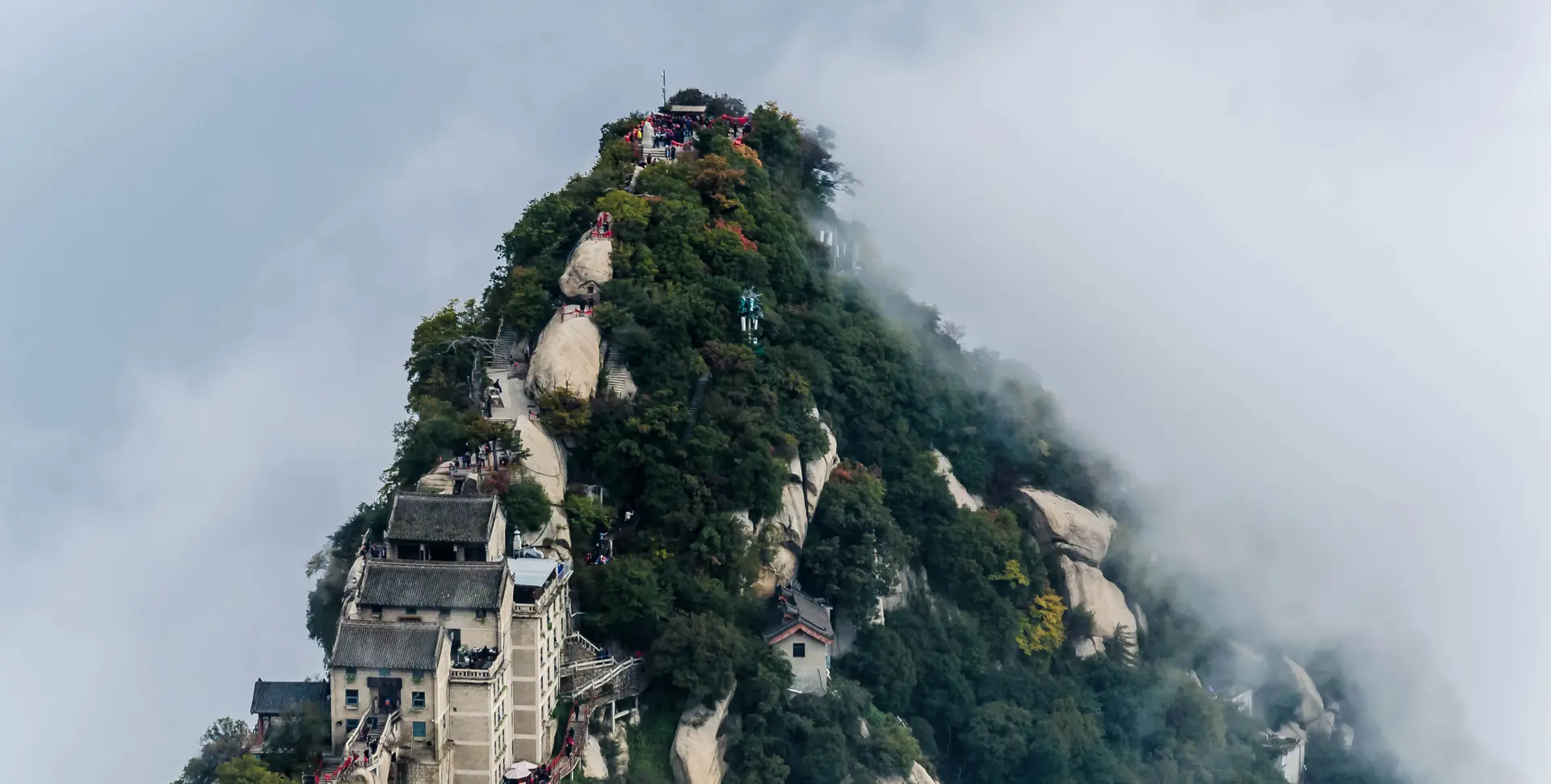
West Peak's sheer walls — the cable car deposits you right at the top of this monolith
West Peak · 2,082 m
Lotus Peak
The most photogenic of the five. From a distance West Peak resembles a blooming lotus; the massive boulder at its top is split by a deep fissure — this is the Axe-Cleaving Rock (斧劈石), from the legend of Chenxiang splitting the mountain to save his mother. The West Peak cable car terminates here, making it the starting point for most visitors. Sunset views are best from this peak, looking west over the Wei River plain.
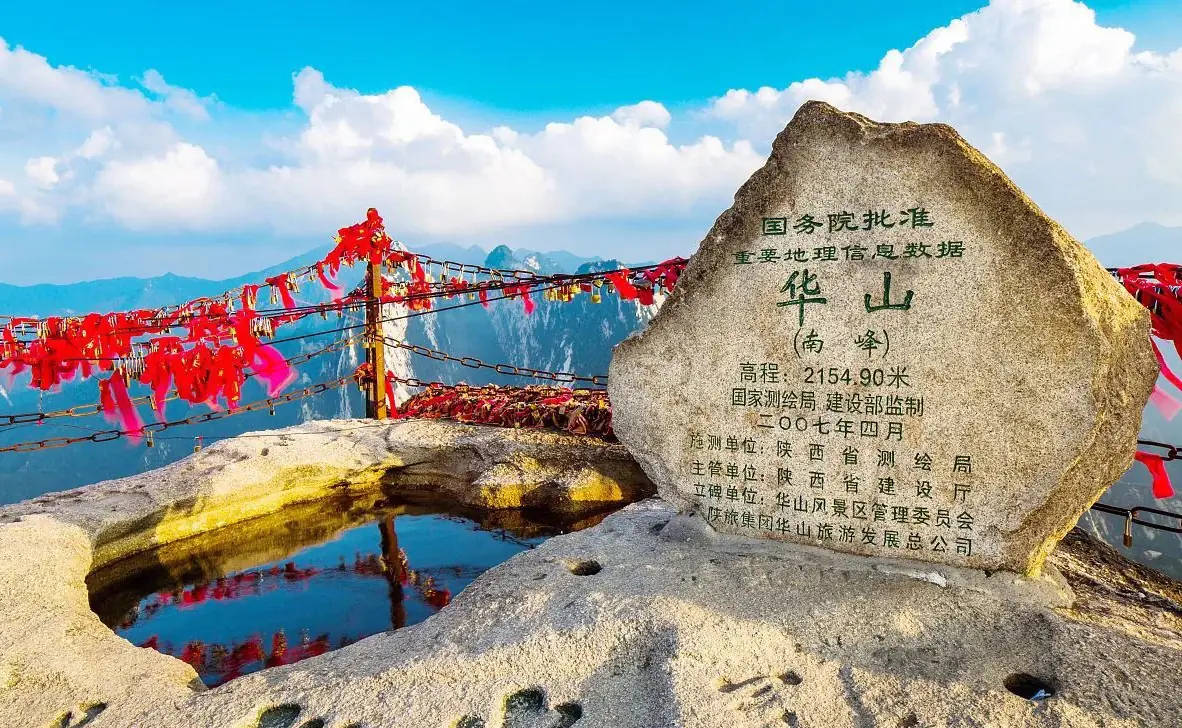
South Peak summit — the highest point among all Five Great Mountains at 2,154.9 m
South Peak · 2,154.9 m
Wild Goose Resting Peak
The highest of all Five Great Mountains. The summit marker stone reading "Pinnacle of Huashan" (华山极顶) is the obligatory photo spot. The Plank Walk clings to South Peak's eastern cliff face. Walking from West Peak to South Peak takes roughly 30–40 minutes.
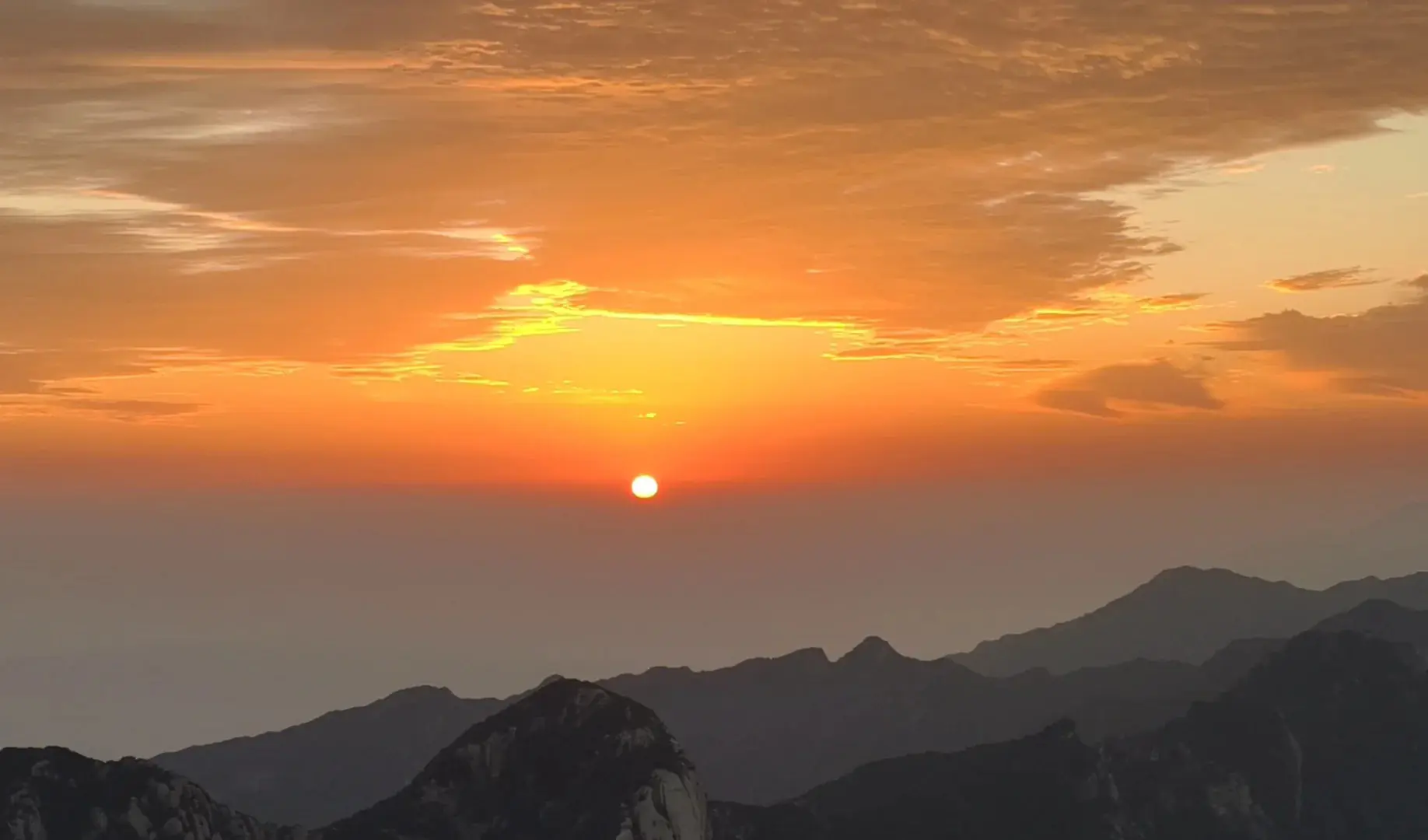
East Peak's Sunrise Terrace — the reward for a grueling night climb
East Peak · 2,096 m
Sunrise Peak
The best seat for sunrise. The Sunrise Watching Terrace (朝阳台) at its top faces due east with completely unobstructed views. The Sparrow Hawk Turn (鹞子翻身) — another white-knuckle trail — begins at East Peak on the path to the Chess-Playing Pavilion. East Peak also features the Immortal's Palm (仙掌崖), a natural rock formation shaped like a giant handprint, listed among the Eight Great Sights of Guanzhong.
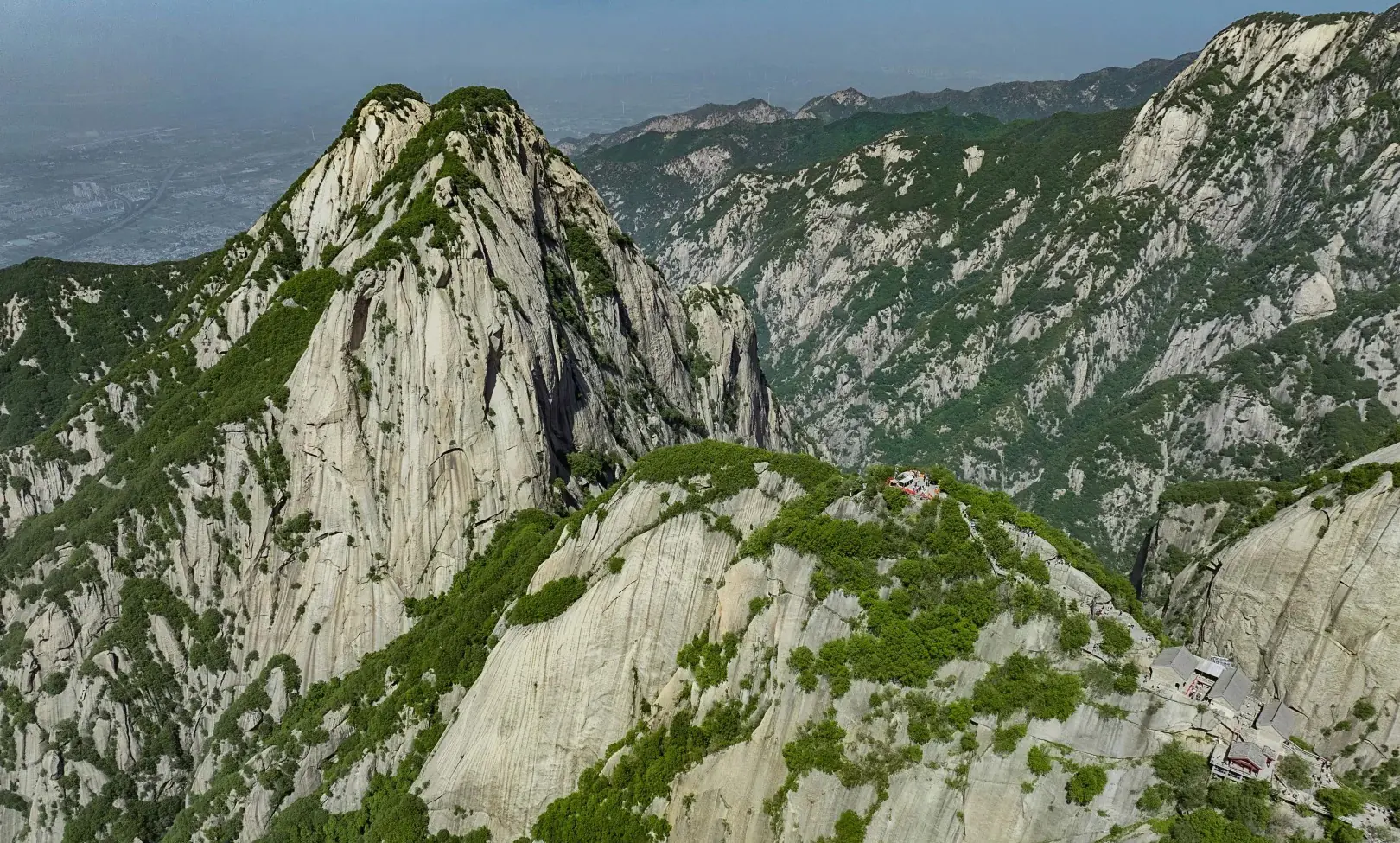
North Peak (Cloud Terrace Peak) — the lowest summit but a gateway to Canglong Ridge beyond
North Peak · 1,614 m
Cloud Terrace Peak
The lowest peak but the richest in modern history. In 1949 the People's Liberation Army scaled its sheer walls to capture Huashan — a story later turned into a feature film, "Outsmarting Huashan" (智取华山). The North Peak cable car ends here, and it's also the first summit hikers reach on foot. Getting from North Peak to the other peaks means crossing Canglong Ridge and Golden Lock Pass — a stretch that's one of Huashan's defining experiences.
Middle Peak · 2,037.8 m
Jade Maiden Peak
The smallest of the five holds the legend of musician Xiao Shi and princess Nong Yu, whose flutes summoned phoenixes. The quiet Jade Maiden Shrine (玉女祠) makes this a useful 10–15 minute pause between East and West Peaks.
The Thrill Trails — Plank Walk, Sparrow Turn & Beyond
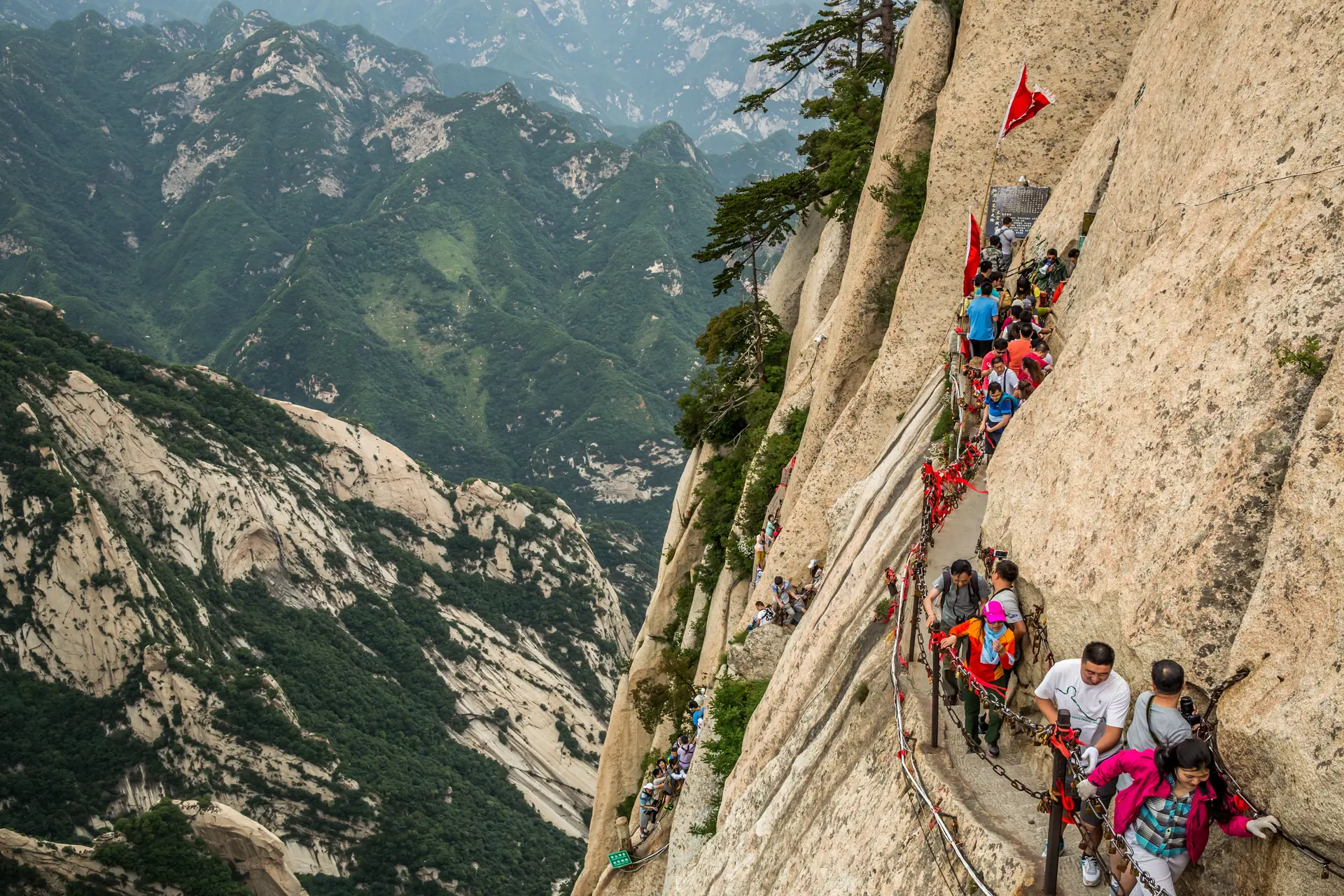
The Plank Walk seen from South Peak's viewing platform — the side angle captures the full scale of the cliff
The adrenaline rush on Huashan isn't about altitude — it's about the trails carved into sheer cliff faces.
Primary controlled trail · South Peak
Plank Walk (长空栈道)
The route combines a narrow upper ledge, a near-vertical chain descent, and the wooden-plank traverse. It is a supervised, out-and-back experience rather than a through-route.
Reservation
- Same-day slots are released from 6:30 when weather permits.
- Reservations cover 2–5 people; solo entry is not accepted under the published system.
- Each batch holds 30 visitors; allow roughly 1.5–2 hours.
Eligibility and safety
- Age 15–55 and at least 150 cm tall.
- Published medical exclusions include heart disease and high blood pressure.
- No sandals, high heels, skirts, metal objects, or sharp tools.
Treat the operating decision as final
Use only the equipment issued through the official reservation process, follow staff at every transition, and do not enter if you do not meet the published health, age, height, or clothing rules. Rain, wind, maintenance, or capacity controls can stop operation without notice. The South Peak viewing platform remains the lower-risk way to see the whole route.
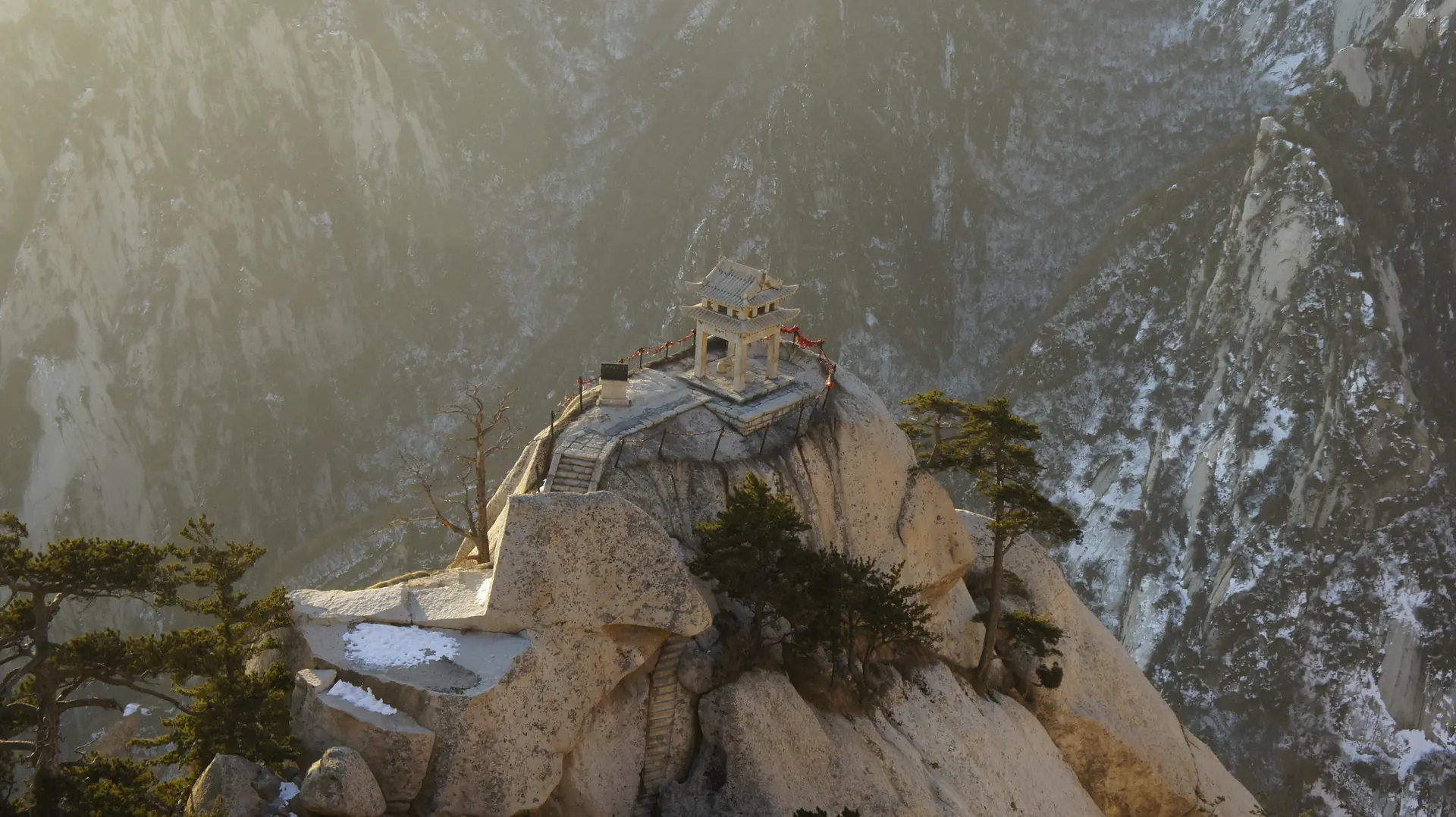
Sparrow Hawk Turn — climbers face the cliff and descend backward into the void
Controlled trail · East Peak
Sparrow Hawk Turn
The Sparrow Hawk Turn (鹞子翻身) is the path from East Peak down to the Chess-Playing Pavilion (下棋亭), known as Huashan's "second great thrill." Unlike the Plank Walk, this route is a downward climb — you face the rock wall with your back to the void, gripping chains and toeing into stone notches like a rock climber. It's shorter than the Plank Walk but the fear is more immediate — you spend the entire time staring at the cliff, afraid to look behind you.
It uses a separate same-day reservation and safety-equipment ticket. Older visitor information quoted about ¥30 for the harness, but the current system sells the equipment ticket online, so treat that figure only as a budget placeholder and verify the live price. The published rule is age 15–55 and at least 160 cm tall — 10 cm taller than the Plank Walk threshold. The bottom is the isolated Chess-Playing Pavilion; the descent-and-return has often been budgeted at about 30 minutes, but the current batch and weather controls decide the real duration.
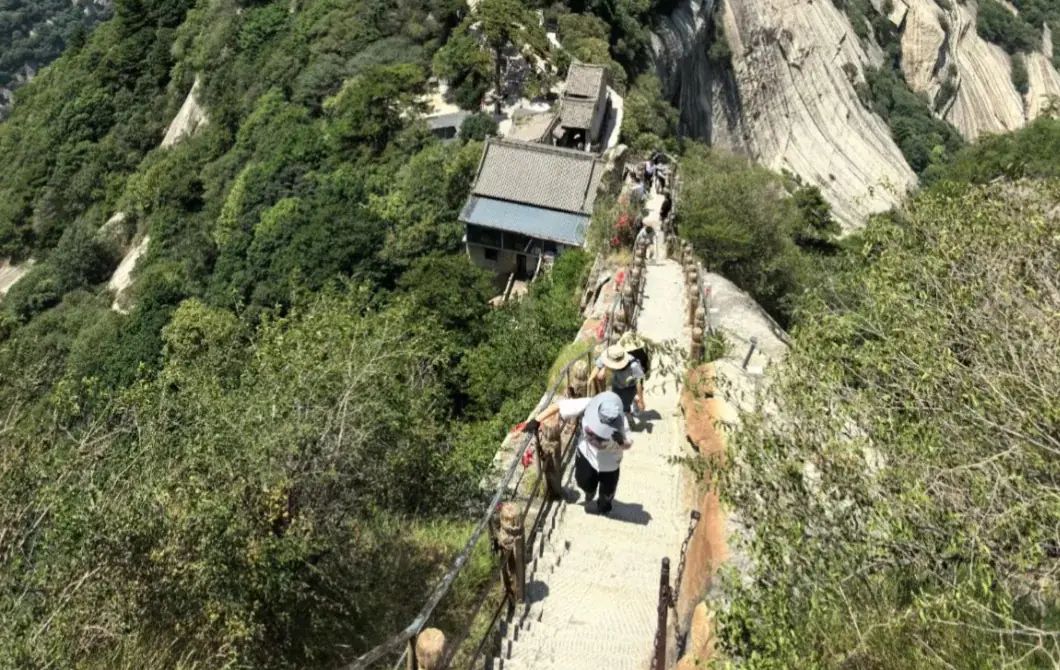
Canglong Ridge — walking the dragon's spine between North Peak and the higher summits
Open mountain route
Canglong Ridge
Canglong Ridge (苍龙岭) is the knife-edge ridgeline connecting North Peak to the higher peaks, with sheer drops on both sides — walking it feels like riding a dragon's spine (hence the name). About 1–1.5 meters wide with stone steps and chain railings, it requires no extra fee or reservation. Less extreme than the Plank Walk, but strong winds can make your legs go wobbly. The Tang dynasty poet Han Yu (韩愈) was so terrified at this spot that he wrote a farewell letter and tossed it off the cliff — a story still told today.
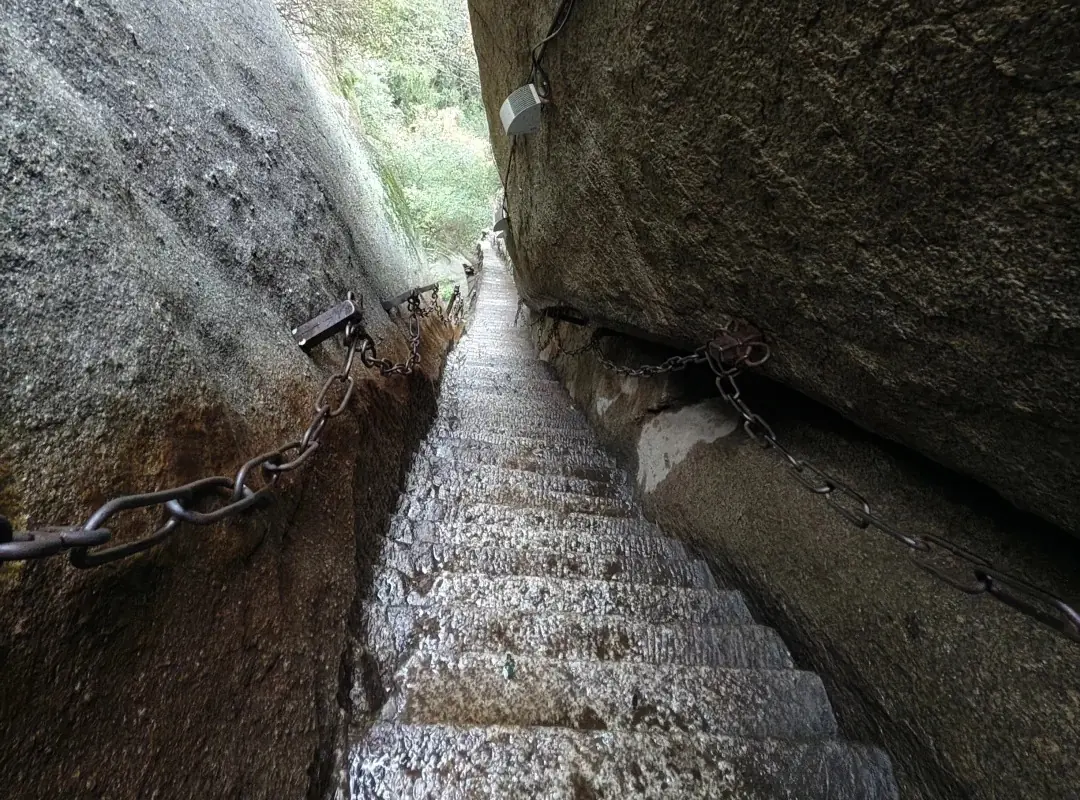
Thousand-Foot Precipice — 370 steps squeezed between two granite walls
Hiking-route stairways
Thousand-Foot Precipice & Hundred-Foot Gorge
These are the steepest staircases on the hiking route — Thousand-Foot Precipice (千尺幢) has 370 near-vertical steps wedged between two enormous boulders, with only a sliver of sky visible when you look up. Hundred-Foot Gorge (百尺峡) follows immediately after, equally narrow and steep. Cable car riders skip both entirely; if you're hiking or night climbing, these are mandatory — and among the most ceremonial parts of the ascent.
Choosing Your Route — Five Ways Up
Route selection is the most common headache for Huashan visitors. Here are five options for five different types of traveler.
Classic first visit · 5–7 hours
West up, North down
Four main peaks with no cable backtracking; mostly level or descending after the West cable. Regular peak-season formula: ¥160 gate + ¥40 West shuttle + ¥140 West cable + ¥80 North cable + ¥20 North shuttle = about ¥440.
More uphill · 6–8 hours
North up, West down
Cross Canglong Ridge while fresh and finish with the West cable. The regular peak-season components are the same as the classic traverse: about ¥440.
Three alternatives
West up, West down
The easiest 4–5 hour summit loop; three peaks, but retraces the cable route and skips North Peak. Regular peak-season total: about ¥520.
Full daylight hike
The old path and Thousand-Foot Precipice; allow 8–10 hours before any summit detours. Gate-only hiking starts at ¥160 regular; add about ¥100 for a North cable-and-shuttle descent or ¥180 for West.
Night climb
Use the same hiking-and-descent cost formula, but trade sleep for East Peak sunrise. Total time can approach a full overnight-and-day outing; the next section covers timing and suitability.
During the temporary Jul 15–Oct 10, 2026 adult gate promotion, subtract ¥80 from the regular peak-season formulas above. Discount eligibility and live cable/shuttle prices must be checked separately.
Before fixing trains and recovery time, compare the mountain day with the other priorities in the Xi'an first-timer overview.
Night Climb for Sunrise — Worth the Pain?
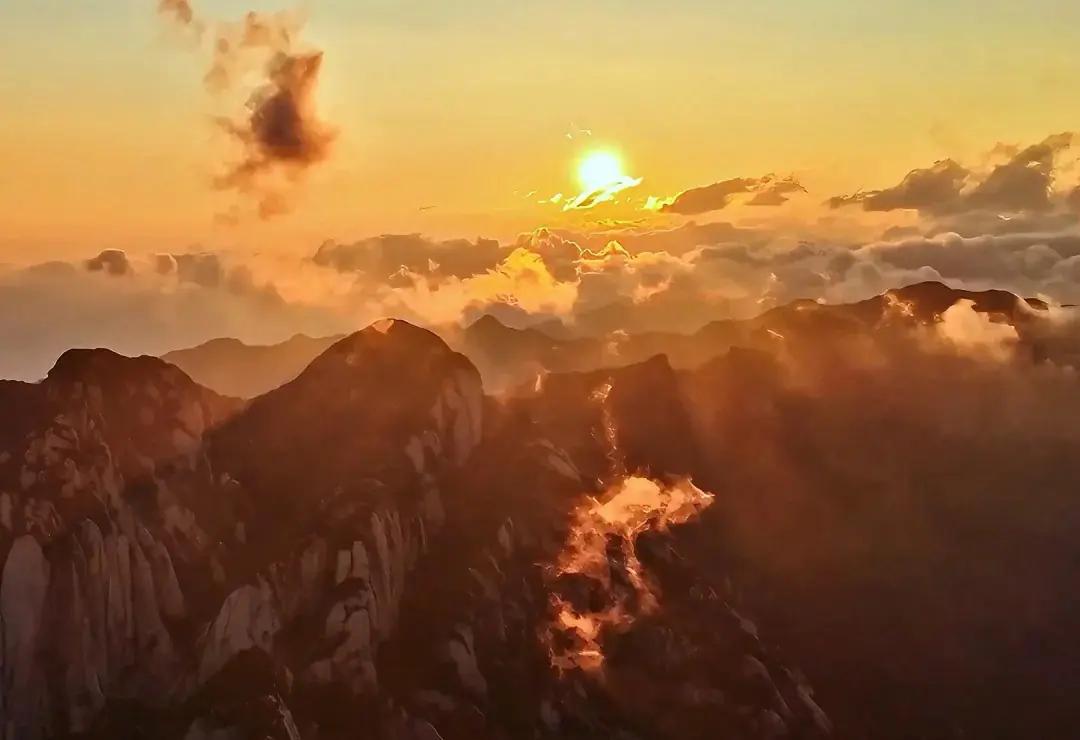
Sunrise above the cloud sea at East Peak — autumn mornings offer the best chance for this scene
Huashan's 24-hour hiking trail (Yuquan Temple entrance) is one of the few mountains in China where you can legally climb at night. The night-climb-for-sunrise is a bucket-list item for many adventurous travelers — grueling but unforgettable.
Back-time the ascent
Use the live sunrise time for your exact date, then add a 30-minute viewing buffer and a hiking margin that matches the slowest person in your group.
Planning estimates:
- Yuquan Temple to East Peak's Sunrise Terrace takes 6–7 hours (fast hikers: 5 hours; slow: 8+)
- Aim to reach the terrace 30 minutes before sunrise
- Summer sunrise ~5:00–5:30 → depart around 10:00 PM
- Winter sunrise ~7:00–7:20 → depart around 10:30 PM
- Spring/autumn sunrise ~5:30–6:30 → adjust by month
Approximate sunrise range
January
7:11–7:20
February
6:45–7:10
March
6:10–6:43
April
5:35–6:08
May
5:08–5:34
June
5:00–5:08
July
5:05–5:20
August
5:20–5:45
September
5:46–6:08
October
6:08–6:35
November
6:35–7:03
December
7:04–7:15
Treat the monthly table as a planning aid
Sunrise shifts daily and cloud, wind, maintenance, or crowd controls can change where you wait. Confirm the date-specific sunrise and the current mountain notice before departure. Bring a headlamp, warm windproof layers, food, and enough battery for the overnight climb. Older planning references put coat rental near the terrace at about ¥20–30 and warned of hour-plus morning cable queues; treat both as rough contingencies, not current guarantees.
Who should try it: medium fitness or above, some hiking experience, comfortable with heights, willing to sacrifice a night of sleep. Go with at least one partner.
Who should skip it: anyone whose health, knees, balance, sleep tolerance, or fear of exposure makes a long overnight stair ascent unsafe; families with young children; and winter visitors without icy-step experience. Choose a cable-assisted daylight route instead.
Taoist Heritage Most Visitors Skip
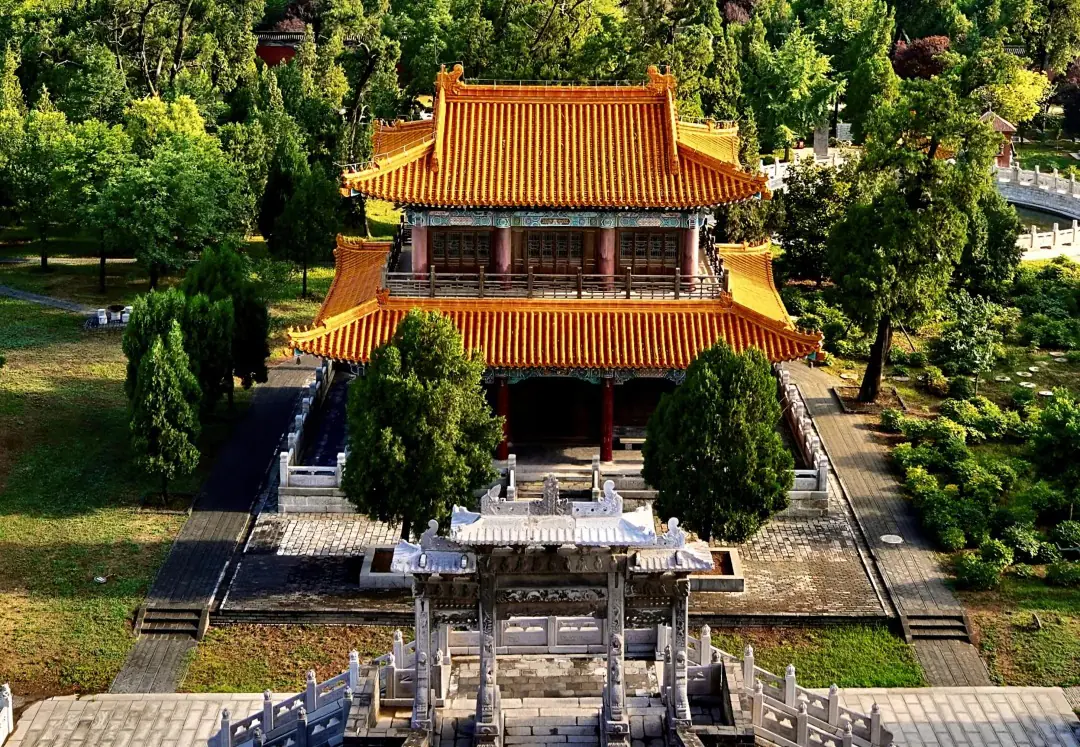
The full Xiyue Temple complex — nicknamed Shaanxi's Little Forbidden City
Huashan holds a status in Taoism comparable to a sacred mountain in any major religion — it's the "Fourth Grotto-Heaven" (第四洞天) in the Taoist cosmology, and since the Han dynasty emperors have traveled here to perform sacrifices to the Western Sacred Peak. Most visitors focus entirely on the thrill trails and photo ops, missing the rich Taoist architecture both on and off the mountain.
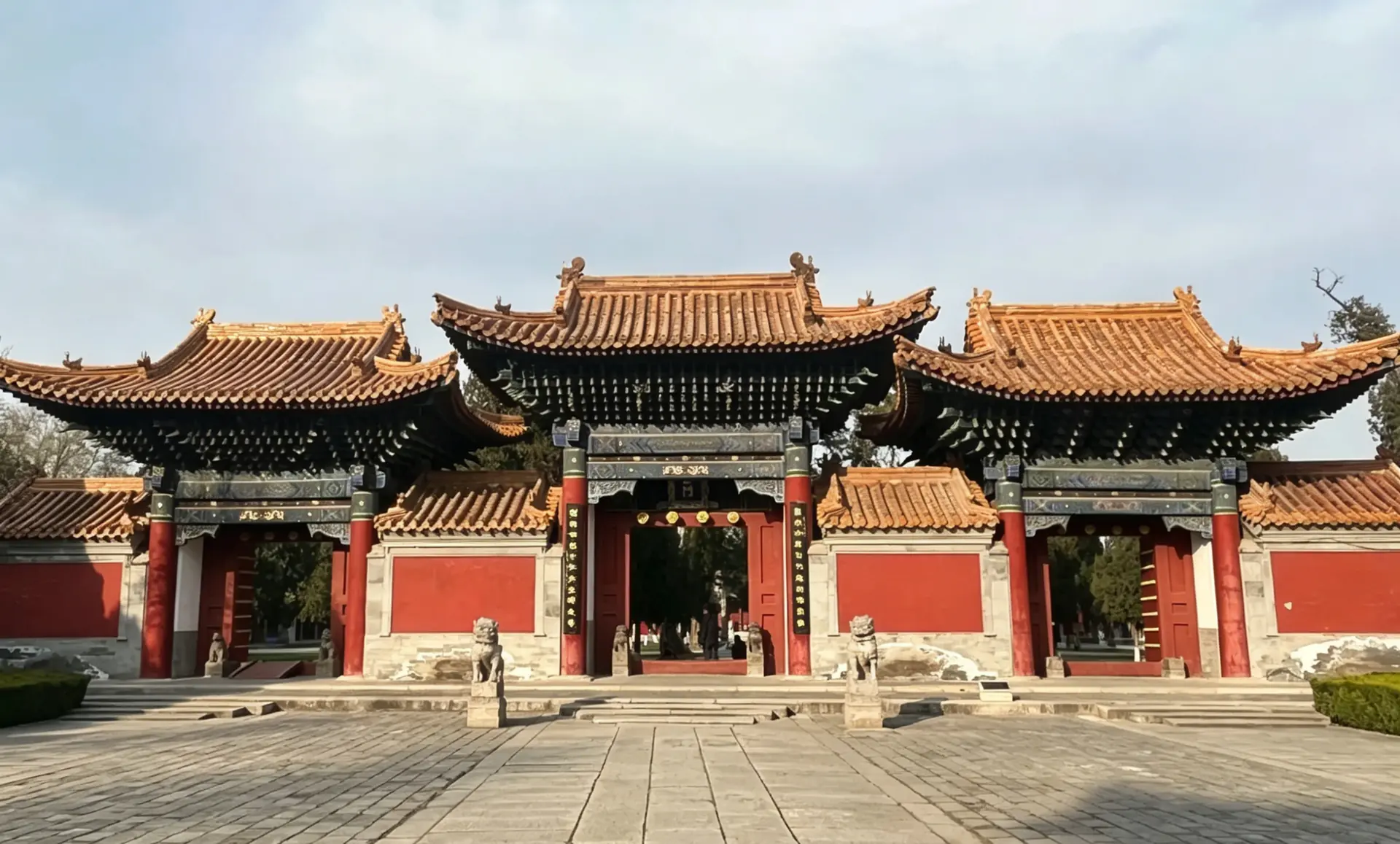
Xiyue Temple's main hall — over 2,100 years of Huashan worship history behind these walls
Main heritage stop
Xiyue Temple · “Shaanxi's Little Forbidden City”
Xiyue Temple (西岳庙) sits in Huayin city, just 1.5 km from the Huashan Visitor Center. Founded in 134 BCE (Western Han dynasty), it has over 2,100 years of history as the official site where emperors performed sacrifices to Mount Huashan. The complex covers 124,000 square meters with red walls, glazed-tile roofs, and flying eaves modeled after Beijing's Forbidden City — earning it the nickname "Shaanxi's Little Forbidden City."
This place sees a fraction of Huashan's summit crowds. Don't miss Haoling Hall and the rear garden. The official visitor-center page says Huashan ticket holders can use the linked green scenic shuttle to Xiyue Temple; confirm whether admission is included in your specific live ticket rather than relying on older ¥15 or 24-hour rules.
Trailhead temple
Yuquan Temple (玉泉院)
The hiking entrance is also a Song-dynasty Taoist monastery, shaded by old cypresses and associated with the hermit Chen Tuan. Pause here before committing to the long stair ascent.
Yuquan Temple (Google | Amap)Shrines on the mountain
Match the shrine to the peak
- Cuiyun Palace, West: beside Axe-Cleaving Rock.
- Jintian Palace, South: the highest Taoist shrine here.
- Zhenwu Hall, East: dedicated to the protector deity Zhenwu.
- Jade Maiden Shrine, Middle: tied to Nong Yu and Xiao Shi.
Tickets, Cable Cars & Scenic Shuttles
Main gate
¥160
Mar–Nov regular
¥100
Dec–Feb regular
Scenic shuttles
North · ¥20
each way
West · ¥40
each way
Cable cars · peak / off-peak
North Peak
One-way ¥80 / ¥45
Round-trip ¥150 / ¥80
West Peak
One-way ¥140 / ¥120
Round-trip ¥280 / ¥240
Temporary adult gate promotion in effect
From July 15 through October 10, 2026, the announced adult main-peak gate price is ¥80. It does not discount cable cars or scenic shuttles. Use the live booking page to confirm availability and the price attached to your date.
- Children under 6 or below 1.2 m: free gate ticket
- Seniors 65+: free gate ticket, half-price cable car
- Students: half-price gate ticket (student ID required)
Buying Tickets with a Foreign Passport
Huashan uses real-name, timed advance booking. Ordinary gate tickets are generally not sold at the site, and the cable-entry product cannot be used at the hiking entrance (or vice versa).
- Trip.com(affiliate link · may earn commission, no extra cost): compare the currently listed passport-compatible products, inclusions, entry route, and cancellation terms before paying
- Official WeChat channel: follow the current passport-entry prompts and select the exact cable or hiking entrance you will use
- Special-ticket counter: concession eligibility may require document verification here; do not treat it as a fallback for an unreserved ordinary ticket
Book as soon as your date and route are fixed, especially around Golden Week and Labor Day. Carry the original passport used for the order.
Cable Car Hours
- Current published window
- 7:00–16:00
- Current published window
- 7:00–19:00
- Current published window
- 00:00–23:59
These are general published windows, not a guarantee for every weather day or maintenance period. Arrive well before the 16:00 cable-entry cutoff and recheck the official notice on the day.
Huashan Visitor Center (Google | Amap)Getting to Huashan from Xi'an
Recommended from Xi'an
Fast train to Huashan North
The ride from Xi'an North is about 30 minutes. A practical advance budget is roughly ¥54.5 for many G trains or ¥34.5 for many D trains, but use the live rail inventory for the exact service. Outside Huashan North Station, official guidance points to free city buses 1 or 2 for the roughly 15-minute transfer to the Visitor Center. Taxis are the flexible alternative; older local estimates put the short ride near ¥15–20, so confirm the meter or app quote.
Huashan North Railway Station (Google | Amap)Slower alternatives
Tourism bus or driving
Current Xi'an tourism-bus departures and stops can change; verify the live Fangzhicheng Transport Hub service rather than using the retired East Bus Station advice. Use about 2 hours and ¥30–40 only as a legacy planning allowance. Driving is about 120 km via the Lianhuo Expressway; parking has often been budgeted around ¥20–30 per day, but confirm the posted rate and road conditions.
Two entrances — ticket type decides
Visitor Center
Use this for cable-route check-in and the scenic shuttles to the North or West cable stations.
Yuquan Temple / Huashan Gate
Use this for the walking ascent. The published hiking-entry window is 24 hours.
| English | Chinese | Pinyin | Say It Like… |
|---|---|---|---|
| Please go to Huashan Visitor Center | 请到华山游客中心 | Qǐng dào Huáshān yóukè zhōngxīn | Ching dow Hwah-shan yo-kuh jong-shin |
| How much to the visitor center? | 到游客中心大概多少钱? | Dào yóukè zhōngxīn dàgài duōshǎo qián? | Dow yo-kuh jong-shin dah-guy dwor-shaow chyen? |
Where to Eat, Sleep & Recharge
Sleep for sunrise
Summit lodging
East Peak is closest to the terrace; West Peak is roughly a 30–40 minute walk away; North Peak is farthest. Basic summit doubles have often been budgeted around ¥600–900 in peak season; verify the live room, bathroom, bedding, and cancellation terms before paying.
Sleep for an early start
Base lodging
Choose Huashan North for train convenience, Yuquan Temple for a night-climb start, or Huayin center for a wider choice. Basic chain rooms near the station have often fallen around ¥150–300; verify the date-specific rate. If sunrise is not essential, the base is usually better value and more comfortable.
Food and water plan
On the mountain
A working budget is roughly ¥15–25 for instant noodles, ¥10–15 for water, and ¥40–60 for a simple meal — often 3–5× base prices. Verify posted prices, carry energy-dense food and enough water, then use North Peak, Golden Lock Pass, and peak hotels as backup resupply points.
At the base
Try Huayin specialties such as broad-cut 大刀面 (Dà Dāo Miàn), sour-broth 麻食泡 (Má Shí Pào), and buckwheat 踅面 (Xué Miàn). Huayin center offers more choice than the transport forecourts.
Weather, Gear & Insider Tips
Best Season
🌸Spring (Apr–May)
Comfortable temperatures, wildflowers, moderate cloud sea chances, medium crowds. A sweet spot between winter chill and summer heat.
🍂Autumn (Sep–Nov)
The top pick. Clear skies, red and gold foliage, highest cloud sea probability — mid-to-late October is peak color season.
☀️Summer (Jun–Aug)
Hot at the base but cool at the summit. Crowded during school holidays, occasional heavy rain in July–August.
❄️Winter (Dec–Feb)
Fewest visitors, stunning snow scenery, but some trails close and ice makes steps dangerous — cable cars may halt in severe weather.
Summit conditions are often markedly colder and windier than the base; use the mountain forecast, not Huayin city weather, when packing.
Packing Checklist
- Non-slip hiking shoes — granite steps are polished smooth
- Windproof jacket or light shell — summit winds can be fierce
- Gloves for gripping iron chains — ¥5–10 at the gate, cheaper than on top
- Headlamp or flashlight (night climb essential)
- 2–3 liters of water
- High-energy snacks: chocolate, nuts, energy bars
- Power bank
- Sunscreen and hat (summer)
- Rain poncho — not an umbrella (too windy)
- Avoid a heavy backpack — confirm current luggage-storage availability and fees before relying on it
Insider Tips
Golden Lock Pass is the bottleneck
Hikers coming up from North Peak and visitors traversing the higher summits funnel through Golden Lock Pass (金锁关). It can become slow on busy days, so protect buffer time instead of building a cable, train, or thrill-trail reservation around a best-case walking pace.
Can't get Plank Walk tickets?
If the reservation slots are gone, South Peak has a viewing platform with a side-on view of the entire walkway. The composition from there is arguably better than selfies taken while shuffling along the planks — and it's free.
Bring your passport — the original
Huashan uses real-name verification. Carry the original passport used for the booking and keep the matching order available; a copy or phone image may not satisfy the current document check.
- Cable-car queue strategy: allow a generous descent buffer on weekends and holidays; a timed train should never depend on the final operating window
- Gloves: bring your own pair for cold or hot chain rails rather than relying on a fixed gate price
- Luggage: travel with essentials only. Storage at the Visitor Center or Yuquan Temple has often been budgeted at about ¥20–30; confirm live availability and price before arriving with a suitcase
Frequently Asked Questions
Yes, but use a live product that explicitly accepts your passport and matches the entrance you will use. Trip.com may list passport-compatible products, while the official channel provides the current route and time-slot inventory. Ordinary on-site gate-ticket sales are not a reliable fallback. Carry the original passport used for the booking.
Sources checked for this guide
- Current official FAQ checked for timed real-name booking, route-specific entry, cable-entry check-in, cable operating hours, and 24-hour hiking entry: Mount Huashan official travel FAQ
- Official ticket and transport page checked for regular gate, cable and shuttle prices, foreign-document concession handling, and the free bus 1/2 connection from Huashan North: Mount Huashan official ticket and transport guide
- Official 2025 route guide checked for West/North cable combinations, transfer context, and realistic route sequence: Mount Huashan official weekend route guide
- Published scenic-area announcement checked for Plank Walk and Sparrow Hawk Turn release time, batch size, duration, age, height, health, clothing, and equipment rules: Huashan thrill-trail reservation announcement mirror
- Live English-facing listing checked for current passport-compatible products and attraction-page continuity; inclusions and document terms remain product-specific: Trip.com Mount Hua listing
- Current public notice cross-check for the Jul 15-Oct 10, 2026 adult main-peak gate promotion and its exclusion of cables and scenic shuttles: 2026 Huashan summer-autumn ticket promotion notice
Beyond This Guide
Huashan packs enough thrills and views to fill two days, but fitting it into a larger Xi'an itinerary — timing the Terracotta Warriors, the Muslim Quarter, and the city wall alongside a mountain day — takes some choreography.
© gochinafreely.com — Original guide by Go China Freely.