Visit basics
Free entry still requires a real-name Alipay/WeChat reservation. See booking rules
Decision notes
Lingyin Temple: Living Zen Monastery
Why Lingyin matters
A 1,700-year monastery that still feels alive
Lingyin Temple (灵隐寺) was founded in 326 CE, long before Hangzhou became famous for West Lake (西湖). This is not a museum behind glass: monks still ring the morning bell, chant at dawn, and keep a 1,700-year Zen tradition alive in the same forested valley.
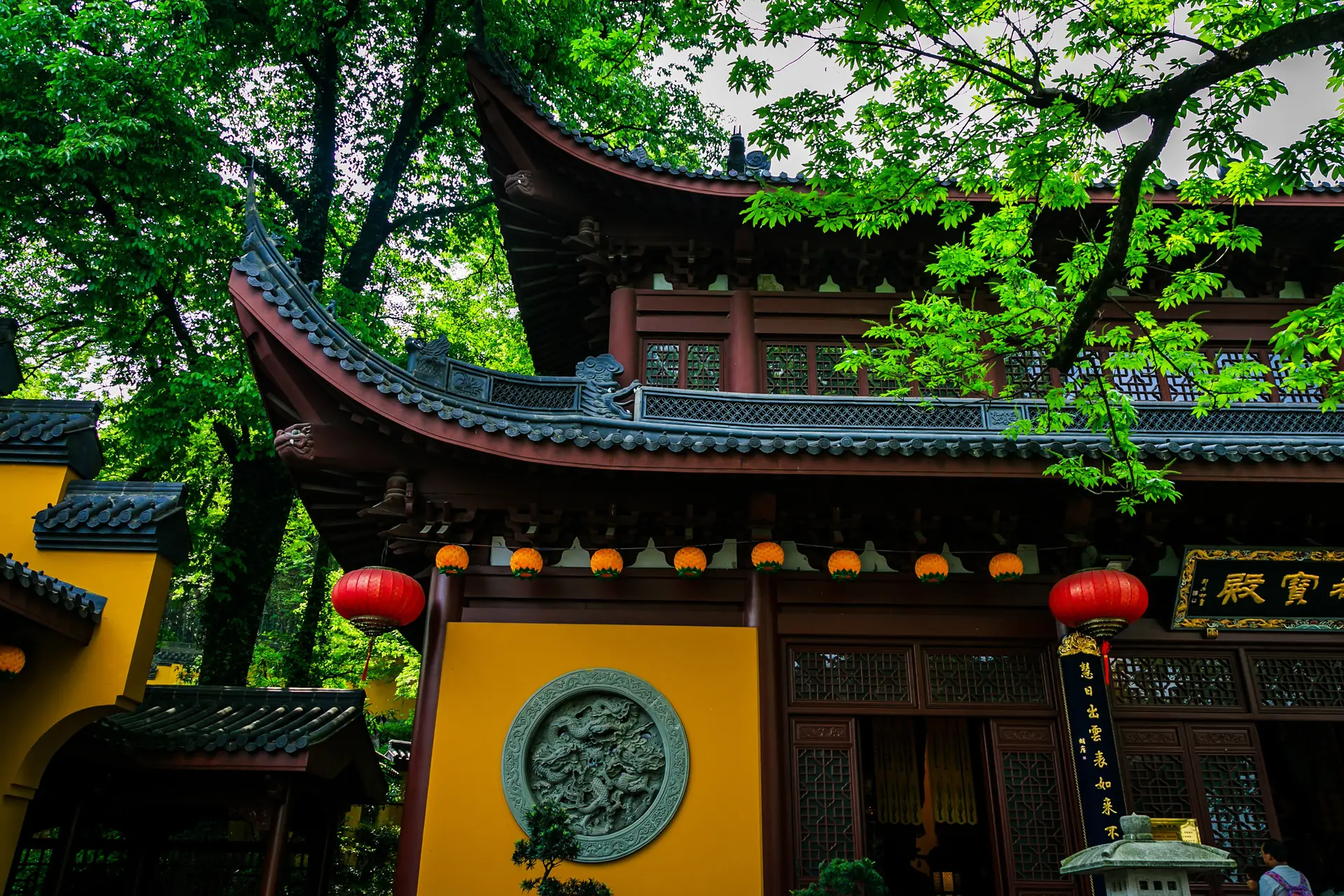
Lingyin's opening mood: forest canopy, yellow monastery walls, and wooden halls before the route reaches the formal temple axis.
Before the temple gate
More than 340 Buddhist figures are carved directly into the cliff face of Feilai Peak (飞来峰), Cold Spring Creek threads through ancient camphor forests, and the air shifts between sandalwood smoke and damp stone.
Free, but not walk-in
Since December 2025 the whole Lingyin-Feilai Peak area has been free, but you still need a reservation; this guide shows you what to see, how to book, and how to pace the visit.

⛰️The Name at the Gate
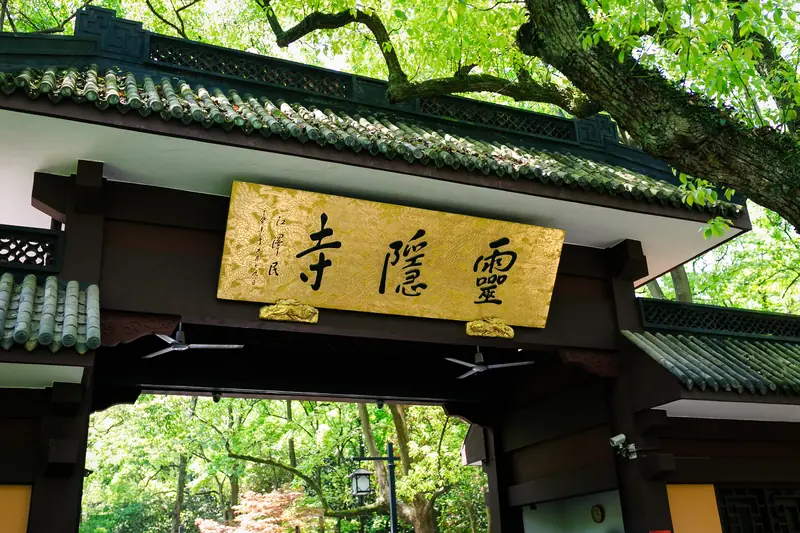
The temple's name, 灵隐 ("where spirits retreat"), is carved into the stone gate plaque at the entrance. Beyond this threshold, the forested hills swallow the sounds of the city, and camphor trees older than many European cathedrals line the path to the first courtyard.
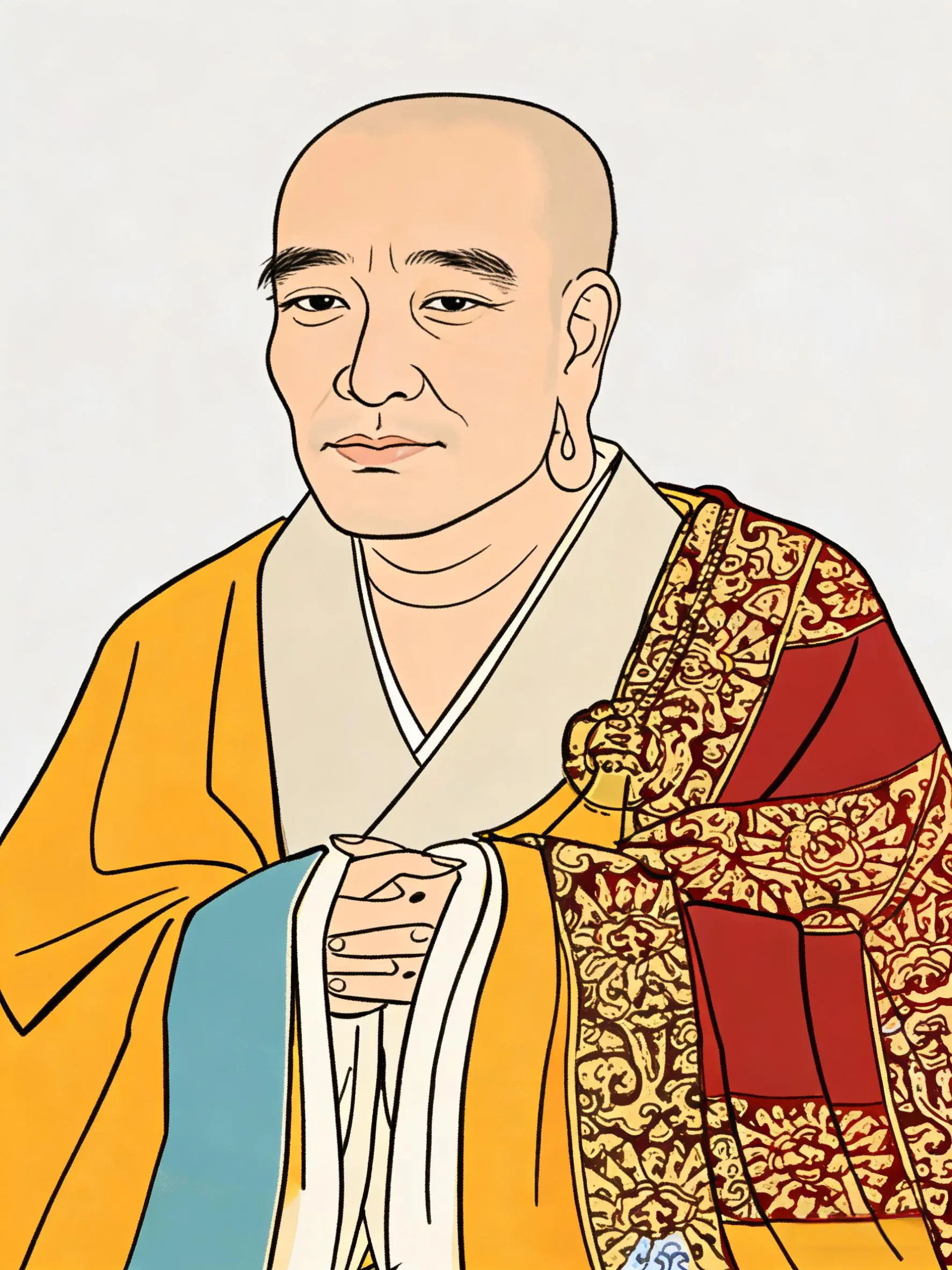
🧘Founder Huili
Look closely at the illustration and you will notice he carries no luggage — just robes and resolve. After walking the Silk Road from India, Huili stopped here, looked up at the limestone peak, and never left.
Best Times & Visit Routes
Timing matters more at Lingyin than the ticket price. The site is free now, but the experience changes sharply by hour, season, and whether you treat the visit as a half-day temple route or a full Hangzhou day.
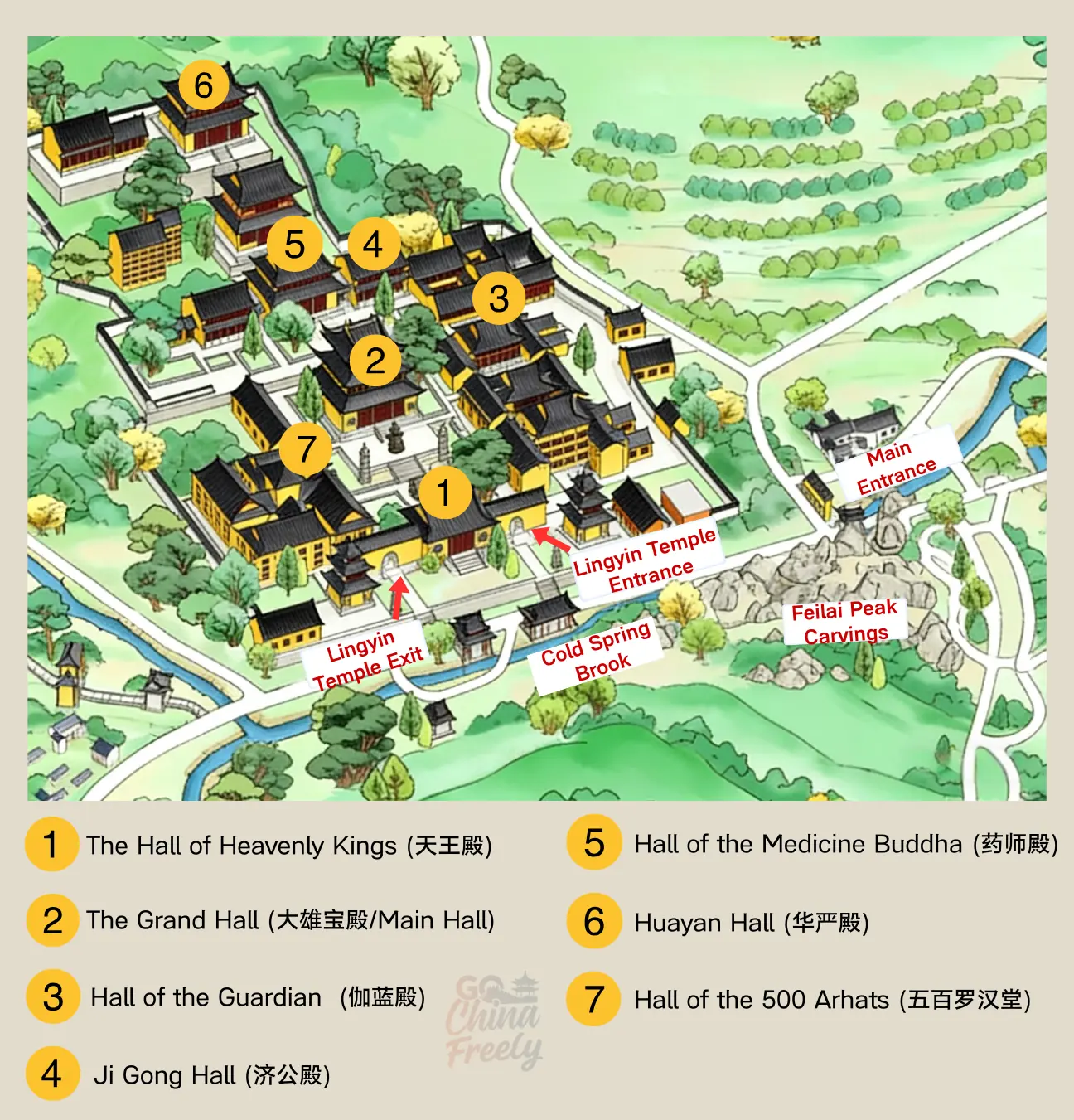
Walking strategy: Read Lingyin as two connected loops. First follow Feilai Peak from the scenic gate toward Cold Spring Creek. Then enter the temple and climb through the halls before looping down to the Arhat Hall.
Use the map like this: On arrival, decide whether you are doing the half-day route or the full-day route. The map should guide your order, not become another detached image.
Two golden windows
07:30-09:00 "The real temple"
Experience
Morning mist, monks chanting, local worshippers, natural sounds dominate.
Best for
Photography, immersive experience.
15:00-17:00 "The golden temple"
Experience
Tour groups thinning out, golden-hour light, quiet personal space.
Best for
Crowd avoidance, golden-hour photos.
Seasonal guide
Mar-Apr
★★★★★
Best — spring blooms, comfortable temperatures, moderate crowds.
May 1-5
Avoid
Labour Day Golden Week — overwhelming crowds.
Jun-Aug
★★★
Hot and humid, but Lingyin in the rain has a special atmosphere.
Sep-early Oct
★★★★★
Best — crisp air, autumn foliage.
Oct 1-7
Avoid
National Day Golden Week — do not come.
Nov-Feb
★★★★
Great — few crowds, crisp air, temples are especially peaceful in winter sun.
Route options
Choose one route before you reserve your time slot:
- Half-day route- Feilai Peak carvings (1 hr) -> Lingyin Temple five halls + Arhat Hall (1.5-2 hrs) -> bowl of noodles at Shi Fang Yuan -> done
- Full-day route- Half-day route + Yongfu Temple (30 min) -> Taoguang Temple hike (1 hr round trip) -> Tianzhu Road snacks or Longjing Village tea tasting
Lingyin + West Lake Combo
Lingyin Temple and West Lake are Hangzhou's two essential experiences, easily combined in one day.
🌉Classic combo
Enter Lingyin at 7:30, finish by 11:30, bus or taxi to West Lake north shore, lunch, then stroll Broken Bridge (断桥), Bai Causeway (白堤), and Su Causeway (苏堤).
🥾Outdoor lover's route
Spend the morning at Lingyin, walk to Nine Creeks (九溪烟树), hike through the valley to Longjing Village, taste tea, then bus back toward West Lake.
Tickets, Reservations & Transport
Since 1 December 2025, the entire Lingyin-Feilai Peak scenic area is free. Visitors previously paid ¥45 for Feilai Peak plus ¥30 for the Lingyin Temple incense voucher — ¥75 total. Now everything is free, but you must reserve in advance. No reservation = no entry, no matter how far you have travelled.
Reservation first
Book the free slot before you go
Open Alipay or WeChat and search the mini-program "杭州灵隐飞来峰" (Hangzhou Lingyin Feilai Peak).
Pick morning 7:30-12:00 or afternoon 12:00-17:00, then register with your passport, HK/Macau/Taiwan ID, or residence permit.
At the gate, scan the QR code or show the original document. Staff can still ask for the same passport or permit used for the reservation.
¥0
Entry price
Reserve 1-7 days ahead through the official mini-program.
35k / 50k / 65k
Daily cap
Weekdays, weekends, and holidays have different capacity limits.
No-show rule
Since February 2026, failing to show up without cancelling may ban your account from booking for 30 days. If your plans change, cancel through "My Reservations" (我的预约) before the visit time — it takes ten seconds.
Slot logic and hotel help
Morning slots are better for the Feilai Peak-first route. Afternoon slots are better for golden light, but leave less margin for Yongfu Temple or the Taoguang hike. If you cannot navigate the Chinese mini-program, ask your hotel front desk to walk you through it the evening before your visit.
Where to aim
Lingyin Temple (Google | Amap) sits roughly 5 km northwest of West Lake, at No. 1 Fayun Lane, Lingyin Road, Xihu District (西湖区灵隐路法云弄1号).
Bus or metro + shuttle
Most reliable from West Lake
From the West Lake core area, take Bus Y2, Bus 7, or Bus 27 to the Lingyin stop — about 30-40 minutes, ¥2-3. Alternative: Metro Line 3 to Huanglong Sports Centre (黄龙体育中心), then the Lingyin shuttle bus for a direct ride to the temple gate — 45-75 minutes total, ¥4-9.
Taxi, Didi, or bike
Use with timing caution
Taxi or Didi from the West Lake core is usually ¥20-50 and 15-30 minutes depending on traffic. Shared bikes take 20-30 minutes through tea plantations and hills, but expect a moderate uphill stretch.
Avoid taxis between 16:00 and 18:00
Closing-time traffic can be brutal: drivers cancel, surge pricing kicks in, and the road near the scenic area backs up. Instead, walk to the underground bus stop, take the shuttle back to Huanglong Sports Centre, then use Metro Line 3.
Show this screen to your driver · 出示给司机看
请带我去灵隐寺正门
Please take me to Lingyin Temple main gate.
Feilai Peak Cliff Carvings
After passing through the scenic area gate, the first thing you encounter is not Lingyin Temple — it is Feilai Peak (飞来峰) (Google | Amap), the stone-carving zone. This is southern China's largest collection of cliff-face Buddhist sculptures: more than 340 figures spread across limestone walls, carved from the Five Dynasties through the Yuan dynasty (10th–14th century) — an open-air gallery of Buddhist art.
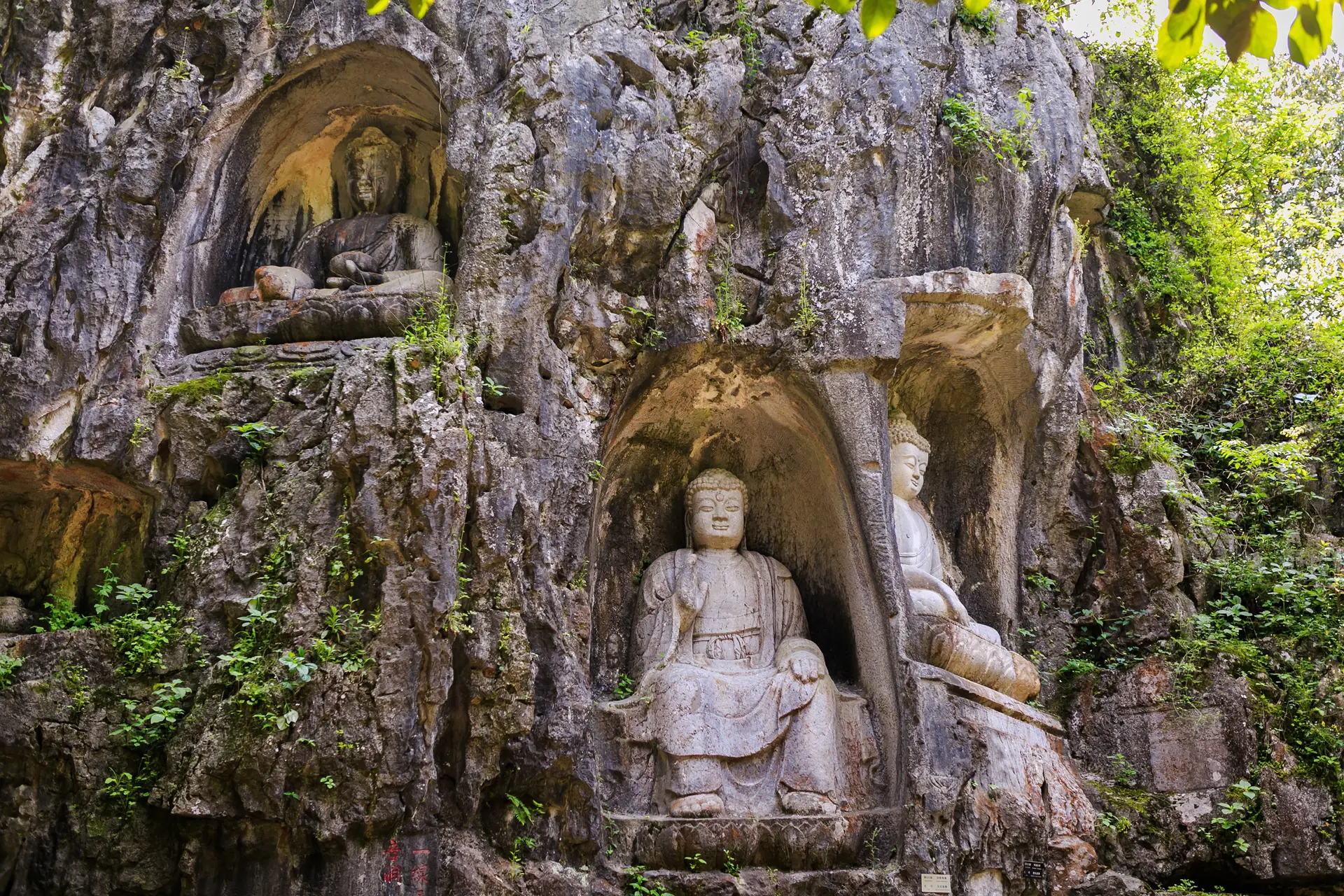
Feilai Peak overview: the carvings are spread across a natural limestone wall, not arranged like a museum gallery. Scan the whole cliff first, then slow down in the real walking order: Qinglin Cave and Ji Gong's rocks, Ligong Pagoda and Guanyin Cave, the Laughing Maitreya cluster, then Cold Spring Creek.
Stage 1 target pace: give Feilai Peak 60-75 minutes before you enter the temple. Walk it as an entrance-to-temple sequence: left into the cave-and-cliff zone first, then follow the creekside cliff toward the temple mountain gate.
- Main Entrance- Turn left first instead of rushing straight to Lingyin Temple.
- Qinglin Cave and Ji Gong rocks- Use the first cave cluster for Ji Gong Bed, the Palm Print, and early Feilai Peak carvings.
- Ligong Pagoda- Pair the pagoda with the Heart-to-Heart Vines beside the Longhong / Guanyin Cave area.
- Guanyin Cave and Thread of Sky- Step inside, cool down, and look up for the thin beam of light.
- Laughing Maitreya cluster- Read the famous Maitreya near the creekside cliff, then notice the Yang Lianzhenjia caution nearby.
- Cold Spring Creek- Follow the shaded streamside path toward the temple mountain gate.
Stop 1 · cave-and-rock cluster
Qinglin Cave and Ji Gong's Trail
After the entrance-left turn, use Qinglin Cave (青林洞) as the first slow stop. The route changes here from a flat sculpture gallery into cave-to-cave exploration, with Ji Gong (济公) legends tucked into the rocks.
Move slowly through the cave cluster and surrounding rock details before continuing toward the pagoda area. Read this stop through Ji Gong, Chinese Buddhism's beloved rebel monk rather than a serene temple statue.
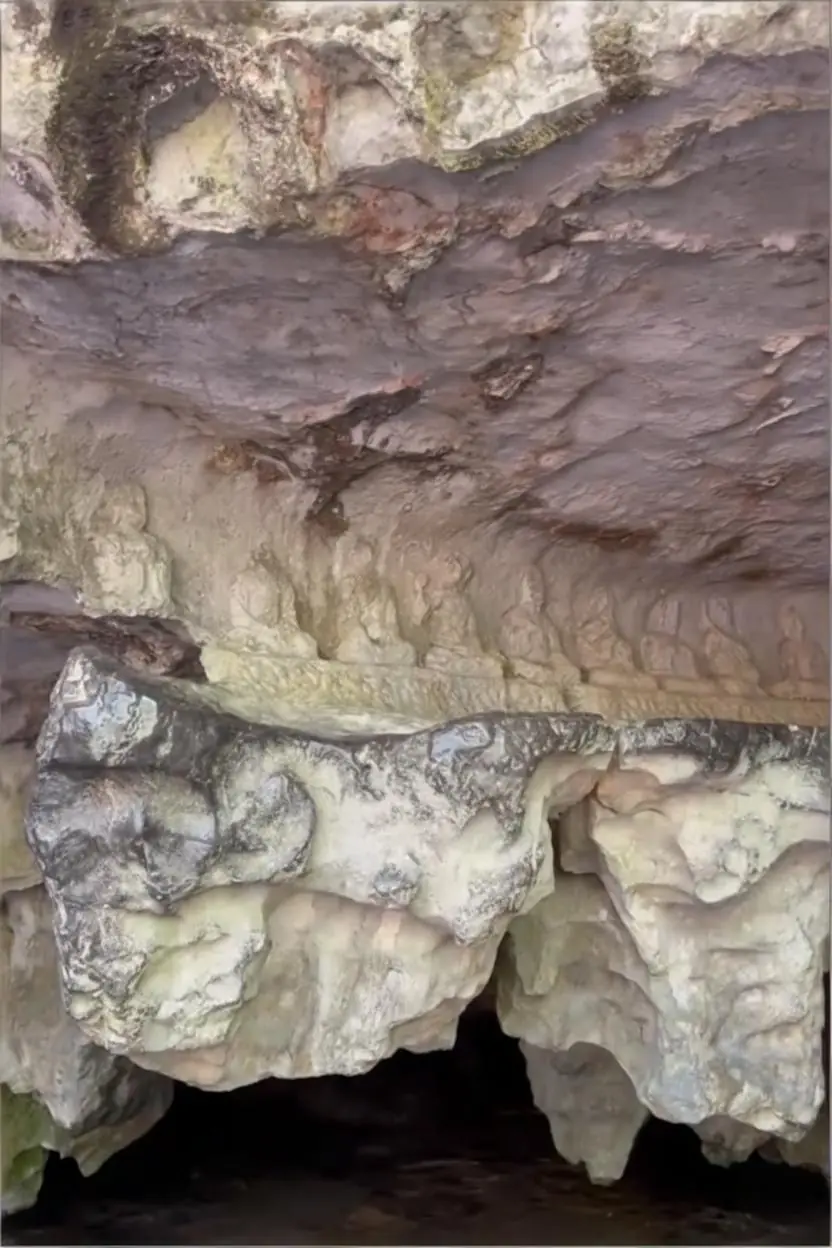
Ji Gong's Bed (济公床)
A flat, oddly-shaped rock where Ji Gong supposedly preferred sleeping over any proper bed, clutching his tattered fan. Local joke: touch this stone to absorb his spiritual energy and cure your insomnia.
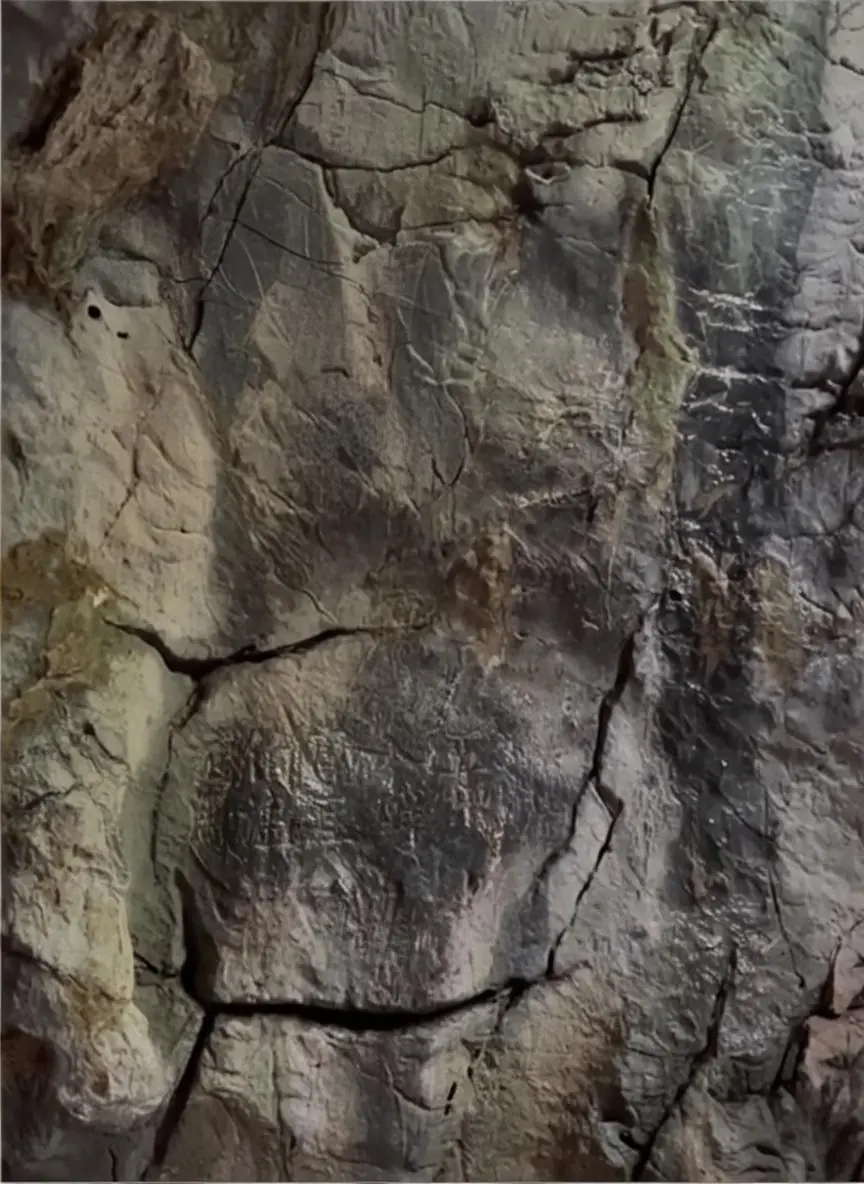
Ji Gong's Palm Print (济公掌印)
Inside a small side cave, a huge hand-shaped depression in the rock marks the legend: Ji Gong pushed the mountain back with one hand to save villagers. Try it — place your hand over the mark and see if you could hold up a mountain.
Who is Ji Gong?
Forget every image you have of serene, meditating monks. Ji Gong ate meat, drank wine, wore rags, and broke every monastery rule in the book. But he was kind-hearted and supernaturally powerful, using his abilities to punish corrupt officials and help the poor. Think of him as Buddhism's Robin Hood.
Stop 2 · founder and folklore
Ligong Pagoda and Heart-to-Heart Vines
Continue toward the Longhong / Guanyin Cave area and you reach two quiet details that are easy to miss if you walk too fast: the founder's relic pagoda and the old wish-making vines beside it.
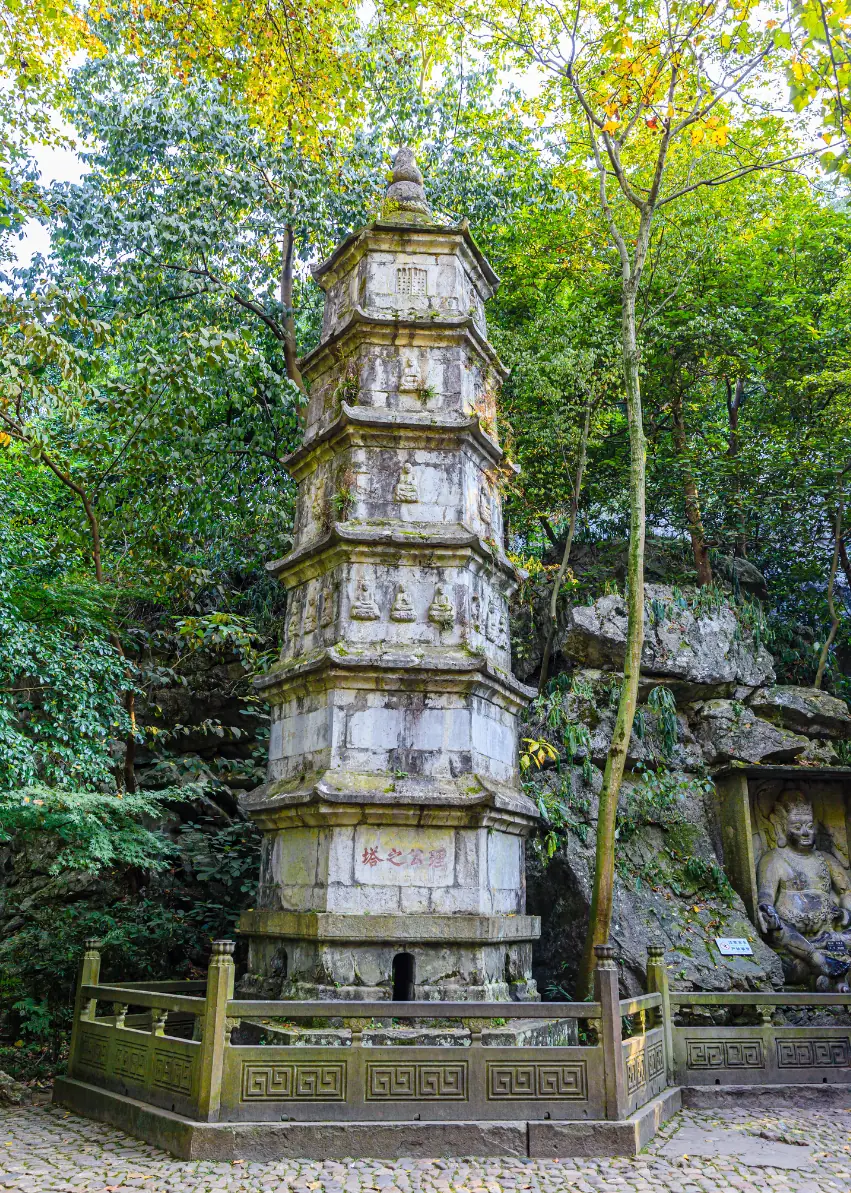
Ligong Pagoda (理公塔)
The relic stupa of founding monk Huili has stood here for 1,700 years. This modest stone tower hides behind trees at the path's edge, barely drawing attention despite being the oldest structure in the entire scenic area.
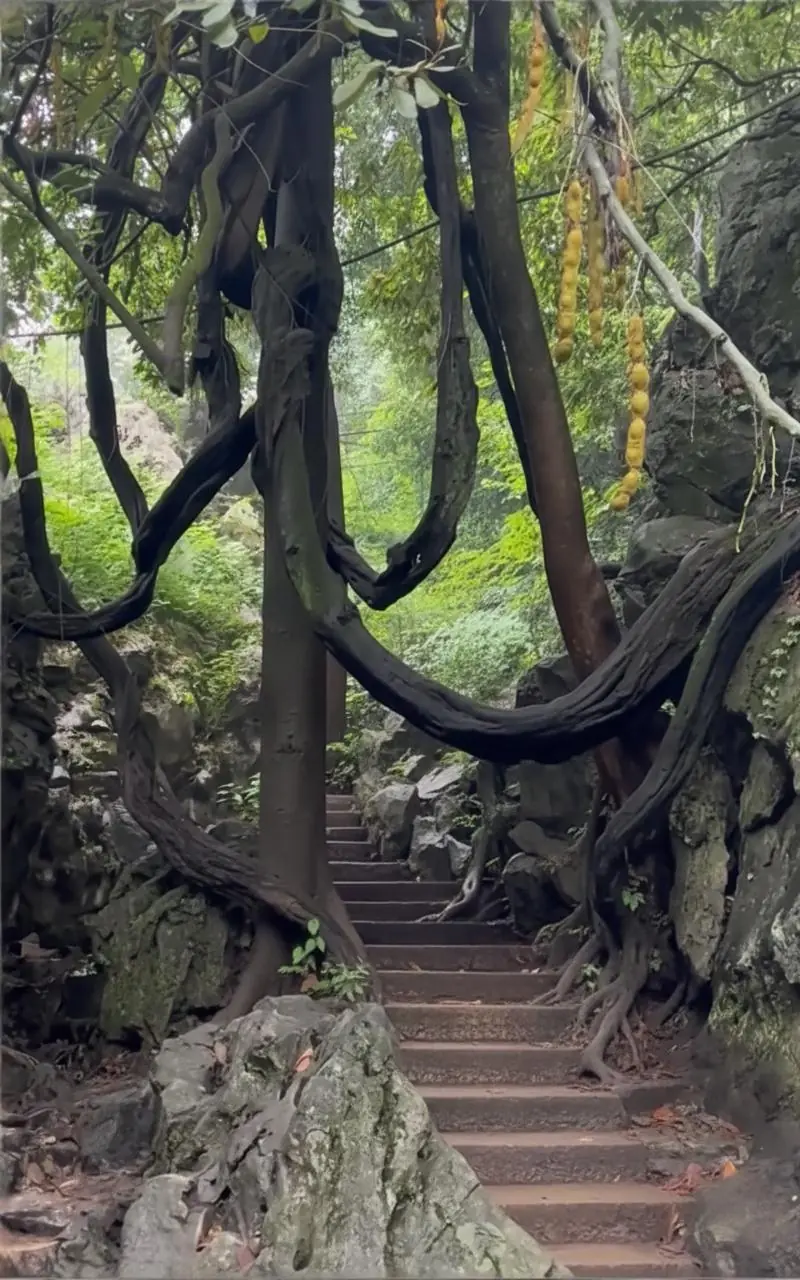
Heart-to-Heart Vines (心心相印千年古藤)
Beside the pagoda, thousand-year-old vines twist around ancient trees and rocks. Legend says couples who make a wish beneath these vines will never be separated. Nature's version of tying the knot.
Stop 3 · cool cave pause
Guanyin Cave and the Thread of Sky
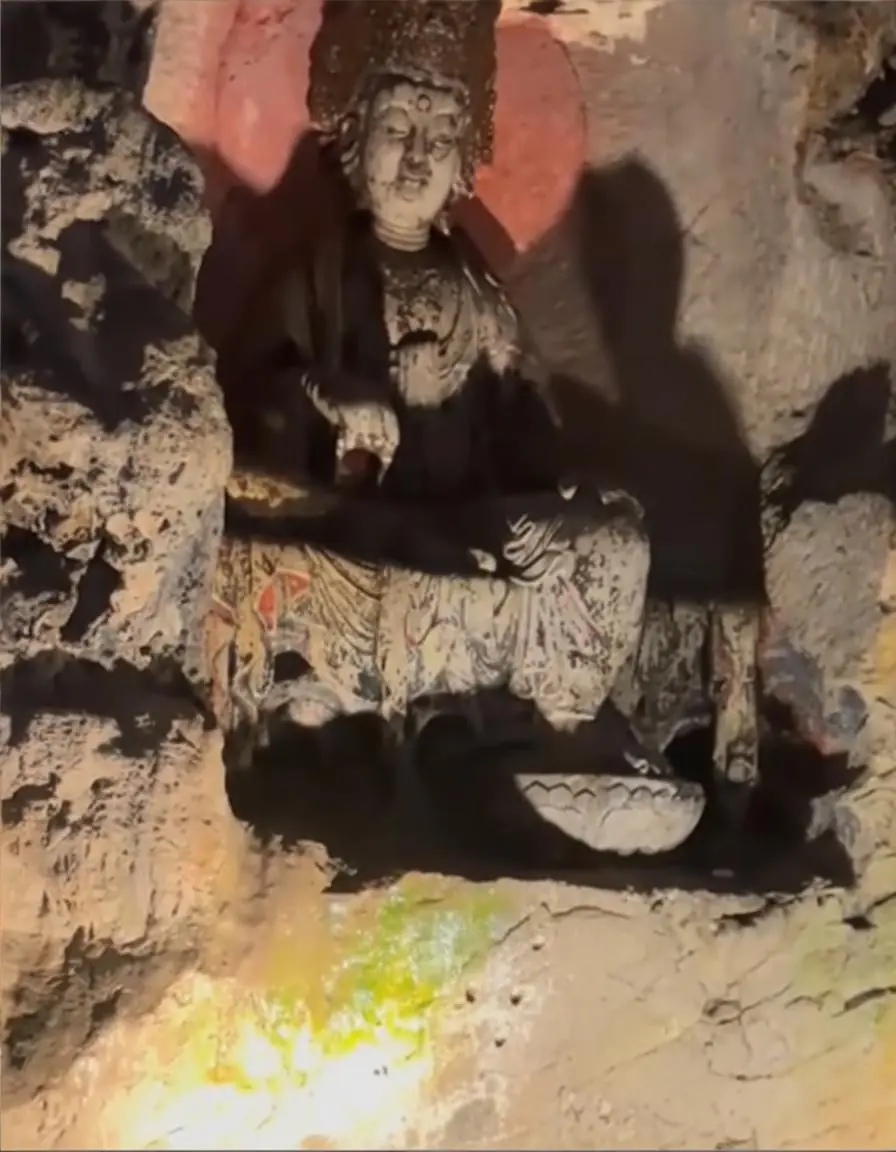
From the pagoda area, continue into Guanyin Cave (观音洞), also listed by many local guides as part of the Longhong Cave (龙泓洞) cluster. The air turns instantly cool, and the cave houses a Guanyin bodhisattva figure.
Do not only look straight ahead. The hidden detail is above you, not at eye level.
Thread of Sky (一线天)
From the right angle, a hair-thin beam of sunlight pierces through a crack in the rock ceiling. Those who spot the light are said to receive good fortune and mental clarity.
Stop 4 · famous carving and caution
Laughing Maitreya and Yang Lianzhenjia
After the cave-and-pagoda cluster, follow the creekside cliff toward Cold Spring Creek (冷泉溪). This pair is easy to misread: one figure is Feilai Peak's most famous blessing image, and the other is preserved as a warning.
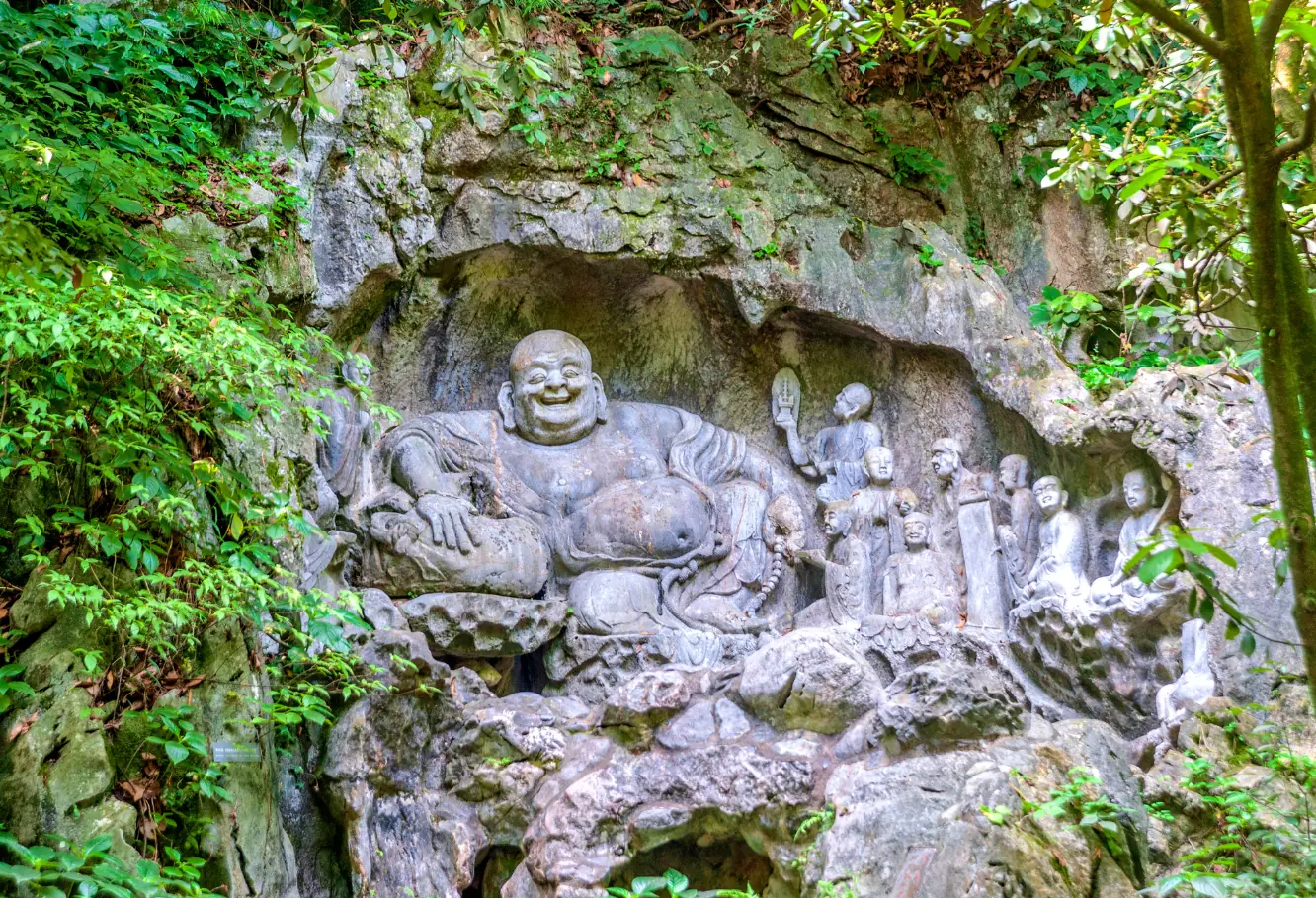
Laughing Maitreya (大肚弥勒佛)
This Song-dynasty pot-bellied Maitreya grins ear to ear and is often mistaken by foreign visitors for the "Laughing Buddha."
Why he laughs
A famous couplet says: "A big belly can contain everything the world cannot tolerate; an open mouth laughs at every absurdity on earth."
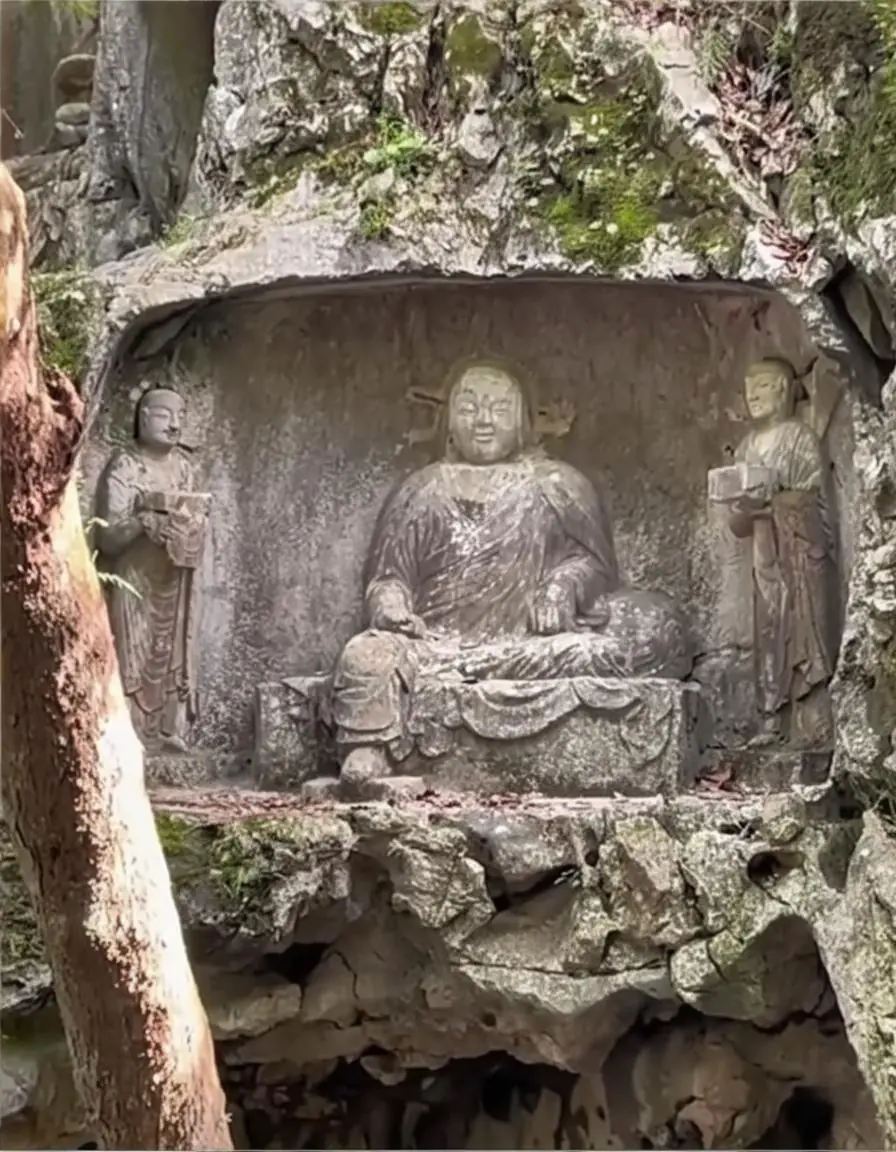
Yang Lianzhenjia (杨琏真珈)
Nearby stands a group of official stone figures. One is Yang Lianzhenjia, a notorious Yuan-dynasty grave robber who looted the Southern Song emperors' tombs and turned imperial skulls into drinking cups.
Do not bow to him
Outraged locals later smashed his original statue; the surviving version was rebuilt so he could be publicly shamed forever.
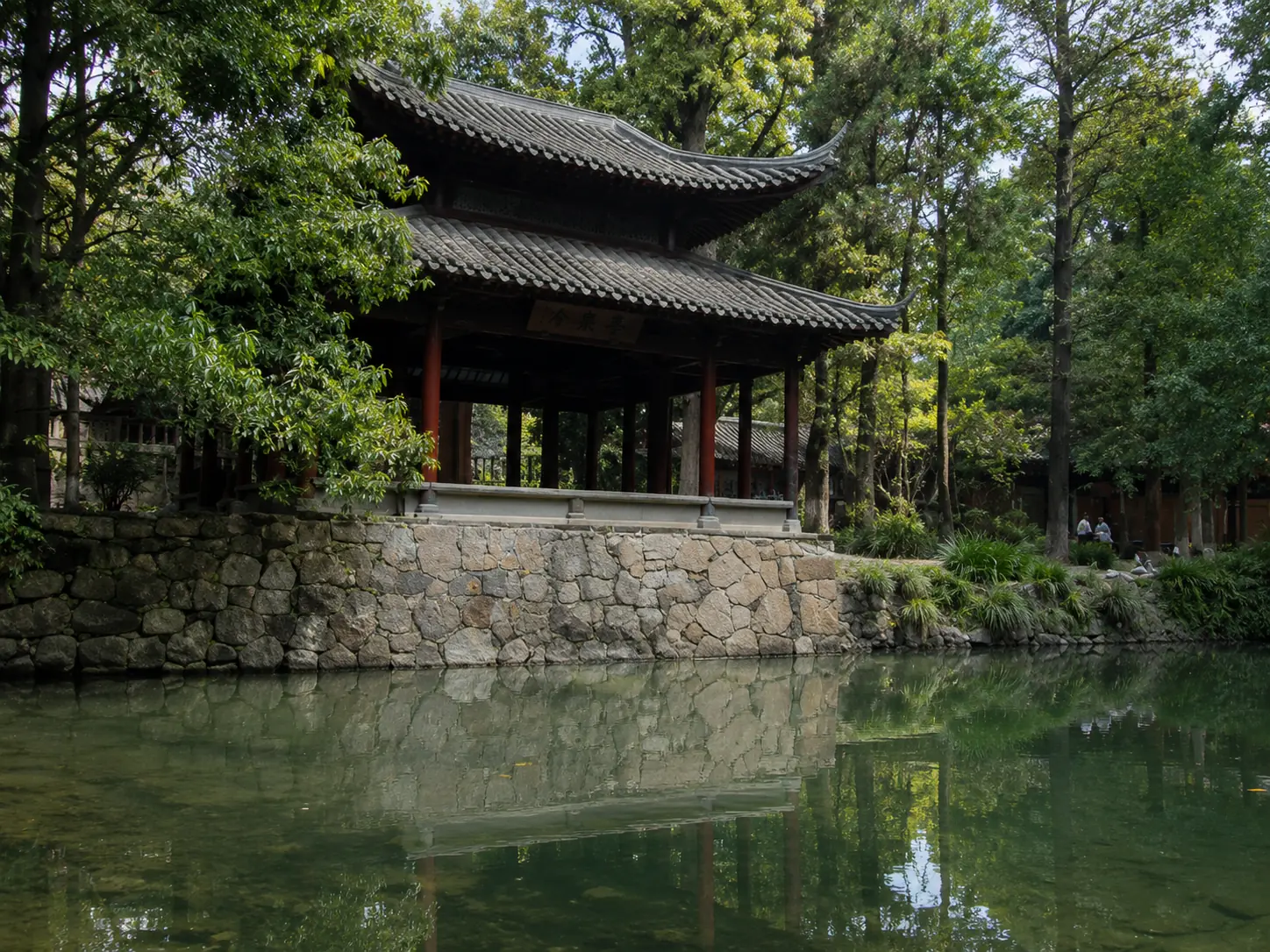
Stop 5 · transition to the halls
Cold Spring Creek Stroll
The 15-minute streamside path from the scenic area gate to Lingyin Temple's mountain gate is a destination in itself: ancient trees tower overhead, water reflects the old Cold Spring Pavilion (冷泉亭), and the air cools down before you enter the temple.
Slow down here. It is the soft transition between the cliff carvings and the monastery halls.
Inside Lingyin Temple
Past the Feilai Peak carvings, you reach Lingyin Temple's mountain gate. The temple is built up the hillside — five main halls climb progressively higher, symbolising the stairway to enlightenment. Allow 1.5–2 hours.
Stage 2 target pace: treat the temple as a one-way climb through the halls, then loop down to the Arhat Hall before you exit. The photos in this section follow that order.
- Hall of Heavenly Kings- Maitreya in front, Four Heavenly Kings on the sides, Weituo behind.
- Mahavira Hall- Big Buddha first, guardian figures second, Guanyin of the Southern Sea relief at the back.
- Jialan Hall- Right-side side hall with Prince Jeta and the first-monastery story.
- Medicine Buddha and Ji Gong halls- Use these smaller halls as detail stops, not separate detours.
- Huayan Hall- Climb to the top hall for the Avatamsaka world view.
- 500 Arhat Hall- Loop down to the bronze maze before you exit.
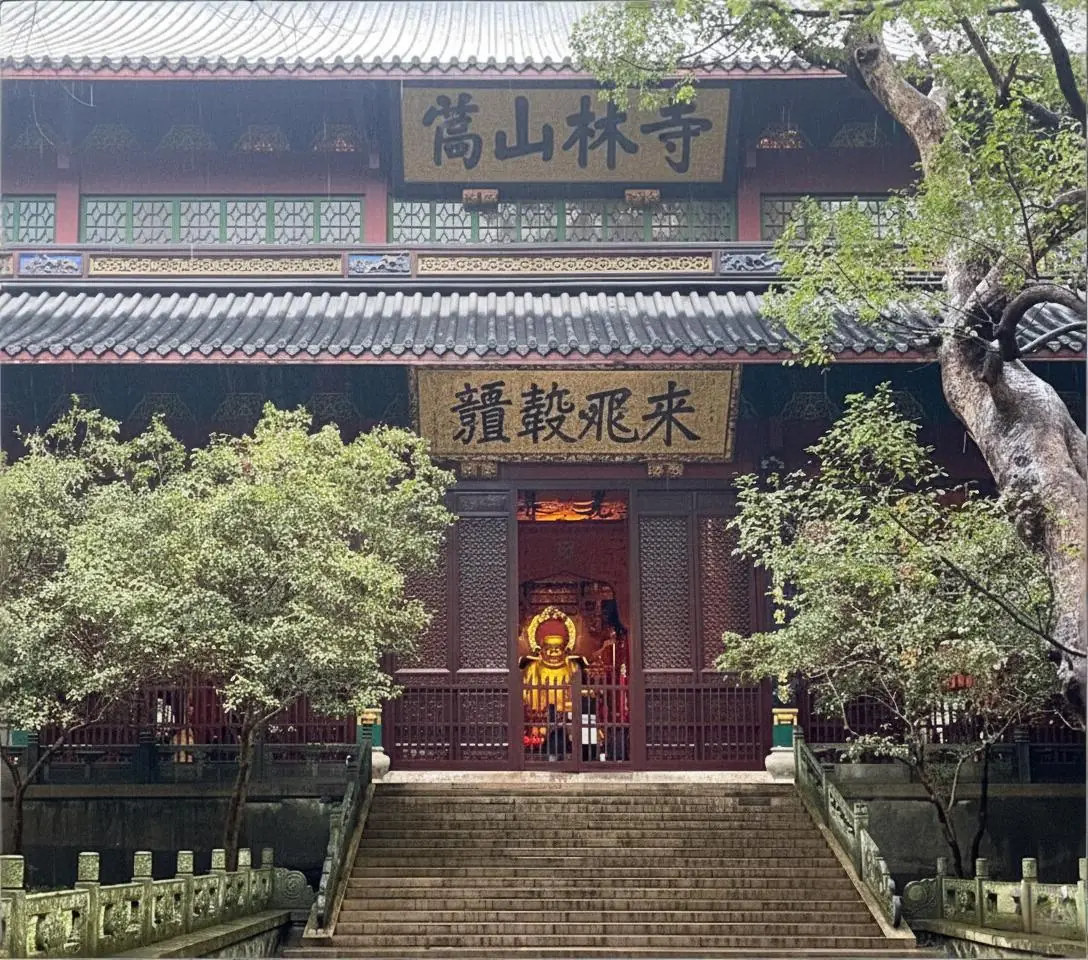
Hall 1 · threshold hall
Hall of the Heavenly Kings — Entrance Hall
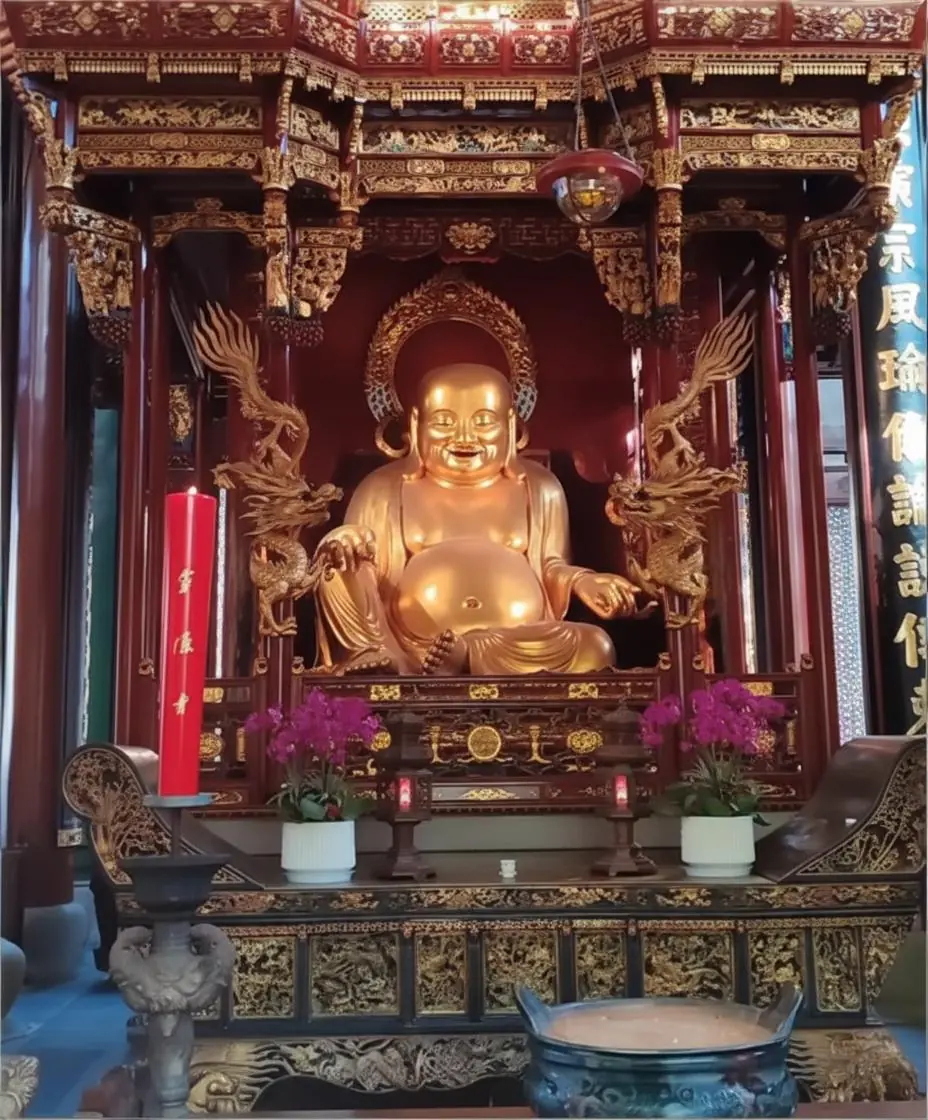
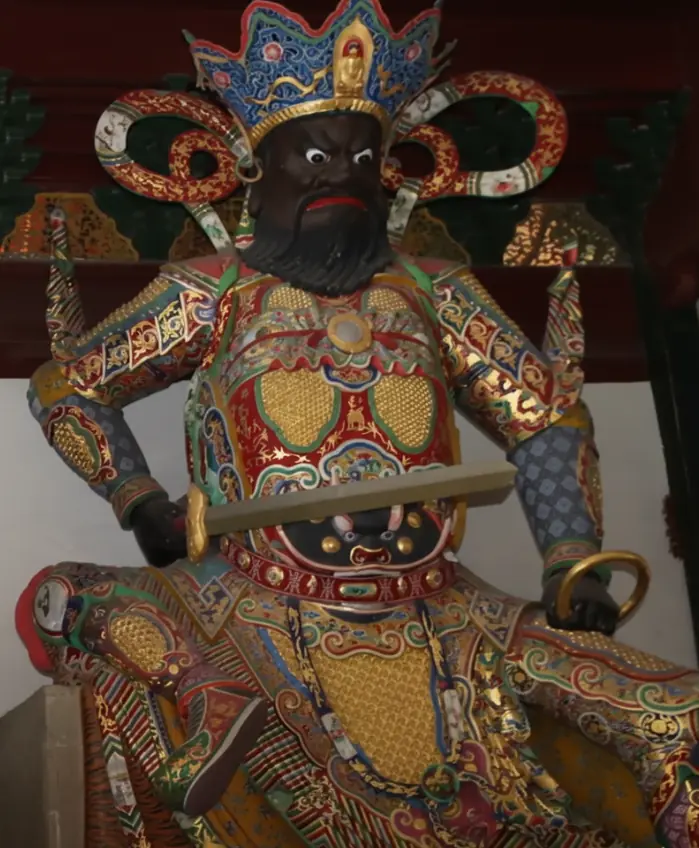
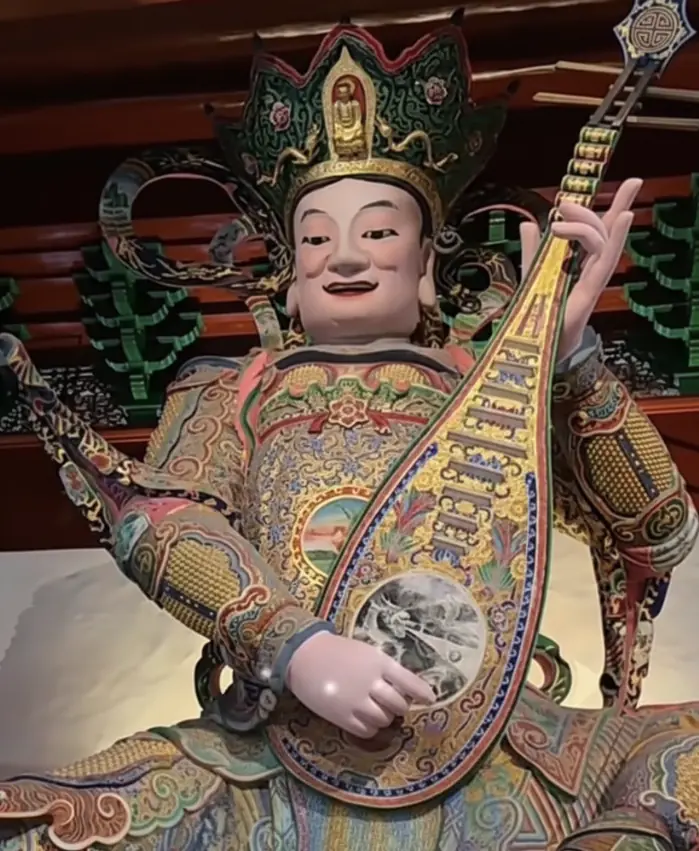
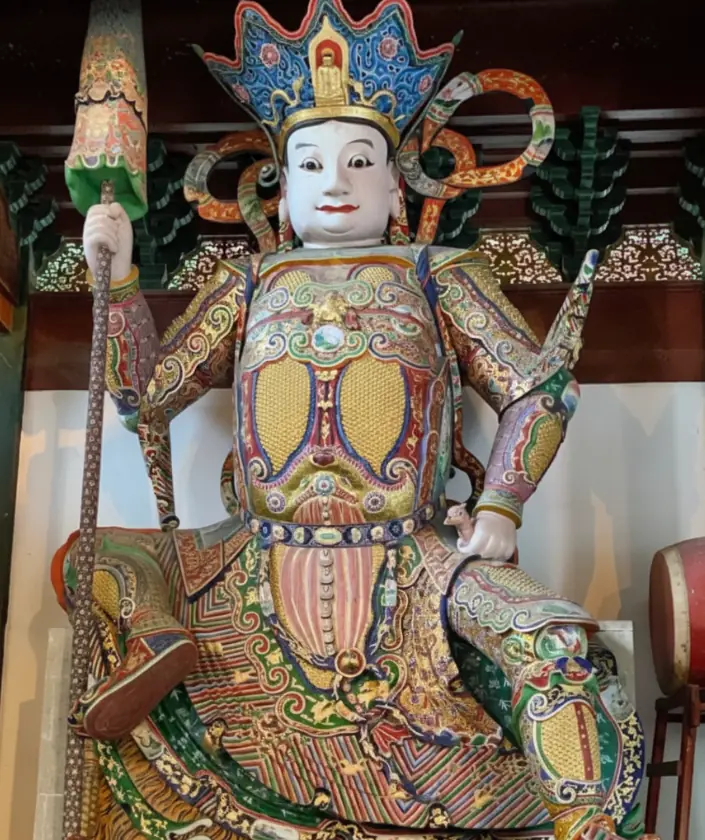
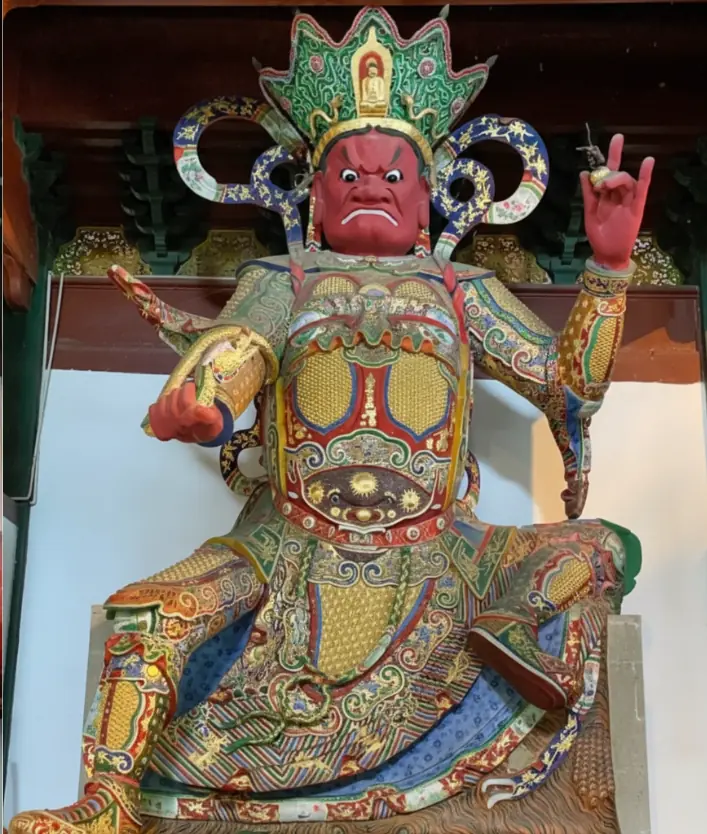
The Hall of the Heavenly Kings (天王殿) is Lingyin Temple's threshold hall. It introduces the temple in one compact sequence: Maitreya smiles at the front, the Four Heavenly Kings guard the side walls, and General Weituo stands behind Maitreya.
Front: Maitreya Buddha (弥勒佛)
The smiling Maitreya greets every visitor first. His round belly and open laugh represent generosity, tolerance, and the ability to laugh at worldly trouble before the guardian figures sharpen the mood.
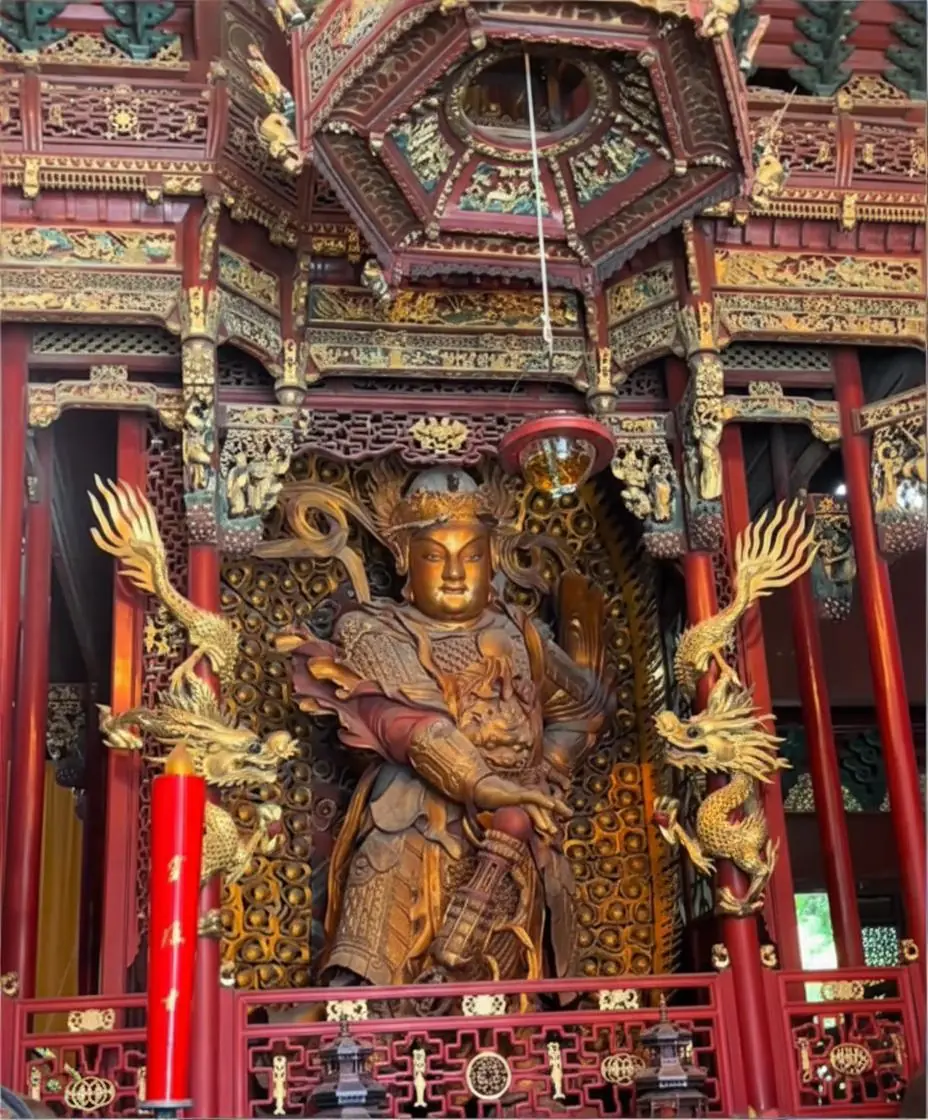
Back: General Weituo (韦陀)
Walk behind Maitreya. Weituo's staff on the shoulder marks Lingyin as a major monastery with guest quarters; staff on the ground means smaller temple, and across the chest means one-night stay.
Sides: Four Heavenly Kings (四大天王)
Look to both side walls. Sword = wind, pipa = harmony, umbrella = rain, serpent = smooth. Together they form 风调雨顺, a blessing for favourable weather and good harvests.
Hall 2 · spiritual core
Mahavira Hall — 24 Camphor Logs
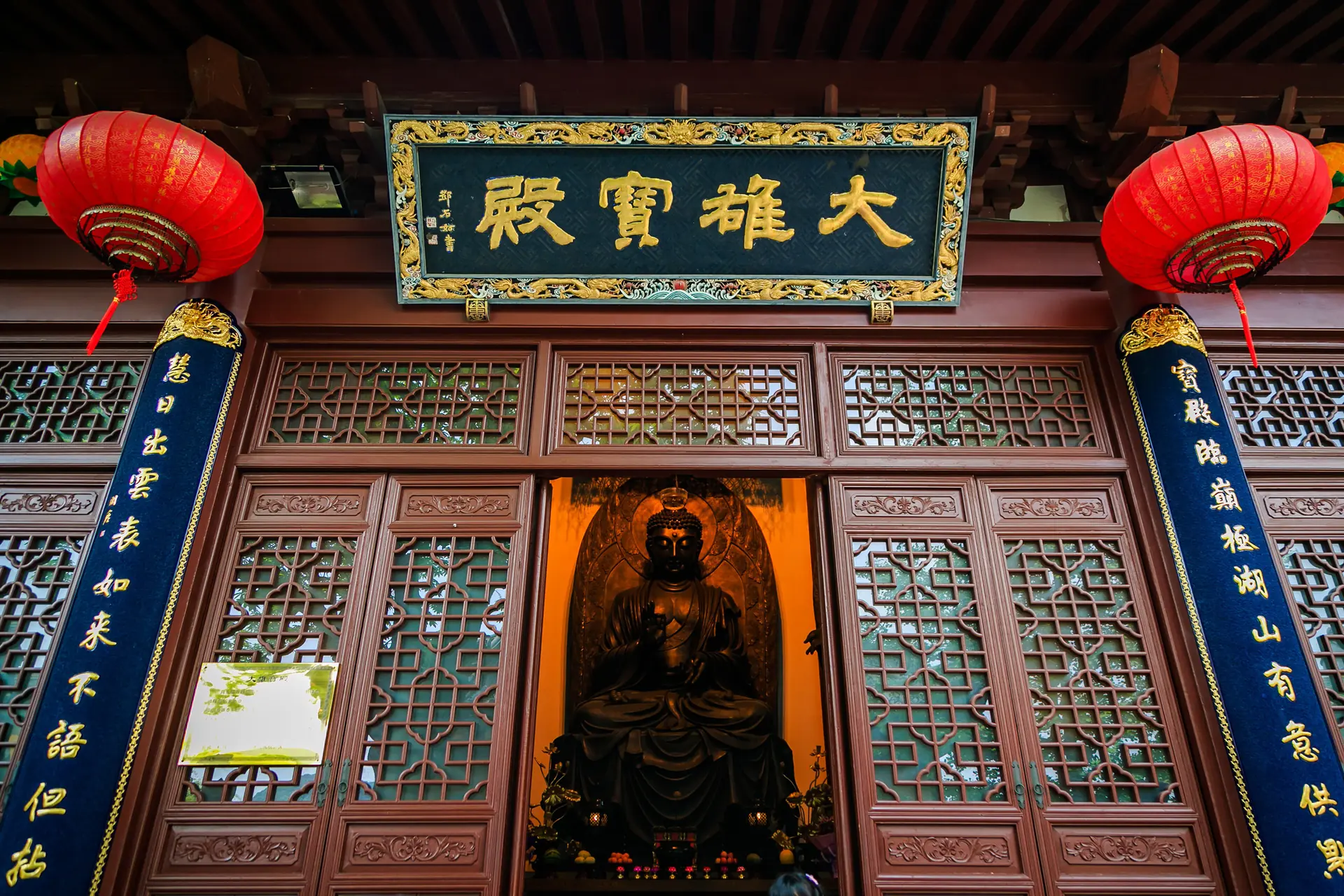
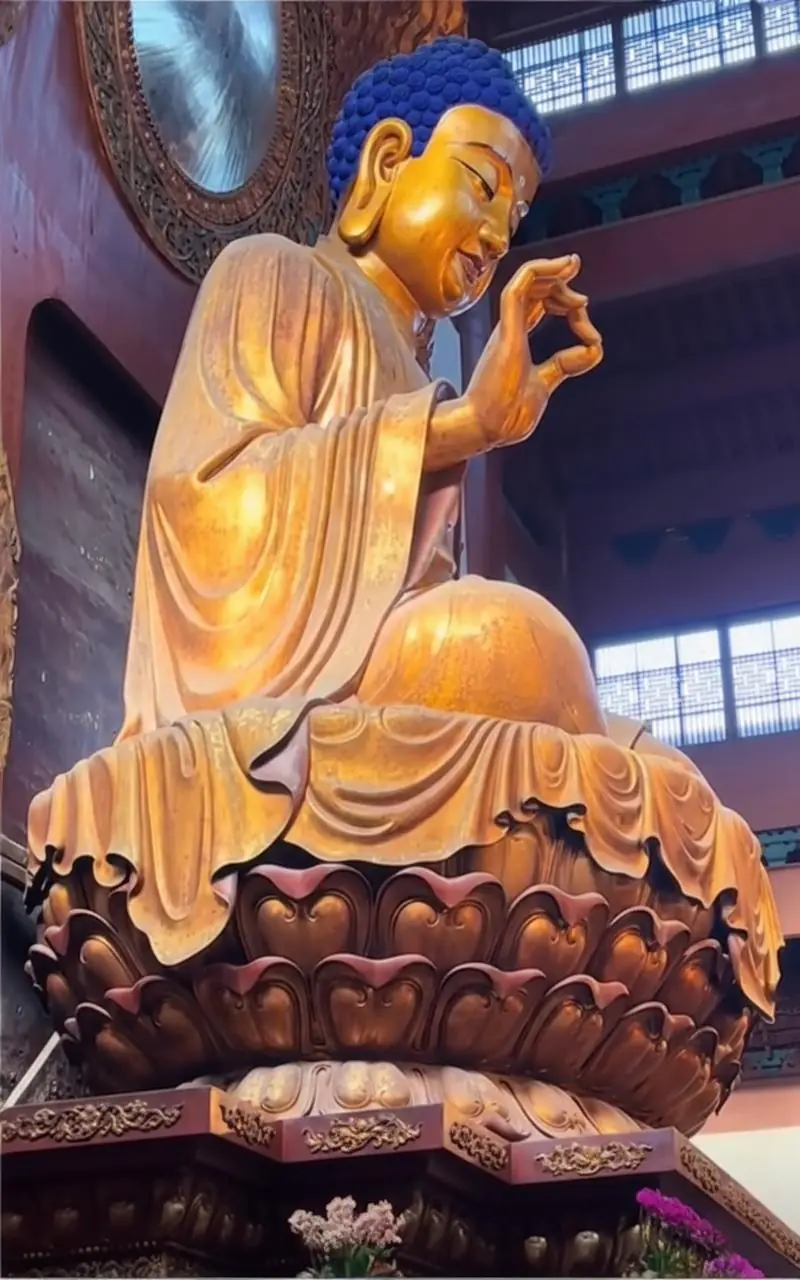
The Mahavira Hall (大雄宝殿) is the spiritual core of Lingyin Temple. Inside sits a 24.8-metre Sakyamuni Buddha, assembled from 24 blocks of camphor wood.
Enter from this facade, read the giant Buddha first, then look to the side guardians and the back-wall relief before checking the right side hall.
Main Sakyamuni Buddha (释迦牟尼佛)
At the front of the hall, tilt your head up to take in the full 24.8-metre Buddha. His right hand forms the "teaching the Dharma" gesture (说法印), so the statue reads as active teaching, not passive meditation.
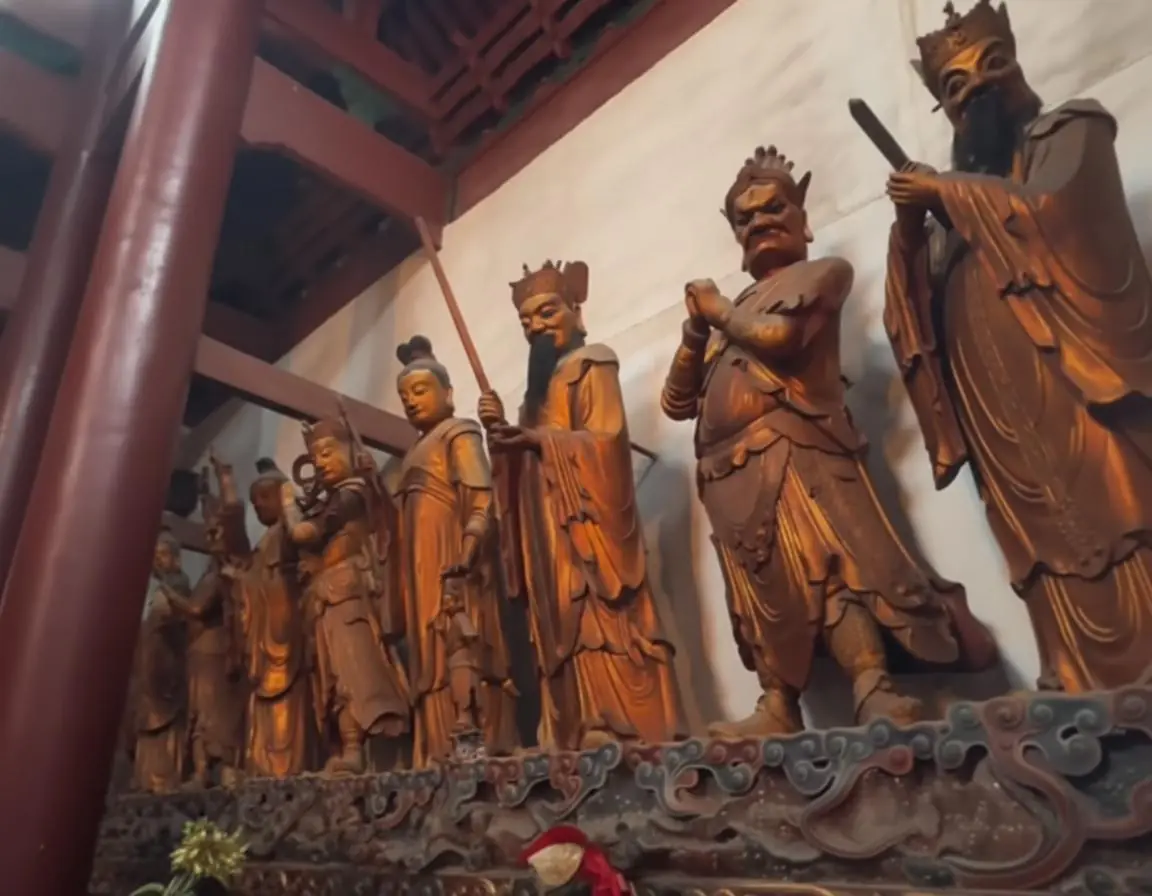
Deva Guardians (二十诸天)
Along the side walls, 20 guardian figures lean forward about 15 degrees. This is not decay; the angle is deliberate, making the whole hall feel as if it is listening to the Buddha's teaching.
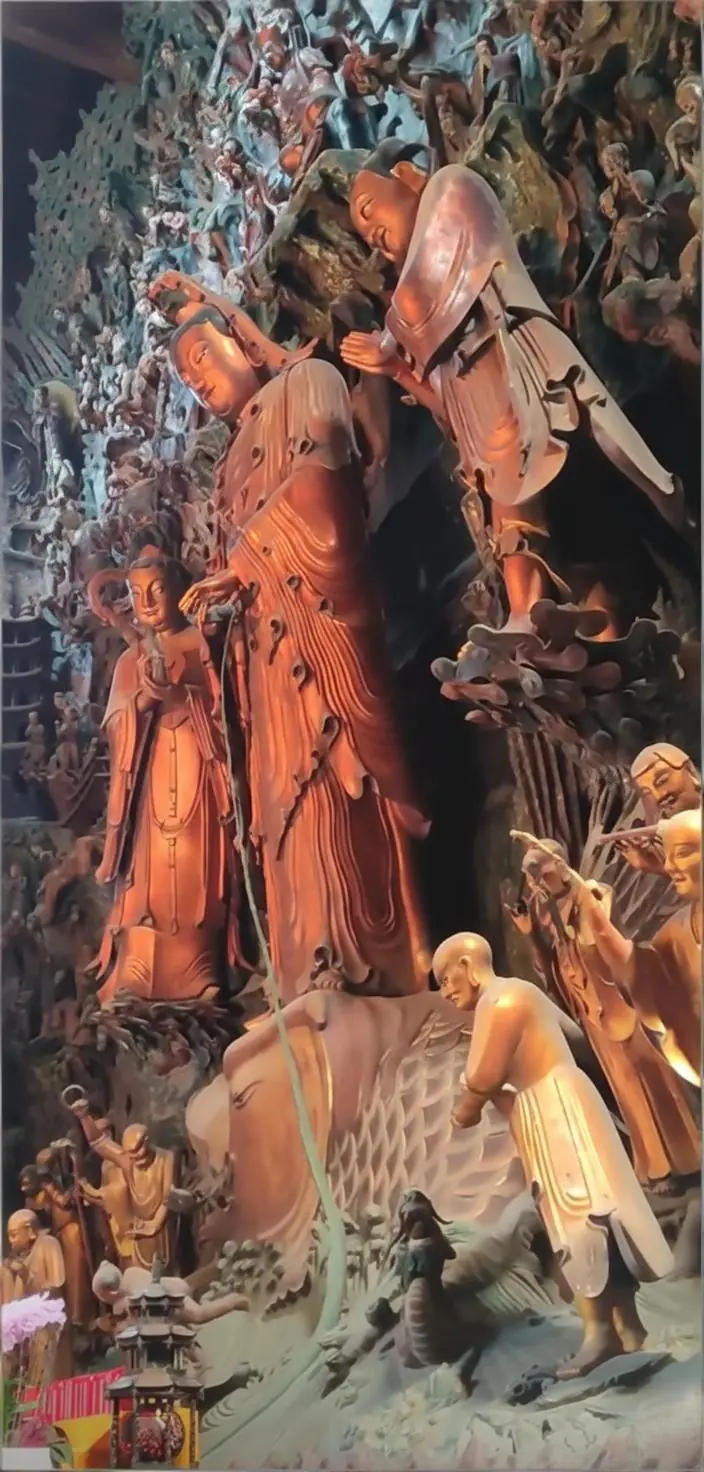
Guanyin of the Southern Sea Relief (海岛观音)
Do not exit after the main Buddha. Walk behind him for a carved seascape with more than 150 figures: the hall's hidden second act, shifting from solemn verticality to a moving ocean scene.
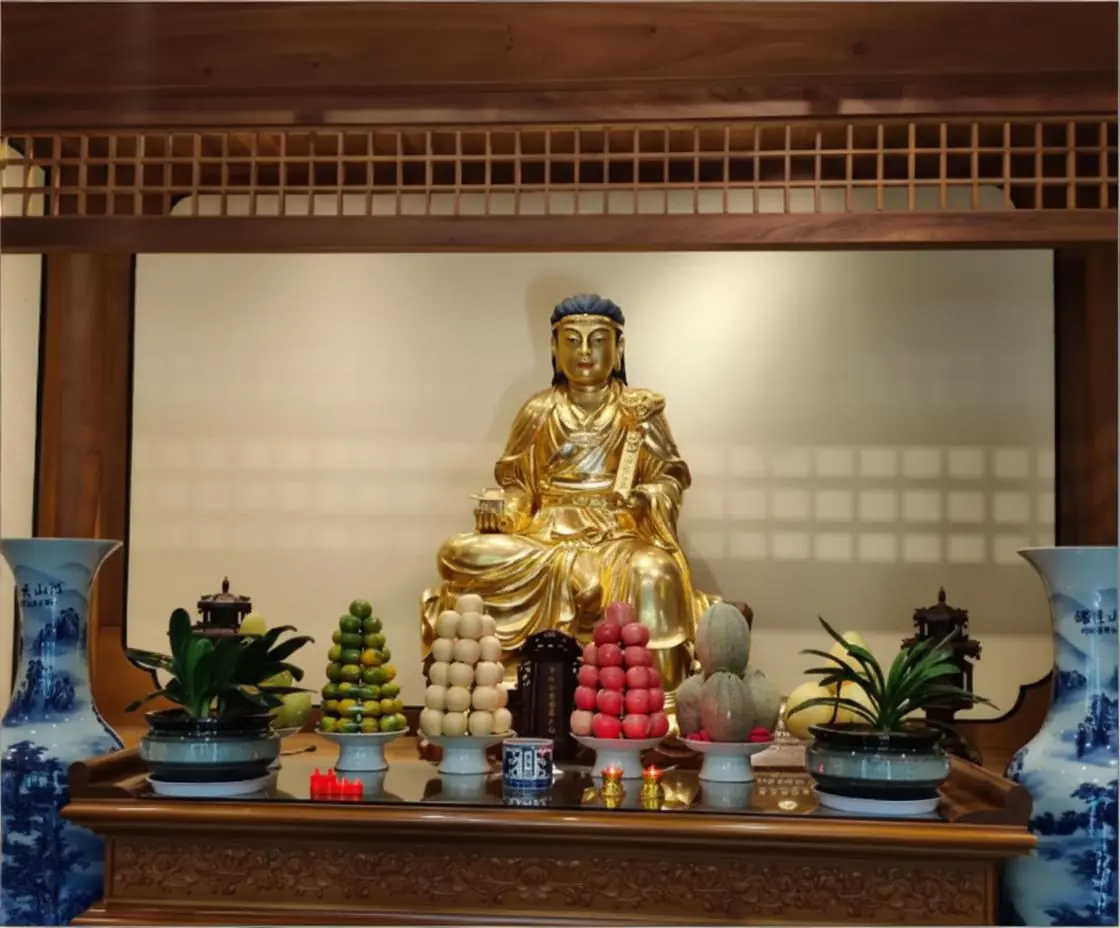
Side hall · after Mahavira
Jialan Hall — Prince Jeta's Gift
Jialan Hall (伽蓝殿) is a right-side hall beside the main axis, not part of the Mahavira Hall's back-wall tableau. Prince Jeta (祇陀太子) holds a miniature house, pointing to the story of the first Buddhist monastery.
Use it as a short independent stop after the Mahavira Hall highlights: front Buddha, side guardians, back-wall Guanyin, then this side hall.
Hall 3 · zodiac detail
Medicine Buddha Hall — Find Your Zodiac Protector
The Medicine Buddha Hall (药师殿) is dedicated to the Buddha of healing, flanked by bodhisattvas representing the sun and moon — symbolising round-the-clock protection.
How to scan the side walls
Along both walls stand the Twelve Divine Generals (十二神将), each linked to a two-hour period and a Chinese zodiac animal. Scan the rows for a familiar creature perched on a warrior's head — Dragon? Tiger? Monkey? The one matching your birth year is your personal protector.
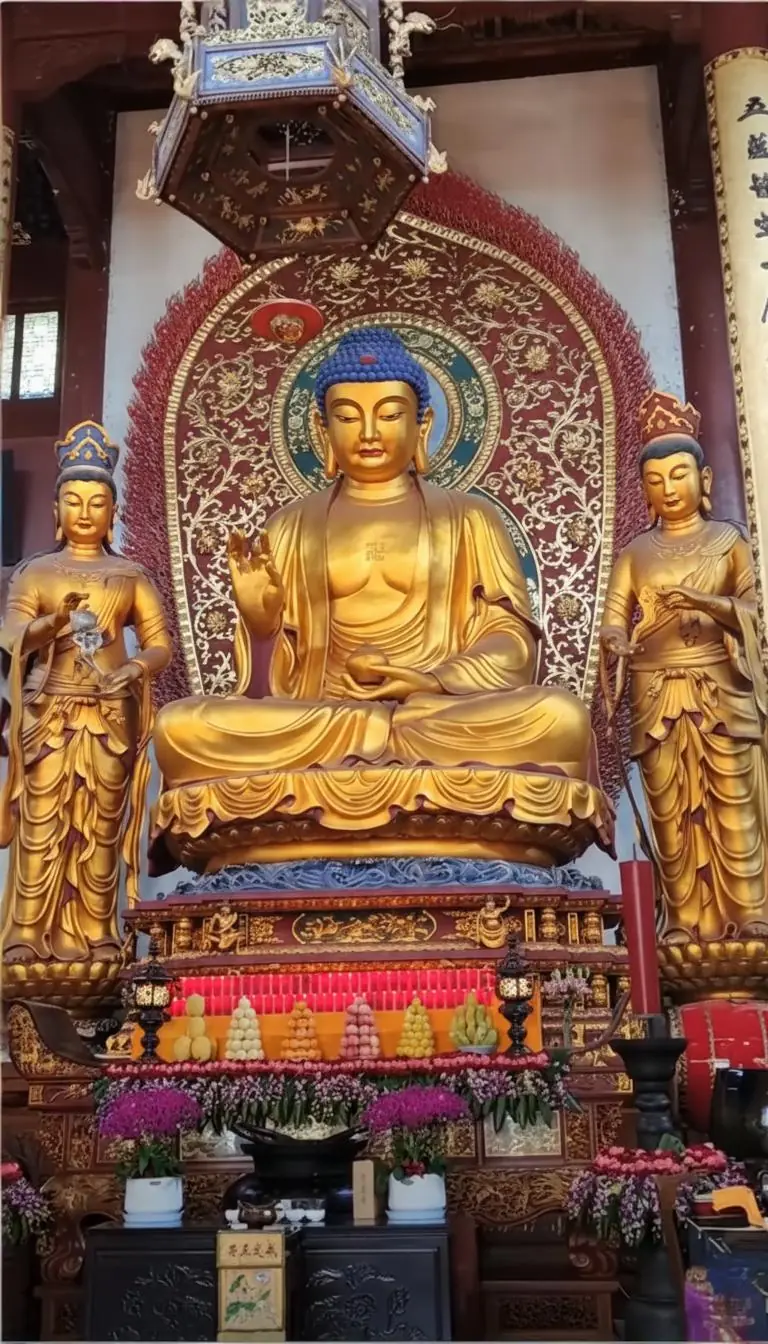
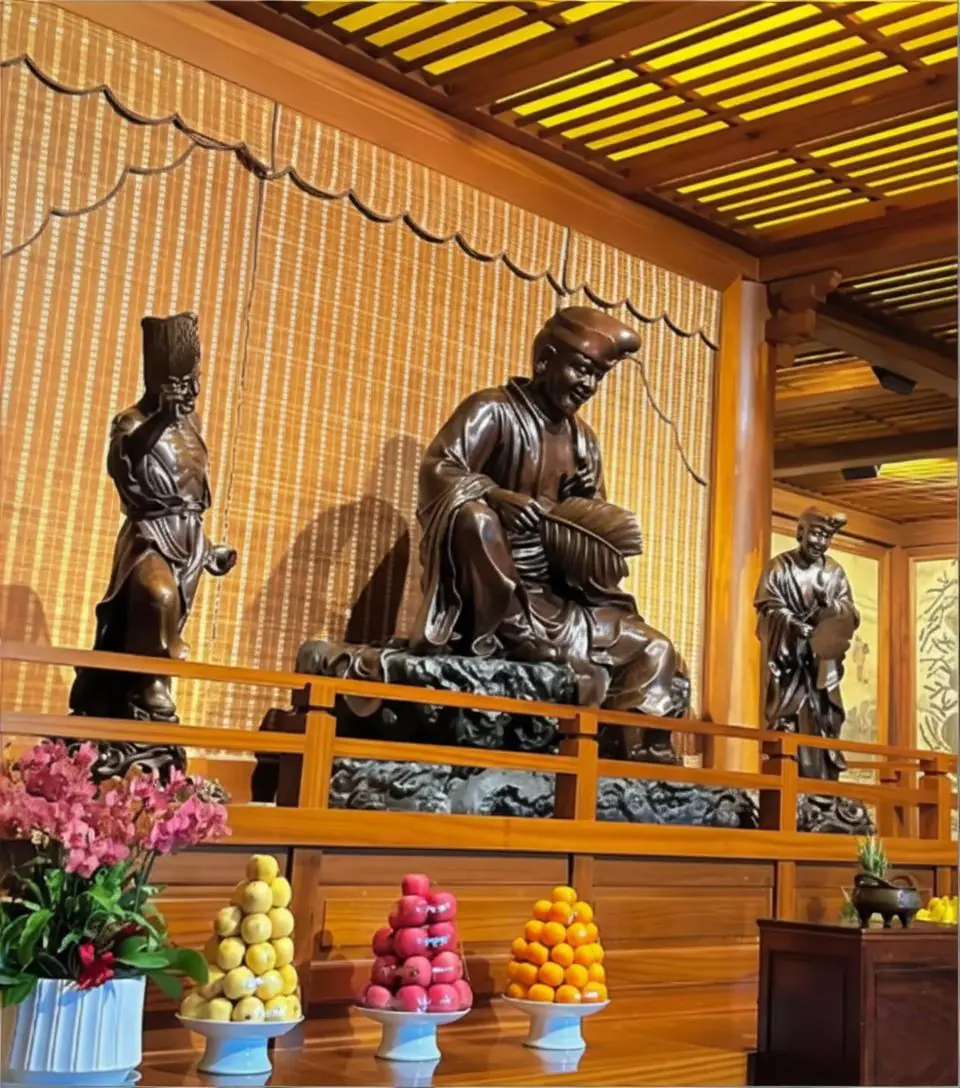
Hall 4 · local legend
Ji Gong Hall — The Mad Monk Comes Home
The Ji Gong Hall (济公殿) is Ji Gong's "home base." The star attraction is not the statue but the huge wall murals, which work like a giant comic strip of his rule-breaking life.
Decode his outfit in three clues: the tattered fan is his "magic wand"; the wine gourd hides wisdom behind fake drunkenness; the ragged robes show he cares about souls, not wealth. Try to spot the scene where he tricks a greedy landlord.
Hall 5 · highest hall
Huayan Hall — Study or Career?
The Huayan Hall (华严殿) is the highest hall in the complex. Its Buddha is carved from precious nanmu wood (楠木), rarer than gold and subtly fragrant.
Read the flanking bodhisattvas as a pair: Manjushri (文殊菩萨) rides a lion and is linked with academic success; Samantabhadra (普贤菩萨) rides an elephant and is linked with career advancement.
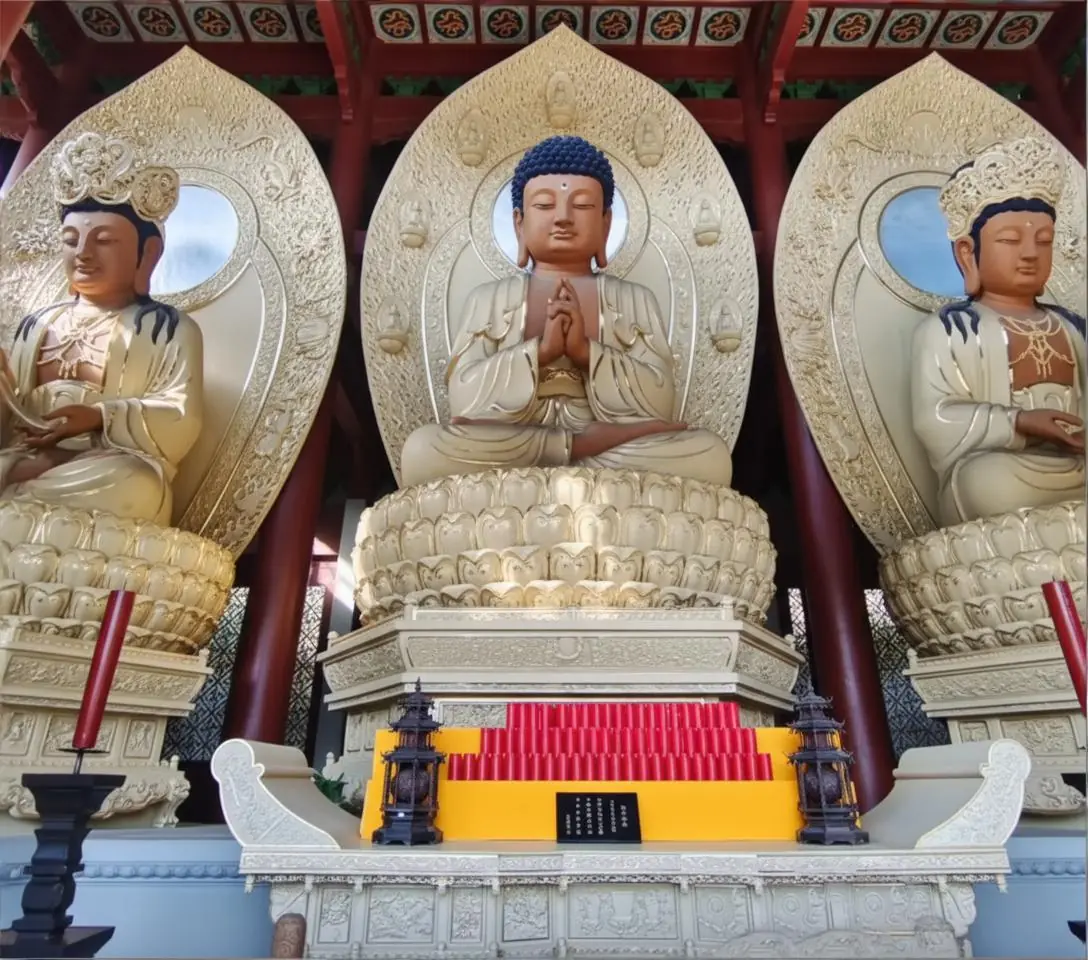
Why the climb matters: by the time you reach this hall, you will have climbed six flights of stone steps — the incline is deliberate, symbolising the ascent toward enlightenment. The effort is part of the experience.
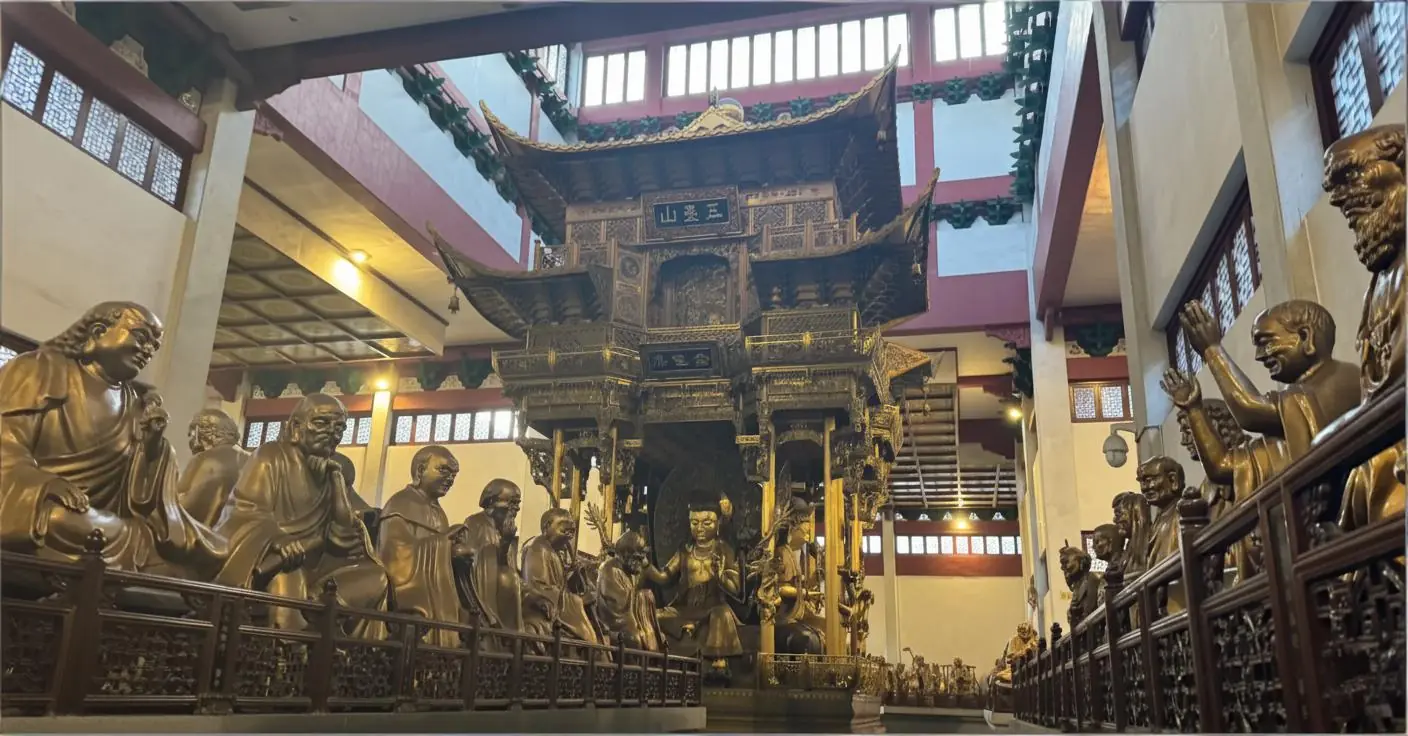
Exit loop · playful finale
500 Arhat Hall — Maze, Treasure Hunt and Fortune
The 500 Arhat Hall (五百罗汉堂) is the last stop, and the most playful one. Its 500 life-sized bronze Arhat statues form a maze-like 卍 pattern, with no two faces exactly alike.
Use it as two simple games: first find Ji Gong among the 500, then choose an Arhat that "calls" to you and count forward by your age. The expression on the final statue is your folk-style fortune for the year.
Exit rhythm: inside, the rows twist and loop; it takes most visitors 15-20 minutes to find the exit. Getting lost is half the fun.
Temple Food & Tea
Inside the temple
Shi Fang Yuan — The Temple's Own "Merit Bowl"
Shi Fang Yuan (十方苑) (Google | Amap) is inside Lingyin Temple itself, to the left of the Medicine Buddha Hall. This is the actual refectory shared by monks and worshippers — basic, crowded, and culturally immersive.
How to order: buy a ticket at the window first, then collect your bowl. Clean your plate — wasting food here is considered bad karma.
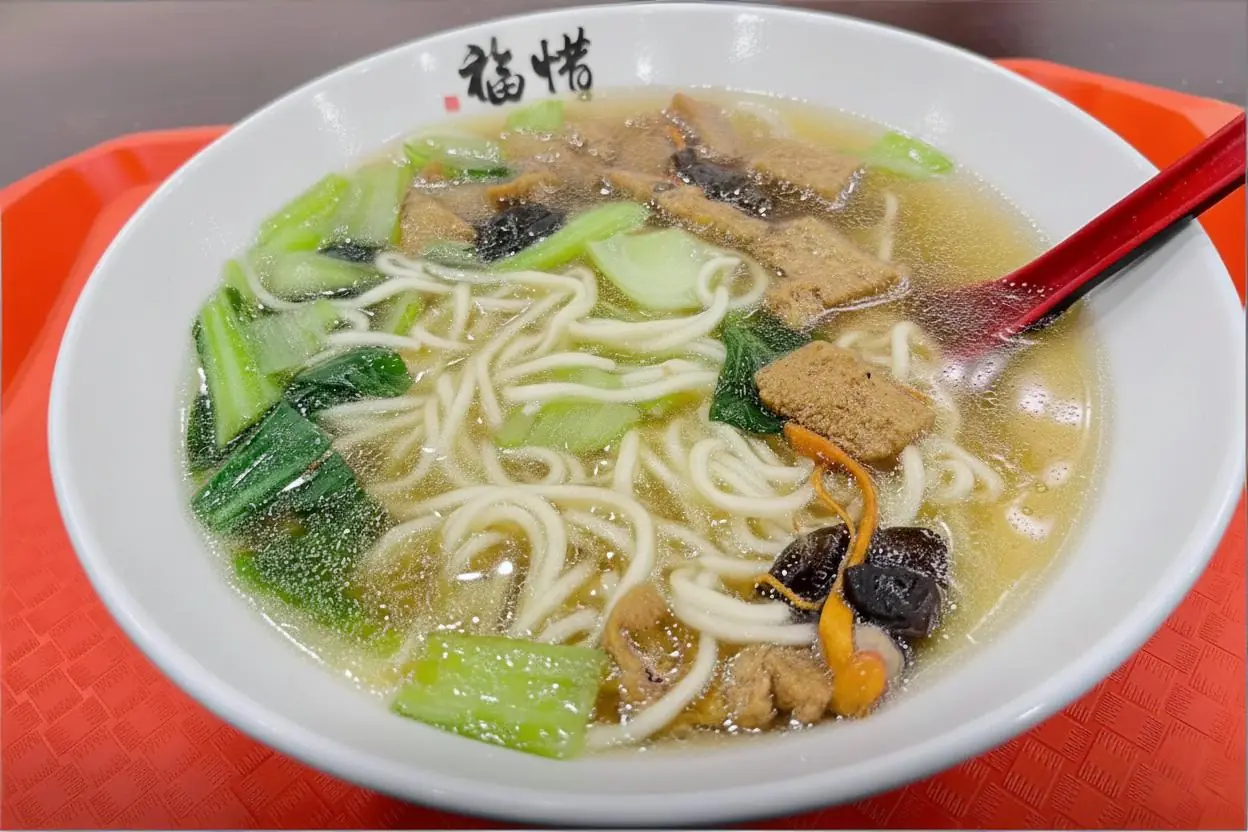
Order rhythm: make a noodle bowl the anchor, then add one cold or soy-glazed side. The refectory is basic and fast, so the meal works best as a quiet reset.

Tofu-skin side
Vegetarian roast goose is the Hangzhou-style add-on worth trying.
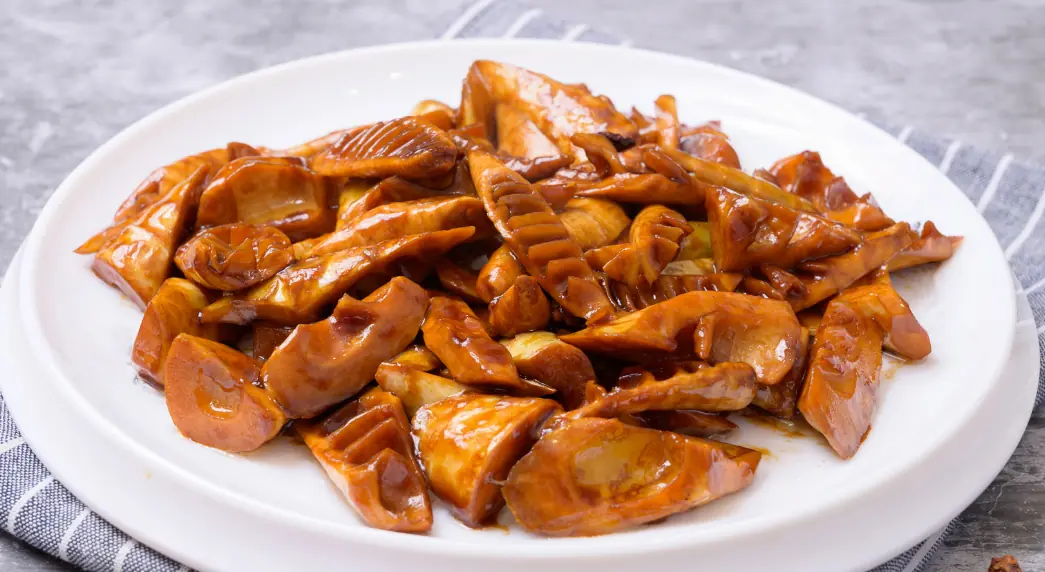
Spring prize
Bamboo shoots are strongest when the groves behind the temple are in season.
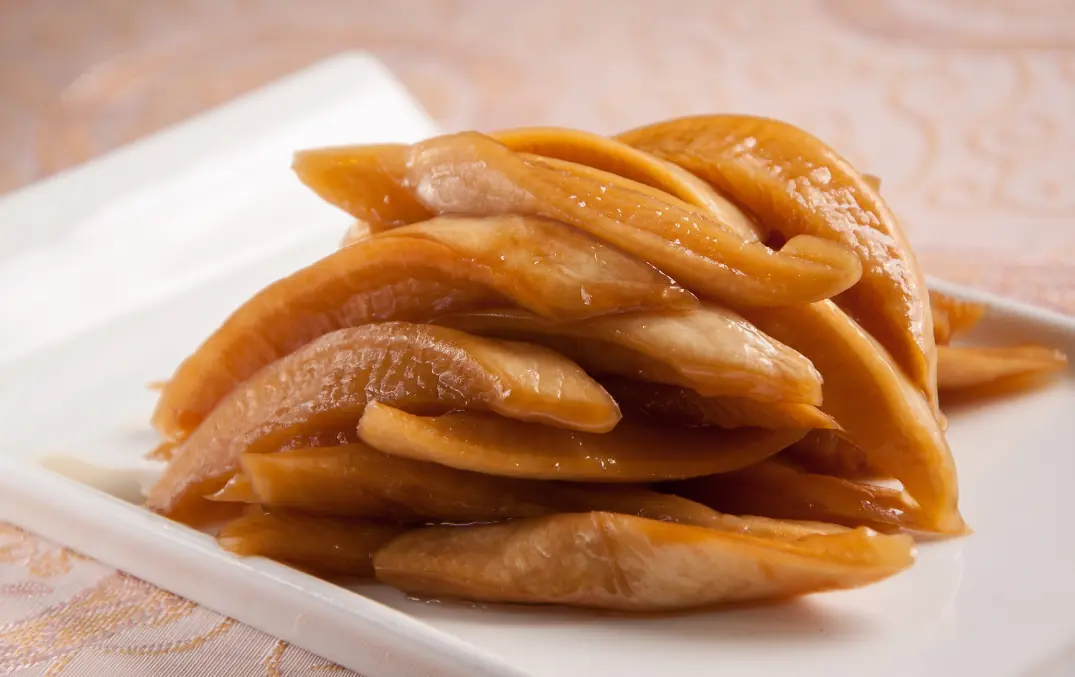
Palate reset
Pickled radish keeps the simple meal crisp and salty.
Outside the gate
Tianzhu Road, Fayun and Longjing Tea
Outside the scenic area, Tianzhu Road (天竺路) is lined with snack stalls selling Hangzhou classics like hairy tofu (毛豆腐) and victory cake (定胜糕). Walk deeper and you reach the Aman Fayun hotel neighbourhood, where boutique tearooms serve proper Longjing tea (龙井茶). There is even a Starbucks inside a Chinese pavilion — order a Longjing tea latte for the ultimate East-meets-West moment.
Lingyin Temple is within walking distance of Longjing Village (龙井村) (Google | Amap), the core production area of China's most celebrated green tea. Sit down at a farmer's home, drink a cup of just-roasted tea, and you have the perfect ending to a Lingyin day.
Snack line
Tianzhu Road works best as a light browse, not a full meal replacement.
Fayun tea rooms
Use the boutique tearooms when you want a calmer finish close to the temple.
Longjing Village
Best if you still have energy for a separate tea-focused extension.
Hidden Temples Nearby
Lingyin Temple's fame overshadows two quieter temple add-ons nearby. They share the same free reservation — no extra ticket needed — and feel calmer because visitors spread out across bamboo groves, stone steps, and hillside courtyards instead of one crowded central axis.
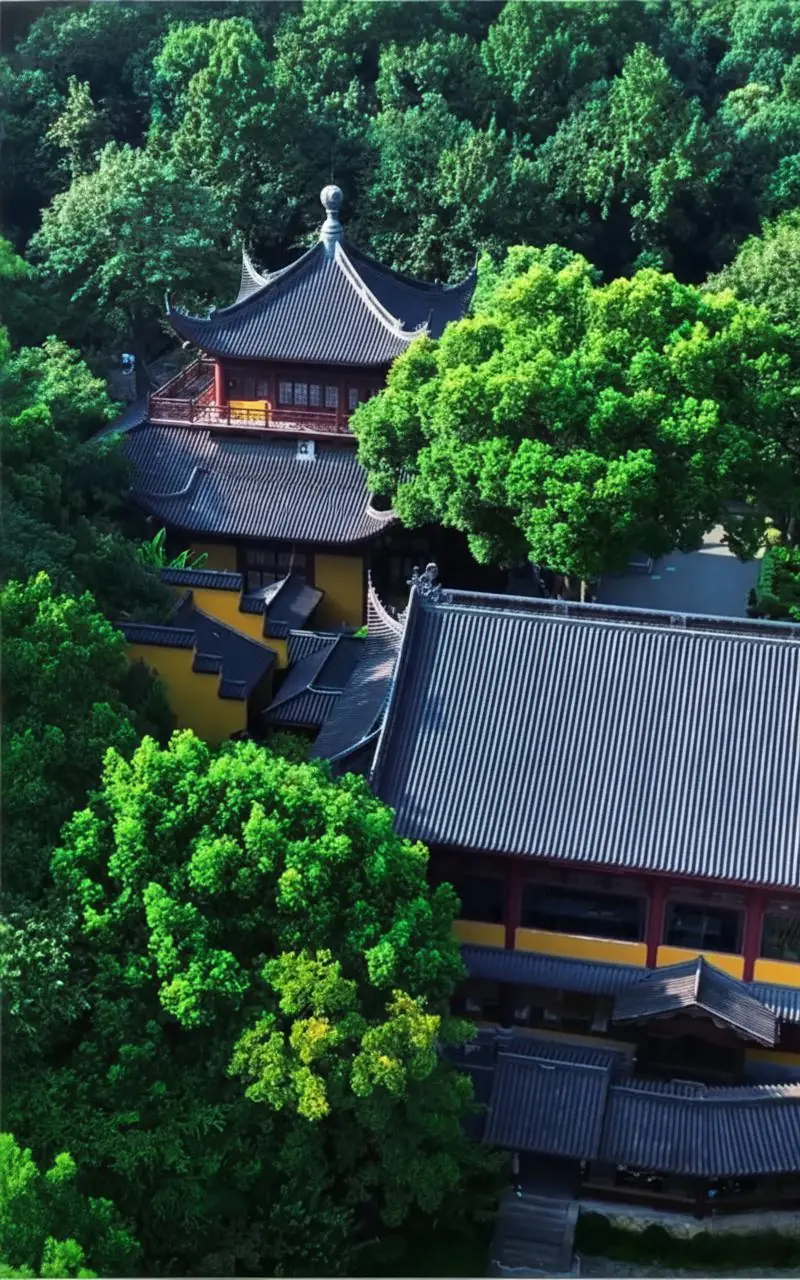
Yongfu is a different world: barely a tenth of Lingyin's crowds, no tour-group noise, only bamboo leaves and distant bells. Inside, a stone inscription reads "Tea and Zen Are One" (茶禅一味). It has gone viral in China as "China's most beautiful temple," yet most foreign visitors still miss it.
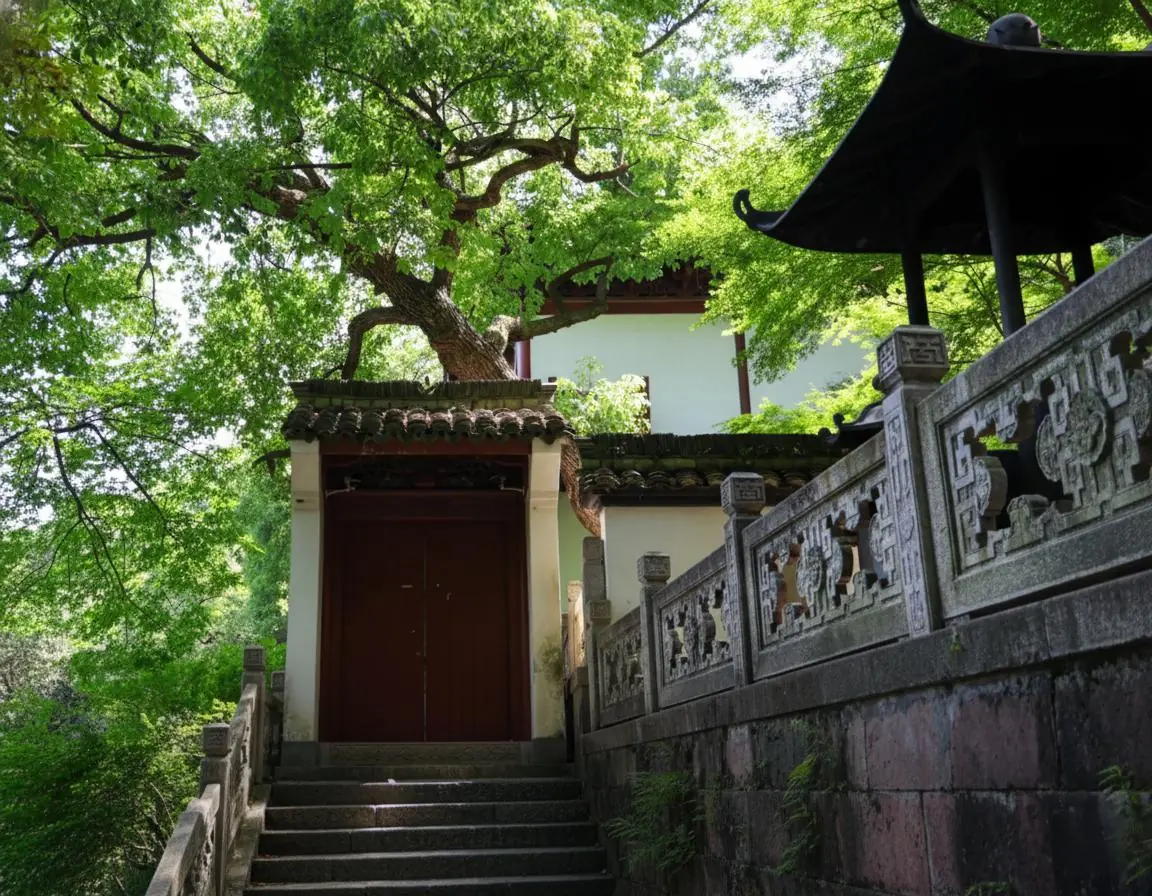
Taoguang requires a moderate uphill hike, but the reward is enormous: this is the only spot in Hangzhou where you can look down on the entire West Lake from a mountain vantage point. On a clear day, the whole lake spreads out below.
Longer extension: Three Tianzhu Temples
Follow Tianzhu Road (天竺路) from Lingyin Temple and you will pass, in sequence, Lower Tianzhu (法镜寺), Middle Tianzhu (法净寺), and Upper Tianzhu (法喜寺) — collectively the "Three Tianzhu." Each has over a thousand years of history, but this is a longer road extension rather than a quick hidden stop inside the Lingyin core.
Etiquette & Practical Tips
Three temple "codes"
🚪Step Over Thresholds
High thresholds in Chinese temples represent the Buddha's shoulders. You must step over them, never step on them.
↻Enter Left, Walk Clockwise
Enter through the left-side door, then follow a clockwise route. The central door belongs to the Buddha and the abbot — even if it is open, ordinary visitors do not use it.
🪔Use Free Incense
Hold incense in your left hand. Lingyin Temple provides three free incense sticks inside, so do not buy incense from vendors at the gate.
Practical information
- Dress code: no formal wear needed, but avoid sleeveless tops and very short shorts. Remove hats inside halls.
- Photography: outdoor areas and hall exteriors are fine; some hall interiors prohibit photos, so check signs before shooting.
- Payment: Alipay, WeChat Pay, and cash are accepted at Shi Fang Yuan and other on-site spots.
- Language: English signage is limited. Download a translation app before you go.
- Restrooms: mostly squat toilets. Bring tissues and hand sanitiser.
- Monkeys roam the scenic area. Do not feed them, and avoid crinkling plastic bags because they may snatch them.
- Rainy days make Feilai Peak paths slippery. Wear shoes with good grip; misty Lingyin is beautiful, but watch your step.
Scenic area hotline
0571-87968665 is the 24-hour scenic area hotline.
Frequently Asked Questions
No. Since December 2025, entry is free but a reservation through the Alipay or WeChat mini-program '杭州灵隐飞来峰' is mandatory. Book 1–7 days in advance. No walk-ins are accepted. If you miss your slot without cancelling, your account will be banned from booking for 30 days.
Sources checked for this guide
- Free-entry policy, daily caps, and reservation requirement: Xinhua/CCTV report on the Hangzhou West Lake Scenic Area notice
- No-show penalty and online waitlist update from February 2026: Hangzhou CPPCC / City Express report
- Lingyin Temple founding story and Huili background: Lingyin Temple official English introduction
- West Lake UNESCO context including Lingyin scenic-area planning: UNESCO World Heritage Centre
Beyond This Guide
Lingyin Temple is just one piece of Hangzhou's story — the city offers lakeside walks, historic tea villages, canal-side architecture, and one of China's best food scenes. Use these next steps to build the day around your pace:
- Turn this into a full day with West Lake Hangzhou.
- Follow a ready-made route with Hangzhou day trip: West Lake, Lingyin Temple & Longjing tea.
- Plan tea after the temple with the Hangzhou teahouse guide.
- Sort taxis, buses, and metro basics with China city transport.
© gochinafreely.com — Original guide by Go China Freely.