Hours & Base Ticket
Cable cars and the mandatory scenic shuttle are sold separately.
Decision Notes
Huangshan: Landscape Art in Stone

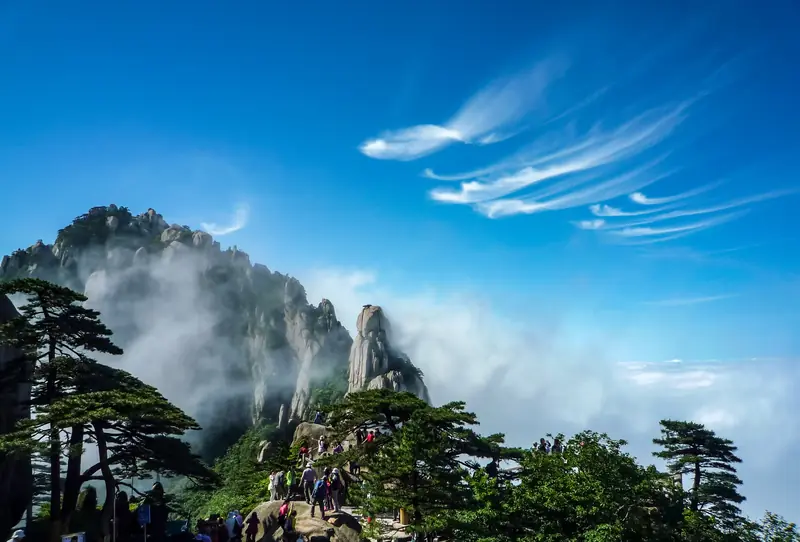
Huangshan's 72 peaks punch through the cloud layer — the view that inspired a thousand years of Chinese landscape painting
1,864 m
Highest point
72 peaks
Granite skyline
Sunrise + Xihai
Best payoff
UNESCO mountain landscape
Granite peaks, pines and cloud seas in one self-guided mountain route
Huangshan (黄山) rises to 1,864 m across 72 granite peaks that punch through a rolling sea of clouds.
The Chinese say "after Huangshan, no other mountain is worth seeing" — and after you've watched sunrise pour gold over the cloud layer from Bright Summit, you'll understand why.
This UNESCO dual heritage site rewards independent travelers who skip the tour-group trail and hike the Xihai Grand Canyon boardwalk most visitors never reach.
Why Huangshan looks different
Huangshan doesn't rank among China's tallest peaks — it wouldn't crack the top 50. What sets it apart are the "Four Wonders": peculiar pines, bizarre rocks, sea of clouds, and hot springs.
Why it works for independent travelers
For foreign visitors, Huangshan has an underrated advantage: it isn't overrun with international tourists the way the Great Wall or Terracotta Warriors are.
The source image behind Chinese landscape painting
For over a thousand years, Huangshan has been the prototype of Chinese landscape painting — those misty ink-wash scroll paintings you've seen in museums were almost certainly painted here, or imagined from here.
In 1990, Huangshan was inscribed as a UNESCO World Natural and Cultural Heritage Site — a dual designation that very few mountains worldwide hold.
Its granite peak forest formed during tectonic uplift 100 million years ago, then glaciers and weathering sculpted the cliffs and rock formations that make hikers stop mid-stride to reach for their cameras.
Reader expectation
Almost every independent traveler who comes here calls it the most stunning natural landscape they've seen in China — more culturally layered than Zhangjiajie, more accessible than Huashan, more visually dramatic than Taishan.
The Four Wonders at a Glance
🌲Peculiar Pines
Huangshan pines root themselves in cliff crevices and grow into natural bonsai shapes — over 100 named specimens cling to the cliffs at altitudes above 800 m. The most famous, the Greeting Guest Pine (迎客松), has become the visual emblem of Anhui Province.
🪨Bizarre Rocks
Granite weathered into fantastical shapes, each with an imaginative Chinese name: Monkey Watching the Sea (猴子观海), Immortal Pointing the Way (仙人指路), Flying Rock (飞来石), and Dream Pen Producing Flowers (梦笔生花).
☁️Sea of Clouds
With over 200 foggy days per year, clouds often settle below the peaks, leaving all 72 summits floating like islands in a white ocean. Best odds come on autumn and winter mornings after rain.
♨️Hot Springs
Natural springs at the mountain's base hold a steady 42°C year-round — a traditional wind-down after your descent. The hot spring zone sits outside the main scenic area and doesn't require a park ticket.
Iconic Peaks, Pines and Stones
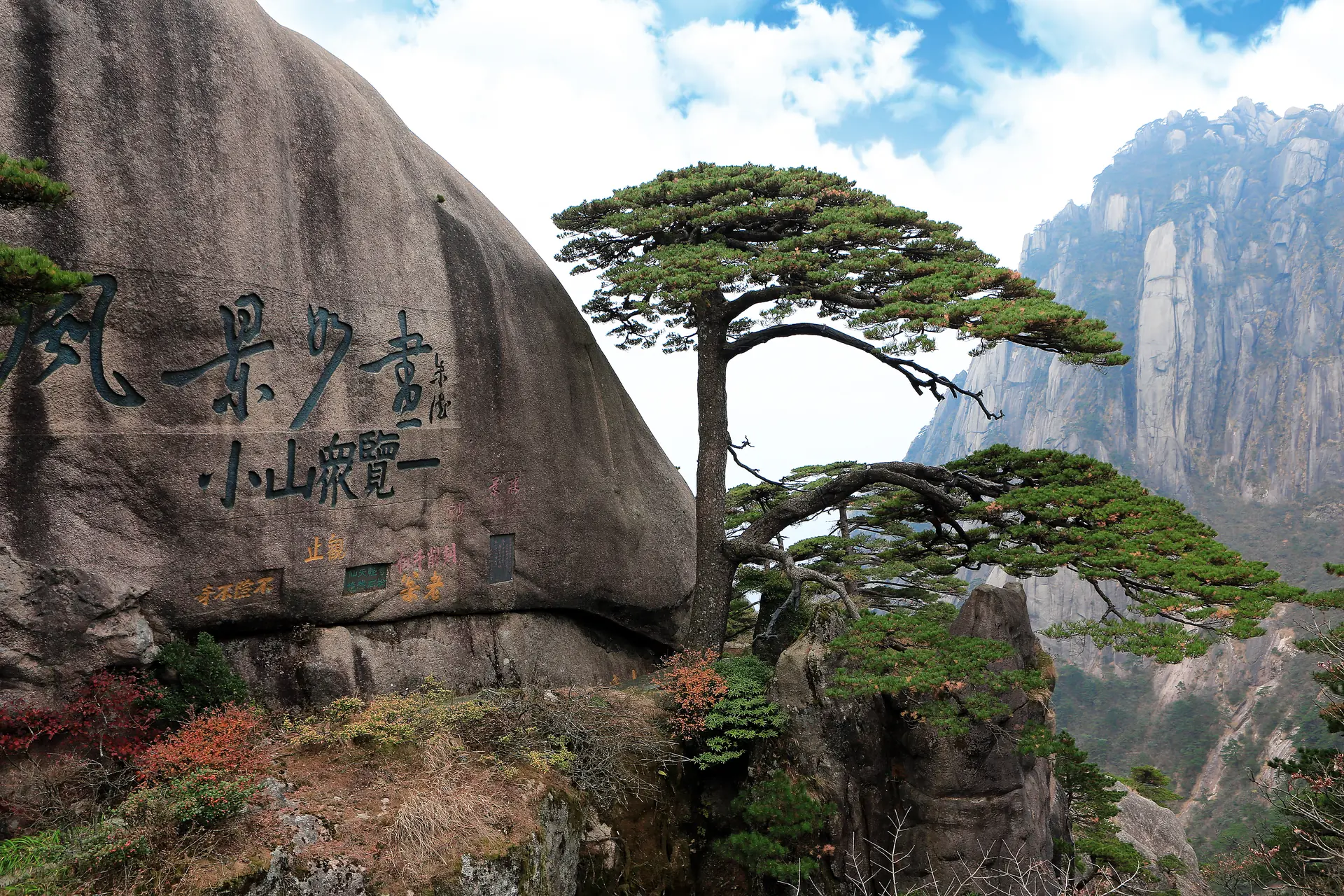
The Greeting Guest Pine — roughly 1,000 years old and the only tree in China with a full-time guardian
Huangshan's peaks, pines, and rock formations are the mountain's living gallery — each with a name, a legend, and a story that Chinese travelers have been retelling for centuries. The three main summits anchor your hiking route, while the iconic rocks and pines become the photo stops you didn't plan but can't walk past.
The Three Main Peaks
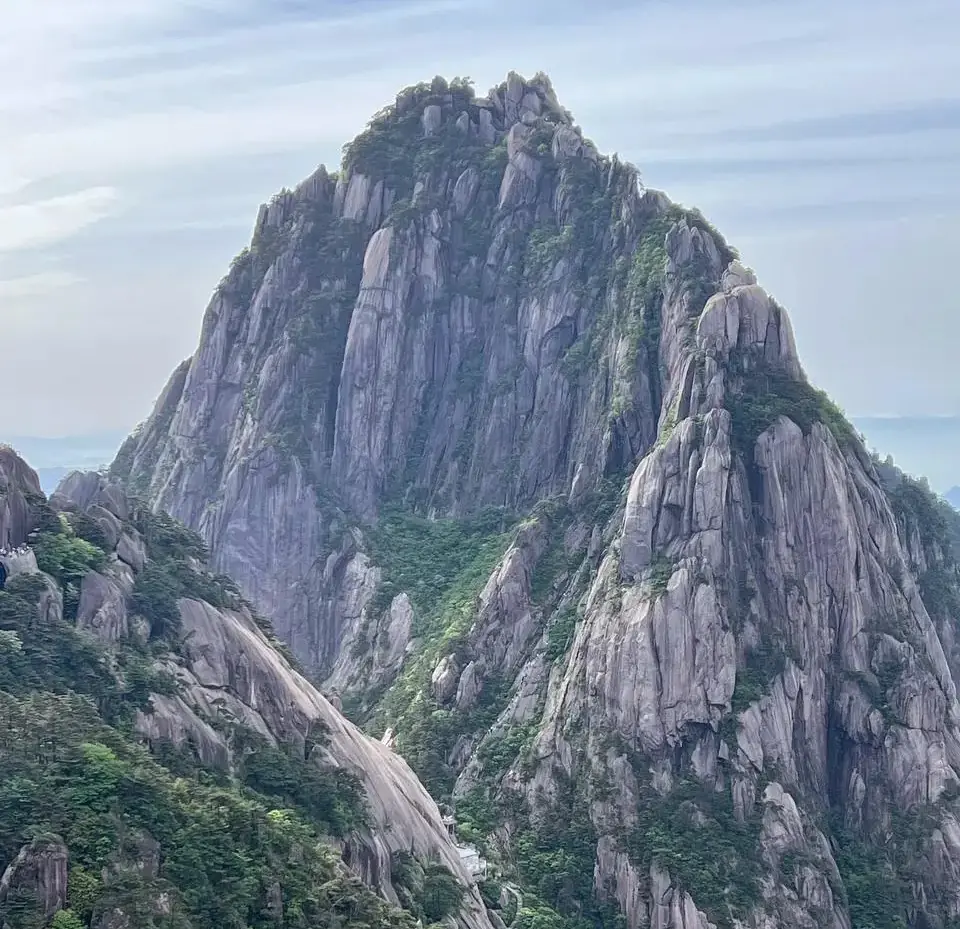
Lotus Peak (1,864 m) — Huangshan's summit, currently closed for vegetation recovery until 2029
Route decisions, not just names
Lotus Peak is the highest but currently resting; Heavenly Capital Peak is the active challenge; Bright Summit is the practical sunrise base.
Use the three peaks as route filters: skip the closed summit, add Heavenly Capital only if your knees and timing allow, and anchor sunrise plans around Bright Summit.
Closed cycle
Lotus Peak
Optional climb
Heavenly Capital
Sunrise base
Bright Summit
Lotus Peak (莲花峰)
Current status: in rest closure from Dec 2023, expected through ~2028.
At 1,864.8 m, Huangshan's highest point. The summit platform measures barely 10 m² with sheer cliffs on all sides; clear-weather views stretch for dozens of kilometers. Key alert: Lotus Peak and Heavenly Capital Peak rotate closures every 5 years to protect vegetation. From December 2023, Lotus Peak entered its current rest closure (expected through ~2028). Heavenly Capital Peak reopened for the current cycle, with seasonal winter closures; check official notices before your trip.
Heavenly Capital Peak (天都峰)
Route meaning: add only if you want the exposed, strenuous optional climb.
At 1,810 m, this is Huangshan's most treacherous summit. The "Crucian Carp Spine" section narrows to under 1 m with drops on both sides — Huangshan's most thrilling stretch. Allow ~1.5 hours for the round trip on steep stairs. Not recommended for anyone with vertigo, knee issues, or over 60. Open 2025–2028, excluding winter maintenance periods; Lotus Peak is closed during this cycle.
Bright Summit (光明顶)
Route meaning: choose nearby lodging if sunrise is a priority.
At 1,860 m, the second-highest peak with a relatively flat, open top. Bright Summit is a top sunrise choice: unobstructed 360° views, and the Guangmingding Lodge sits just 5 minutes away. The weather station's spherical radar dome is the landmark.
Must-See Rocks and Pines
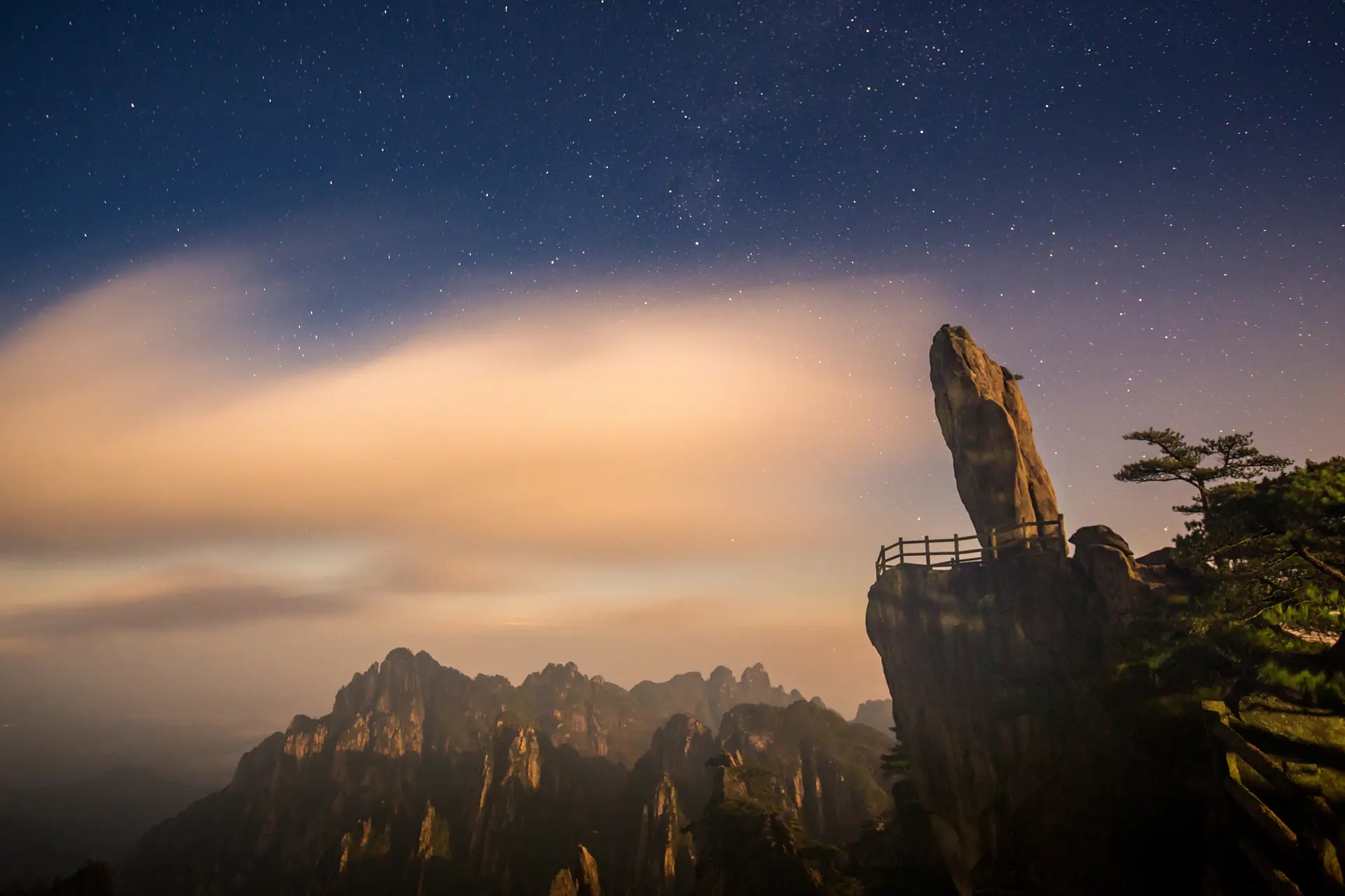
Flying Rock — the 360-ton boulder that starred as the Spirit Stone in the 1987 Dream of the Red Chamber
Route markers, not detours
These rocks and pines work best as route markers, not separate mini-attractions.
Flying Rock is the easiest symbol to spot from a distance; Greeting Guest Pine is the cultural icon most Chinese visitors know before they arrive.
Cultural icon
Greeting Guest Pine
Easy landmark
Flying Rock
Cloud-sea photo
Monkey Watching the Sea
Greeting Guest Pine (迎客松)
Look for it: beside Yuping Tower, near the classic front-mountain route.
Rooted on a cliff beside Yuping Tower, roughly 1,000 years old, it is China's most famous individual tree. Since the 1980s the park has assigned it a dedicated 24-hour guardian — now in the 19th generation — who inspects it every 2 hours.
Flying Rock (飞来石)
Route meaning: easiest rock symbol to recognize from a distance.
A ~12 m tall, ~360-ton boulder standing upright on a flat mountain top. The opening shot of the classic 1987 TV series Dream of the Red Chamber — the "Spirit Stone" — was filmed right here.
Monkey Watching the Sea (猴子观海)
Photo timing: strongest when clouds roll in around Lion Peak.
On the north side of Lion Peak, a monkey-shaped rock faces the cloud sea. When clouds roll in, the "monkey" appears to gaze across the ocean. One of Huangshan's most photogenic formations; early morning light is ideal.
Dream Pen Producing Flowers (梦笔生花)
Look for it: a brush-like rock pillar in the North Sea area.
The North Sea landmark: a slender rock pillar with a pine growing from its tip, resembling a calligraphy brush in bloom. The original pine (扰龙松, 600+ years old) died in 1982. In 2004, the park transported a ~50-year-old Huangshan pine up via a steel-cable pulley system stretched between two peaks, and experts confirmed it had taken root by 2005.
Farewell Guest Pine
Context: the counterpart to Greeting Guest Pine.
Counterpart to the Greeting Guest Pine on the other side of Yuping Tower. The original tree died; what you see today is a replacement.
Sunrise, Sunset and the Sea of Clouds
Sunrise Planning
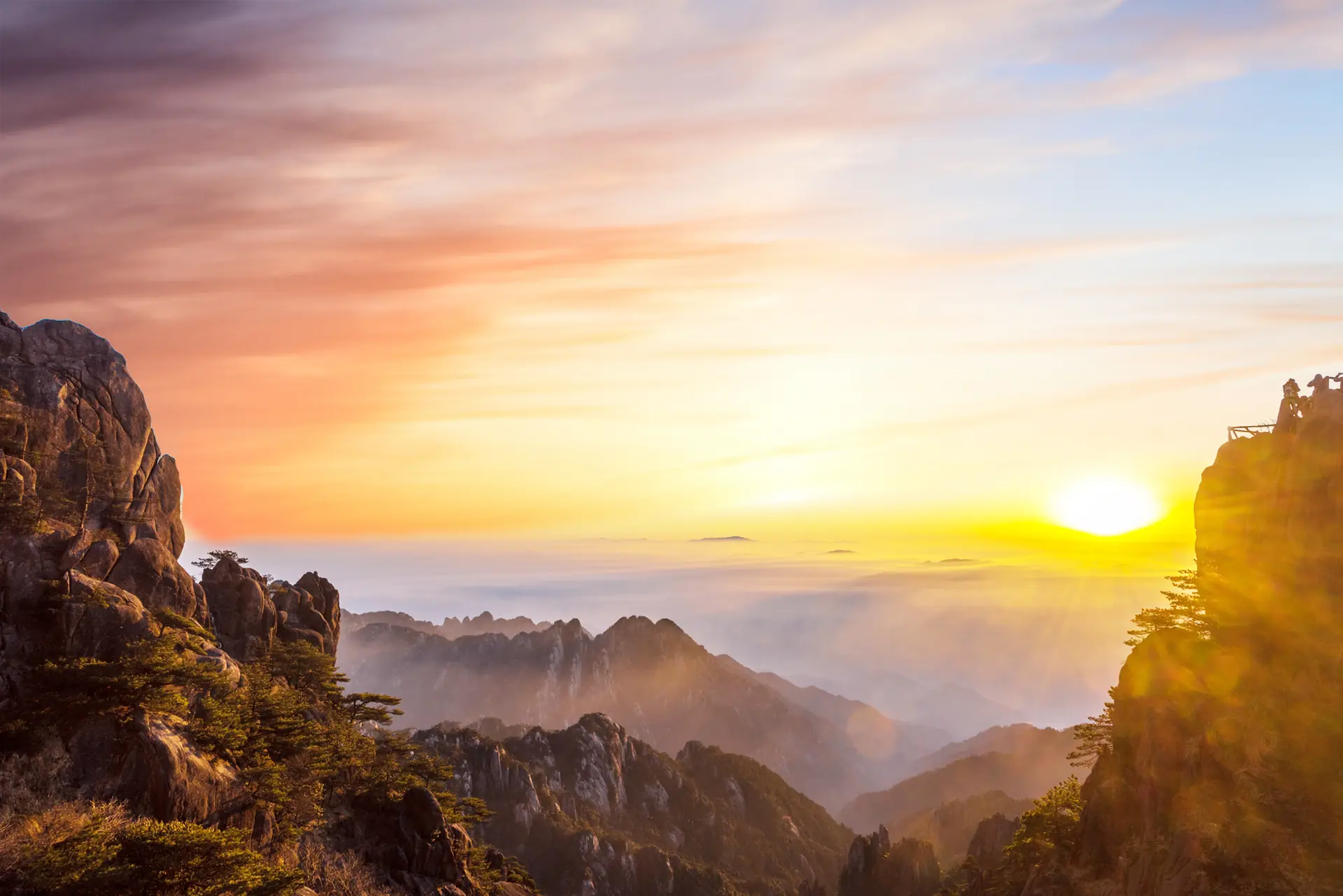
Sunrise from Bright Summit — the most popular vantage point for Huangshan's iconic dawn spectacle
Main mountain payoff
Sunrise is worth the pre-dawn cold only if your hotel, viewpoint, and timing line up.
The sun climbs through the cloud sea while distant peaks blush gold and red, and nearby pines stand silhouetted like cutouts. Almost everyone who has seen it says it was worth freezing through the pre-dawn hike.
Best sunrise spots
Most popular
Bright Summit (光明顶)
360° unobstructed, widest panorama. Nearest hotel: Guangmingding Lodge, about 5 minutes away.
Quieter classic
Lion Peak (狮子峰) / Cool Terrace
Sunrise + Monkey Watching the Sea in one frame. Nearest hotels: Beihai Hotel / Shilin Grand Hotel, about 10–15 minutes away.
Fewer people
Beginning-to-Believe Peak (始信峰)
Small summit, fewer people, unique angle. Nearest hotel: Beihai Hotel, about 15–20 minutes away.
Photography angle
Danxia Peak (丹霞峰)
West Sea peaks backdrop, great for photography. Nearest hotels: Xihai Hotel / Paiyunlou Hotel, about 10 minutes away.
Sunrise time reference
Jan–Feb
6:50–7:10
Mar–Apr
5:50–6:20
May–Jun
5:10–5:30
Jul–Aug
5:20–5:40
Sep–Oct
5:40–6:10
Nov–Dec
6:10–6:50
Dawn timing
Arrive 30–40 minutes early to claim your spot. Bright Summit is the most popular but has plenty of room; Lion Peak / Cool Terrace is quieter but the platform is small, so latecomers get no good position on busy days.
In summer, sunrise before 5:30 means a 4:30 wake-up — the closer your hotel, the better. Bring a headlamp; the trails have no lights.
Sunset and Cloud Sea
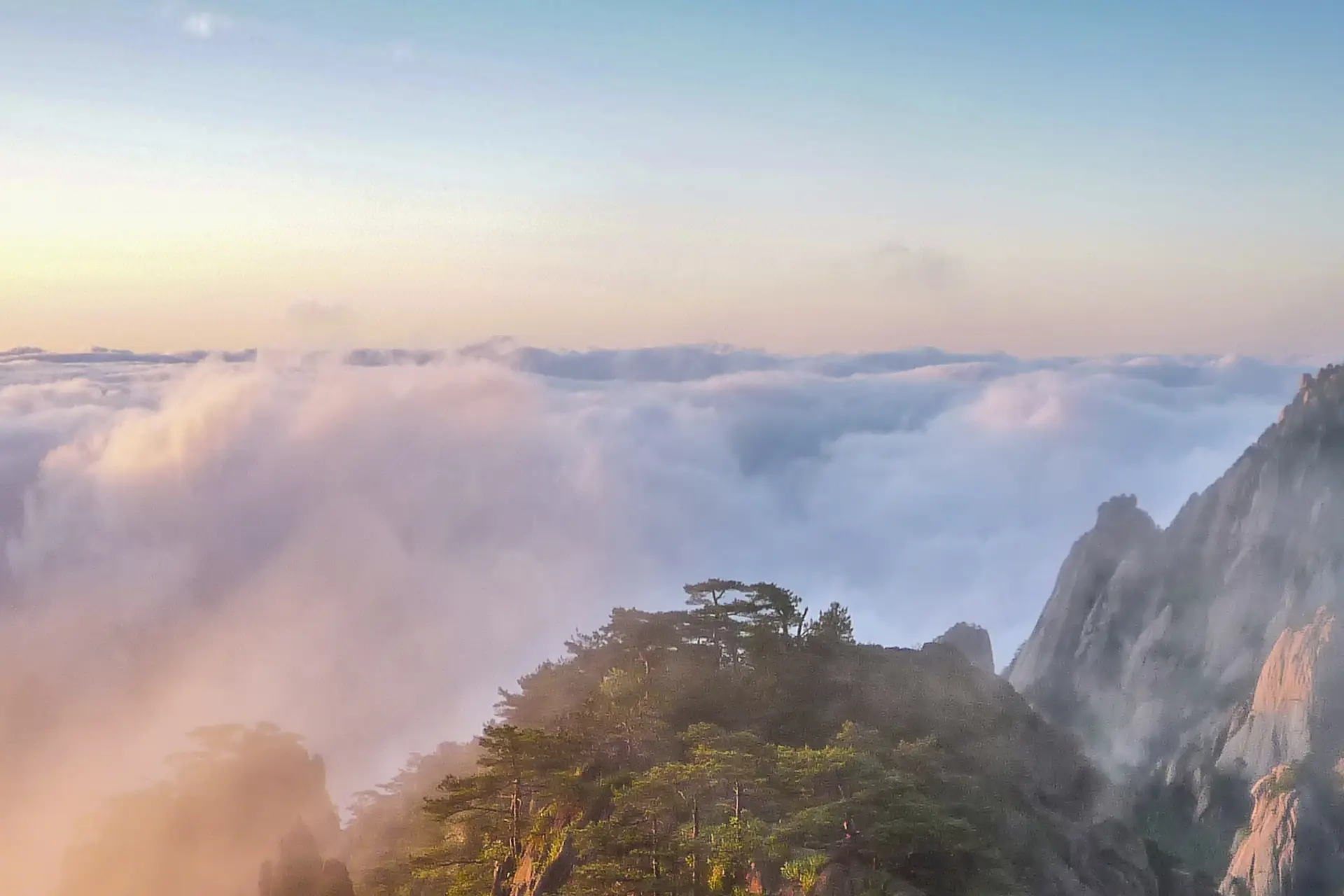
Pine silhouettes frame the cloud sea — autumn and winter mornings after rain offer the best odds
Evening and weather windows
Sunset is easy to catch; the cloud sea is the prize you plan around weather.
The sea of clouds is Huangshan's signature spectacle, but it doesn't appear every day. Best conditions: Autumn (Sep–Nov) and winter (Dec–Feb) offer the highest odds, visible roughly 30–40% of days.
Rain or overcast the day before followed by clear skies next morning means very high probability. It is most dramatic within 30 minutes of sunrise.
Best sunset point
Paiyun Pavilion (排云亭)
It faces the West Sea peaks, and the afterglow paints the ridgeline in layered gradients. Near Flying Rock works well too. Sunset is more relaxed than sunrise: arrive 15 minutes early and you're fine.
Best cloud-sea viewpoints
Bright Summit, Paiyun Pavilion, Turtle Peak and Lion Peak
If you only have 2 days, check the weather forecast and pick a day with "rain turning clear" or "overcast turning partly cloudy" — your odds of witnessing the cloud sea double. The official Huangshan WeChat account publishes daily cloud sea forecasts.
Xihai Grand Canyon: Hidden Highlight
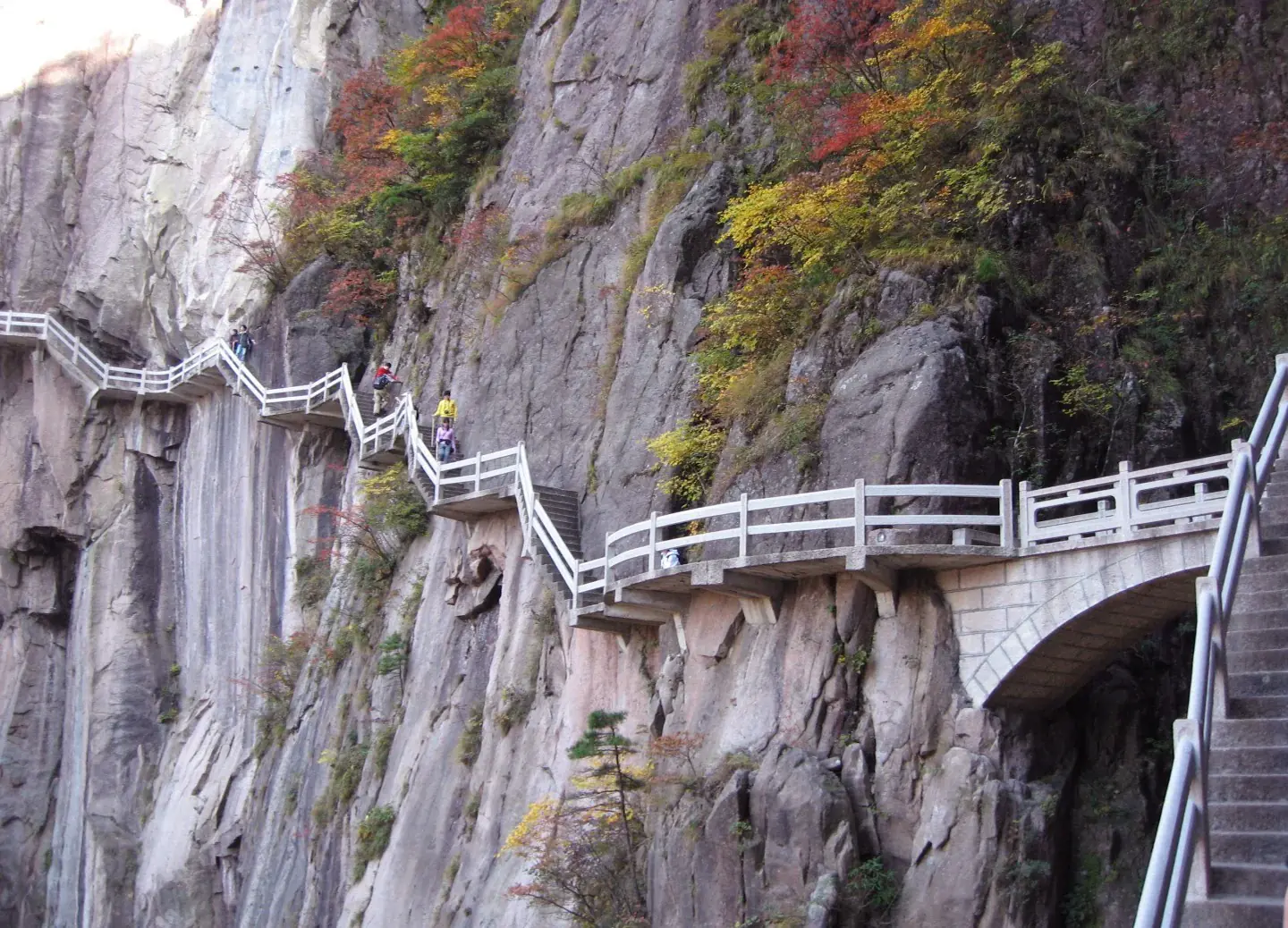
The Xihai Grand Canyon boardwalk — most tour groups skip this, leaving it blissfully uncrowded
Protect the canyon time
Xihai Grand Canyon is the hidden highlight only if you give it real route space.
The Xihai Grand Canyon (西海大峡谷) is a boardwalk route within Huangshan that only opened in 2001.
Treat it as a route commitment, not a quick viewpoint: the full version needs 3–4 hours and works best when you have at least 2 days on the mountain.
Why it feels quieter
Most tour groups skip it
The full loop takes 3–4 hours, so it falls outside most fast tour-group routes.
Crowd relief
Roughly 1/3 of Bright Summit density
Even during Golden Week, the boardwalk usually feels much calmer than the central summit area.
Best scenery
Huangshan's most dramatic close-up views
Deep-cut cliffs and boardwalks are seen up close, not from a distant ridgeline.
Route and timing
Enter the canyon by descending from Paiyun Pavilion. Choose the shorter out-and-back if time is tight; choose the full descent if Xihai is one of your main reasons for coming.
Moderate fitness / limited time
First Loop
1.5–2h
Round trip from Paiyun Pavilion
Route: descend from Paiyun Pavilion to the first loop's lowest point, then retrace your steps back up.
Best for: visitors with only one day on the mountain, or anyone who wants a taste of the canyon without committing to the full descent.
Trade-off: does not reach the most dramatic full-loop boardwalk sections.
Recommended experience
Full Loop + Funicular
3–4h
One way · funicular ¥100 peak / ¥80 winter
Route: descend all the way through the canyon's most spectacular boardwalk sections.
Exit: ride the Xihai Grand Canyon Funicular, about 5 minutes, up to Tianhai.
Best for: anyone with 2+ days on Huangshan — this is the highlight you came for.
Planning guardrails
Trail conditions
Fully paved stone steps with handrails, but extremely steep and mostly downhill. Bring trekking poles if you have knee concerns. Slippery when wet — wear shoes with good grip.
Winter closure
The entire Xihai Grand Canyon closes December 1 through March 31 every year (including the funicular), so winter visitors cannot access it.
Best rhythm if you have two summit nights
If you're staying two nights on the summit, enter the canyon after 2:00 PM on Day 1 from Paiyun Pavilion — by then most hikers have turned back, and the entire boardwalk feels like your private trail.
Afternoon light enters from the west side of the canyon, illuminating the opposite cliff faces and pine silhouettes — the golden hour for photography. Take the funicular up, check into Baiyun Hotel or Guangmingding Lodge, and catch sunrise the next morning.
Huangshan Routes: 1, 2 or 3 Days
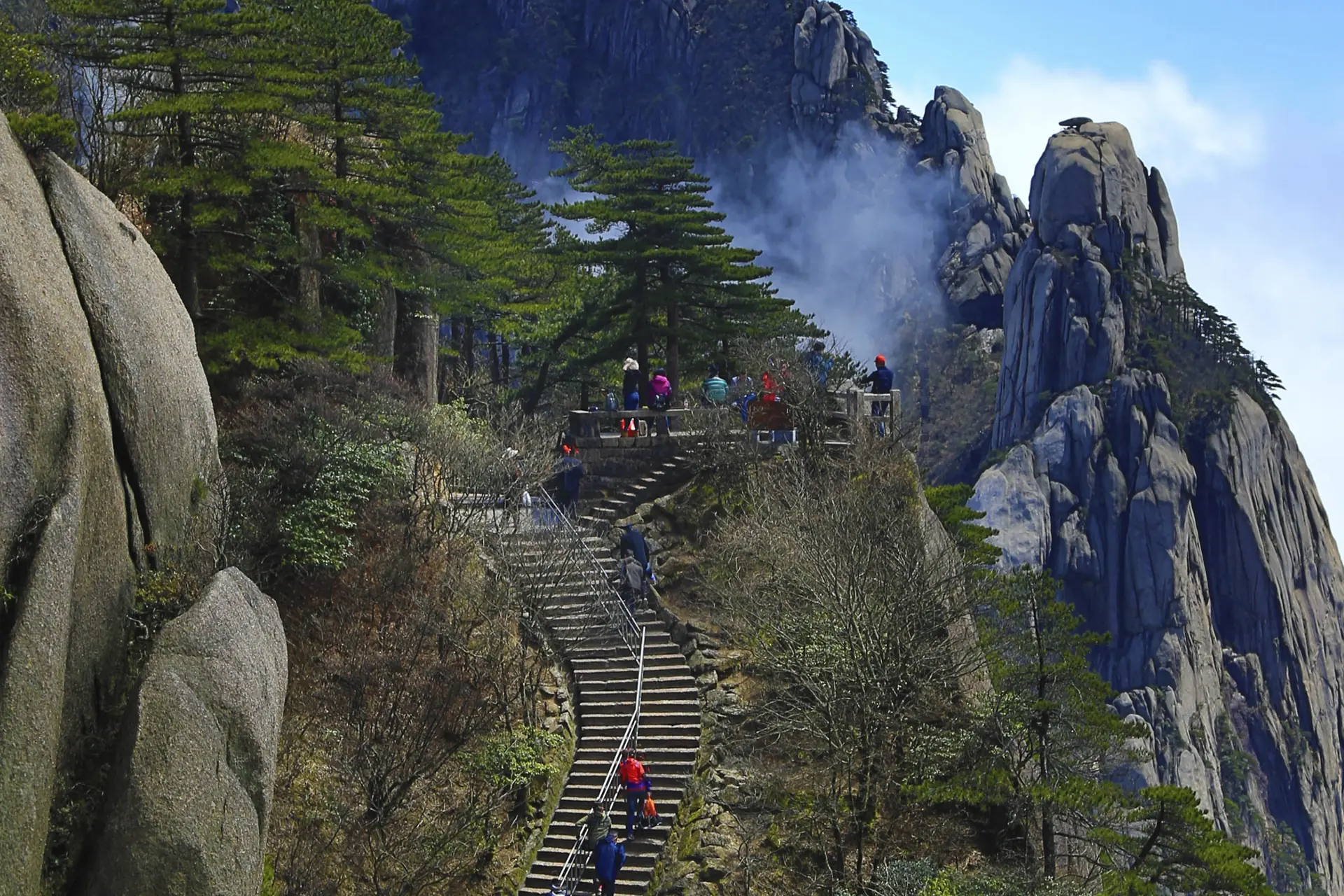
The Hundred-Step Cloud Ladder — one of Huangshan's most thrilling stairway sections between peaks
Choose the route by the experience you most want to protect, not by how many scenic names you can pack into the day.
Two days is the strongest first-time Huangshan plan. It protects the full Xihai Grand Canyon, a summit hotel night, sunrise, and the classic front-mountain descent.
One day keeps the famous ridge and pines but gives up sunrise and usually Xihai Canyon. Three days is for fit hikers who want to slow down, add a hike-up approach, or leave through the quieter North Gate.
1 day · Fastest
Best when time is tight and you mainly want the classic ridge.
Cable cars up and down make this a 6–8 hour route with about 10 key stops: North Sea, Flying Rock, Bright Summit, Greeting Guest Pine, and the front-mountain descent.
Payoff: efficient first taste of Huangshan's famous peaks and pines.
Trade-off: no sunrise and usually no Xihai Grand Canyon.
2 days · Recommended
The best first-time route if you can sleep on the summit.
Rear mountain up, Xihai Canyon, summit hotel, dawn at Bright Summit, then front mountain down. This protects both the canyon and sunrise.
Payoff: Xihai Grand Canyon + summit sunrise in one clean loop.
Watch: book the summit hotel early; it controls whether this route works.
3 days · Deep hike
Best for fit hikers who want stairs, forest, and a quieter exit.
Build on the 2-day classic route and add either a hike-up approach or the North Gate descent through Songgu scenic area.
Payoff: less rushed pacing and a quieter old-growth forest finish.
Trade-off: more stairs and more weather exposure.
Detailed flow
1-Day Highlights Route
Use cable cars both up and down. This is the practical 6–8 hour version for visitors with limited time but reasonable fitness; the major trade-off is skipping sunrise and the full Xihai Grand Canyon.
- Tangkou Shuttle Bus(汤口换乘中心)- 7:00 — Buy tickets online in advance
- Yungu Cable Car Up(云谷索道)- 7:30 — ~8 min to White Goose Ridge
- Beginning-to-Believe Peak(始信峰)- 8:00 — ~40 min round trip
- North Sea Area(北海景区)- 9:00 — Dream Pen + Monkey Watching the Sea, 1–1.5 hrs
- Flying Rock(飞来石)- 10:30 — via Xihai Hotel
- Bright Summit(光明顶)- 11:00 — Lunch at Guangmingding Lodge
- Turtle Peak + Hundred-Step Cloud Ladder(鳌鱼峰 + 百步云梯)- 12:30 — Optional: Heavenly Capital Peak if open (~1.5 h)
- Greeting Guest Pine(迎客松)- 14:00 — Must-see photo stop
- Yuping Cable Car Down(玉屏索道)- 14:30 — ~8 min to Ciguang Pavilion
- Shuttle Bus Back to Tangkou(返回汤口)- 15:00 — End
If you only have one day but desperately want Xihai
You could sacrifice Greeting Guest Pine and the Yuping descent, then head to Paiyun Pavilion for the first loop instead. It works only with an early start, good weather, and very tight timing.
Detailed flow
2-Day Classic Route
The recommended first-time Huangshan experience: front and back mountain highlights, Xihai Grand Canyon, a summit hotel night, and sunrise.
Day 1: Rear Mountain Up → North Sea → Xihai Grand Canyon → Summit Hotel
- Tangkou Shuttle Bus(汤口换乘中心)- 6:30 — Start early to beat the crowds
- Yungu Cable Car Up(云谷索道)- 7:00
- Beginning-to-Believe Peak(始信峰)- 7:30 — 40 min round trip
- North Sea Area(北海景区)- 8:30 — Dream Pen + Monkey Watching the Sea
- Paiyun Pavilion(排云亭)- 10:00 — Quick lunch at Paiyunlou Hotel
- Xihai Grand Canyon(西海大峡谷)- 10:30 — 3–4 hours full loop
- Funicular Tram to Tianhai(地轨缆车)- 14:00 — ¥100
- Summit Hotel Check-in(山顶酒店)- 14:30 — Baiyun Hotel or Guangmingding Lodge
- Optional Sunset(日落)- 17:00 — Paiyun Pavilion or Flying Rock
- Early Bedtime(早休息)- 4:30–5:00 AM wake-up for sunrise
Day 2: Sunrise → Front Mountain Down
- Bright Summit Sunrise(光明顶日出)- 4:30–5:00 — Headlamp required; winter: 1 hour later
- Hotel Breakfast + Check-out(早餐退房)- 6:30
- Turtle Peak + Hundred-Step Cloud Ladder(鳌鱼峰 + 百步云梯)- 7:30
- Heavenly Capital Peak (Optional)(天都峰)- 9:00 — 1.5 h round trip, strong hikers only; Lotus Peak closed 2023–2028
- Greeting Guest Pine(迎客松)- 10:30 — Yuping Tower
- Yuping Cable Car Down(玉屏索道)- 11:00 — to Ciguang Pavilion
- Shuttle Bus to Tangkou(返回汤口)- 11:30 — Lunch in Tangkou or Tunxi
Detailed flow
3-Day Deep Hike
The 3-day option suits fit hikers who want the deepest experience without rushing. Build on the 2-day route and add one slower approach or exit day.
- Hike up instead of taking the cable car- Yungu Temple ~2.5–3 h, or Ciguang Pavilion ~3–3.5 h — steeper but lets you hit Heavenly Capital Peak on the way if open
- Follow the classic summit route- Use the 2-day core: North Sea, Xihai Grand Canyon, summit hotel, and sunrise
- Descend via the North Gate Taiping Cable Car- Go through Songgu scenic area for very few visitors and an old-growth forest atmosphere
Tickets, Cable Cars and Shuttle Buses
Huangshan operates a 3-tier ticketing system — a fact many foreign visitors only discover on arrival. Understanding it in advance saves significant queuing time.
¥190 / ¥150
The compulsory scenic-area ticket. Discounts and free-entry rules depend on age, documents, and current notices.
¥19 one way
Mandatory from Tangkou Transfer Center to the cable-car or trailhead zones. Private cars cannot enter.
¥65–100 one way
Yungu, Yuping, Taiping, and Xihai Funicular are priced separately, so your route changes the total cost.
Ticket and Transport Details
Cost formula
Entry ticket + scenic shuttle + whichever cable cars your route uses.
Most first-time visitors pay the park entry, the Tangkou shuttle, and one or two cable-car rides. Xihai Grand Canyon adds the funicular only if you descend to the canyon bottom.
1. Park entry
¥190 peak season / ¥150 winter
Half tickets are usually ¥95 peak / ¥75 winter for eligible students and ages 60–65 or 6–18. Free entry usually applies to ages 65+, children under 6, or children under 1.2 m.
Peak season is Jan 21–Dec 19; winter season is Dec 20–Jan 20.
2. Scenic shuttle
¥19 one way / ¥38 round trip
Tangkou Transfer Center → Yungu Temple or Ciguang Pavilion takes about 20 minutes. Private cars cannot enter the scenic area, so the shuttle is the only way to reach the trail and cable-car starting points.
3. Cable cars
¥65–100 one way, depending on line and season
Yungu
¥80 / ¥65
Rear mountain: Yungu Temple ↔ White Goose Ridge
Yuping
¥90 / ¥75
Front mountain: Ciguang Pavilion ↔ Yuping Tower
Taiping
¥80 / ¥65
North Gate: Songgu Temple ↔ Danxia Station
Xihai Funicular
¥100 / ¥80
Canyon bottom → Tianhai, uphill only
Default strategy: Yungu up + Yuping down covers both sides without backtracking. Arrive before 7:00 on peak days; weekends and holidays can push queues to 1–2 hours.
4. How to buy
Use the official "Huangshan Tourism" (黄山旅游官方平台) WeChat mini-program or OTAs like Trip.com(affiliate link · may earn commission, no extra cost).
On weekends and holidays, book 1–3 days in advance. Golden Week tickets can sell out a week early. Weekdays rarely hit capacity but online purchase still saves queuing.
Cable-car tickets are available on the WeChat mini-program or by scanning QR codes on-site. Buy early if your route depends on a specific cable-car direction.
Getting to Huangshan
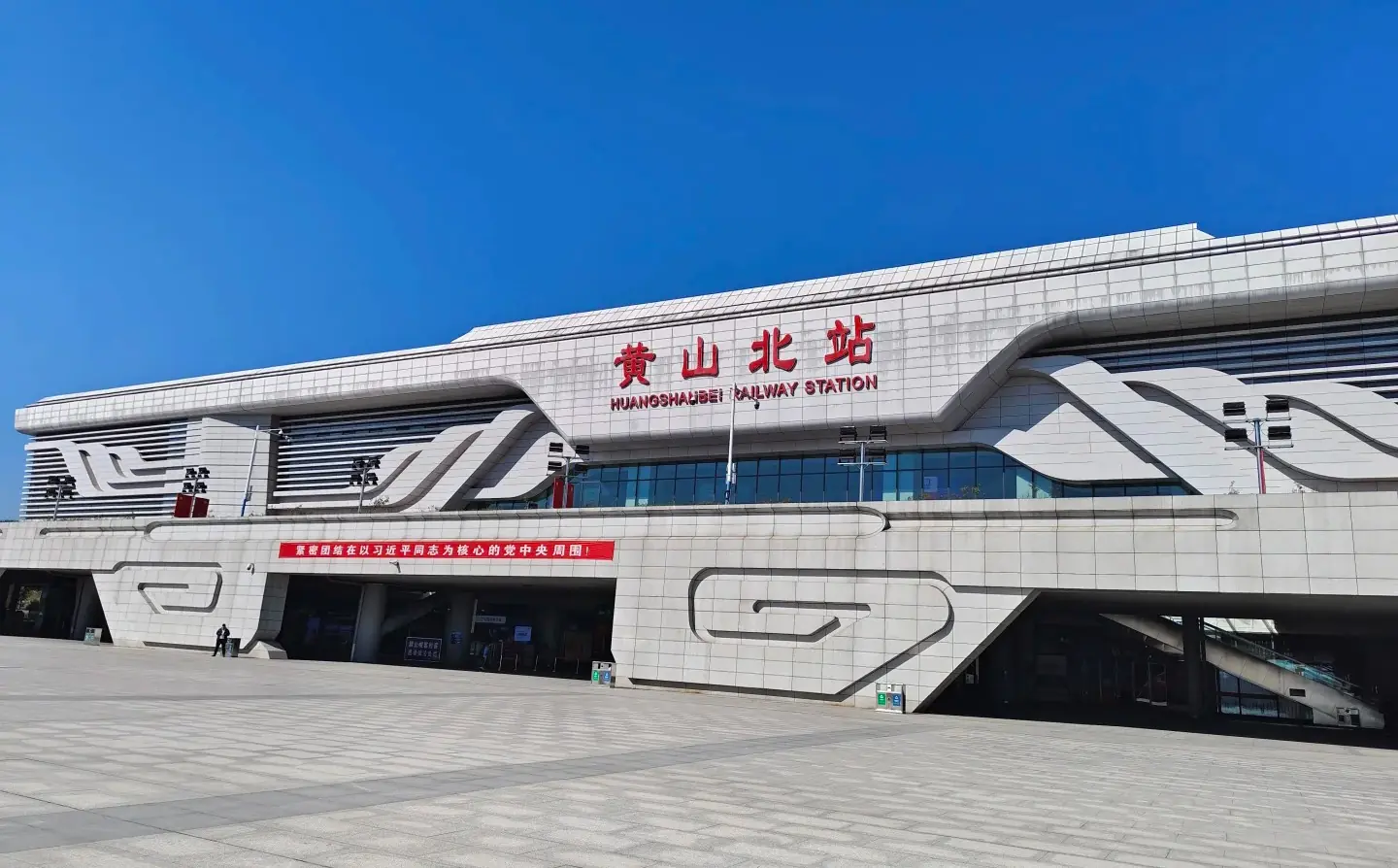
Tangkou — the gateway town where all visitors transfer to the scenic area shuttle bus
City first, mountain second
Do not aim for “Huangshan” generically; aim for Huangshan City, then Tangkou Town, then the scenic shuttle.
A common point of confusion: "Huangshan" is both the mountain's name and the city's name. The scenic area sits near Tangkou Town (汤口镇) in southern Huangshan City, roughly 60 km from the urban center (Tunxi District).
The important chain is simple: reach Huangshan City, continue to Tangkou Town, then use the official scenic shuttle for the final mountain access.
Best arrival
High-speed rail to Huangshan North
Huangshan North Station (黄山北站) (Google | Amap) is the main hub. Shanghai Hongqiao → ~2.5 hours, ~¥200. Hangzhou East → ~1.5 hours, ¥120. Hefei South → ~2 hours, ~¥150. Nanjing South → ~2.5 hours.
Transfer logic
Huangshan City → Tangkou Town → scenic shuttle
Taxis and buses get you to Tangkou; only the scenic shuttle takes visitors to the trail and cable-car starting points.
Flight backup
Huangshan Tunxi International Airport
Huangshan Tunxi International Airport (黄山屯溪国际机场) has domestic routes from Beijing, Guangzhou, Shenzhen, Chengdu, and more. The airport is about 7 km from downtown Tunxi.
Huangshan City → Tangkou Town (Park Gate)
Best default
Tourist bus
~1 hour · ¥20–25. Direct from Huangshan North Station and the bus terminal.
Fast but pricier
Taxi / ride-hailing
~50 min · ¥150–200. Negotiate or use Didi.
Group option
Private car hire
~50 min · ¥200–300. Good for groups splitting costs.
From Huangshan North Station, direct buses to Tangkou Transfer Center (汤口镇换乘中心) (Google | Amap) depart from the exit plaza roughly every 30 minutes.
If your train arrives in the afternoon, stay overnight in Tangkou and head up first thing next morning. Tangkou has plenty of hotels in the ¥100–400/night range.
Taxi Card
For taxis and Didi, use the transfer center name rather than asking for a cable-car station. Drivers drop you at Tangkou; the scenic shuttle takes you the rest of the way.
Show this screen to your driver · 出示给司机看
请带我去汤口镇换乘中心(黄山风景区南大门游客换乘点)
Please take me to Tangkou Transfer Center, the visitor shuttle hub for Huangshan Scenic Area South Gate.
This is where taxis and Didi drop visitors. From here, take the official scenic shuttle to Yungu Temple or Ciguang Pavilion.
Where to Stay on the Mountain
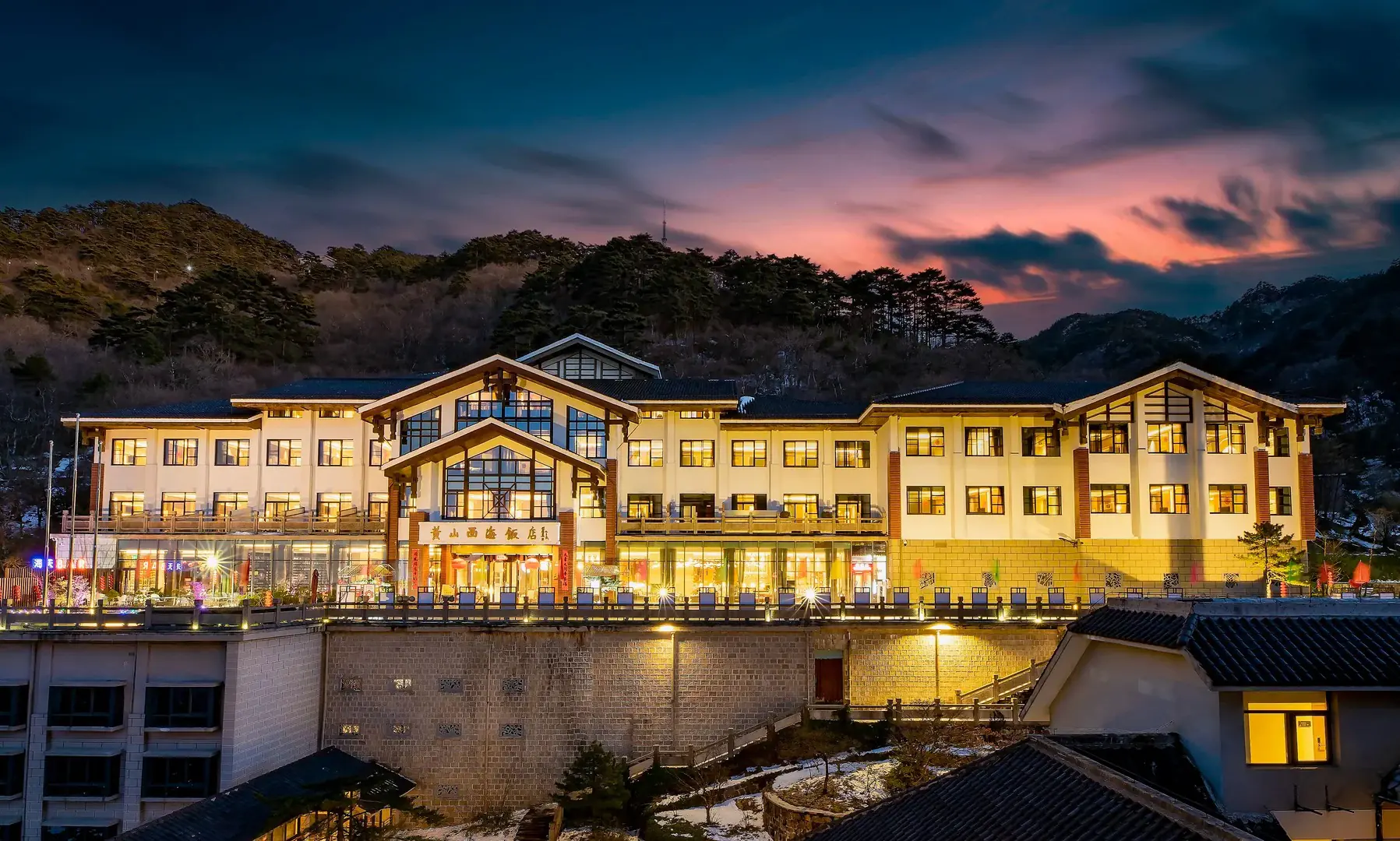
Golden hour from the summit — booking a night on top is the key to catching both sunset and sunrise
Stay on top if sunrise or Xihai matters
Summit hotels are not luxury splurges here; they decide whether sunrise and Xihai Grand Canyon are realistic.
To catch sunrise or hike the Xihai Grand Canyon, you need at least one night on the summit. Rooms are limited, expensive, and sell out fast during peak periods — this is the single most important booking to plan ahead.
Hotel selection logic: work backwards from your preferred sunrise location. For Bright Summit sunrise, stay at Guangmingding Lodge or Baiyun Hotel; for Lion Peak / Cool Terrace, stay at Beihai Hotel.
Guangmingding Lodge or Baiyun Hotel
Best if you want the shortest pre-dawn walk to the widest panorama.
Beihai Hotel or Shilin Grand Hotel
Best if you want a smaller platform and the Monkey Watching the Sea angle.
Xihai Hotel or Paiyunlou Hotel
Best if the canyon entrance and Paiyun Pavilion sunset matter most.
Summit hotel shortlist
Beihai Hotel (北海宾馆)
North Sea area · ¥900–1,500 · Closest to Lion Peak sunrise
Shilin Grand Hotel (狮林大酒店)
North Sea area · ¥800–1,400 · Same area, slightly quieter
Xihai Hotel (西海饭店)
West Sea area · ¥1,000–1,800 · Best-renovated, near Paiyun Pavilion
Paiyunlou Hotel (排云楼宾馆)
Beside Paiyun Pavilion · ¥800–1,300 · At the Xihai Canyon entrance
Baiyun Hotel (白云宾馆)
Tianhai · ¥900–1,500 · Near Bright Summit, funicular endpoint
Guangmingding Lodge (光明顶山庄)
Bright Summit · ¥800–1,200 · 5-minute walk to Bright Summit sunrise
Yuping Tower Hotel (玉屏楼宾馆)
Yuping Tower · ¥900–1,500 · Right beside Greeting Guest Pine
Booking strategy
Peak periods (Golden Week, May Day, summer weekends): book 2–4 weeks ahead — popular hotels sell out. Weekdays: 3–5 days ahead is usually fine. Winter: prices drop 50–70%, but some hotels may close entirely.
Booking channels: Trip.com (English interface), Ctrip, Meituan, or hotel WeChat mini-programs.
Dormitories and camping
Some hotels offer dormitory beds (¥150–300/bed) — full during peak season. Sleeping bags in hotel lobbies used to be a backpacker option but management is strict now; not recommended.
No camping allowed: Camping is strictly prohibited on the mountain — once tolerated, now enforced with fines.
When to Visit Huangshan
Season chooser
Autumn is the easiest first-time bet, but every season has a reason to go.
Use the season to decide what you are protecting: flowers and waterfalls in spring, cloud seas in summer, clear air in autumn, or snow and low crowds in winter.
Spring · Mar–May
Azalea blooms and strong waterfalls
Mid-April to mid-May is the flower peak. Watch for frequent rain, fog, and unpredictable visibility.
Summer · Jun–Aug
Cooler summit air and cloud seas after storms
The summit is 6–8°C cooler than the lowlands. Watch for summer-holiday crowds and thunderstorm safety.
Autumn · Sep–Nov
Best season for clear skies and comfortable hiking
Autumn foliage, high cloud-sea odds, and easier temperatures make this the safest pick. Avoid Golden Week if possible.
Winter · Dec–Feb
Rime ice, snow peaks, half-price tickets, fewer visitors
Best for ink-wash snow scenery. Watch for Xihai Canyon closure, peak closures, slippery trails, and the need for crampons.
Avoid if you can
Golden Week (Oct 1–7) and May Day (May 1–5): daily visitors hit 30,000–50,000, and cable-car queues can exceed 2 hours.
Qingming, Dragon Boat, and Mid-Autumn holidays: also busy, especially around transport and cable-car bottlenecks.
Better crowd windows
Mid-September weekdays
The calm before Golden Week, with excellent weather.
Early November
End of autumn color, with a sharp crowd drop.
Weekday rule: visitor counts typically run at 1/3 to 1/2 of weekends.
What to Pack and Trail Tips
Pack for stairs, weather, and summit prices
Huangshan is not a gentle park walk; your shoes, knees, and bag weight matter.
The whole mountain is stone steps. A 2-day route can involve roughly 60,000–80,000 steps, plus pre-dawn cold if you are chasing sunrise.
Essential gear
Hiking shoes / non-slip shoes
Trainers work, but proper hiking shoes save your knees on long stone-step days.
Rain poncho, not umbrella
Weather shifts fast; umbrellas throw off balance on stairs and can flip in wind.
Headlamp
Essential for sunrise because pre-dawn trails have no lighting.
Trekking poles
Highly recommended for descents; buy at base shops for ¥10–30/pair or bring your own.
Power bank
Summit hotels have electricity, but outlets may be limited.
Warm layer
Even in summer, summit pre-dawn temperatures can dip below 10°C; autumn and winter demand a down jacket.
Never wear heels, flip-flops, or leather shoes
You will regret it within 30 minutes on wet or uneven stone steps.
Keep some cash
Most spots accept WeChat Pay / Alipay, but a few stalls and porters still prefer cash.
Expect stairs, not paths
A 2-day route covers 15–20 km, almost entirely on stairs. Cable cars reduce the count, but the ridgeline still has constant ups and downs. Trekking poles reduce knee impact by 30–40%.
Porters and sedan chairs
Mountain porters carry luggage and supplies up and down all day.
Luggage porterage
~¥1–2 per jin
One jin is about 500 g; expect roughly ¥100–200 per uphill trip.
Sedan chairs
¥300–800+
Priced by section; suitable for elderly or mobility-impaired visitors.
Trail courtesy: porters carry 50–100 kg up thousands of steep stone steps. Yield the right of way.
Food on the mountain
Everything on the summit — food and water — is carried up by porters, so prices run 3–5× base prices.
Hotel buffets usually run ¥100–200 per person.
Pack light snacks
Bring energy bars, dried fruit, and chocolate to reduce summit spending. Do not overpack; heavier bags mean more painful stairs.
Huizhou Villages Near Huangshan
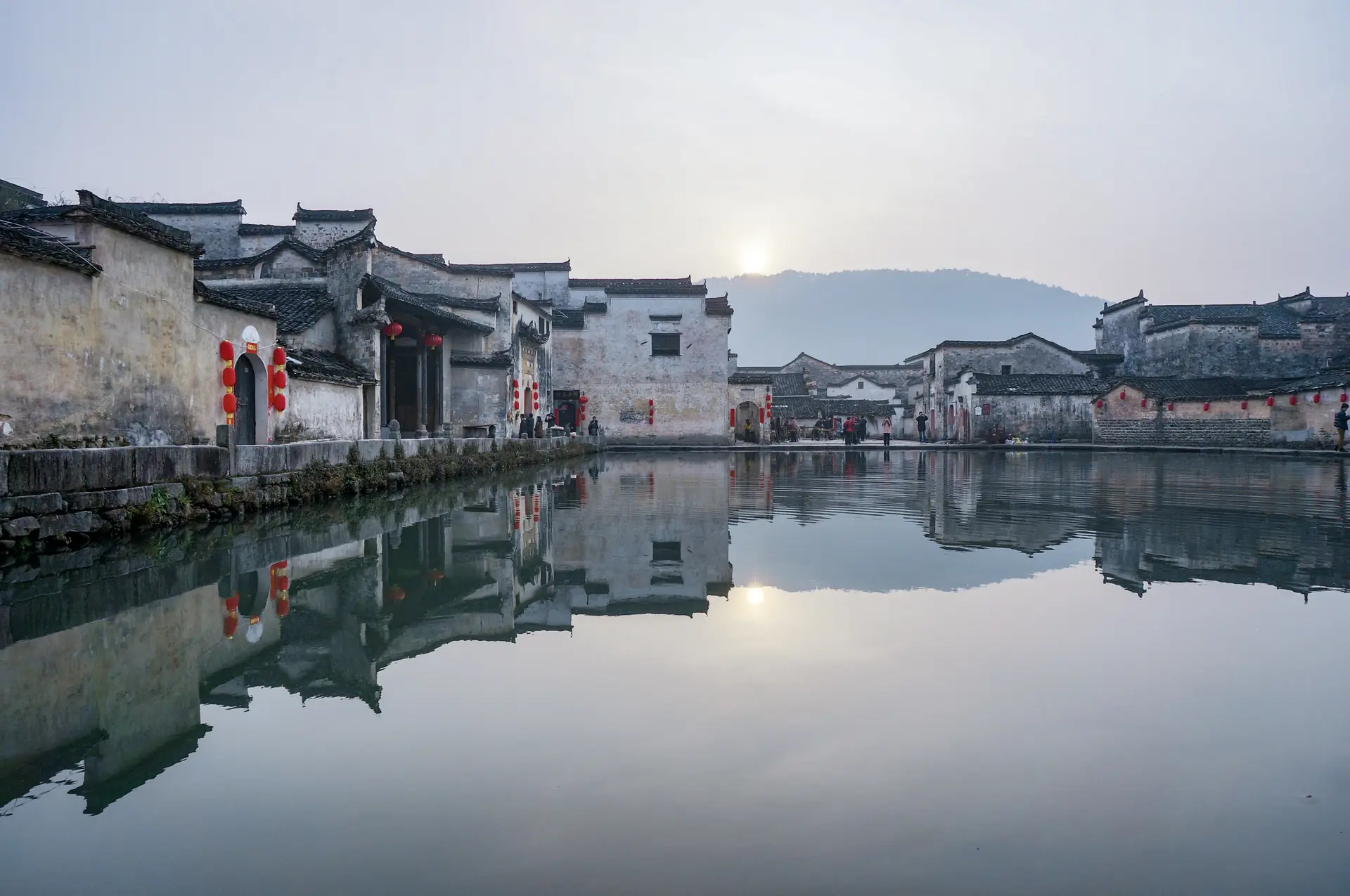
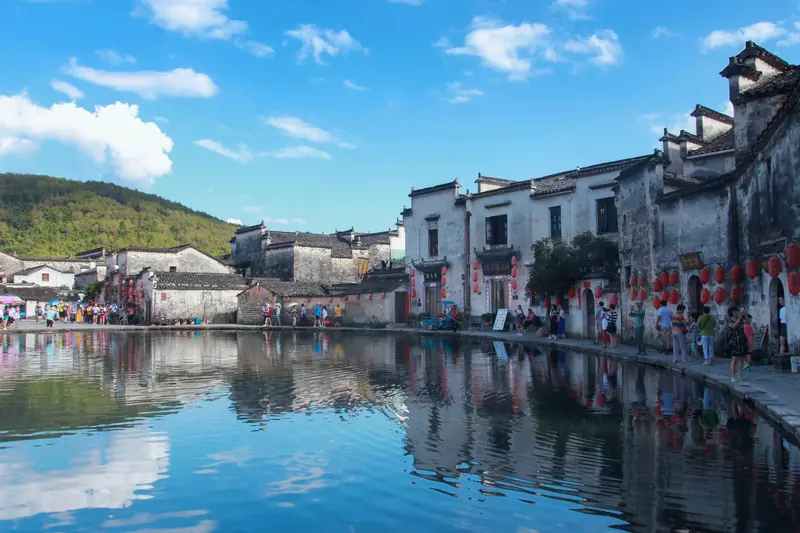
Hongcun's Moon Pond — the 900-year-old village that inspired Crouching Tiger, Hidden Dragon
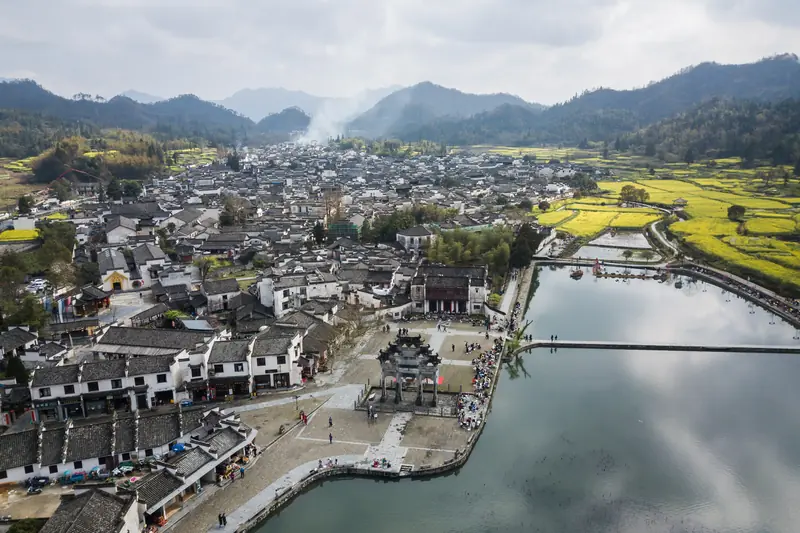
The ancient Huizhou (徽州) region surrounding Huangshan City preserves China's best-kept collection of Ming and Qing dynasty villages. If your schedule allows, adding a village day before or after the mountain makes the trip feel more complete.
Choose Hongcun for the classic water-reflection scene, Xidi for quieter architecture and carved details, and Tunxi Old Street for an easy evening reset around food, tea, and rail logistics.
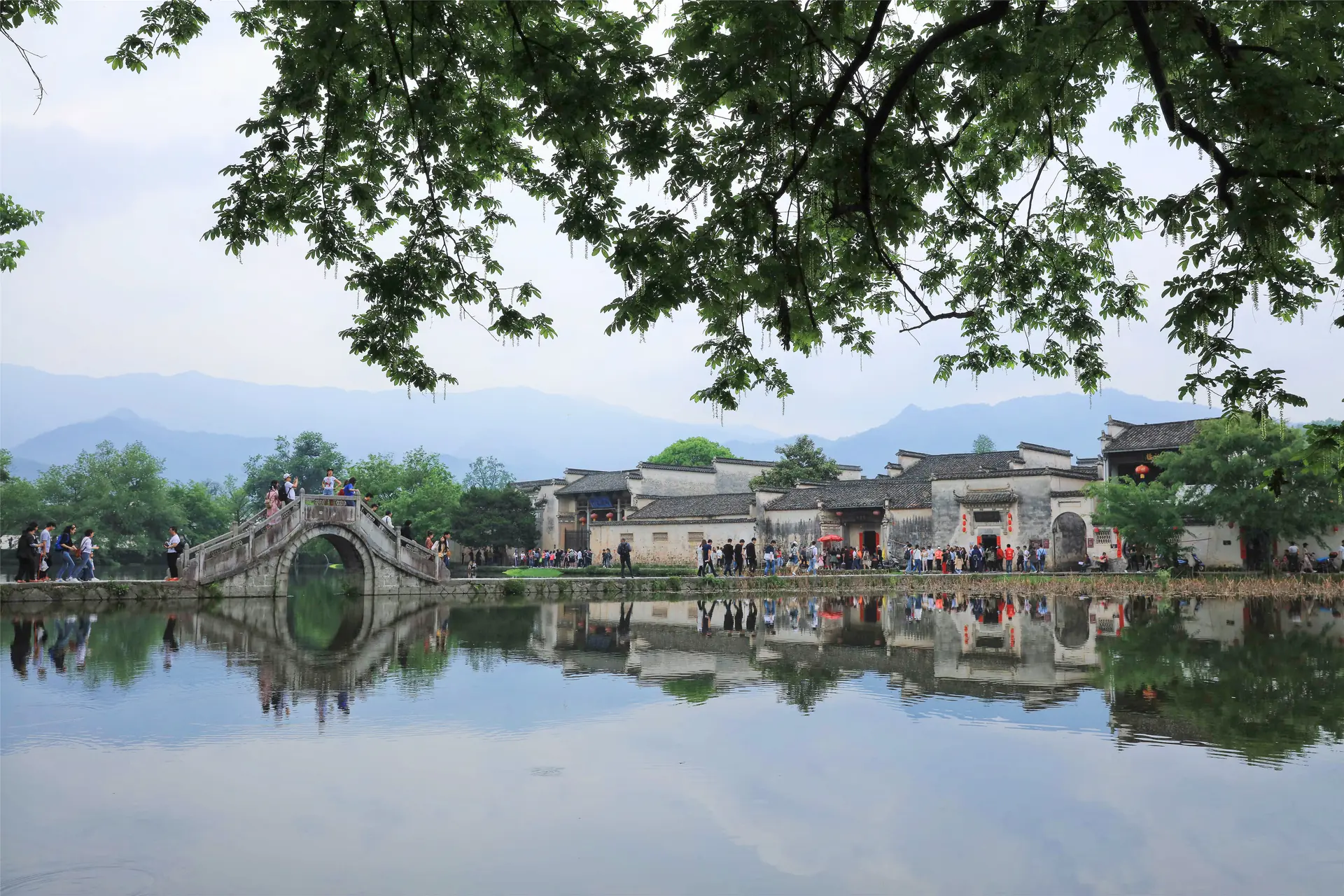
Best for: the postcard Huizhou scene: Moon Pond (月沼), South Lake reflections, white-walled houses, and the Crouching Tiger, Hidden Dragon filming location.
Time and logistics: ~¥104, 2–3 hours. Direct bus from Tangkou is about ¥13 and ~30 minutes, so Hongcun is the easiest village add-on after descending the mountain.
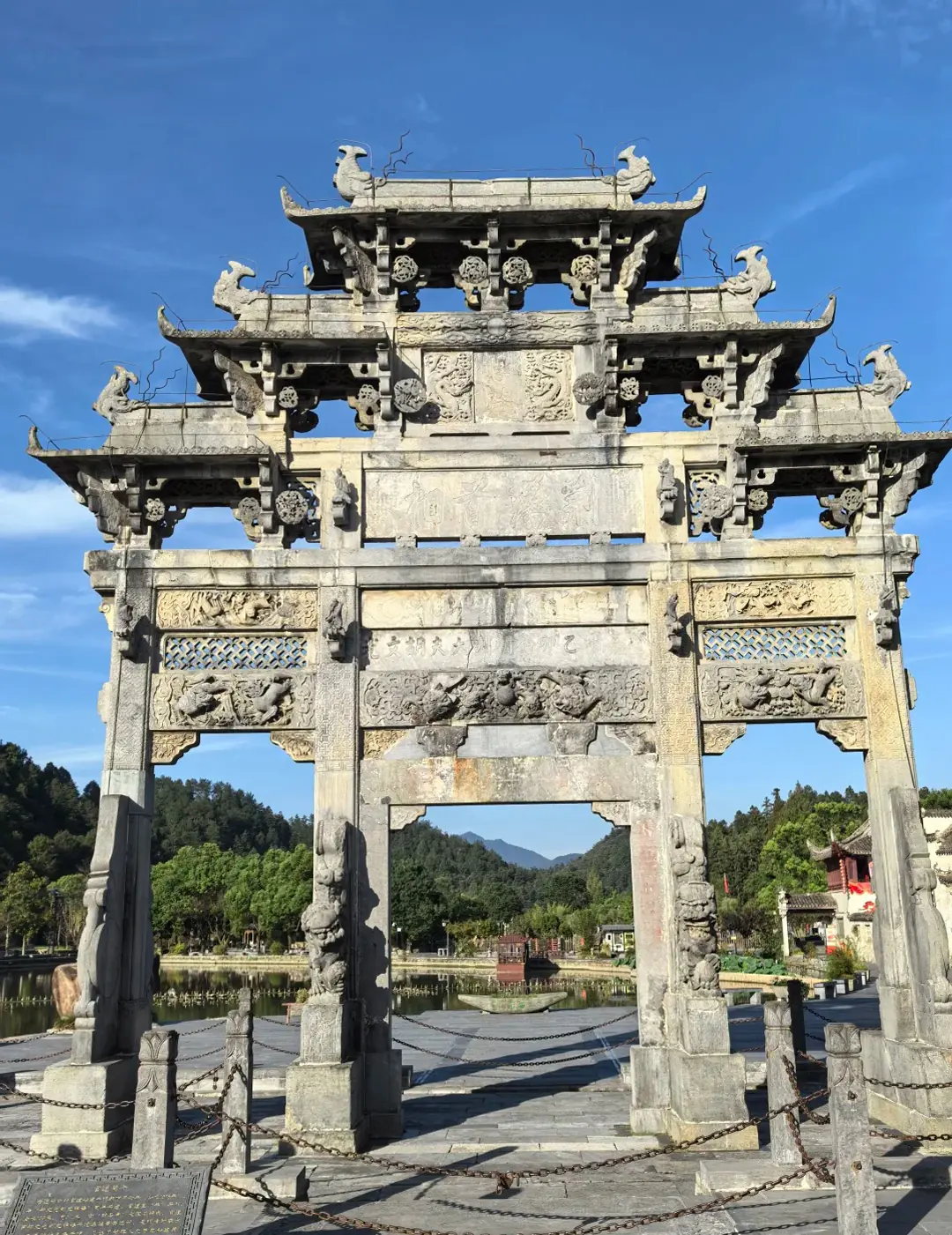
Best for: architecture rather than the single famous photo. Xidi is quieter than Hongcun, with memorial archways, ancestral halls, courtyard houses, and sky wells.
Time and logistics: ~¥104, 2–3 hours. It works best when you can slow down and look at carved details instead of rushing through one photo stop.
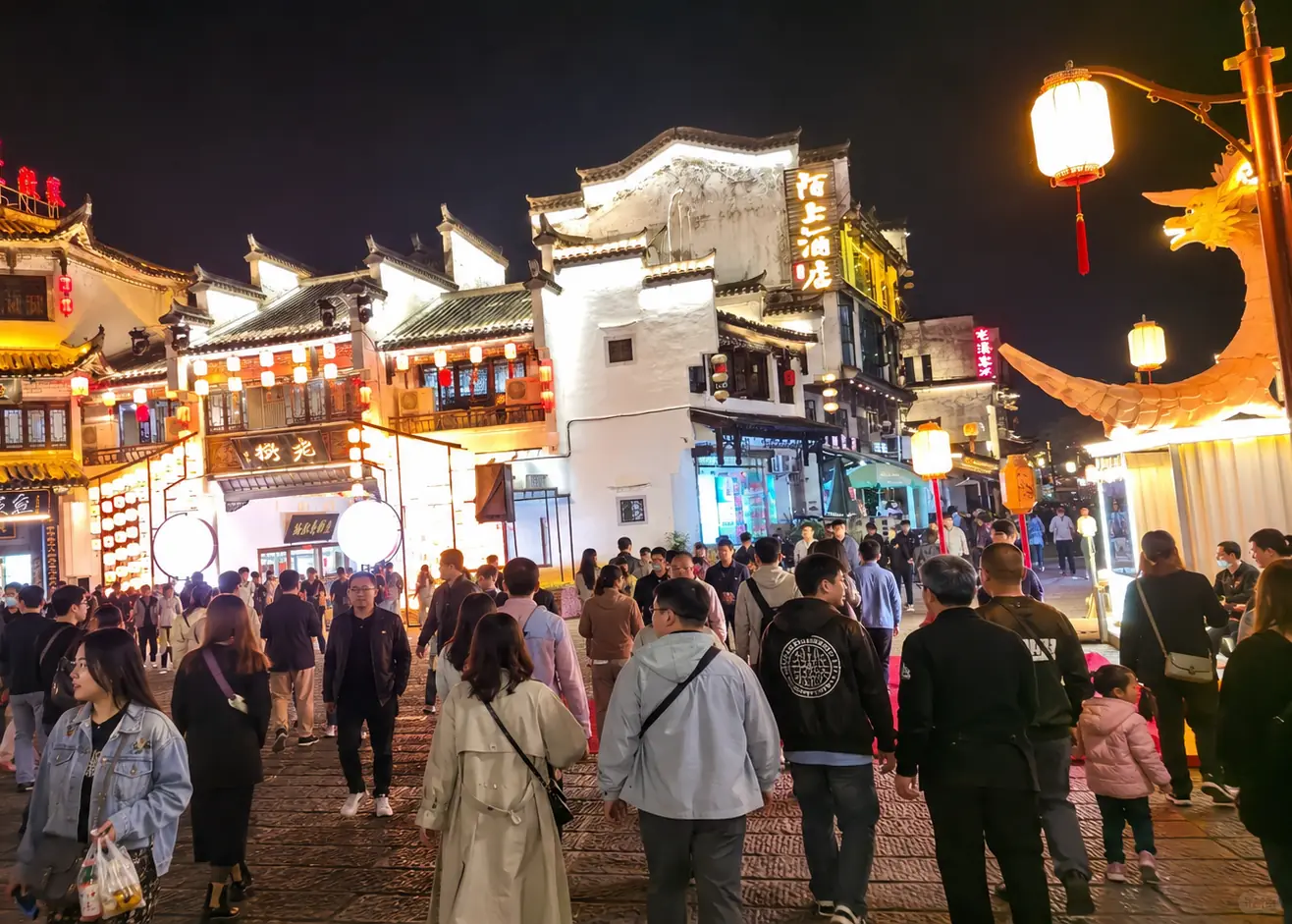
Best for: a low-effort evening before or after the mountain. It is not a full village day, but it is useful for dinner, tea, snacks, and souvenirs.
Time and logistics: free and open all day. The street is about 1.3 km long and roughly 15 minutes by taxi from Huangshan North Station.
Recommended combos
2 days Huangshan + 1 day Hongcun
The classic combination. Head to Hongcun after descending, then return to Tunxi or catch an evening train.
2 days Huangshan + 1 day Xidi + Hongcun
With more time, spend a half-day in each village instead of treating them as quick photo stops.
Frequently Asked Questions
Technically yes — cable cars up and down plus the main ridge trail takes 6–8 hours. But you'll miss sunrise and the Xihai Grand Canyon, which are the two most memorable Huangshan experiences. At least one night on the summit is strongly recommended.
Sources checked for this guide
- UNESCO World Heritage Centre checked for Mount Huangshan inscription, landscape-art context, granite peaks, cloud-sea framing, and Lotus Peak elevation: UNESCO Mount Huangshan listing
- Huangshan municipal ticket-policy Q&A checked for base ticket prices, winter and peak windows, cable-car prices, discount groups, and the note that prices can adjust with official notices: Huangshan municipal ticket-policy Q&A
- Huangshan municipal transport guide checked for South Gate and Tangkou access, Huangshan North express-bus fare, and the required transfer-center shuttle: Huangshan official transport guide
- Huangshan municipal news checked for West Sea Grand Canyon reopening after winter maintenance and sightseeing cable car resumption: Huangshan West Sea Grand Canyon reopening notice
Beyond This Guide
Before you lock the rest of the Huangshan region into your itinerary:
- Best Things to Do in Huangshan — compare Yellow Mountain, Hongcun, Xidi, Tunxi, food, tea, and base choices
- Hongcun Village guide — use this if the classic water-reflection village image matters most
- Xidi Village guide — use this if you want a quieter architecture-focused village day
- China high-speed rail guide — plan the train leg if you are pairing Huangshan with Shanghai, Hangzhou, Nanjing, or Hefei
- China mobile payments: Alipay & WeChat Pay — set up QR payments before shuttle buses, meals, taxis, and ticket windows become urgent
Planning a Huangshan trip with Xihai Grand Canyon, sunrise strategy, and Huizhou village visits involves several moving parts: ticket timing, hotel availability, weather, and cable-car choices all interact. Our planners can design a route, recommend the right sequence, and walk you through the practical choices while paid tickets and hotels stay under your own control.
© gochinafreely.com — Original guide by Go China Freely.