Visit Basics
Verify the current admission policy before paying; shuttle and raft are separate.
Decision Notes
Where Mountains Bleed Red into Green Water
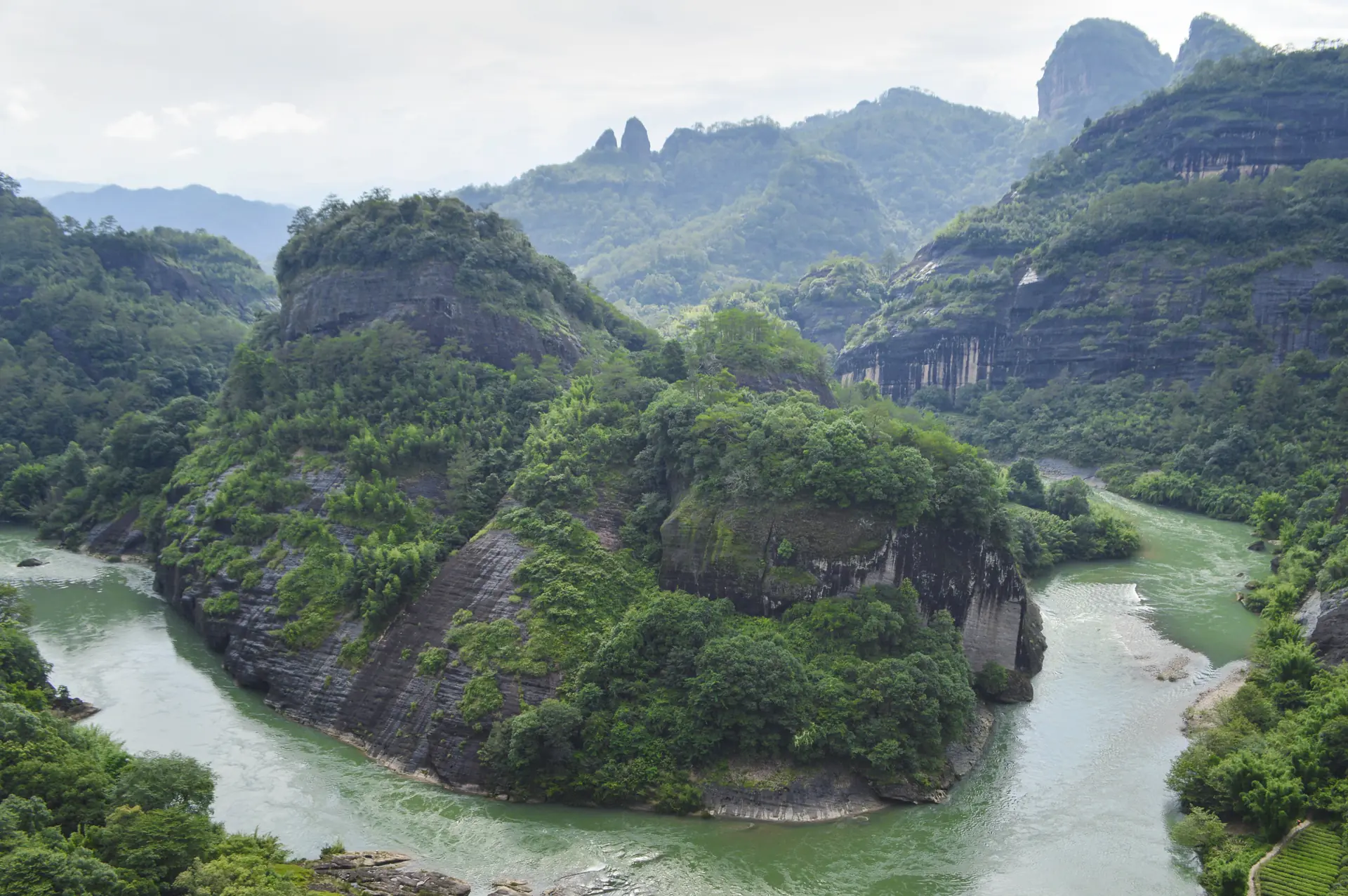
Wuyishan's core landscape: red Danxia cliffs wrapped by the green Nine-Bend Stream
Danxia, water, and rock tea
Red cliffs, green water, and tea culture in one compact valley
Wuyishan (武夷山) is one of the rare places in China where the signature experiences sit close together: red Danxia cliffs, a slow bamboo raft through the Nine-Bend Stream, and the tea culture behind Da Hong Pao.
Inscribed as a UNESCO dual World Heritage site in 1999, the valley binds scenery, biodiversity, tea, and scholarship more tightly than most first-time visitors expect.
717 m
Highest main peak
1999
UNESCO dual listing
9.5 km
Nine-Bend Stream
350+
Years of tea heritage
Why the landscape feels different
Wuyishan is not tall: Sanyang Peak (三仰峰) tops out at just 717 m. The drama comes from the combination of Danxia landforms and water: rust-red sandstone pillars, jade-green Nine-Bend Stream (九曲溪), cliff-hugging tea bushes, and bamboo rafts drifting through the gaps. The Chinese shorthand is "green water, red mountains" (碧水丹山), and it is exact.
Why the culture matters
Zhu Xi (朱熹) founded Wuyi Jingshe (武夷精舍) here in 1183, taught for roughly seven to eight years, trained over 200 disciples, and completed the Collected Commentaries on the Four Books. Daoism ranks the mountain as the 16th Grotto-Heaven (升真元化洞天). Wuyishan is also the birthplace of Chinese oolong tea and Da Hong Pao (大红袍), the "King of Teas," whose production techniques are inscribed as national intangible cultural heritage.
Best First-Visit Rhythm
The strongest first visit combines the river, Tianyou Peak, and Da Hong Pao. That gives you Wuyishan's three core layers in one trip: Danxia sandstone and water, a manageable hike, and the tea culture that makes the mountain famous. For independent travelers, Wuyishan also feels calmer than Huangshan or Zhangjiajie, with more room to explore at your own pace.
Drifting the Nine-Bend Stream by Bamboo Raft
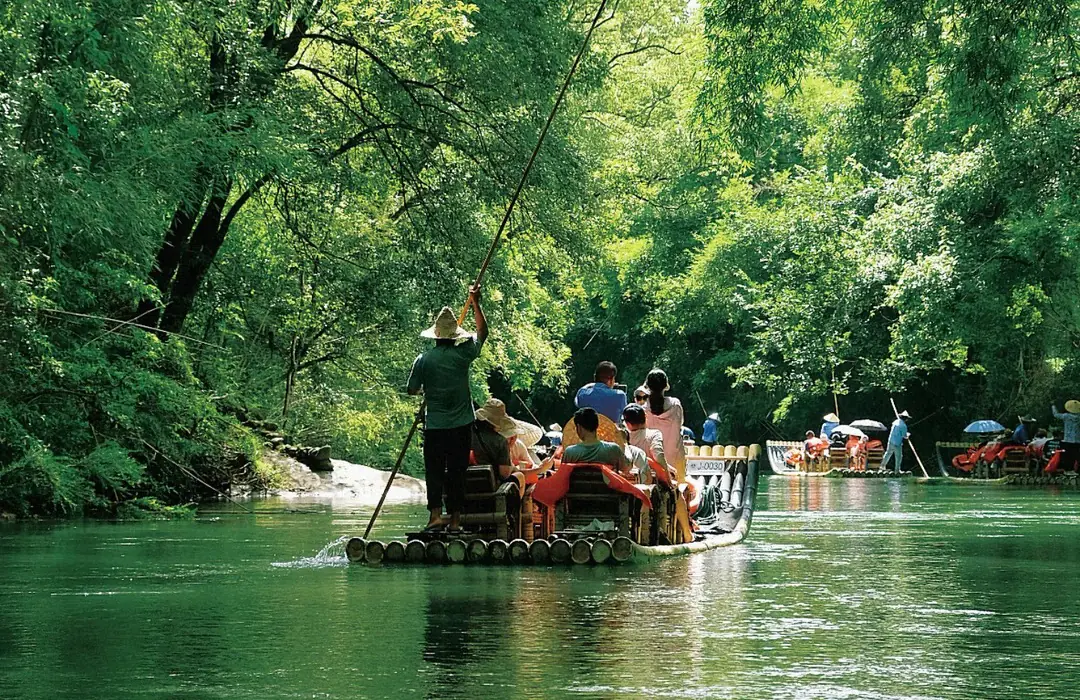
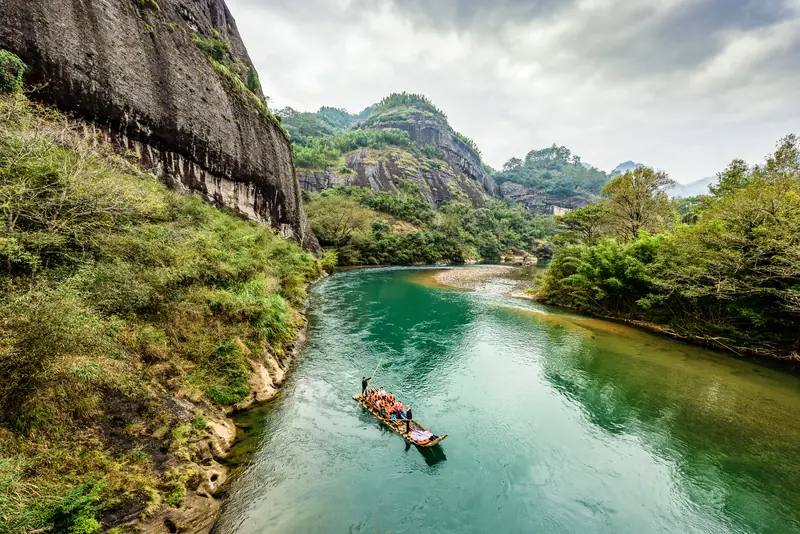
Bamboo rafting on the Nine-Bend Stream — slow, scenic, and close to the cliffs
Signature river experience
A 1.5-hour raft through Wuyishan's Danxia corridor
The Nine-Bend Stream is Wuyishan's soul. The river winds past 36 peaks across 9 bends, covering about 9.5 km.
You sit on a bamboo raft while the boatman poles slowly through red cliffs, hanging tea bushes, and quiet bends where egrets sometimes pass overhead.
This is not whitewater rafting. It is a slow, 360-degree visual immersion, and the best way to understand why Wuyishan is described as green water between red mountains.
9 bends
about 9.5 km
36 peaks
river canyon scenery
1.5 hr
calm raft pace
Bend-by-Bend Highlights
Read the raft as four visual beats: an open starting pillar, tea-field banks, a narrowing red-cliff canyon, and the 6th Bend photo moment.
- Dawang Peak(大王峰)- Tallest freestanding rock pillar in Wuyishan, right at the starting point.
- Tea-field banks- Wide water with terraced tea fields along both sides.
- Narrow canyon- Red cliffs close in and the ride begins to feel enclosed.
- Wuyi Jingshe site(武夷精舍)- The riverside area linked with Zhu Xi original academy.
- Jade Maiden Peak(玉女峰)- Three stone pillars reflected in the stream; the raft key photo moment.
- Tightest canyon walls- The current quickens slightly as the cliffs tighten.
- Wuyi Palace landing(武夷宫)- Step off the raft and continue on foot toward the Wuyi Palace area.
6th Bend photo moment
Jade Maiden Peak is the raft's key shot
The 6th Bend delivers the raft's signature view: three slender stone pillars of Jade Maiden Peak (玉女峰) mirrored in the still water.
Have your camera ready on the left side of the raft. This is the moment where the river, cliffs, and reflection line up most cleanly.
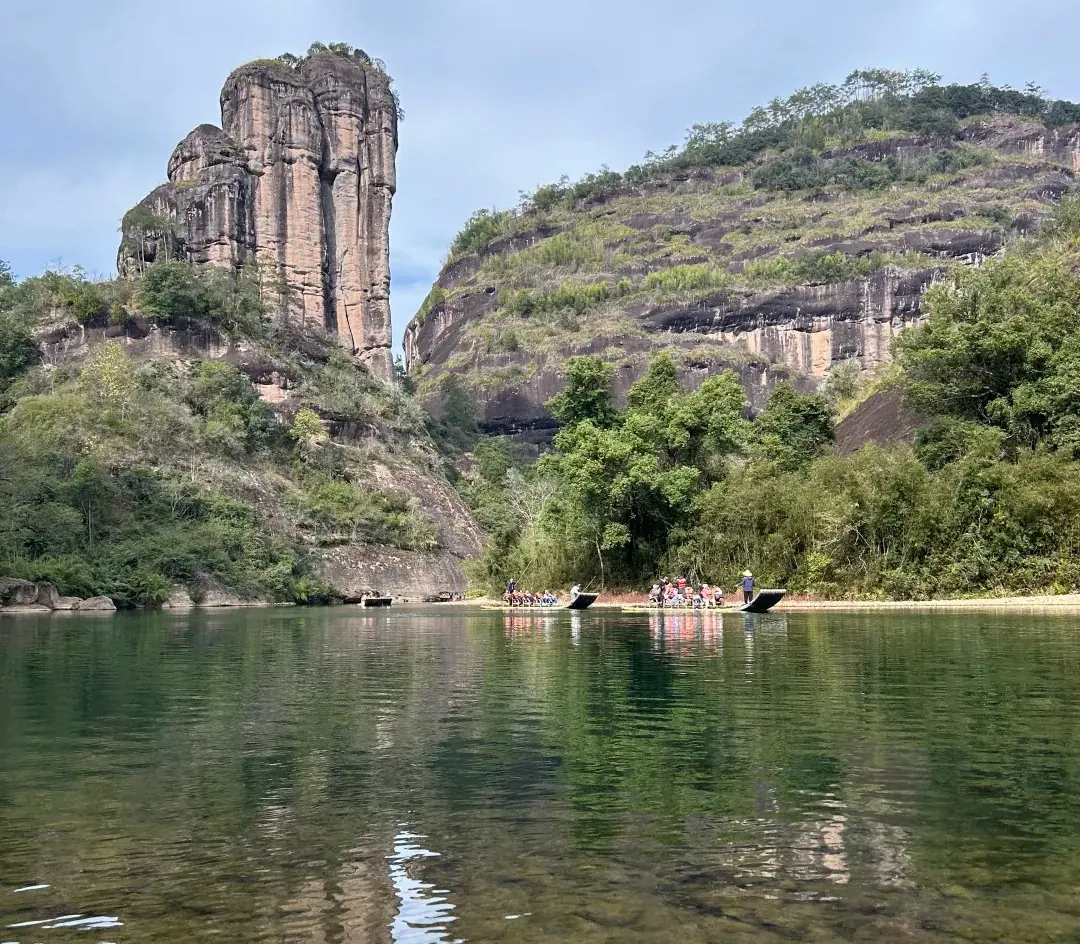
Jade Maiden Peak at the 6th Bend — the raft's most photogenic moment
How to Get Raft Tickets
This is the single hardest logistical challenge in Wuyishan. Raft tickets are sold separately from the scenic pass and sell out fast in peak season.
Raft ticket priority
Lock the raft first, then build the rest of your Wuyishan day around it.
¥130
per person
scenic pass separate
3-7 days
book earlier
especially peak periods
First raft
best slot
usually around 7:00-7:30
Booking channel and seating
Use the official "Wuyishan Tourism" (武夷山旅游) WeChat mini-program or an OTA such as Trip.com. Popular dates can sell out earlier.
Each raft seats 6-8 passengers. Solo travelers and small groups share with others.
On the raft
Default narration is in Mandarin. A ¥20 tip often unlocks a more detailed and entertaining commentary; the boatmen's stories and jokes are part of the experience.
Waterproofing: There is no dry storage on the raft. Put your phone in a waterproof pouch and keep your bag at your feet. Splashing is minimal, but it happens.
Treat same-day purchase as a backup only
If the raft matters to your Wuyishan trip, check availability before you finalize trains, hotels, or a one-day route.
What If Raft Tickets Are Sold Out
If your date is sold out, two fallback options stay realistic:
- Shift dates 1-2 days forward or back; weekdays are far easier than weekends.
- Walk along the banks, where several trail sections parallel the stream, though the view from the water is incomparably better.
Don't Miss the Raft
Missing the raft means missing the heart of Wuyishan. If your schedule is flexible, lock in raft tickets first, then plan everything else around them.
Tianyou Peak — The Classic Panorama
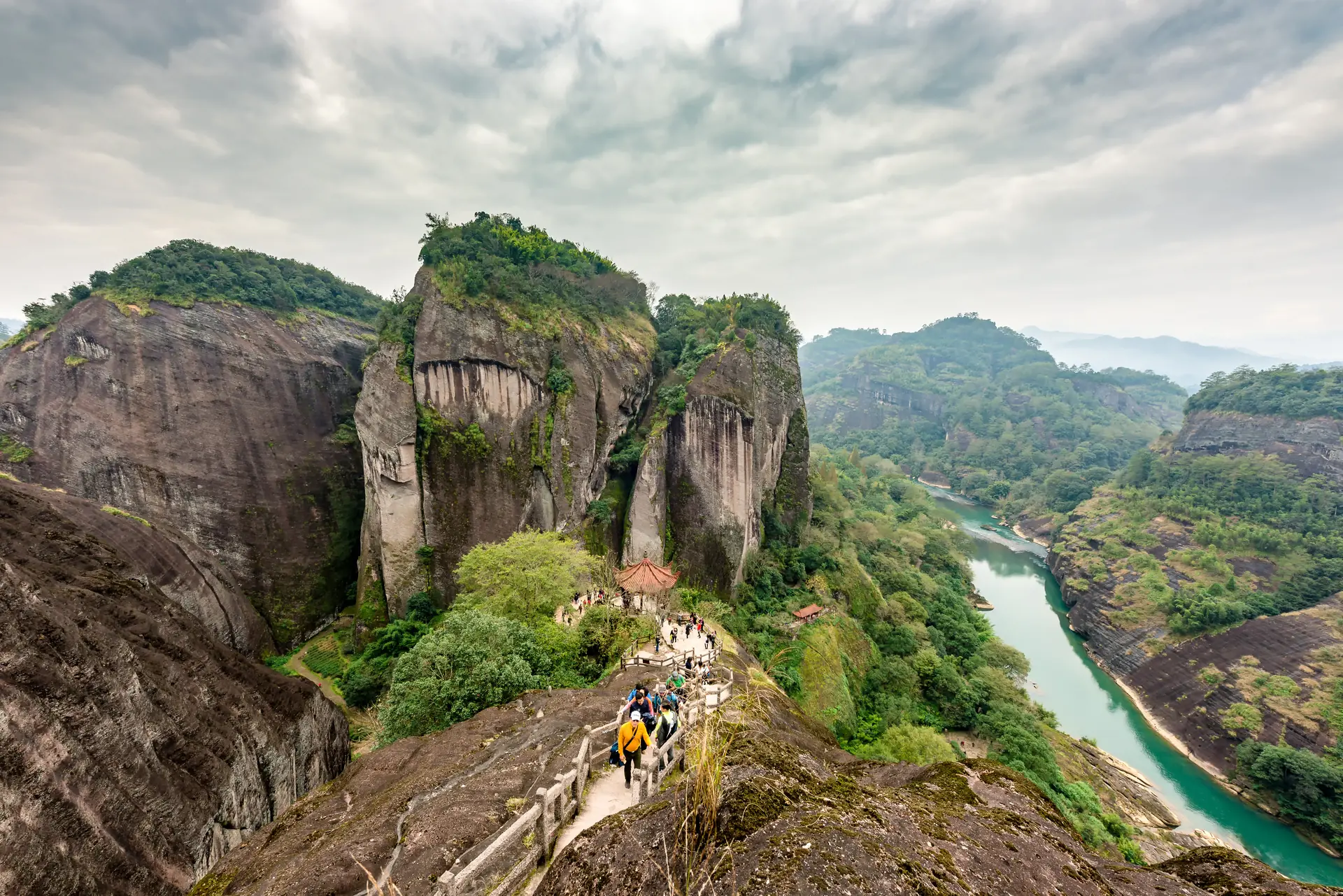
The defining Wuyishan panorama — Nine-Bend Stream from Tianyou Peak summit
Classic panorama climb
Tianyou Peak (天游峰)
800+ steps · 215 m vertical gain · Wuyishan's defining viewpoint
Tianyou Peak has been called the "First Scenic Spot of Wuyi" (武夷第一胜地). From its summit, the entire Nine-Bend Stream unfurls below your feet, with Danxia peaks arranged like a bonsai garden on either side.
The climb is moderate: well-maintained stone stairs with handrails, easier than Huangshan or Zhangjiajie, but still requiring basic fitness.
40-60 min
uphill pace
5th-6th
bend views
7:00-7:30
best arrival
Climb notes for the same Tianyou Peak route
Climb feel
Roughly 800+ stone steps and about 215 m of vertical gain. Most people summit in 40-60 minutes, with 30-40 minutes back down.
View payoff
The summit platform overlooks the 5th and 6th bends of the Nine-Bend Stream, the classic brochure angle. Clear days sharpen the red-green color contrast; misty days wrap the peaks in a softer mood. Bring a wide-angle lens or use panorama mode.
Crowd timing
Arrive by 7:00-7:30 for the best light and thinnest crowds. After 9:30, tour groups flood in and the staircase queues.
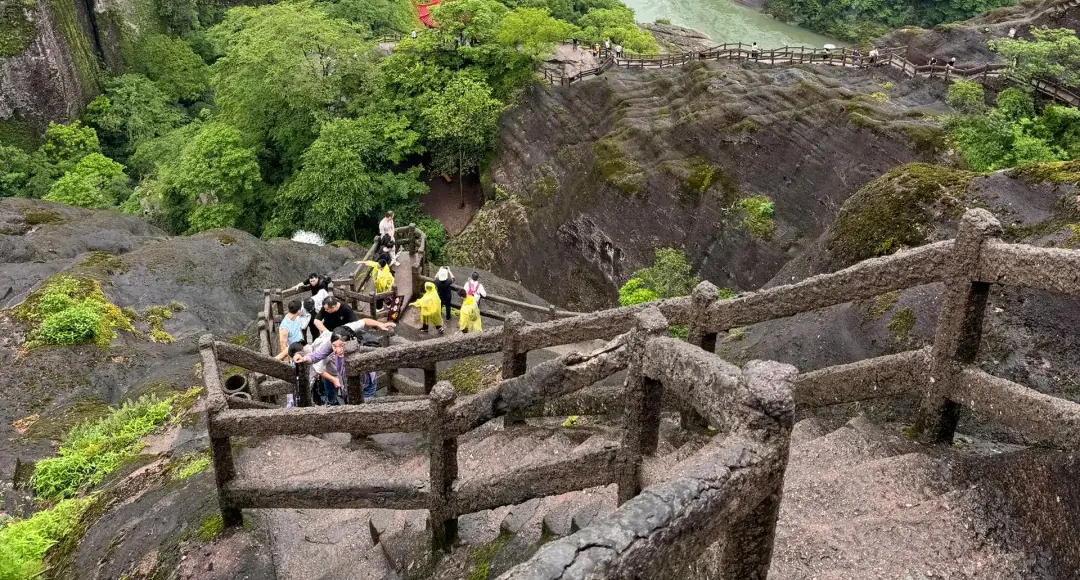
The 800+ stone steps up Tianyou Peak — arrive early before tour groups fill the stairs
Da Hong Pao and Wuyi Rock Tea
Wuyishan is the birthplace of Chinese oolong tea, and Da Hong Pao (大红袍) is the crown jewel of Wuyi rock tea. If you have even a passing interest in tea, the Da Hong Pao scenic area is not optional.
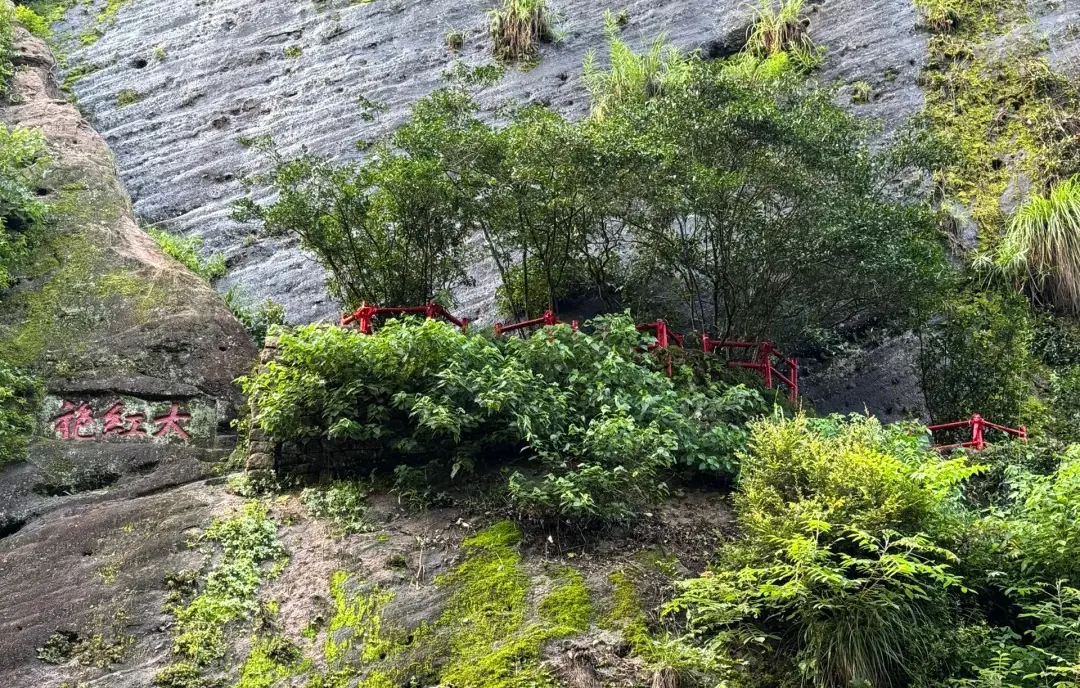
The 350-year-old Da Hong Pao mother trees — off-limits to harvesting since 2006
Core tea stop
The Mother Trees
On a cliff face in Nine Dragon Nest (九龙窠) canyon grow 6 Da Hong Pao mother trees, the ancestors of every Da Hong Pao tea bush in the world.
Over 350 years old, these trees have been off-limits to harvesting since the Wuyishan city government's preservation order in May 2006.
In 2005, at the Wuyishan Da Hong Pao Tea Culture Festival, 20 grams of mother-tree tea sold at auction for 208,000 yuan. The final harvest of 20 grams was donated to China's National Museum for permanent collection.
6
original trees
May 2006
protected since
¥208,000
per 20 g auction lot
What you actually see
You can walk to the viewing platform directly across from the mother trees: six bushes wedged into cliff crevices halfway up the rock face, surrounded by iron railings and 24-hour surveillance cameras.
A carved stone beside them reads "大红袍" in red characters.
Slow tea walk
Rock Fragrance Tea Trail
Flat tea-garden walk after the mother trees
Starting from the mother trees, a roughly 2 km walking trail — Rock Bone Flower Fragrance Walkway (岩骨花香漫游道) — threads through Wuyishan's core tea-growing zone.
Terraced tea gardens line both sides, squeezed between Danxia canyon walls, the air fragrant with tea leaves, especially during the April-May picking season.
This is a quiet, flat, slow-walking route that pairs well with the intensity of the Tianyou Peak climb.
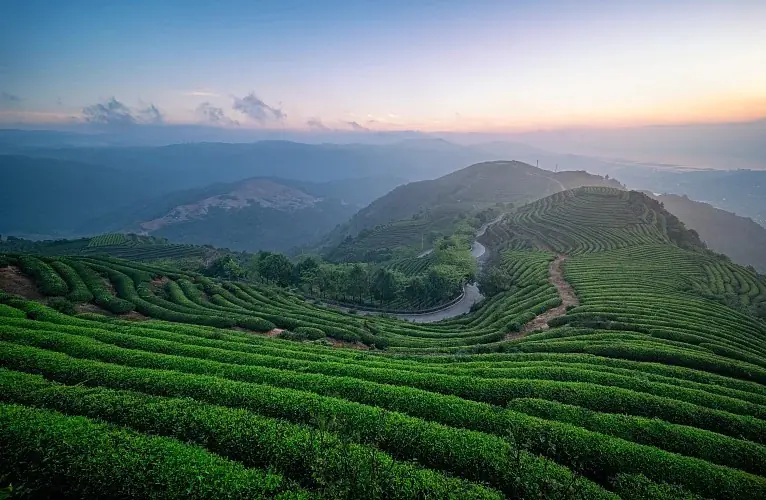
Rock Fragrance Tea Trail — a quiet stroll through Wuyishan's core tea-growing zone
Tea tasting and buying notes
Tasting
Tea houses inside and outside the scenic area offer free tastings. Sit down, watch the tea master brew, sip, and walk away without buying if you prefer, though the farmer hopes you will buy some.
Flavor cue
Authentic Wuyi rock tea's signature trait is "rock bone, flower fragrance" (岩骨花香): a mineral heaviness on the first sip, followed by a floral-fruity finish.
Buying
Prices inside the scenic area run high. For better value, compare at tea markets in Wuyishan city center or Sangu Town (三姑镇). Choose shops with branded packaging or that let you taste before buying. Avoid stalls outside scenic-area gates where quality is inconsistent.
One-Line Sky and Hidden Gorges
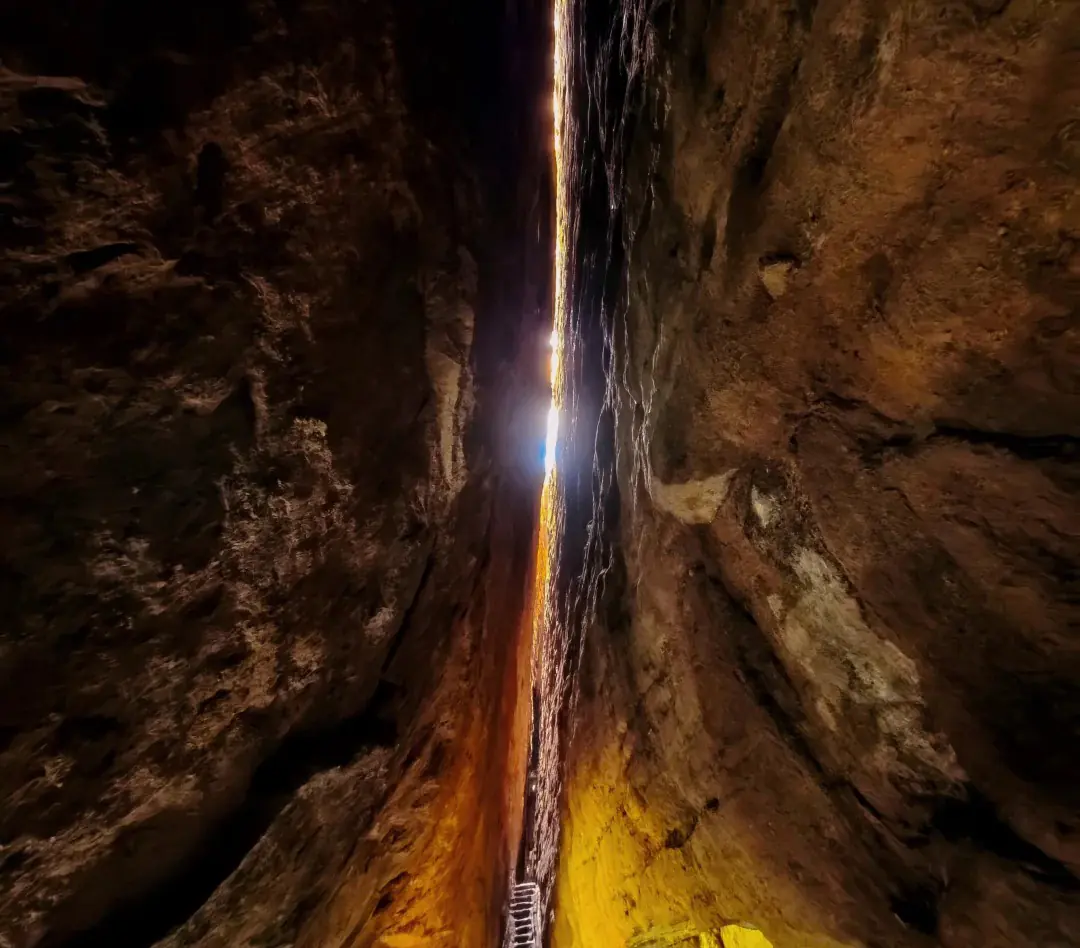
One-Line Sky — just 30 cm at its narrowest, 65 m straight up
Short gorge add-ons
Darker, tighter, and more physical than the raft or Tianyou Peak
Treat these as short add-ons, not the core of the trip: One-Line Sky is the memorable squeeze, Tiger Roaring Rock is the quieter climb, and Water Curtain Cave is seasonal.
30 cm
narrowest gap
10-15 min
inside the squeeze
Before 9:00
best queue buffer
One-Line Sky (一线天)
The main squeeze
One-Line Sky is one of Wuyishan's most "viral" experiences: you enter a crack between two vertical rock walls, 65 m tall and 176 m long, narrowing to just 30 cm at its tightest point.
Look up and all you see is a sliver of sky. Allow 10-15 minutes to squeeze through.
Tiger Roaring Rock (虎啸岩)
Quieter climb nearby
Tiger Roaring Rock, near One-Line Sky, is worth the detour: halfway up sits a natural cave that produces a tiger-like roar when the wind blows through, some imagination required.
The climb is comparable to Tianyou Peak in difficulty but with a fraction of the crowds.
Water Curtain Cave (水帘洞)
Seasonal valley stop
In rainy season, a waterfall drapes down the cliff face. In dry season, it may be little more than a trickle. The site itself takes 15 minutes, but the valley trail en route is scenic.
Not essential: if you only have 2 days, skip this and save your time for Tianyou Peak and the raft.
Before you enter One-Line Sky
Go early: One-Line Sky produces Wuyishan's longest queues. Arrive before 9:00 on weekdays; after 9:30, waits often reach 30-60 minutes.
Body size warning: the 30 cm gap is real. Larger-built visitors may not fit; an alternate bypass route exists.
Bats live inside: they do not bite, but they will swoop overhead.
Bring a light: the inside is extremely dark; your phone flashlight works fine.
Tickets, Shuttles and Scenic Passes
Ticket budget
Plan the scenic pass, shuttle, and bamboo raft as separate cost lines.
Ticket policies can shift by year and campaign. Use these as the usual scenic-area prices, then verify the current official ticket page or WeChat mini-program before paying.
¥140-160
1-3 day scenic pass
¥70-95
Shuttle bus
¥130
Bamboo raft
Pass duration choices
1-day pass ¥140, 2-day pass ¥150, 3-day pass ¥160. Shuttle bus is not included in the base pass.
Shuttle duration choices
Shuttle bus is usually ¥70 for 1 day, ¥85 for 2 days, or ¥95 for 3 days. It transfers between the major scenic stops.
Booking rules and discounts
Official channel: "Wuyishan Tourism" (武夷山旅游) WeChat mini-program. English-facing option: Trip.com can be easier if you need an English interface.
Real-name tickets: registration is required. Book 1-3 days ahead in normal peak periods and earlier for bamboo raft slots. Seniors 60+, children under 1.2 m, students, and military travelers may receive free or half-price admission.
Regular opening windows
Peak season
Mar-Oct
6:30-18:00
Off season
Nov-Feb
7:00-17:00
Bamboo raft ticket sales close at 10:30. Hours, raft operations, and weather closures can shift, so check the official channel on the travel day.
Scenic shuttle system
Wuyishan's scenic area covers a large footprint. Distances between attractions are not walkable in most cases, so use the shuttle for South Entrance, Tianyou Peak, One-Line Sky, Da Hong Pao, Water Curtain Cave, and Wuyi Palace.
South vs North Entrance
Most visitors enter from the South Entrance because it has better facilities and sits closer to the resort district. The North Entrance suits travelers staying in Xingcun Town (星村镇).
Getting to Wuyishan

Wuyishan scenic area entrance — most visitors arrive via the South Entrance
High-speed rail is the cleanest gateway
Wuyishan North Station → scenic area
For most independent travelers, Wuyishan North Station (武夷山北站) (Google | Amap) is the primary gateway. Fuzhou takes about 1-2 hours (2nd class ¥80-129), Xiamen about 2.5-4 hours (¥170-269), Shanghai Hongqiao about 3-4 hours, and Nanchang about 1.5-2 hours.
Arrive the night before if you want the first raft slot or an early Tianyou Peak climb. Morning train arrivals can work, but they reduce your buffer if raft slots or weather shift.
Best arrival rhythm
Base yourself near Sangu Town or the South Entrance if this is your first visit. It keeps early shuttles, dinner options, and the taxi handoff simple.
Station transfer options
Taxi / ride-hailing · fastest after arrival
Route: Wuyishan North Station → scenic-area resort district or South Entrance.
Duration: 15-20 minutes. Cost: usually ¥20-30.
Public bus · cheapest transfer
Route: station bus stop → scenic-area area.
Duration: about 30 minutes. Cost: usually ¥3.
Flights
Wuyishan Airport (武夷山机场) has limited domestic routes, including Beijing, Shanghai, Xiamen, and others, but flights are infrequent. The airport is about 10 km from the scenic area, taxi ¥20-30.
Show this screen to your driver · 出示给司机看
去武夷山景区南入口
To Wuyishan Scenic Area South Entrance
Where to Stay and Eat
Where to Stay
Base chooser
For a first Wuyishan trip, choose your base by morning friction: South Entrance convenience, lowest price, or earliest raft access.
Sangu Town (三姑镇)
Best first-visit base
Resort district · ¥100-500/night
Walk or take a short ride to the South Entrance. This is the closest base to the scenic area, has the widest hotel and guesthouse range, and is the recommended choice for most visitors.
Wuyishan City Center
Budget-first choice
Budget-friendly · 15 km from the scenic area
Best if price matters more than scenery access. You are nearer the railway station and airport, but farther from the mountain entrances, so budget extra time for early raft or Tianyou starts.
Xingcun Town (星村镇)
Raft-first base
Mid-range · near the raft departure point
Useful if you want the earliest raft slot without a long commute. It has fewer dining options than Sangu, but a quieter and more local feel.
What to Eat
Dinner rhythm
Use Song Street for an easy evening meal, then add a tea banquet only if you want a slower rock-tea dinner.
Song Street (宋街) at Wuyi Palace (武夷宫) is a Song Dynasty-style commercial street with local snacks and restaurants. The atmosphere is best in the evening, especially after a raft or Tianyou day when you want food without another transfer.
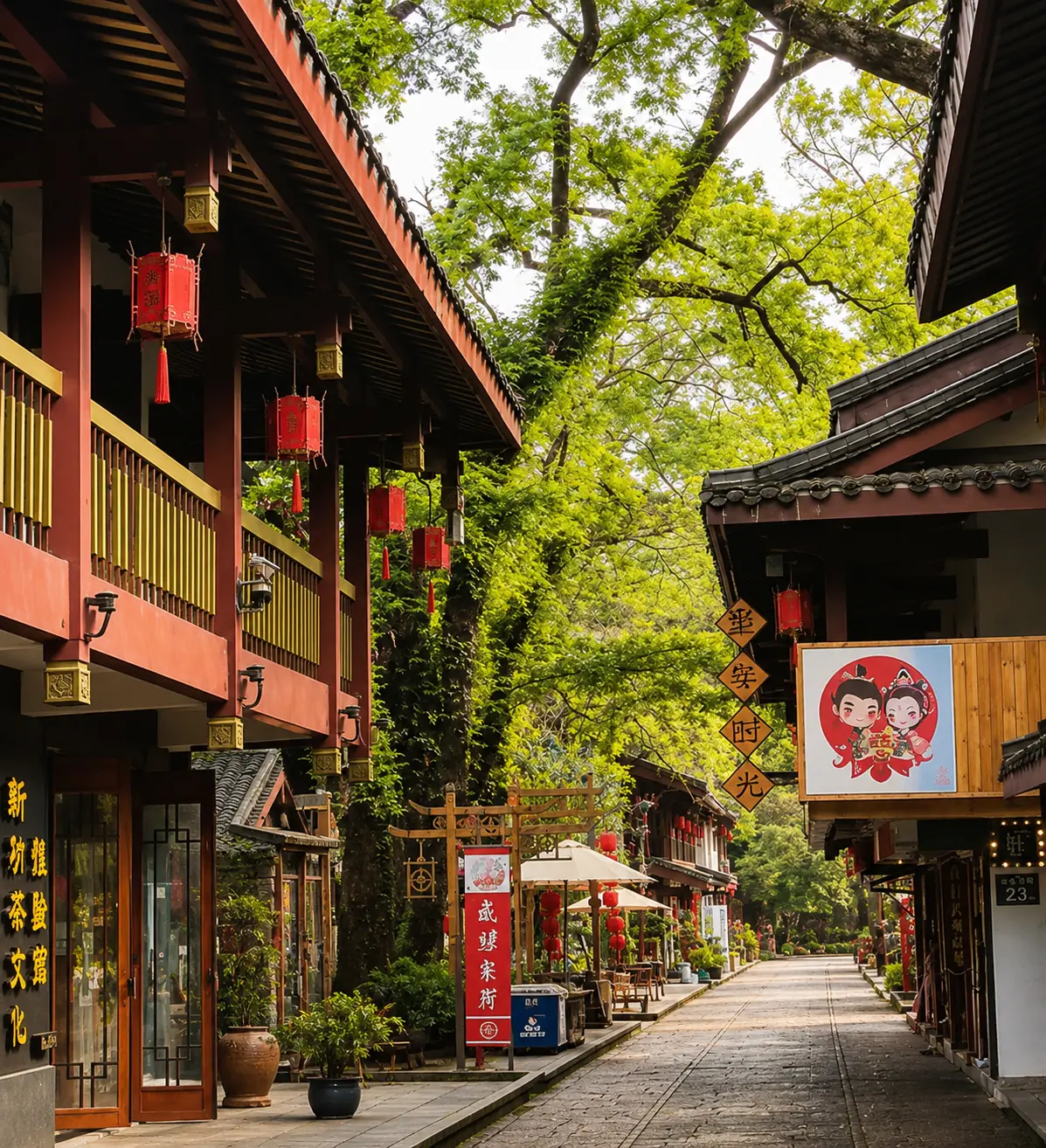
Song Street at Wuyi Palace — easiest scenic-area food stop, best in the evening
Local specialties to order
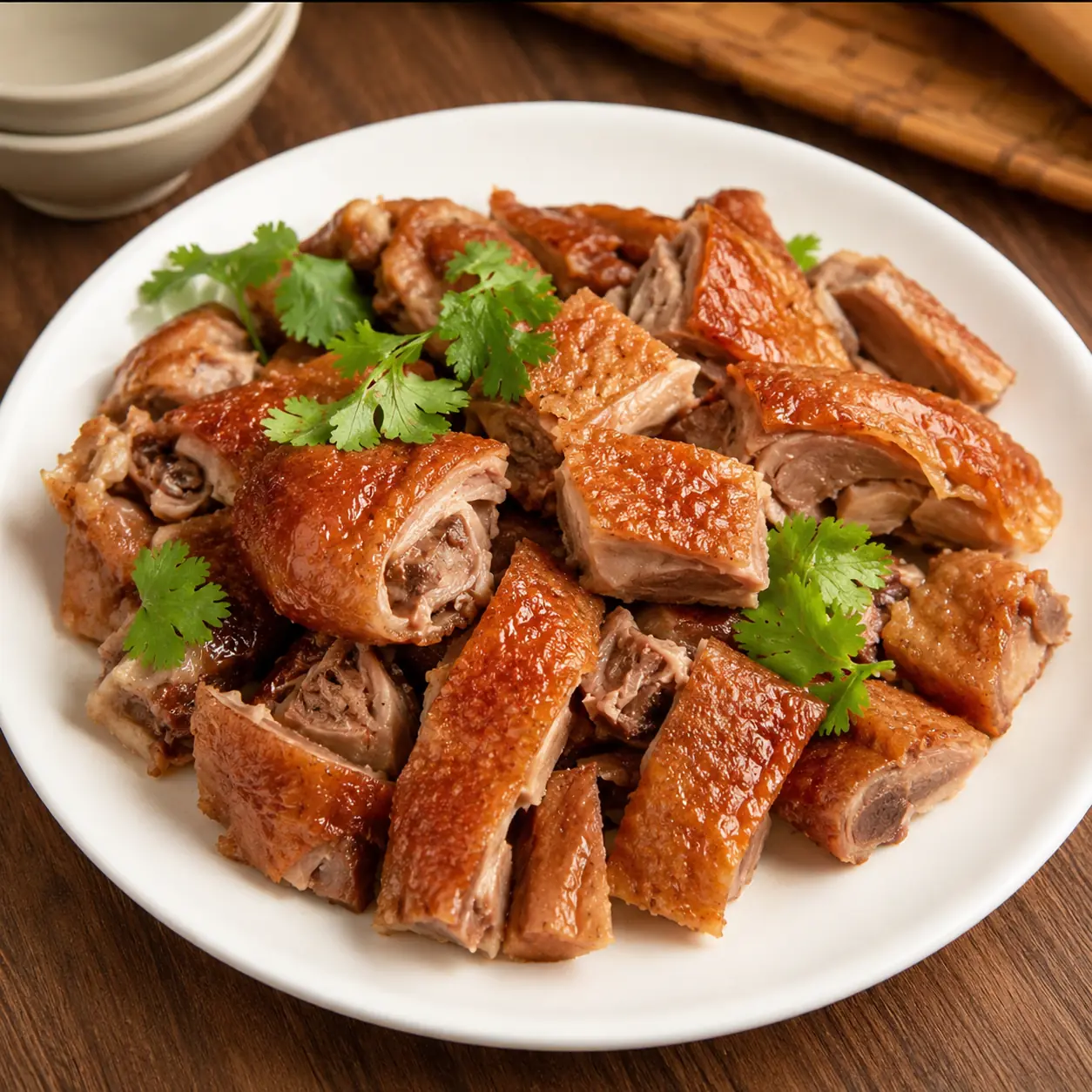
Most distinctive order
Smoked duck and Langu smoked goose (熏鸭 / 岚谷熏鹅)
Order Langu smoked goose where available. Many restaurants also serve similar sliced smoked poultry plates, including smoked duck.
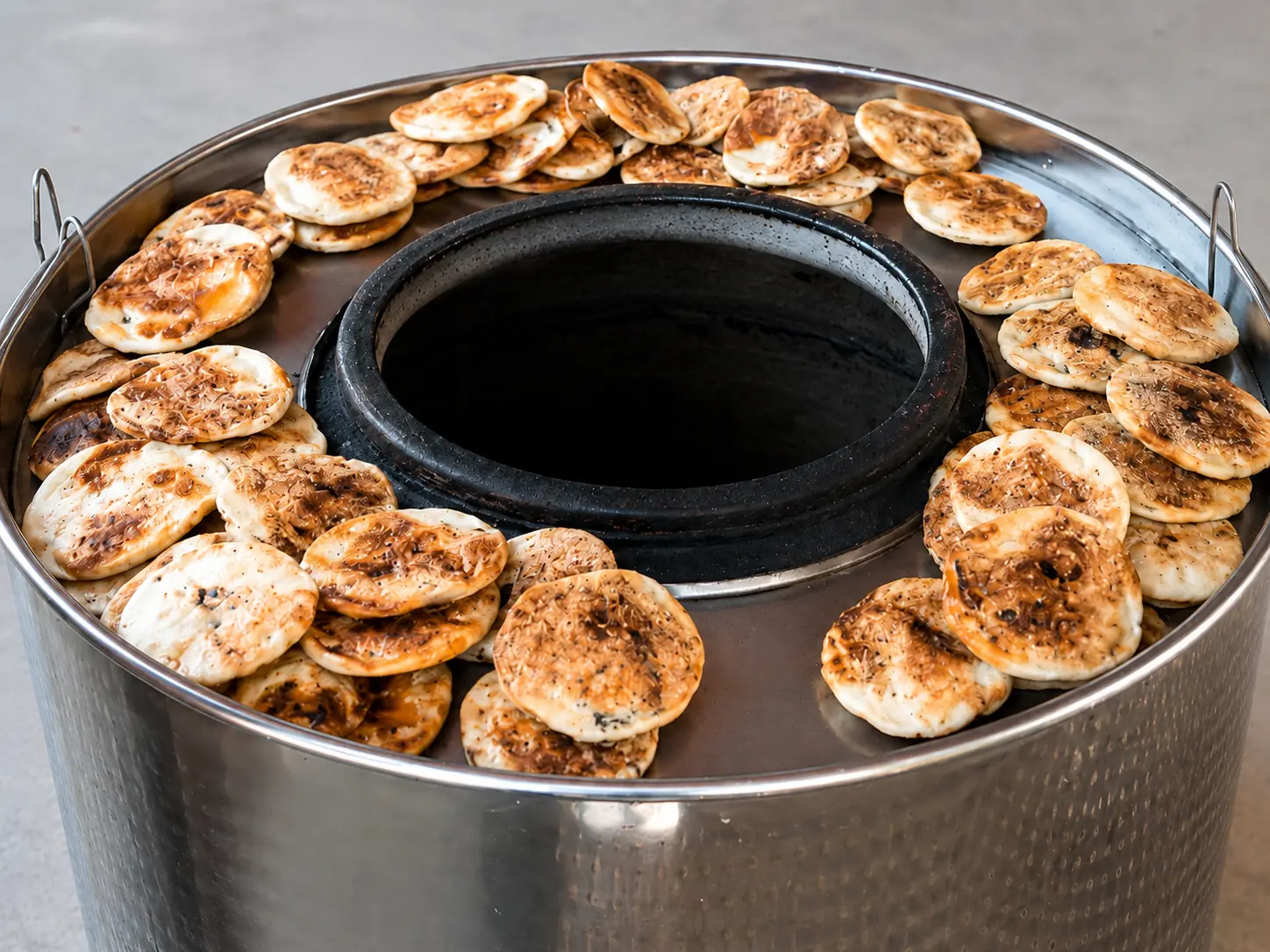
Snack between stops
Guangbing flatbread (光饼)
A simple Fujian snack that works well between scenic-area stops.
Lighter table orders
Bamboo shoots and wild mountain vegetables
Bamboo-shoot dishes are common mountain-restaurant orders. Wild mountain vegetables are best for a lighter meal after tea tasting or hiking.
Tea dinner option
Tea banquets (茶宴) appear at some upscale hotels and tea houses, with each course infused with a different Wuyi rock tea. Best for tea-focused travelers rather than a quick meal.
Impression Da Hong Pao Night Show
Evening add-on after dinner
A tea-culture show for travelers with one open evening.
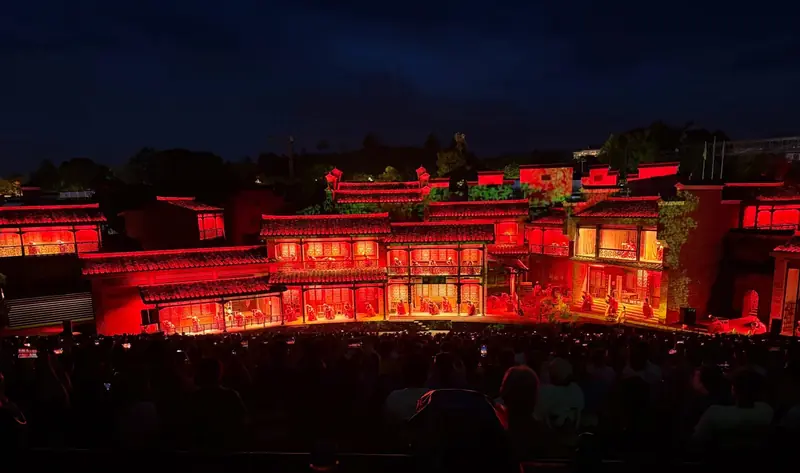
Impression Da Hong Pao (印象大红袍) is a large-scale live performance directed by Zhang Yimou's team and staged against Wuyishan's mountains and water, with Da Hong Pao tea culture as its theme.
Tickets usually run ¥188-238/person, with evening shows. See it if tea culture interests you, but keep it behind the raft, Tianyou Peak, and Da Hong Pao scenic area in priority.
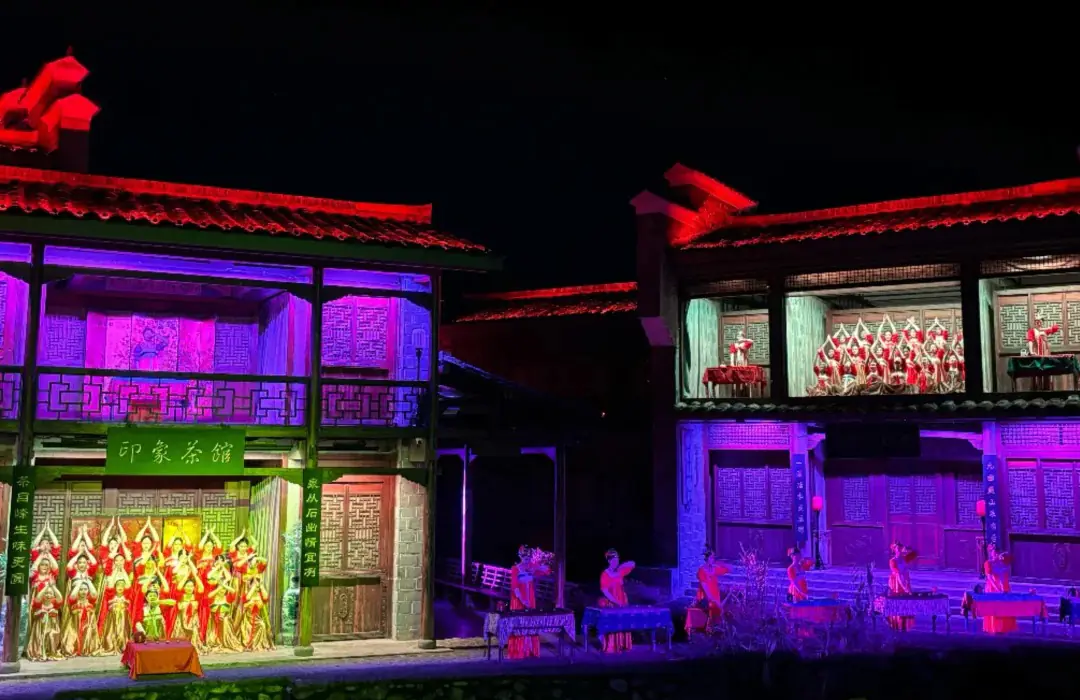
Impression Da Hong Pao — best treated as an optional evening add-on, not a core scenic-area stop
Best Time to Visit Wuyishan
Season rhythm
Spring and autumn are the cleanest choices. Summer and winter still work, but they need more weather flexibility.
Spring (Mar-May)
Best for tea season
Best season. Tea-picking season runs through April-May, temperatures are pleasant, and wildflowers soften the trails. Watch out for frequent rain; raft service may pause during high water.
Summer (Jun-Aug)
Green but busier
Lush greenery and cooler air than the lowlands make summer possible. Watch out for school-holiday crowds and occasional heavy storms.
Autumn (Sep-Nov)
Best for clear weather
Best season. Clear skies, autumn foliage, and golden tea gardens make this the strongest photo window. Avoid the extreme Golden Week crowd spike.
Winter (Dec-Feb)
Quietest window
Very few visitors, occasional cloud seas, and frost flowers. Some attractions may shorten hours; raft service may suspend during low-water periods.
Best Windows
Mid-April gives you tea-picking season, spring scenery, and moderate crowds. Late October gives you autumn color and quieter travel after Golden Week.
Recommended 2-Day and 3-Day Routes
The cleanest Wuyishan plan protects the raft first, then uses Tianyou Peak and Da Hong Pao as the two land anchors. Two days covers the signature experiences; the third day should slow the trip down rather than add another rushed checklist.
2-Day Highlights Route
Day 1: Tianyou Peak + One-Line Sky + Wuyi Palace
- South Entrance- Shuttle to Tianyou Peak.
- Tianyou Peak- Climb and summit views.
- One-Line Sky + Tiger Roaring Rock- Go early to avoid queues.
- Lunch- Inside the park or resort district.
- Wuyi Palace + Song Street- Or Zhu Xi Memorial Hall.
- Impression Da Hong Pao- Optional show if you still have energy.
Day 2: Nine-Bend Stream Raft + Da Hong Pao
- Nine-Bend Stream Bamboo Raft- Earliest slot, best light.
- Da Hong Pao Scenic Area- Mother trees + Rock Fragrance Tea Trail.
- Tea Tasting + Lunch- Sample Wuyi rock tea.
- Depart- Station or next destination.
3-Day Deep Dive
Add to the 2-day route:
Water Curtain Cave
Day 3 morning
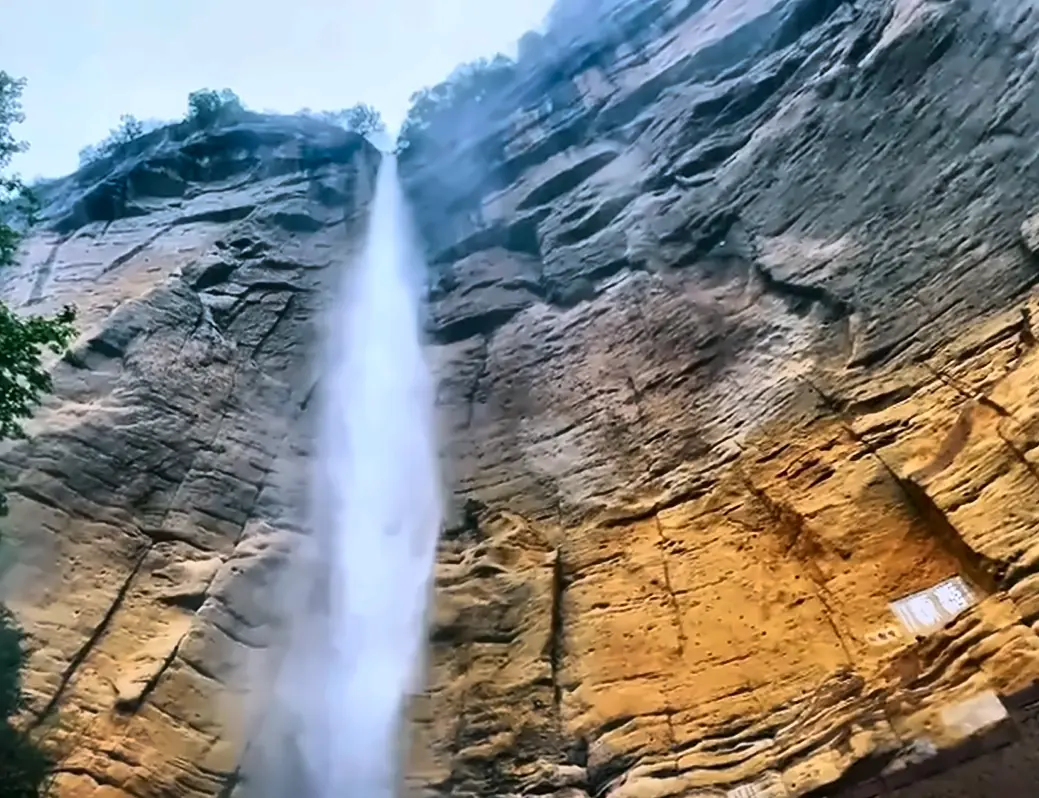
Add Water Curtain Cave and the surrounding valley trails for a slower nature deep-dive.
Xiamei Ancient Village (下梅古村)
Day 3 afternoon
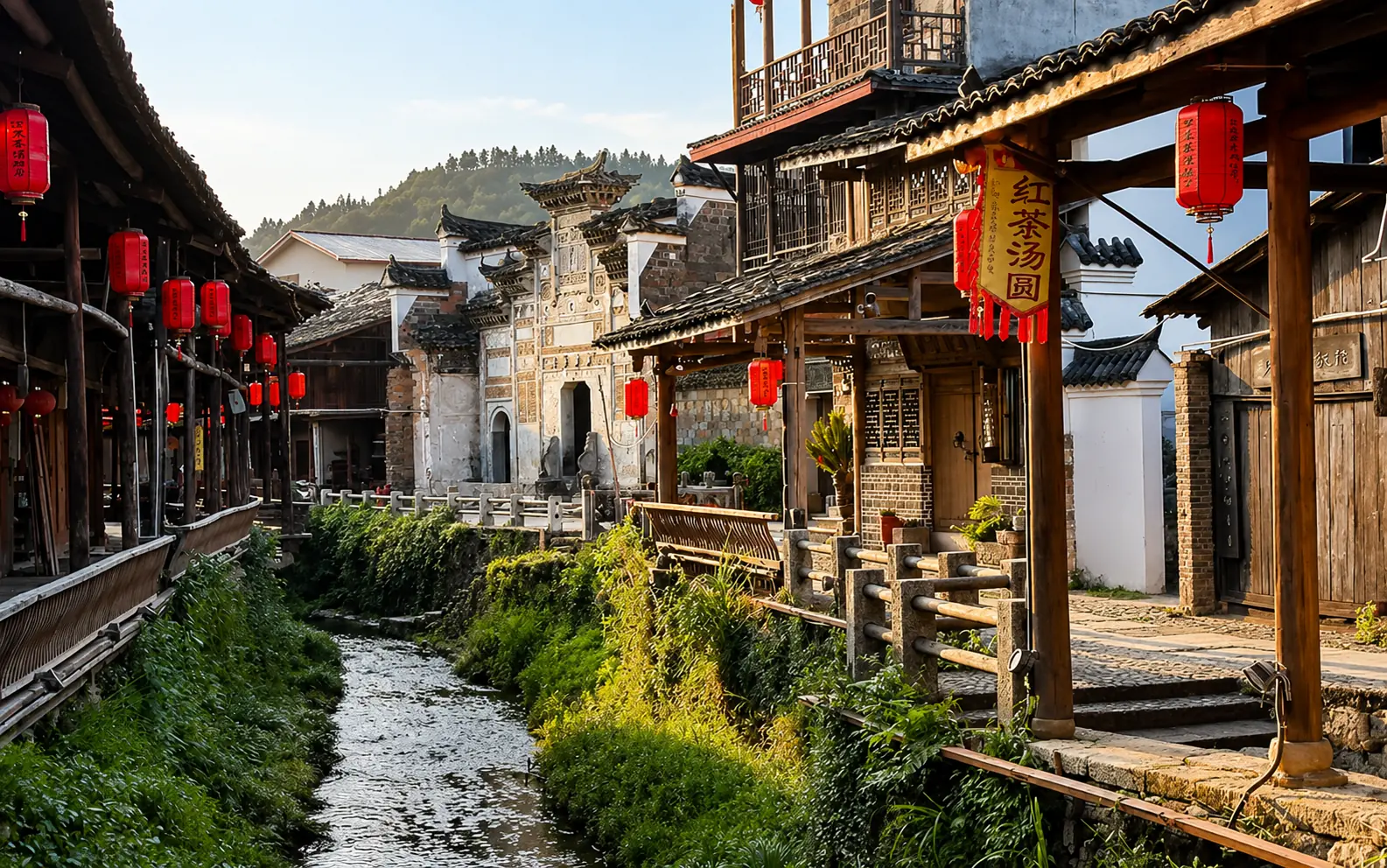
A Qing-dynasty village about 10 km from the scenic area and one of the starting points of the historic Tea Road. Virtually no tourists — perfect for travelers who love quiet old villages.
Frequently Asked Questions
Two days covers the core — Tianyou Peak, bamboo raft, and Da Hong Pao. Three days is more comfortable and adds Water Curtain Cave, Xiamei Ancient Village, and extra tea sessions.
Sources checked for this guide
- Official Wuyishan scenic-area overview for Danxia landscape, Nine-Bend Stream, Tianyou Peak, Da Hong Pao, and heritage framing: Wuyishan scenic-area official English overview
- Official UNESCO World Heritage listing for Mount Wuyi inscription, criteria, property scale, and protection context: UNESCO Mount Wuyi World Heritage Centre
- China Ministry of Culture and Tourism notice for traditional tea processing techniques and associated social practices entering the UNESCO intangible cultural heritage list: China Ministry of Culture and Tourism tea-heritage notice
- Live traveler-facing ticket cross-check for current ticket, shuttle, bamboo raft, and booking-channel notes: Trip.com Wuyishan ticket guide
Beyond This Guide
Wuyishan's raft booking, Tianyou Peak timing, and tea-culture experiences all demand precise scheduling — especially in peak season when raft tickets vanish and one wrong call can cost you the centerpiece experience. If you want a Wuyishan itinerary that locks in the raft, paces the hikes, and weaves in tea culture without the stress, we can design one for you.
© gochinafreely.com — Original guide by Go China Freely.