Chinese customs are not a secret exam for foreign travelers. They are a set of social signals: how to avoid embarrassing someone, how to show respect without overdoing it, and how to read symbolic rules around numbers, colors, family occasions, and public conversation. Learn the logic once, and many scattered taboos start to make sense.
Chinese Customs Logic

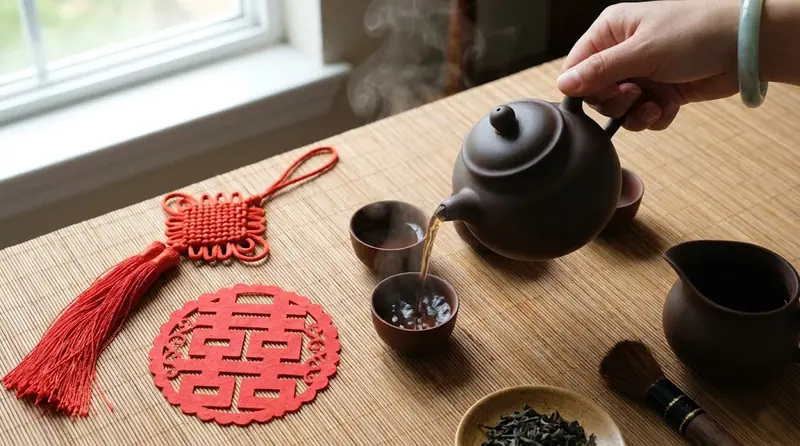
Spring Festival decorations are one visible example of how symbols carry social meaning.
Read the signal
Many Chinese customs make more sense once you stop reading symbols as decoration. Numbers, colors, word sounds, family roles, and public harmony can all carry social meaning.
For travelers, the goal is not to believe every custom yourself. The useful skill is recognizing when a number, color, phrase, object, or topic has social weight for the people around you.
The sound shortcut
Chinese has many homophones. Four (四) is pronounced very close to death (死), so it can feel unlucky; eight connects with the idea of getting rich or prospering (发), so it often feels lucky. That is why a hotel floor, phone number, wedding gift, or red envelope amount can carry meaning.
Symbols are social signals
A red envelope, a white flower, a green hat, or the number 4 can say more than the object itself. The safest traveler habit is to pause before turning symbolic items into jokes.
Context changes the rule
Modern big-city life is flexible. Weddings, funerals, family visits, business openings, elder-facing gifts, and festival meals are where traditional rules matter most.
Face, Harmony and Family
These three ideas explain many everyday choices, but use them as practical lenses, not personality rules. Urban, young, professional, regional, and family contexts can handle these values differently.
Face
Face means public dignity. Giving face means showing respect; causing someone to lose face means embarrassing them in front of others. Public criticism, blunt refusals, and correcting a host too sharply can feel harsher in China than travelers expect.
Harmony
Harmony means keeping the social atmosphere workable. People may soften disagreement, avoid direct confrontation, or choose an indirect answer so the group does not feel tense.
Family Respect
Elders and family roles still carry moral weight. This explains Spring Festival travel, elder-first dining habits, and why family obligations may outrank personal convenience.
Quick read
When a custom feels confusing, ask which value it protects: public dignity, group comfort, family respect, or a lucky symbolic meaning. The answer usually appears quickly.
Use the specific guide
For greetings, gifts, titles, home visits, and elder-respect details, use the Chinese social etiquette guide. For queues, noise, toilets, staring, and public-space habits, use the public behavior in China guide.
When Customs Matter Most
Not every custom needs the same attention. For travelers, the useful question is whether the moment affects dignity, family hierarchy, ritual meaning, or a posted rule.
Casual service, sightseeing, shopping, or a quick hotel-desk exchange
Low-pressure etiquette
Be polite, smile, and do not overperform culture.
A host-led meal, family introduction, elder-facing moment, or formal invitation
Relationship signal
Watch the host, copy the group pace, and ask before making bold moves.
A number, color, flower, gift, money amount, or ceremonial object
Symbolic meaning
Respect the preference even if you do not personally believe it.
A public correction, argument, refusal, or complaint
Face risk
Lower your voice, solve it privately, and avoid making someone look foolish.
A sign, staff instruction, security check, or religious-site rule
Hard boundary
Follow it directly. This is not the moment to test local flexibility.
Relax
In ordinary city life, most people do not expect foreign visitors to know every signal. A calm apology fixes many small slips.
Pause
Slow down around elders, hosts, formal meals, family occasions, ceremonies, and anything involving gifts or money.
Do not debate
You do not have to believe the custom yourself. In that moment, just respect the host's preference and keep the atmosphere comfortable.
How to Ask About Customs
When you are unsure, ask in a practical way. A short question signals respect without turning the moment into a cultural interview.
Ask without overexplaining
Are there any local customs I should pay attention to here?
这里有什么需要注意的习俗吗?
zhè lǐ yǒu shén me xū yào zhù yì de xí sú ma?
Say it like: juh lee yo shun muh shoo yao joo ee duh shee soo mah
Is it appropriate to do it this way?
这样做合适吗?
zhè yàng zuò hé shì ma?
Say it like: juh yahng dzwoh huh shir mah
I am not sure if this is appropriate.
我怕这样不太合适。
wǒ pà zhè yàng bù tài hé shì
Say it like: waw pah juh yahng boo tie huh shir
Ask Once, Then Follow
If someone says there is no need to worry, accept the answer. Asking once is respectful; asking repeatedly can make the moment more awkward.
High-Risk Taboos
These are visitor-safe defaults, especially in elder-facing, family, formal, wedding, funeral, or ceremonial settings. The risk changes by age, relationship, city, region, and how public the moment is.
Gift amount or red envelope
Safer Move
For red envelopes that are actually expected, or for symbolic gift amounts, use a clear even amount; 6 or 8 can feel lucky.
Avoid
Amounts built around 4, or turning red envelopes into routine tips
Wedding guest outfit
Safer Move
Neat formal or smart-casual clothes, with burgundy, pink, champagne, or gold as accents
Avoid
Bridal-looking white, all-black funeral styling, or full bright red unless requested
Flowers for a host
Safer Move
Fruit, tea, boxed snacks, or a practical gift; bright mixed flowers only when the setting suits flowers
Avoid
Funeral-looking bouquets, especially white or yellow chrysanthemums for hosts, teachers, elders, or dates
Chopsticks at a meal
Safer Move
Lay them flat or on a rest
Avoid
Sticking them upright in rice
Social conversation
Safer Move
Food, travel, hometowns, local tips, and light work or family talk
Avoid
Political debate, or prying about salary, marriage, children, or personal problems
Photographing people
Safer Move
Ask first around people, children, elders, worshippers, rituals, private homes, and local or ethnic-community events
Avoid
Secret close-ups, ritual photos without permission, or assuming every local custom follows Han urban defaults
Use the specific guides when the detail matters
For deep dives, read Chinese lucky numbers and gift amounts, Chinese color meanings and taboos, Chinese social etiquette and gift giving, Chinese dining etiquette, Chinese wedding etiquette, Chinese festival customs, sensitive-topic conversation etiquette, and Chinese superstitions and folk beliefs. For clocks, umbrellas, pears, sharp objects, gift presentation, and chopstick details, use the dedicated social and dining guides.
Cultural Mistake Recovery
Made a cultural mistake? Do not panic. Chinese people usually give foreign travelers a wide margin when the mistake is honest. The important part is to notice, apologize lightly, and avoid turning the apology into a long defense.
A natural recovery formula:
Smile, say "不好意思,我不太懂这个习俗," and move on. Over-explaining can make the awkwardness last longer.
Gave a red envelope amount with 4
Low-MediumSmile and say you just learned the custom. Use 6 or 8 next time.
Wrapped a gift in white paper
Gift contextApologize sincerely and say you did not know the mourning association. Use red, gold, or warm neutral packaging next time.
Gave someone a green hat
Joke or giftApologize sincerely and explain you did not know the meaning.
Raised a sensitive topic at dinner
Context riskChange direction immediately, then privately apologize to your friend if needed.
Photographed someone without asking
MediumStop, apologize, and delete the photo if asked.
Useful recovery phrases
Sorry or excuse me; a light apology
不好意思
bù hǎo yì si
Say it like: boo how ee sir
Sorry, I do not really understand this custom
不好意思,我不太懂这个习俗。
bù hǎo yì si, wǒ bù tài dǒng zhè ge xí sú
Say it like: boo how ee sir, waw boo tie dong juh guh shee soo
Thank you for reminding me
谢谢你提醒我
xiè xie nǐ tí xǐng wǒ
Say it like: shyeah shyeah nee tee shing waw
Frequently Asked Questions
No. Most Chinese people do not expect foreign visitors to know every rule. Focus on high-impact moments: gifts, weddings, funerals, family meals, sensitive conversation, and respectful photography.
Sources checked for this guide
- Core Chinese cultural concepts including harmony, face, relationship networks, family respect, and urban-rural variation: Cultural Atlas Chinese core concepts
- Chinese etiquette context for elder respect, dining hierarchy, greetings, and gift behavior: Cultural Atlas Chinese etiquette
- Sensitive-topic and do-not guidance used to frame public conversation cautions for travelers: Cultural Atlas Chinese do and do not guide
- Gift-giving examples covering red envelopes, taboo gifts, white flowers, green hats, and number associations: Cheng & Tsui Chinese gift-giving etiquette
Beyond This Guide
Chinese customs become easier when you connect them to real travel situations. Continue with Chinese social etiquette, Chinese dining etiquette, public behavior in China, and sensitive conversation etiquette in China.
© gochinafreely.com — Original guide by Go China Freely.