Route & Pricing
Most fares include cabin, meals, shore excursions, and ship guide service.
Good to Know
The World's Most Engineered Canyon

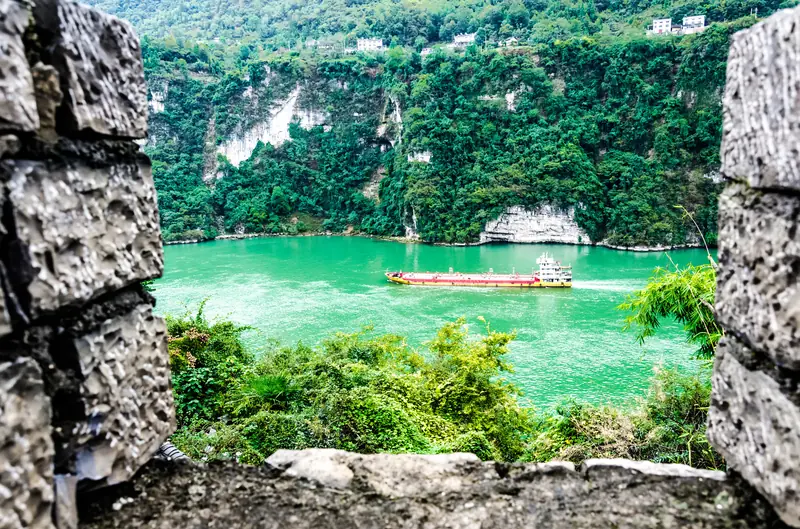
A cruise ship threading through the narrow gorge — the scale of the cliffs only hits you when the ship looks tiny
Engineered canyon journey
A 193 km river corridor where cliffs, dams, and ship locks share the same journey
Yangtze Three Gorges (长江三峡)
The route stretches from Baidicheng (白帝城) in Chongqing to Nanjinguan (南津关) near Yichang — three consecutive canyons so different in character they feel like separate landscapes.
193 km
Core gorge route
4-5 days
Typical cruise
Why it works for independent travelers
This may be the only trip in China where you don't need to navigate, don't need to book daily tickets, and don't need to speak a word — just stand on deck and watch the cliffs close in.
What changed
After the Three Gorges Dam reached full capacity in 2006, the water level rose about 110 meters. Xiling Gorge lost its dangerous rapids — now a calm reservoir — but the cruise became safer and more comfortable.
What did not drown
Many people assume the gorges were "drowned." The cliffs at Qutang Gorge still tower 700-800 meters above the water, so the visual impact remains staggering.
What still feels high
Goddess Peak (神女峰) in Wu Gorge still stands high on its ridge, and the gap between summit and waterline barely changed.
The name comes from three very different gorges
Qutang Gorge (瞿塘峡) is the shortest and fiercest, with its entrance at Kuimen (夔门) just 100 meters wide and printed on the back of China's ¥10 note.
Wu Gorge (巫峡) is the most elegant, lined with the Twelve Peaks of Wushan (巫山十二峰) draped in mist; Xiling Gorge (西陵峡) is the longest at 66 km and was historically the most treacherous stretch of the Yangtze.
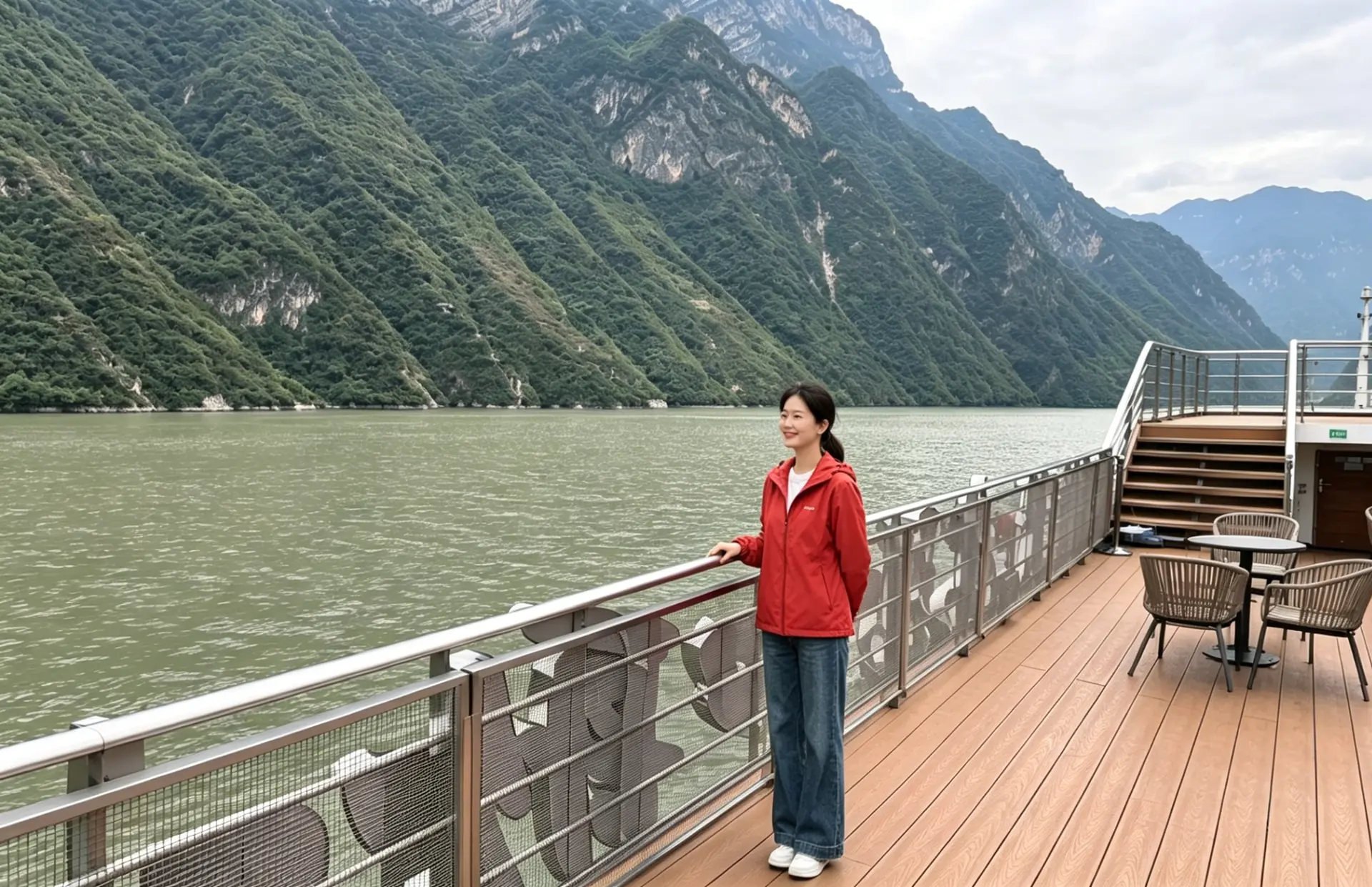
Deck viewing is the main event — mornings through the gorges draw everyone topside
Board once, then let the river carry the logistics
For foreign visitors, the unusual ease is the point: food, accommodation, included shore excursions, and ship guide service are bundled into the ticket for the next 4-5 days.
Choosing Your Three Gorges Route
Route decision
Downstream is the default; upstream and Wuhan are slower alternatives.
Downstream
Chongqing → Yichang · 4D / 3N
Most popular · widest ship choice
The scenery builds from Chongqing into ever-more-dramatic canyons.
The current carries you at a pace that feels right for deck viewing.
Most cruise companies run flagship ships on this route.
Best for first-time visitors and travelers with limited time.
Upstream
Yichang → Chongqing · 5D / 4N
Slower rhythm · more time on board
The extra day is about fighting the current, not covering more distance.
More relaxation time on board and a slower daily rhythm.
The visual drama is less theatrical because you sail from open water into the gorges.
Best for relaxed travelers who want more deck time.
Wuhan Departure
Wuhan → Chongqing · 6D / 5N
Newer route · extra culture stops
Starts in Wuhan before entering the classic Three Gorges section.
Passes Yueyang Tower (岳阳楼) and Jingzhou before the canyon scenery.
Combines Hubei's Chu culture with Three Gorges scenery.
Best for travelers with extra time and culture enthusiasts.
Our pick
If you're visiting once and time is limited, go downstream (Chongqing → Yichang). Four days, scenery that builds to a climax, and the widest selection of ships and services.
Cruise Ships and What They Cost
Three Gorges cruises span every budget. For foreign travelers, the most important criterion isn't price — it's whether the ship offers English service. Some ships have full-time English guides, English announcements, and English menus; others cater exclusively to Chinese tour groups.
Ship tiers
Choose by English service first, then by cabin comfort.
Luxury
¥4k-8k+ · 26-105 m² cabins
Century series · Yangzi Explorer
Century Glory (世纪荣耀), Century Victory (世纪凯歌), and Yangzi Explorer (长江探索).
Full-time English guides, Chinese and Western buffet, plus a la carte dining.
Cultural activities, gyms, pools, spas, tai chi, tea ceremonies, and Sichuan opera face-changing.
Yangzi Explorer is the boutique vessel: 148 guests and private butler service.
Best for foreign travelers wanting top-tier comfort and full English service.
Standard
¥1.7k-4k · 23-53 m² cabins
Victoria series · Star series
Victoria Sabrina (维多利亚凯珍) and Star series are the common references.
English announcements and basic English service are usually available.
Newer facilities may include elevators and medical rooms.
Best for travelers who want comfort without the premium price tag.
Budget
¥800-1.5k · 15-20 m² cabins
Domestic-tour-group ships
No English service; announcements are in Chinese.
The language barrier severely affects shore-excursion commentary.
Not recommended for independent foreign travelers.
Seasonal pricing
Off-season
Mar-Apr, Nov-Dec
65%-70% of base
Mid-season
May-Jun, late Sep-mid Oct
Base price
Peak season
Jul-Aug, Golden Week
120%-150% of base
Save money
Book 30+ days ahead to save around ¥300 per cabin. Depart on Monday or Tuesday instead of weekends. November's red-leaf season has the most beautiful scenery and the lowest prices — the best-kept deal on the Yangtze.
How to Book as an Independent Traveler
This is where most foreign visitors get stuck — Three Gorges cruises aren't on 12306, and you can't just show up and scan a QR code at the dock.
Booking channels
Most foreign travelers should pay a little more for English support.
English agencies
Recommended for most foreign visitors
ChinaDiscovery · EasyTourChina · AsiaOdyssey
English customer service, airport or station transfers, and visa advice.
International credit cards accepted, with far fewer language barriers.
Usually 5%-10% above direct booking prices.
Cruise line websites
Direct, but slower after-sales support
Century Cruises · Victoria Cruises
Both Century Cruises and Victoria Cruises have English websites for direct booking.
Email replies can be slow, and phone support quality varies.
Chinese OTA platforms
Cheapest if you have local help
Ctrip · Meituan
Often the lowest listed prices.
Interfaces and customer support are in Chinese only.
If you have a Chinese friend who can help, this is the cheapest route.
Booking timeline
Peak season
45-60 days ahead
Use this window for July-August, Golden Week, and better English-service ships.
Mid-season
20-30 days ahead
Enough for most May-June and late September to mid October sailings.
Off-season
7-14 days ahead
Often fine in March-April and November-December; you may even book after arriving in Chongqing.
Visa note
Visa and passport note
The cruise stays entirely within mainland China — no border crossings. If you're using the 144-hour visa-free transit, confirm your exemption period covers the full cruise. The ship will hold your passport during the voyage for checkpoint registration; you'll use your boarding card for shore excursions.
Shore Excursions Worth Your Time
Three Gorges cruises aren't all deck time — every day includes 1–2 shore excursions (included in the fare), with transport and guides arranged by the ship. Here's the typical stop sequence on a downstream route (Chongqing → Yichang):
- Fengdu Ghost City(丰都鬼城)- 2,000-year-old underworld temples
- Baidi City(白帝城)- Li Bai poetry site + Kuimen photo spot
- Lesser Three Gorges or Shennv Stream(小三峡 / 神女溪)- Narrow tributary canyons by small boat
- Three Gorges Dam(三峡大坝)- World largest hydropower station + ship lock
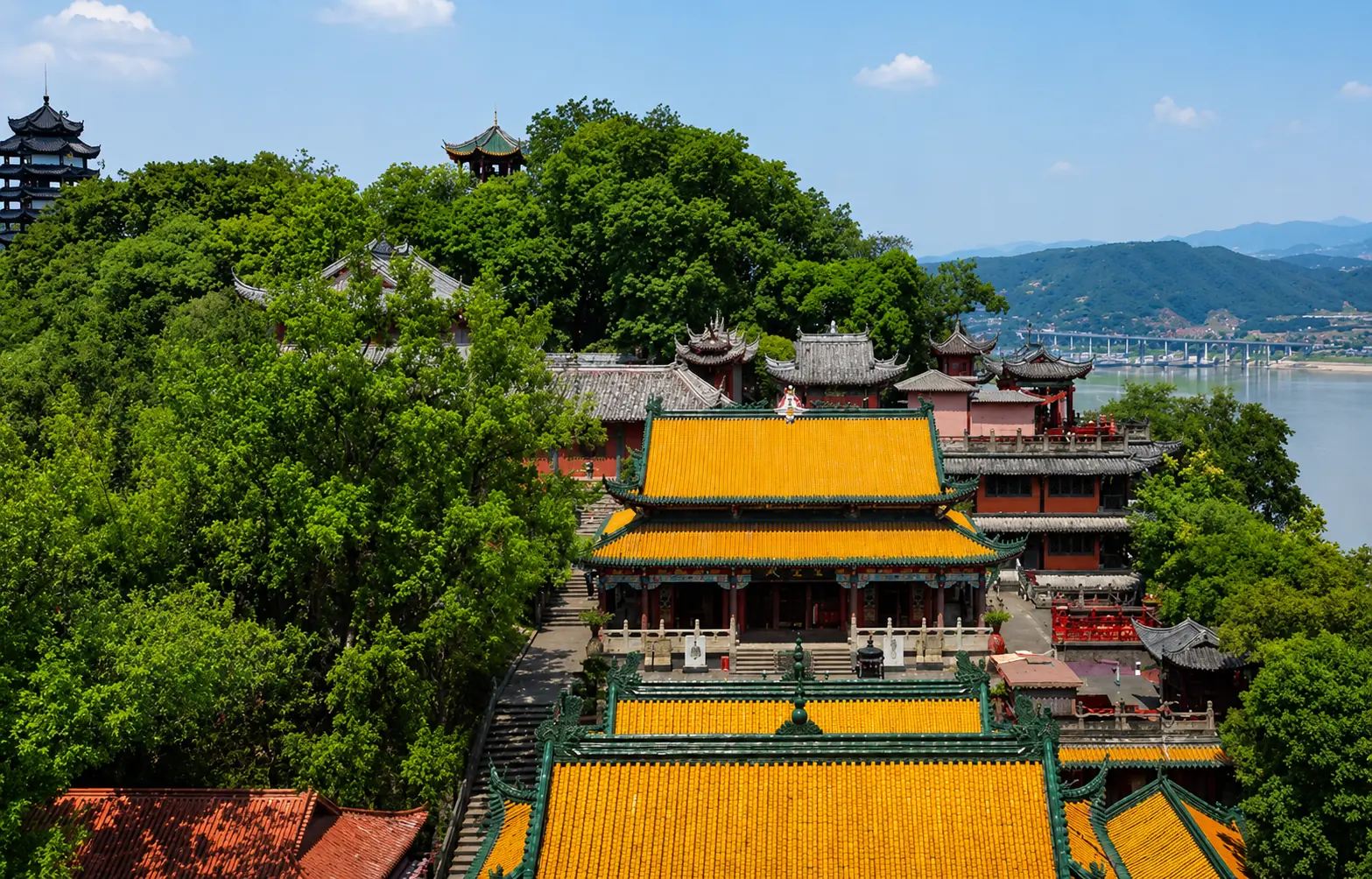
Fengdu Ghost City — hillside temples above the Yangtze with steep paths and river views
What it is
Fengdu Ghost City sits on a hillside above the Yangtze's north bank — China's only ancient site themed around the underworld.
Why it matters
This isn't a haunted house. It is a 2,000-year-old complex of Taoist and Buddhist temples depicting the Chinese vision of the afterlife through sculptures and murals: the Bridge of Helplessness, the Palace of the King of Hell, and the Eighteen Levels of Hell.
Mobility
The site involves a significant climb; visitors with limited mobility can take the cable car.
Language
Most signs and sculptures lack English labels. If your ship only has Chinese guides, download an offline Chinese translation pack before the excursion.
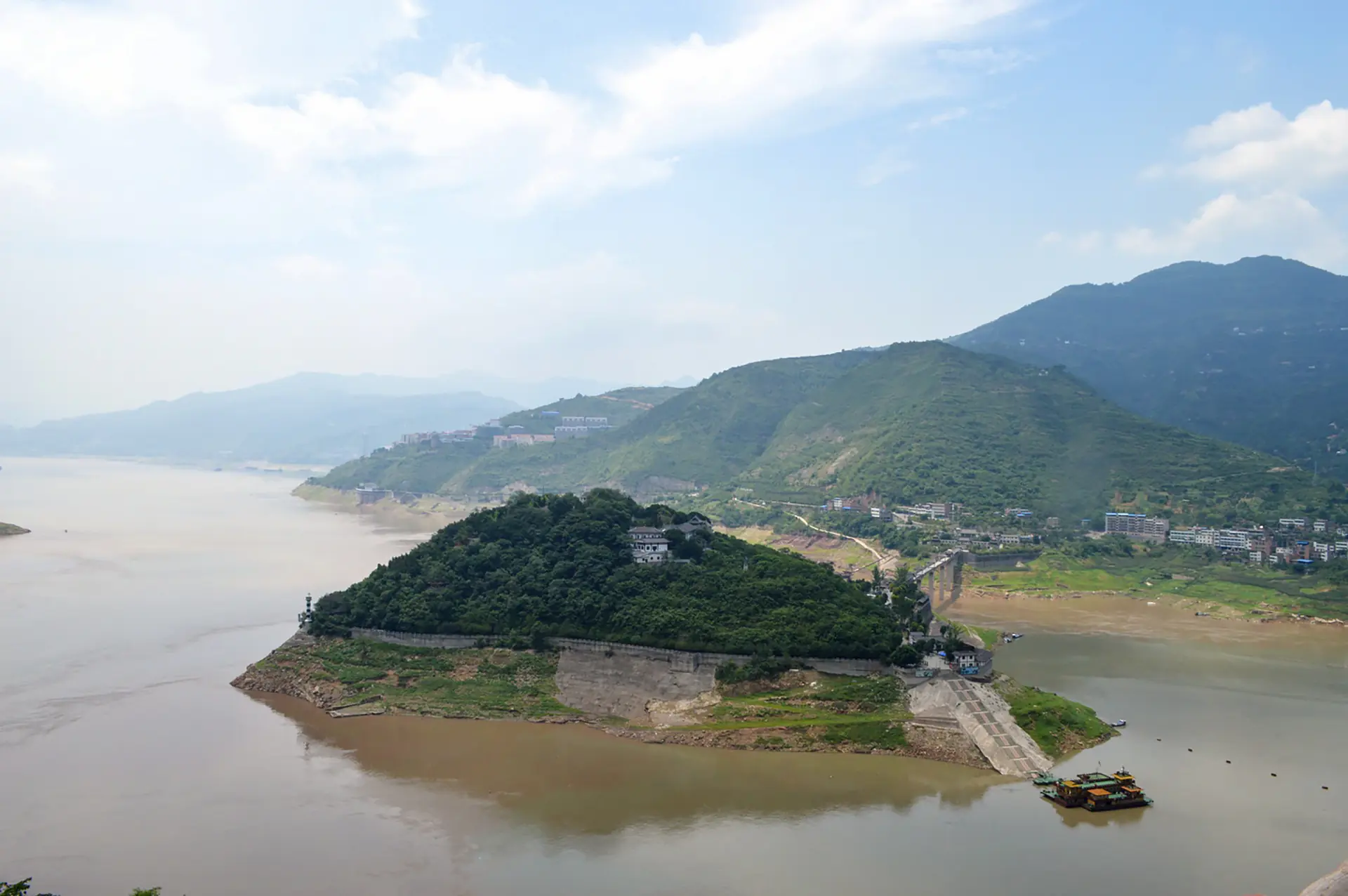
Baidi City became an island when the reservoir filled — now reached by a covered walkway
Setting
Baidi City perches on a small hill at the entrance to Qutang Gorge, surrounded by water on three sides.
Story
This is where the Tang poet Li Bai wrote his famous verse "Departing Baidi among morning clouds" and where Liu Bei entrusted his kingdom to Zhuge Liang in the Three Kingdoms era.
Access
After the reservoir filled, the hilltop became an island. You reach it via a long covered walkway, which has become a scenic attraction in its own right.
Best photo spot
From the summit, use the viewing platform near the Zhuzhi Poetry inscriptions for the classic Kuimen angle — the exact view on China's ¥10 note. Early morning light is best.
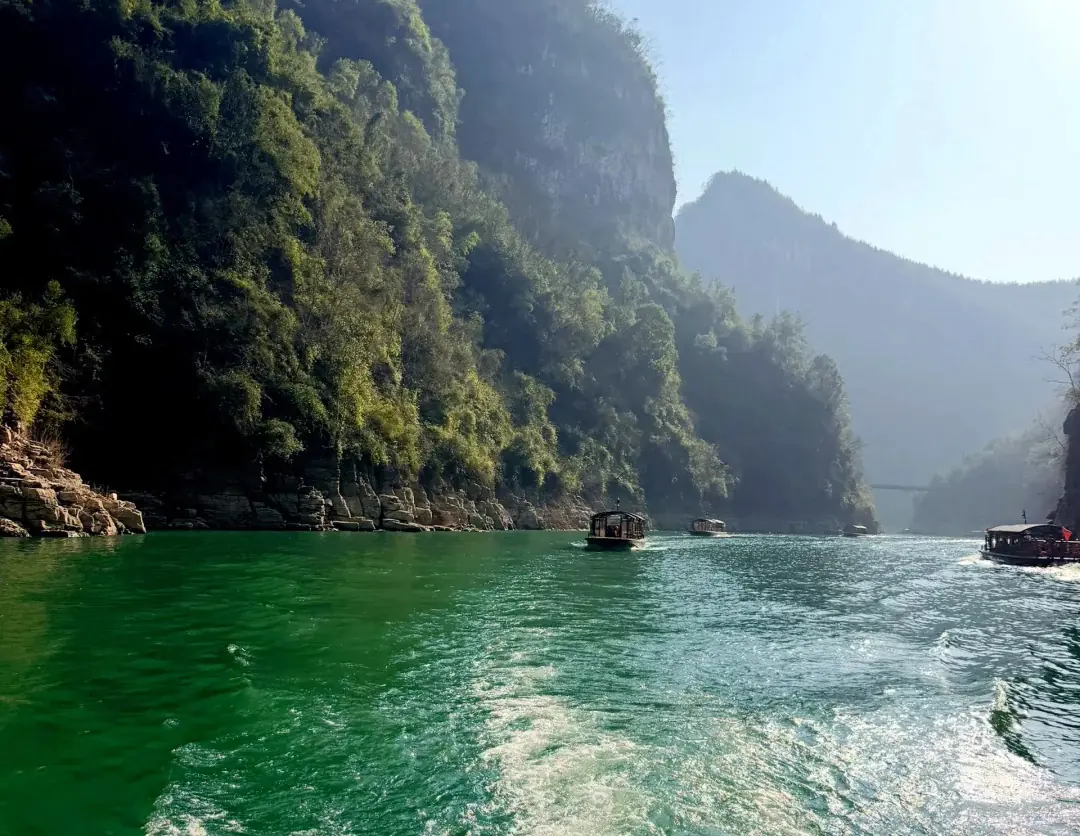
The Lesser Three Gorges — tributary canyons so narrow you see only a sliver of sky
Day 3 afternoon
Lesser Three Gorges or Shennv Stream (小三峡 / 神女溪)
Most cruises include either the Lesser Three Gorges or Shennv Stream, not both. Confirm which one your ship visits before booking.
Included on many ships
Lesser Three Gorges (小三峡) (Google | Amap)
River setting
The Lesser Three Gorges lie along the Daning River (大宁河) in Wushan County — one of the biggest highlights of any Three Gorges cruise.
Small-boat route
Passengers transfer to smaller boats and navigate through Longmen Gorge, Bawu Gorge, and Dicui Gorge: tributary canyons only tens of meters wide, with ancient plank road remnants and hanging coffins on the cliffs above.
Mini Three Gorges
The Mini Three Gorges (小小三峡) require a second transfer into hand-rowed wooden boats on an even narrower upstream tributary. The channel is so tight you see only a sliver of sky overhead, and the water is clear enough to spot pebbles on the riverbed.
Alternative tributary
Shennv Stream (神女溪) (Google | Amap)
Setting
Shennv Stream is a tributary within Wu Gorge.
Goddess Peak angle
Smaller boats take you close to Goddess Peak (神女峰), one of the famed Twelve Peaks of Wushan.
Old river technique
At the narrowest points, boatmen pull the vessel through with ropes — an ancient river technique that has completely vanished from the Yangtze's main channel but survives on these tributaries.
Best moment
The best experience comes when morning mist hasn't yet cleared: the water mirrors the green peaks on both sides, and you might spot macaques leaping across the cliffs.
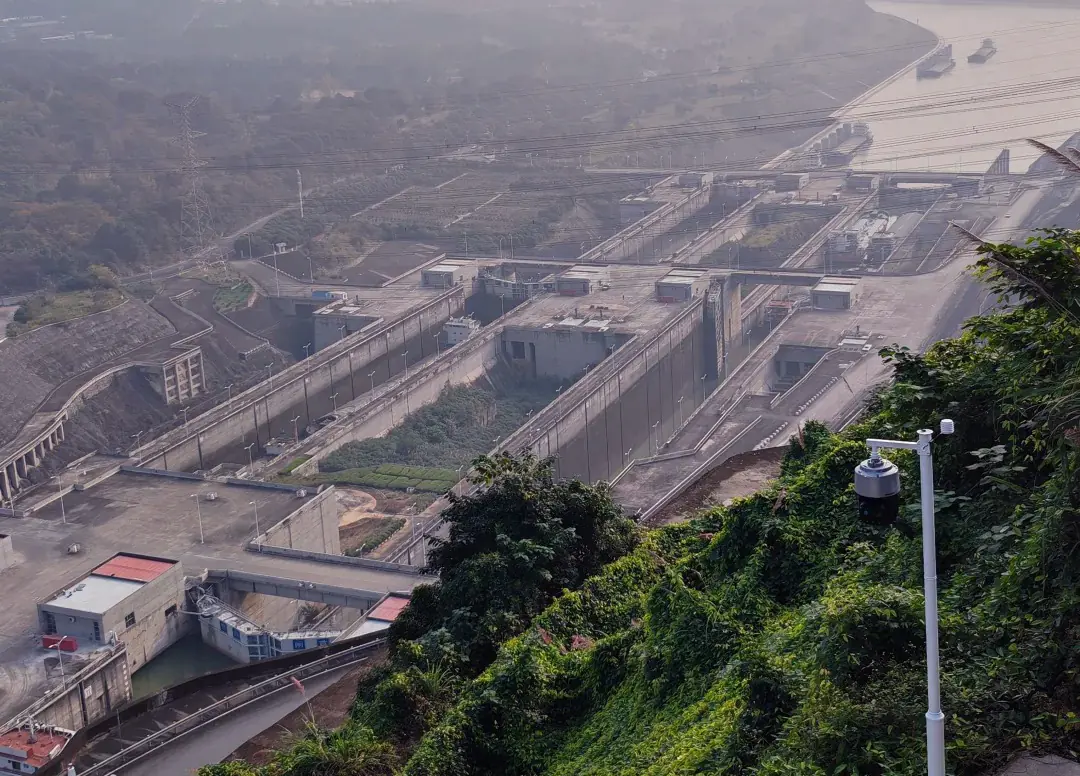
The view from Tanziling — the dam, the ship lock, and the water-level gap in one frame
Scale
The world's largest hydropower station by installed capacity — 185 meters high, 2,335 meters long, generating roughly 100 billion kWh annually.
Tanziling (坛子岭)
Highest observation point, with the dam, five-stage ship lock, and water-level difference in one view.
185 Platform
Level with the dam crest at 185 meters for a close-up, eye-level view of the concrete structure and upstream reservoir.
Memorial park
River Closure Memorial Park (截流纪念园) shows heavy machinery and historical footage from the 1997 river diversion.
Ship lock or lift
Some ships, especially upstream, transit the five-stage ship lock: a 113-meter water elevator that takes roughly 3-4 hours. Yangzi Explorer transits the ship lift instead, lifting the ship plus water in about 40 minutes.
Entry rules
Admission is free, but the mandatory scenic-area shuttle costs ¥35 per person. Security is strict — bring your passport. The Three Gorges Project Museum may close on Mondays; check current hours before your visit. Drones are prohibited throughout the scenic area.
What the Three Gorges Actually Look Like
This is the heart of the journey — sailing through the gorges themselves. On most downstream itineraries, Day 3 covers all three gorges. Here's what you'll see from deck:
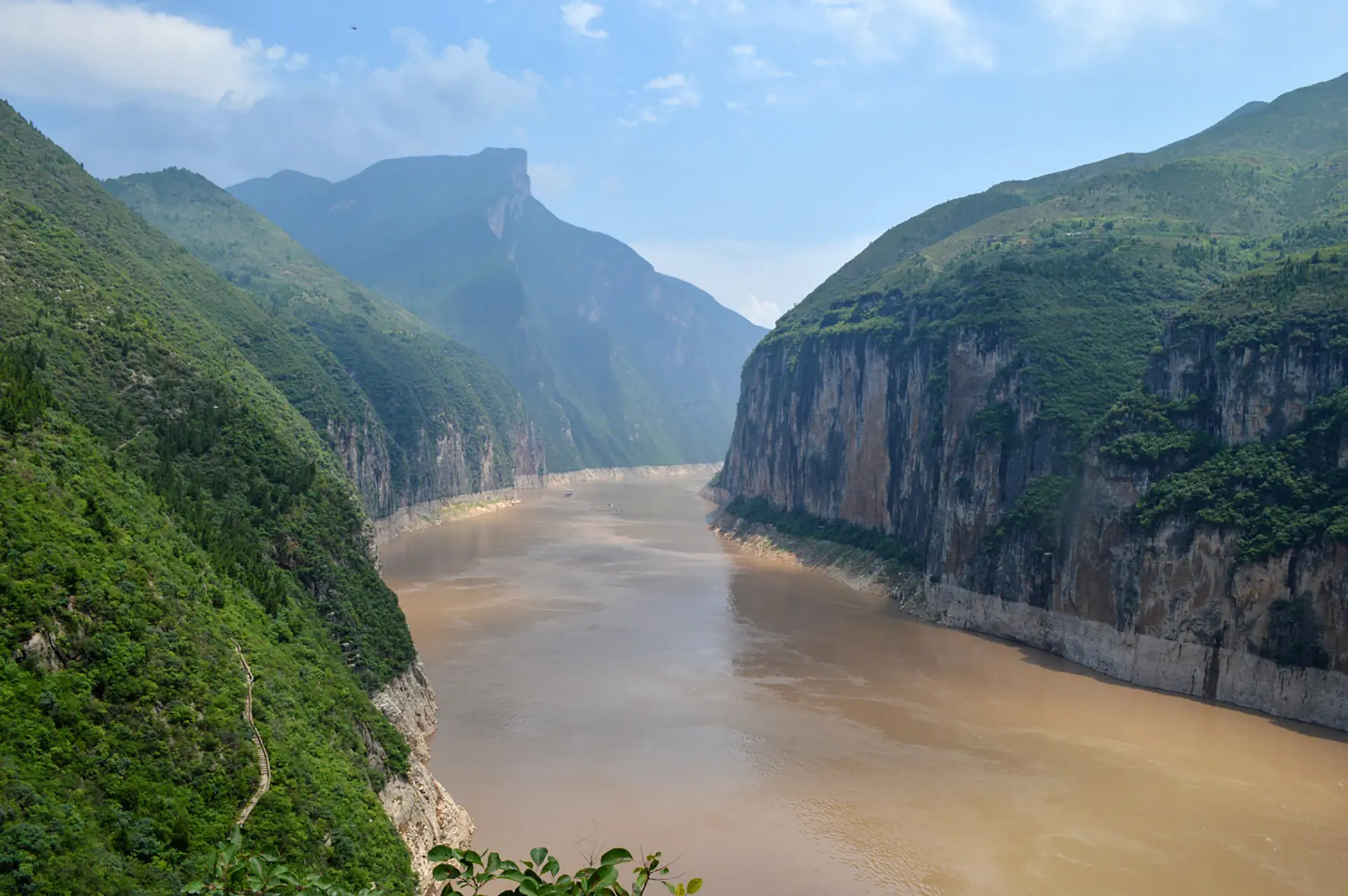
Kuimen — the entrance to Qutang Gorge, printed on China's ¥10 note
Shortest and fiercest
Qutang Gorge (瞿塘峡)
The shortest gorge is also the most compressed: the ship slips through Kuimen as the cliffs seem to close in from both sides.
Scale
Qutang Gorge stretches just 8 km — the shortest of the three, but the most imposing.
Kuimen gate
At the entrance stands Kuimen (夔门): sheer cliffs rise vertically on both sides — Baiyan Mountain (白盐山) to the south and Chijia Mountain (赤甲山) to the north — narrowing the river to about 100 meters.
Deck moment
The moment the ship sails from open water into Kuimen, the walls close in from both sides — the single most dramatic visual of the entire Three Gorges.
Deck strategy
When the ship enters Kuimen, everyone rushes to the bow. For clean photos without crowds, try the stern — you can capture the classic shot of Kuimen closing behind the ship.
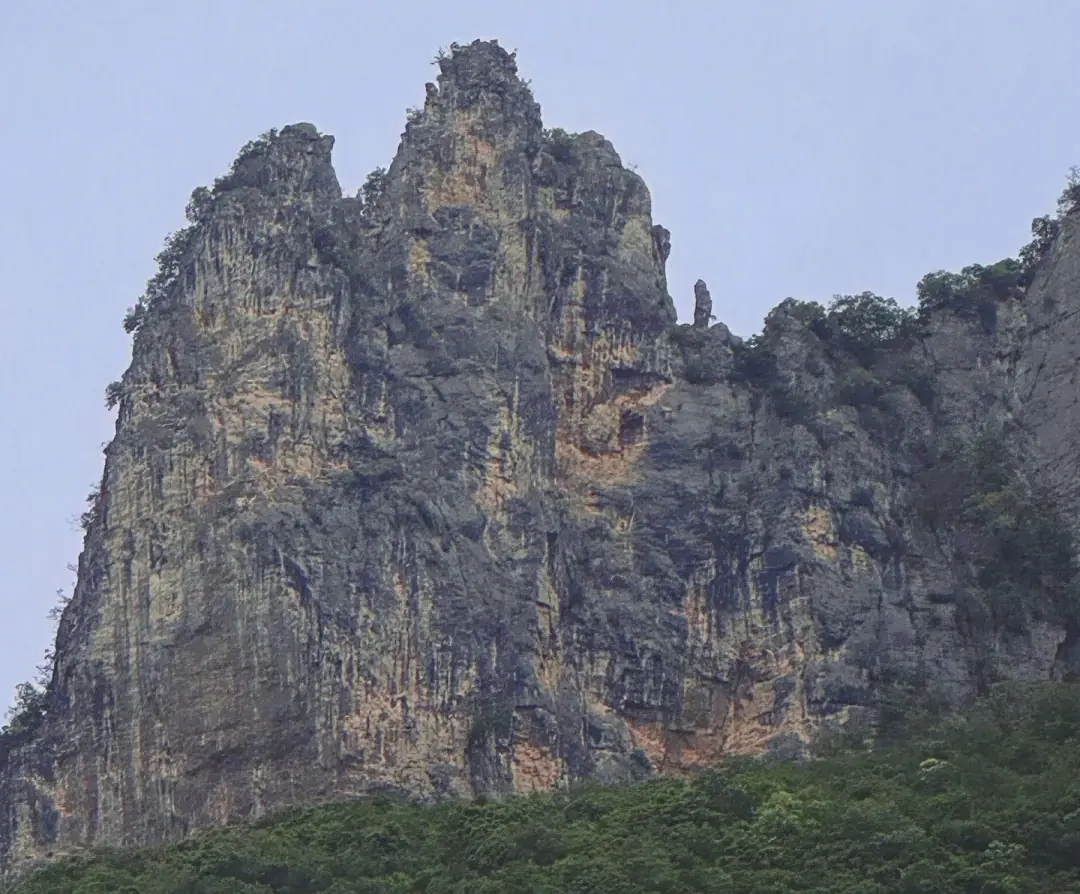
Goddess Peak in Wu Gorge — best seen at dawn when mist weaves around the ridges
Most elegant
Wu Gorge (巫峡)
The most graceful gorge, known for layered peaks, morning mist, and the famous Goddess Peak silhouette.
Length
Wu Gorge runs 46 km — the most beautiful stretch of the Three Gorges.
Goddess Peak
Unlike Qutang's sheer compression, the peaks here are layered and varied, each with its own silhouette. The most famous is Goddess Peak (神女峰) — the only one of the Twelve Peaks visible from the ship — shaped like a standing maiden, the subject of centuries of Chinese poetry.
Mist rhythm
Wu Gorge is frequently wrapped in morning mist: fog rises from the river, weaves around the mountainsides, and drifts in and out of view.
Best viewing
6:30-8:00 AM, when the mist is thickest and most atmospheric. Experienced travelers set alarms specifically for this.
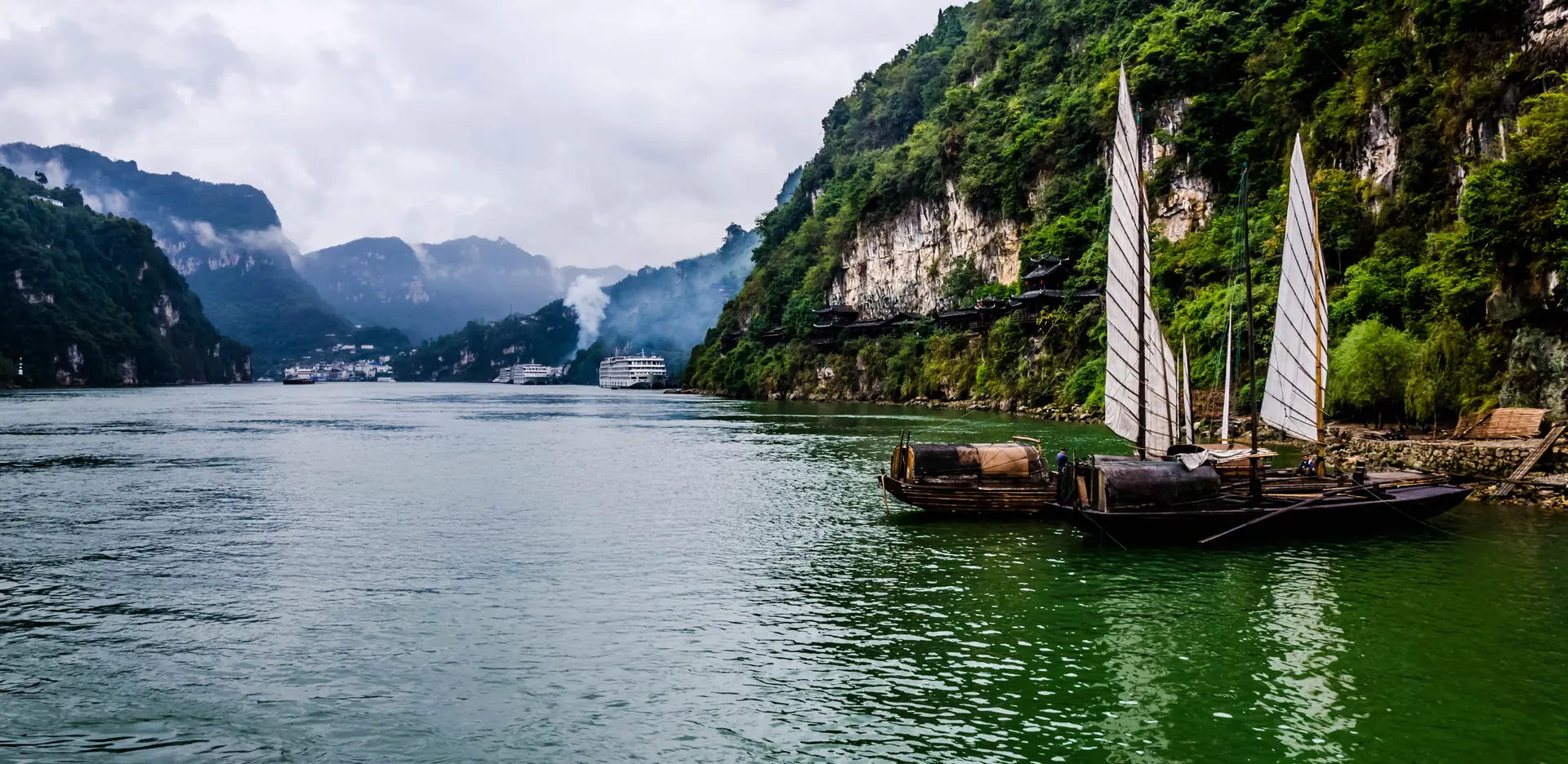
Xiling Gorge — the longest of the three, now calm after the dam tamed its rapids
Longest and richest in history
Xiling Gorge (西陵峡)
The longest gorge is calmer after the dam, but it still carries the route's strongest engineering-before-and-after story.
Length
Xiling Gorge extends 66 km — the longest of the three.
Before the dam
This was the Yangtze's most dangerous section, with dozens of rapids and an old saying: "Xiling's rapids crowd together like joints of bamboo." Countless ships sank here over the centuries; rope grooves carved by trackers who hauled boats upstream are still visible on the cliffs.
Now
After the reservoir filled, every rapid disappeared beneath calm water. The cliffs and mountain scenery remain impressive, and the higher waterline reveals cliff textures previously out of sight.
The other half
Xiling Gorge is rich in cultural heritage — Three Visitors Cave (三游洞), the Temple of Qu Yuan (屈原祠), and the hometown of Wang Zhaojun (昭君故里) all line its banks. The lower section below the dam is not part of the cruise route; to see the complete gorge, book a "Two Dams, One Gorge" (两坝一峡) half-day excursion in Yichang.
Life on Board a Yangtze Cruise
A Three Gorges cruise isn't just transport — the ship itself is a core part of the experience.
Exact timing varies by company and river traffic, but this is the rhythm most first-timers should expect.
Daily rhythm
6:00-7:00
Deck tai chi session, free and usually with an instructor.
7:00-8:30
Breakfast buffet, usually Chinese and Western.
8:30-12:00
Shore excursion organized by the ship.
12:00-13:30
Lunch.
14:00-17:00
Free time, gorge passage, deck viewing, or cultural activities.
18:00-19:30
Dinner.
20:00-21:30
Evening program: captain's welcome or farewell dinner, performances, and ship activities.
Dining
Food style
Luxury ships serve Chinese and Western buffets plus à la carte — steaks, pasta, and salads are standard. Standard ships lean toward Chinese buffet but typically include bread, eggs, and coffee.
Included meals
All meals are included in the fare — no extra charge except for alcoholic drinks; some luxury ships include open bar.
Dietary requests
If you have dietary restrictions such as vegetarian, halal, or allergies, register at the front desk when boarding. The kitchen usually accommodates requests, but set expectations at filling and decent rather than five-star dining.
Entertainment
Lectures and context
Cultural lectures on Three Gorges history and the dam are common. Luxury ships offer English versions; standard ships are mostly in Chinese.
Evening shows
Sichuan opera face-changing performances appear on nearly every ship, and they're spectacular even without understanding Chinese. Captain's welcome and farewell dinners usually happen on the first and last evenings.
Luxury extras and tai chi
Some luxury ships host deck barbecues or hotpot nights under the stars. Morning tai chi sessions run every day — doing tai chi on the Yangtze is an experience in itself.
When to Cruise the Three Gorges
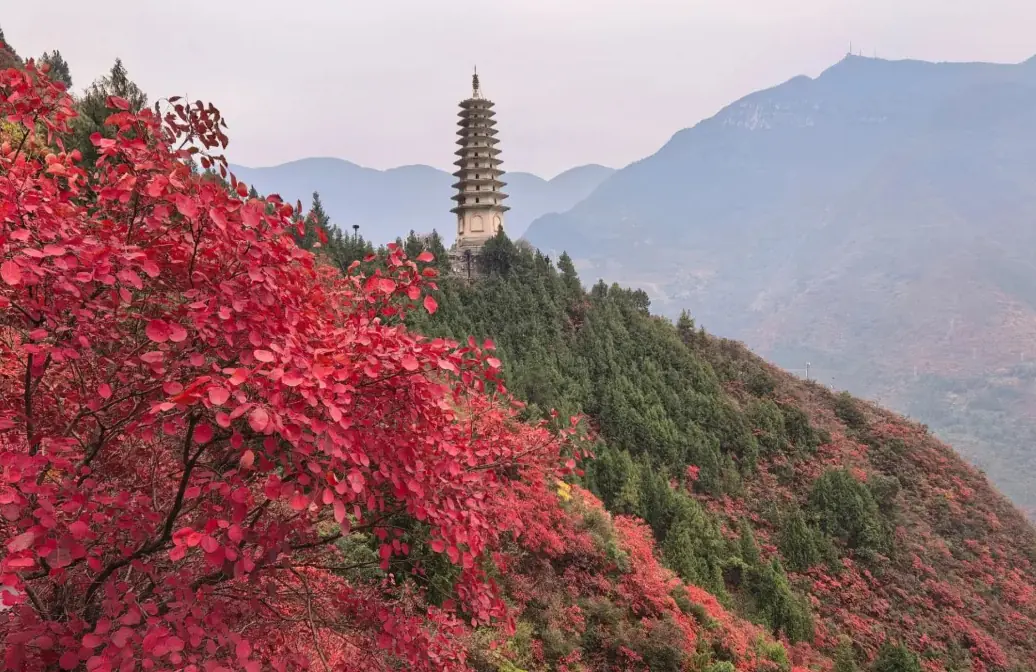
November's red-leaf season — the best scenery at the year's lowest prices
Best overall window
Come in November if your dates are flexible
Late October through November brings red leaves, smaller crowds, and off-season pricing. It is the rare China travel window where the best scenery and the best value overlap.
Autumn (Sep-Nov)
Top recommendation. Cool weather, little rain, high visibility. Late October through November is red-leaf season, and prices can drop to 65%-70% of base.
Spring (Mar-May)
Value pick. Comfortable temperatures, frequent mist, and the "clouds and rain of Wushan" at their most dramatic. March water levels may be lower, and some tributary excursions can adjust.
Summer (Jun-Aug)
Busiest. School holiday peak means the most tourists and highest prices. Waterfalls are stronger and mountains are green, but fog or downpours can block deck views.
Winter (Dec-Feb)
Quietest. Fewest tourists and low prices, but some ships stop running, especially in January and February. Cold, damp, windy deck conditions suit bargain hunters more than scenery-first travelers.
Bottom line: November has the best foliage, lowest prices, and smallest crowds.
Getting to Chongqing and Yichang
Downstream departure city
Chongqing
Air
Chongqing Jiangbei International Airport (江北国际机场, CKG) has domestic and some international flights. Taxi to Chaotianmen Dock takes about 40-50 minutes (¥60-100).
Rail
Chongqing North (重庆北站) handles most trains; Chongqing West (重庆西站) and Shapingba (沙坪坝站) are also useful. From Chengdu: 1-1.5 hours, fastest under 1 hour. From Xi'an: 4-5 hours. From Beijing: 7-8 hours.
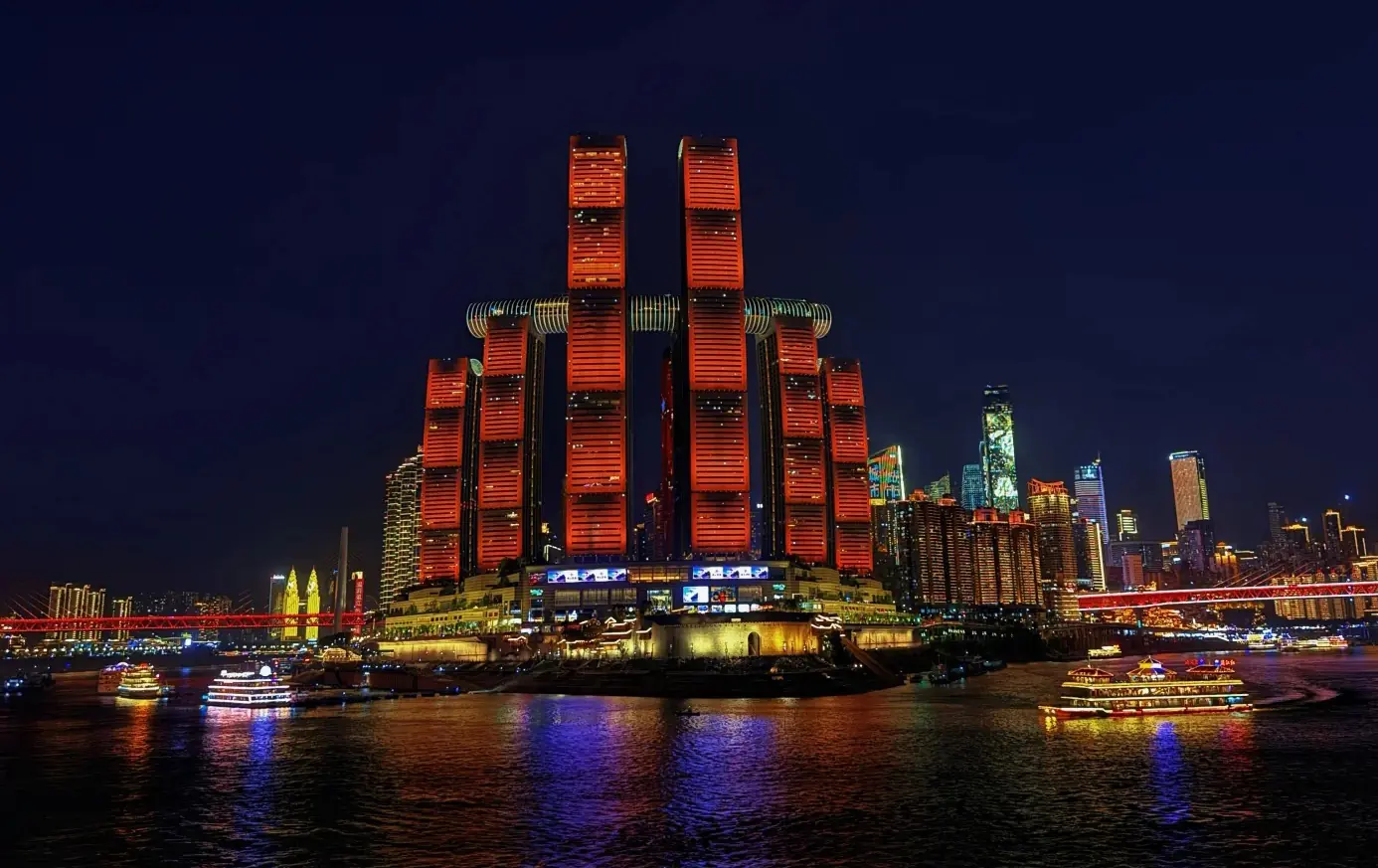
Chaotianmen Dock — most cruises board here in the evening before a morning departure
Arrive early
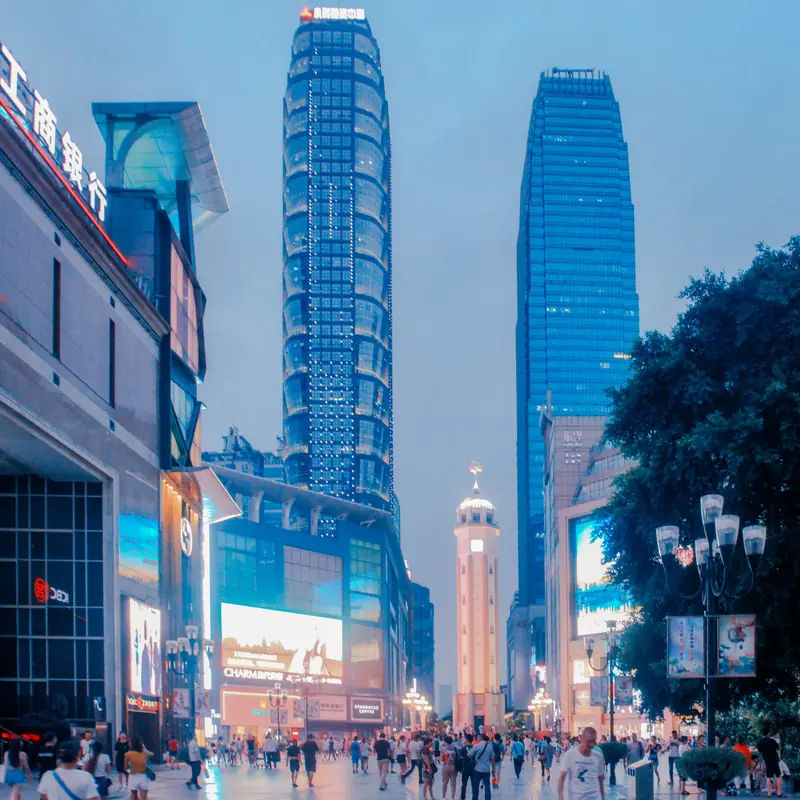
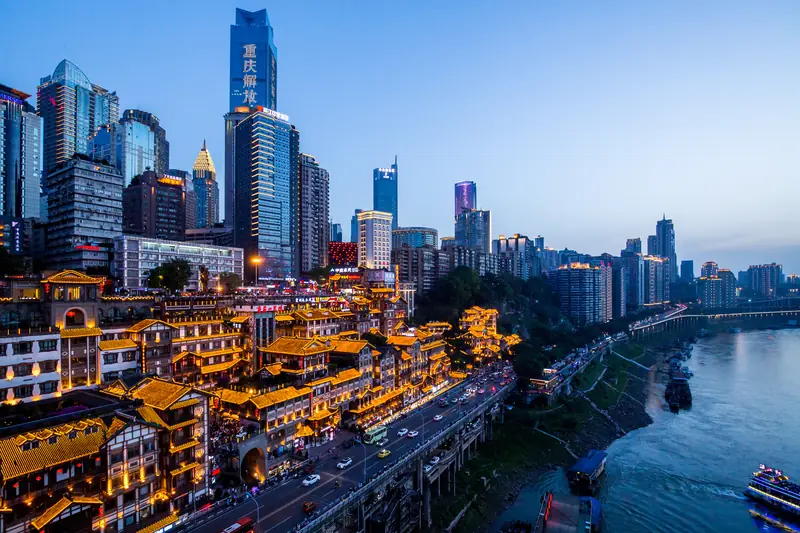
Come to Chongqing 1-2 days before boarding to explore Jiefangbei (解放碑), Ciqikou (磁器口), and Hongyadong (洪崖洞), all within walking distance of Chaotianmen Dock. Chongqing itself easily fills 1-2 days.
Show this screen to your driver · 出示给司机看
师傅您好,请送我到重庆朝天门码头。具体登船码头我会按游轮公司通知确认,谢谢。
Please take me to Chaotianmen Dock in Chongqing. I will confirm the exact boarding terminal from my cruise company.
Use this for most downstream Chongqing departures; always check your cruise company's latest dock notice.
Upstream departure or downstream arrival city
Yichang
Air
Yichang Sanxia Airport (三峡机场, YIH) has limited routes, mainly connecting Beijing, Shanghai, and Guangzhou.
Rail
Yichang East Station (宜昌东站) is the main high-speed rail hub. From Wuhan: about 1.5-2 hours. From Changsha: 3-4 hours.
Show this screen to your driver · 出示给司机看
师傅您好,请送我到宜昌秭归茅坪港(太平溪港)。请不要送到宜昌市中心,谢谢。
Please take me to Maoping Port / Taipingxi Port in Zigui, Yichang. Please do not take me to downtown Yichang.
Use this for upstream boarding or when arranging transport back to the cruise port area.
Don't mix up the dock and the city
Yichang city center and the cruise dock are separated by 70 km of mountain roads. If you're disembarking on the final day of a downstream cruise, leave at least 3 hours between getting off the ship and your train or flight departure.
Practical Tips for the Voyage
Passport and security
Keep your passport on you at all times — checkpoints along the route and shore excursions require it. The ship collects passports at boarding for checkpoint registration and returns them before disembarkation. Store valuables in the cabin safe.
What to pack
- Comfortable walking shoes — shore stops (especially Fengdu and Baidi City) involve significant stair climbing
- Windproof jacket — breezy on deck even on summer evenings
- Rain gear — Three Gorges weather changes fast
- Motion sickness pills — rarely needed on rivers, but bring them if you're sensitive
- Power bank and cables — outlets are limited; some older cabins have only one
Phone and internet
Signal
Phone signal drops in and out through the gorges, especially in Qutang and Wu Gorge.
Ship Wi-Fi
Most ships offer paid Wi-Fi (¥50-100 per day), but speeds are slow — messaging apps only, no video calls or work emails.
Before boarding
Download offline maps, translation packs, and reading material before boarding.
Photography rhythm
Deck positions
Bow and the highest open deck, usually deck 6 or 7.
Sunrise
6:00-7:00 AM toward Wu Gorge.
Sunset
5:00-6:00 PM toward Qutang Gorge if upstream.
Night lock passage
Use a tripod plus long exposure for light reflections. Drones are banned at the Three Gorges Dam scenic area.
Health and safety
On board: both luxury and standard ships have medical rooms with basic supplies.
Summer: sun protection and insect repellent are recommended.
Mobility: contact the ship in advance if you have significant mobility challenges — most have elevators, but shore excursion sites may not.
Mobility reality check
The ship pace is relaxed, but several included shore excursions are not flat.
Stairs and ramps: Fengdu Ghost City and Baidi City.
Security + shuttle + viewpoints: Three Gorges Dam.
Frequently Asked Questions
Yes. The gorges tower hundreds of meters above the waterline, so the visual scale barely changed. What you lost in rapids you gained in comfort — and passing through the five-stage ship lock or ship lift is now a highlight of the trip.
Sources checked for this guide
- Cruise-line itinerary references for route length, ship services, and downstream/upstream rhythm: Century Cruises official itinerary and Victoria Cruises official itinerary
- Three Gorges Dam engineering dimensions and ship-lock context: China Three Gorges Corporation official project page
- Three Gorges Dam visitor viewpoints and scenic-area shuttle sequence cross-check: Yangtze River Cruises dam site guide
Beyond This Guide
The Three Gorges are just one piece of a longer Yangtze journey — Chongqing's hotpot scene, Yichang's dam-side scenery, and connections to Chengdu or Wuhan make this an easy add-on to a broader China trip.
Related reading:
- Chongqing Food Guide — what to eat before your cruise
- Dazu Rock Carvings — UNESCO art near Chongqing
- Chongqing destination hub
© gochinafreely.com — Original guide by Go China Freely.