Times & ticket scan
Admission, vehicle use, show prices, and operating times can change by notice. Passport holders may need the staffed ticket window. Check the official site
Same-day decisions
Five Shows Hidden in a Mountain Village
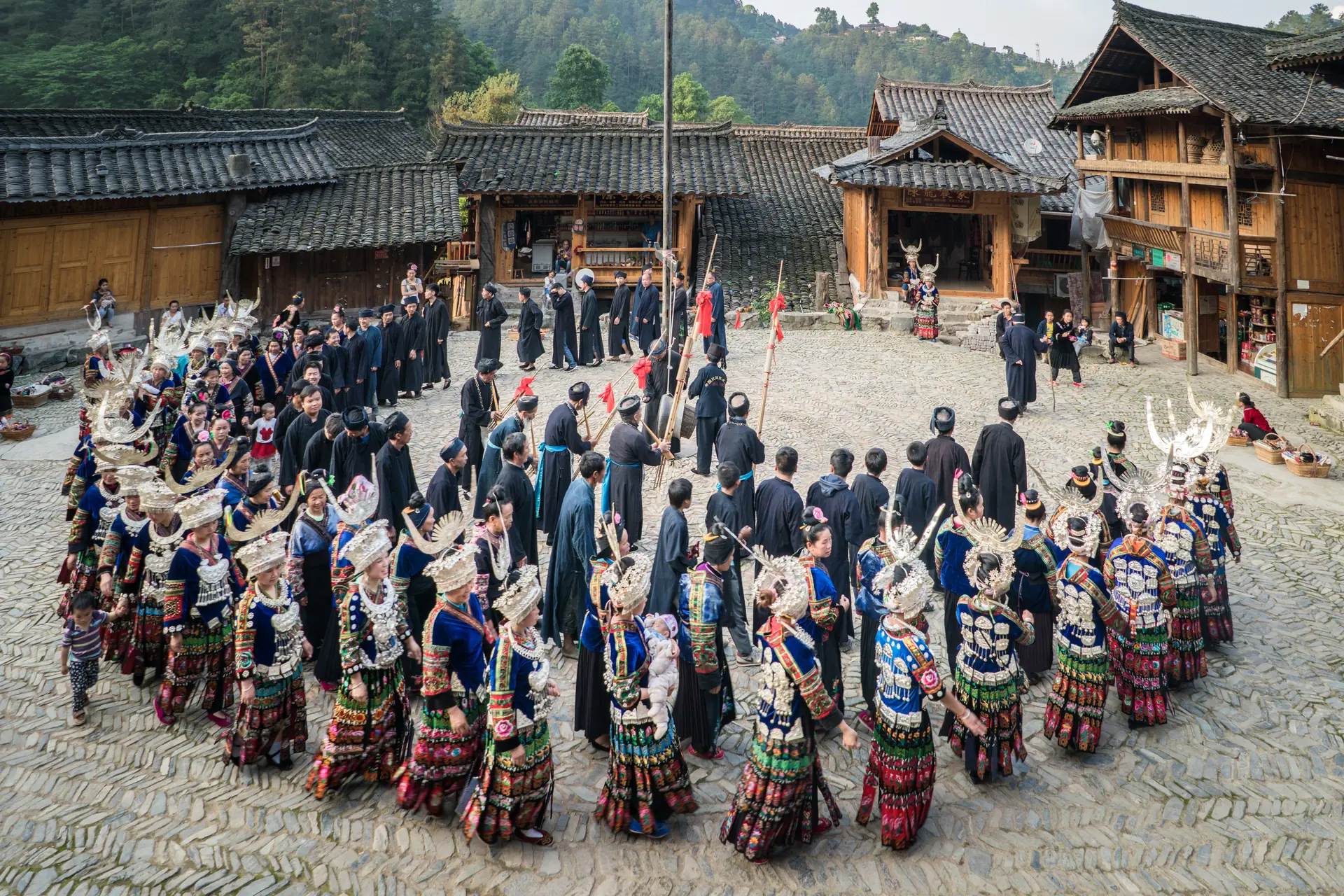
Lusheng Square shows how performance, village life, and the mountain setting overlap in Xijiang.
A village with several kinds of stage
The performances are spread between a gate, a square, a banquet table, a theater, and the lanes between them.
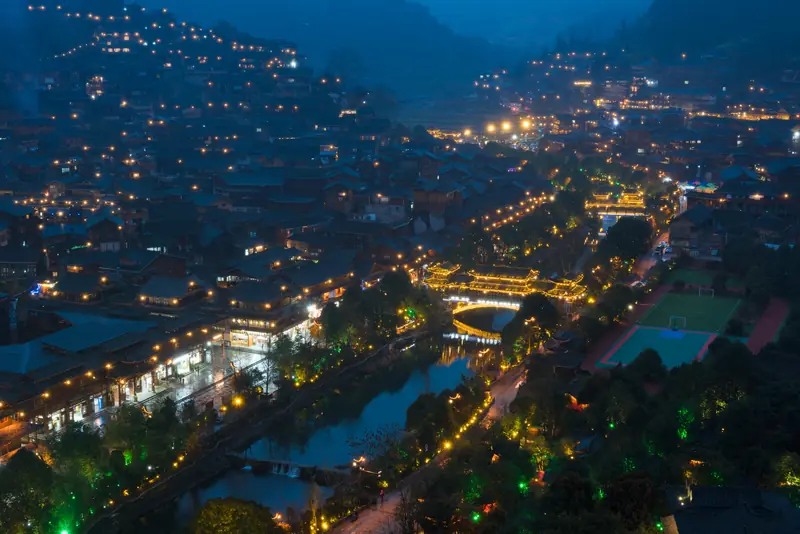
Xijiang Thousand Miao Village (西江千户苗寨) has 1,468 households and more than 6,000 residents. Most visitors know the valley of stilt houses after dark; the more useful way to plan is to separate five performance formats, because their tickets, schedules, and reliability are different.
1 · Gate welcome
The twelve-toast ceremony uses broad daytime windows that change with the operating calendar.
2-3 · Square and theater
The free Lusheng program is paused; the separately ticketed daytime and evening theater shows have resumed.
4-5 · Table and lanes
Banquet songs are part of a paid meal, while bridge and alley music is spontaneous rather than scheduled.
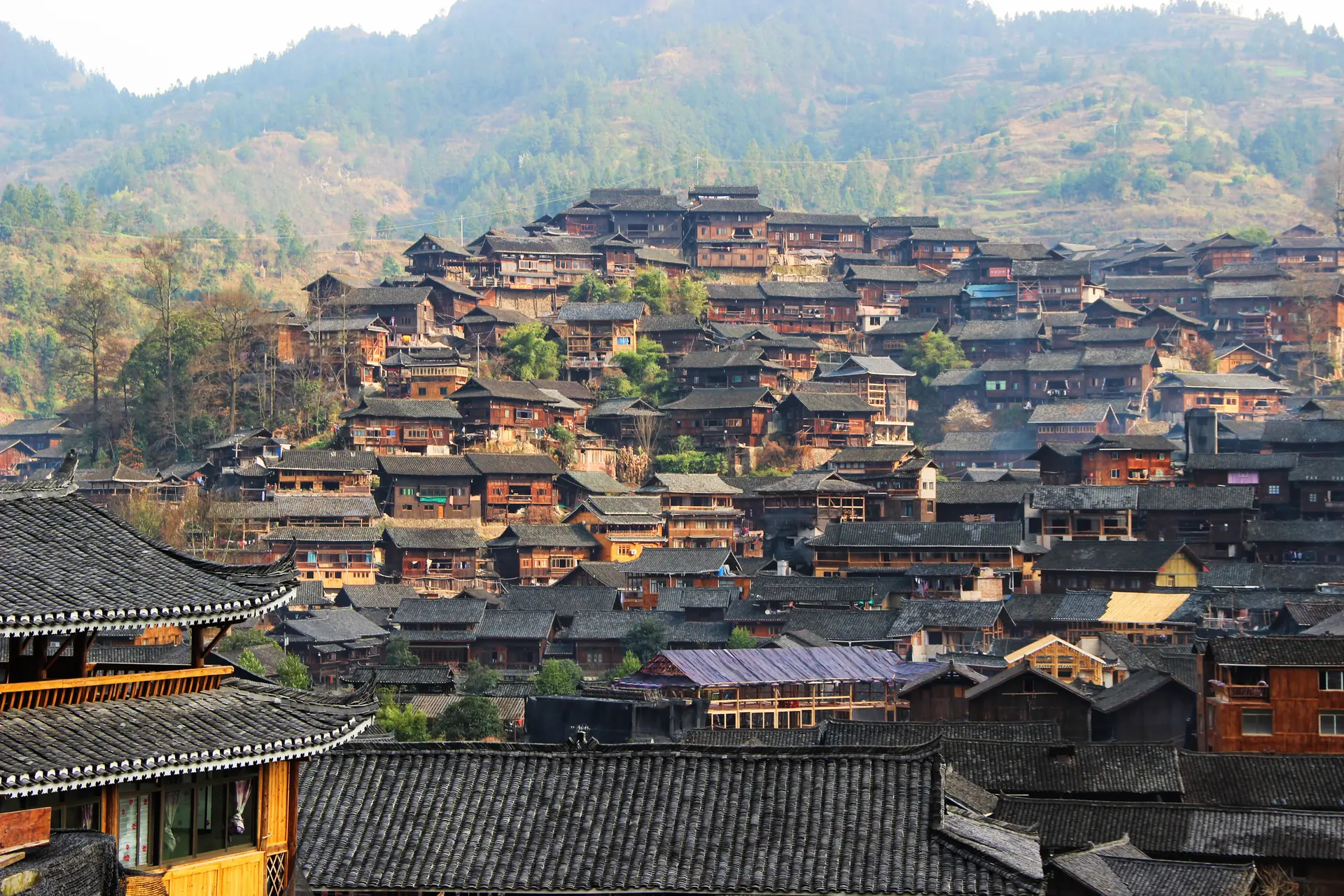
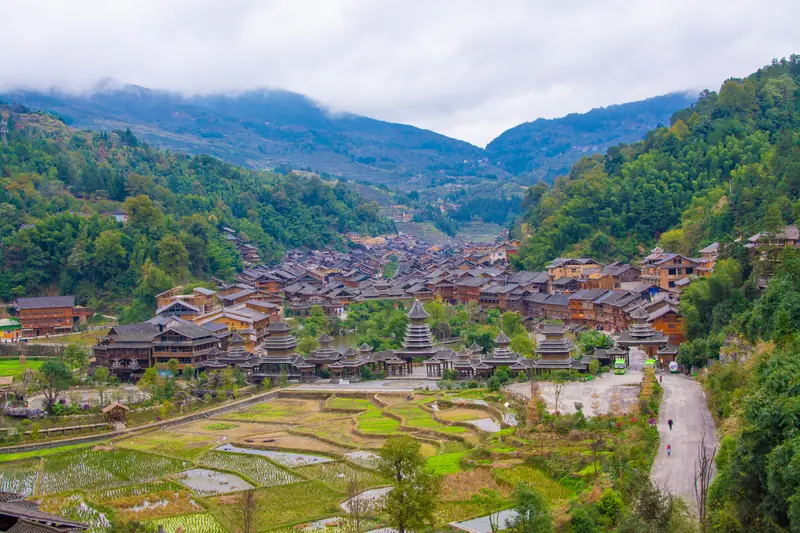
The valley and its timber houses create the setting around the formal and informal performances.
Xijiang works differently from a sealed theater district. Timber stilt houses (吊脚楼) climb from the river toward the ridgeline, and the main performance spaces sit inside the same lanes used by residents, restaurants, workshops, and visitors.
Use the village as the organizing idea: start with the welcome at the gate, check the current board before committing to a show, then leave time for the quieter craft and music spaces between formal programs.
The operator's live notices matter more than an old daily timetable. On 22 July 2026, the paid daytime and evening shows resumed, while the latest notice still left the free Lusheng Square program suspended.
The Twelve-Toast Welcome: Your First Test
Your first encounter with Xijiang may happen before you enter the village proper: a sung welcome, a line of ceremonial dress, and twelve symbolic cups at the North Gate.
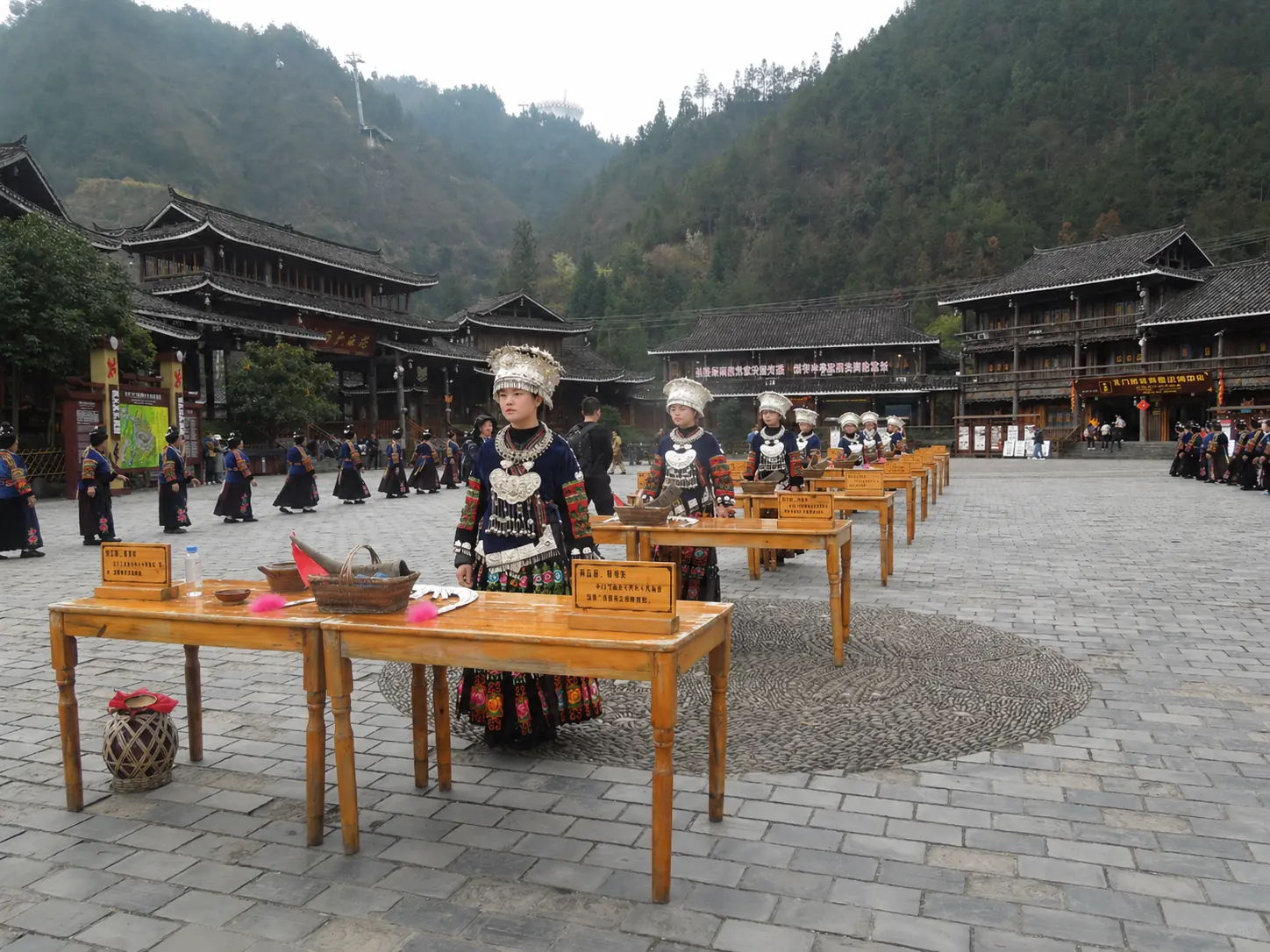
The twelve-toast welcome is a formal greeting at the North Gate, not a drinking test visitors must pass.
The Twelve-Toast Blocking-Door Wine (十二道拦门酒) presents twelve blessings through songs and cups of local rice wine. Official festival programs commonly place the welcome in a late-morning window and again later in the afternoon, but the exact operating window changes.
A one-day July 2026 notice cancelled only the 16:00-17:00 session on 21 July, a useful reminder that the posted board and the current notice should decide your arrival time.
- Check the window first. Look at the official notice or the board before you wait at the gate; broad program windows are not a promise of continuous performance.
- Stand to either side. The center is the working entrance and processional line; side positions give a clearer view without blocking it.
- Join only if comfortable. A tiny sip is optional. You can decline clearly and still watch the music, dress, and greeting ritual.
- Photograph the whole line. A slightly wider position shows the order of the welcome better than a close portrait of one cup.
Alcohol is optional, and strength varies
The cups may contain home-brewed rice wine, so there is no reliable single alcohol percentage. If you do not drink, say no, smile, and use an open hand to stop the pour. Do not rely on a symbolic sip if you avoid alcohol for health, faith, medication, pregnancy, or driving.
Lusheng Square: Music, Dancing, and Drums
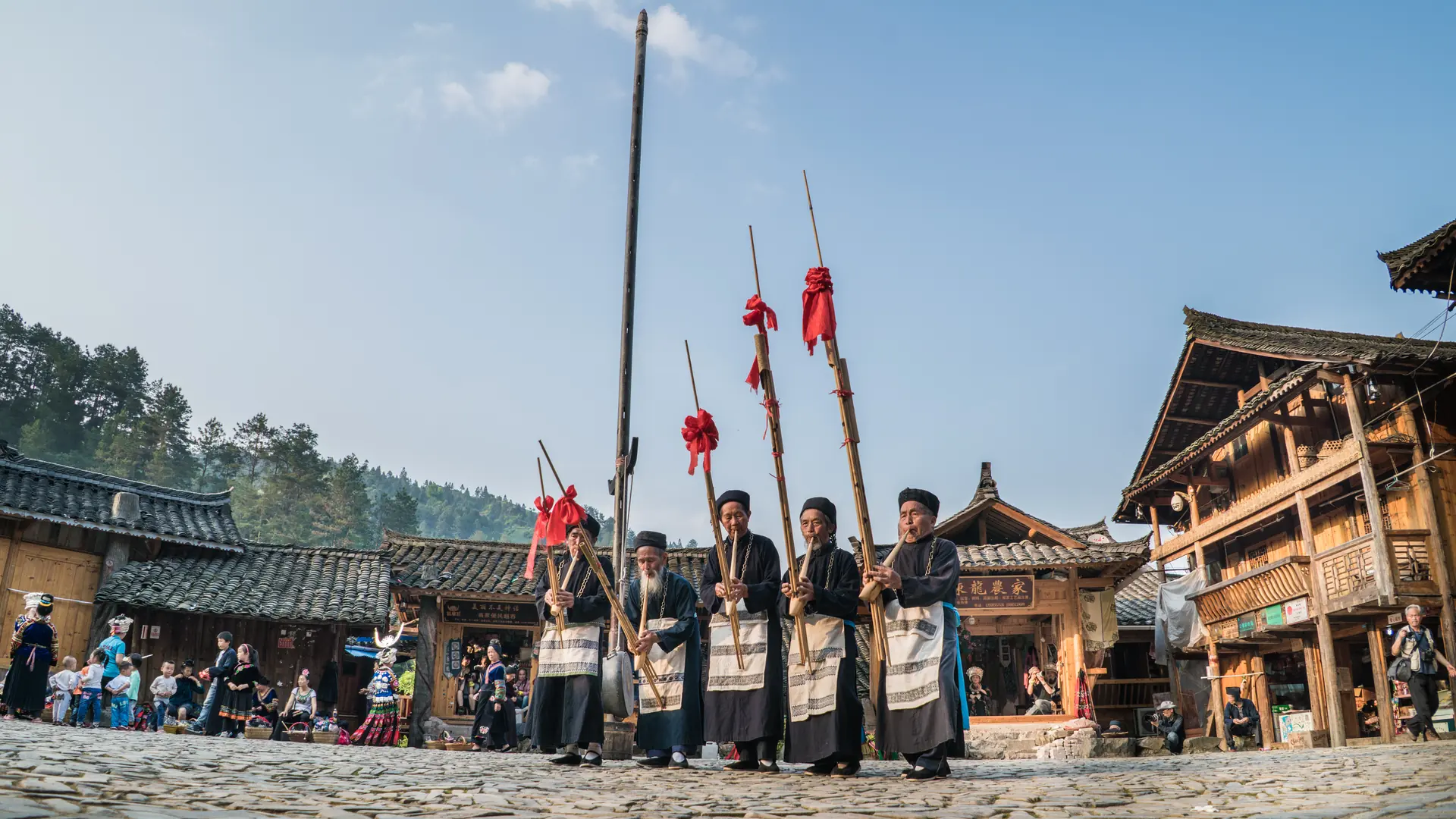
Lusheng Square is an open-air cultural space near the museum in Xijiang's core lanes.
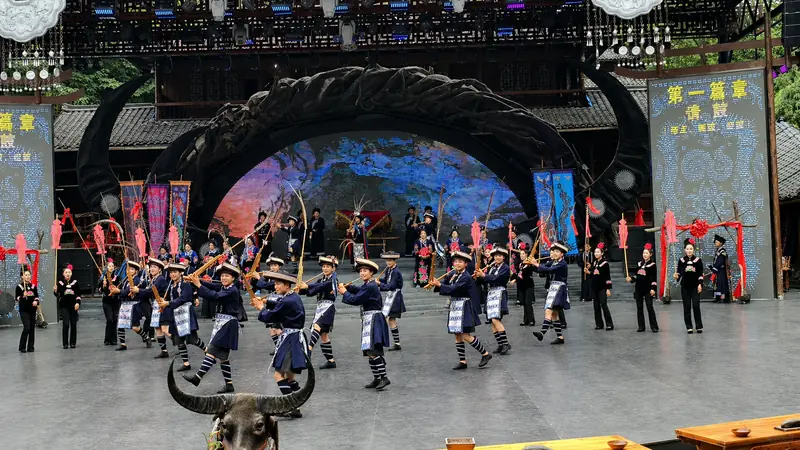
Lusheng Square (芦笙场) is an open-air plaza ringed by timber houses. The lusheng (芦笙) is a bamboo reed-pipe instrument played while moving, so music, circle formations, costume, and footwork belong to the same performance.
Drums and reed pipes also connect these staged programs to festival and ancestor-ritual traditions across Miao communities. Treat the square as a cultural venue, not a guarantee that a show will be running whenever you arrive.
Three Daily Shows · the old pattern is not current
The most recent official notice for the square is more useful than repeating an old morning-afternoon-evening timetable.
- Current status
- Original-ecology program suspended from 18 July 2026
- Posted time
- 14:00-15:00 program
- Ticket position
- Previously a free scenic-area activity
- What to do
- Check for a recovery notice before waiting
- Current status
- Earlier public information
- Posted time
- About 14:00-14:45
- Ticket position
- Included when operating
- What to do
- Historical context only, not today's timetable
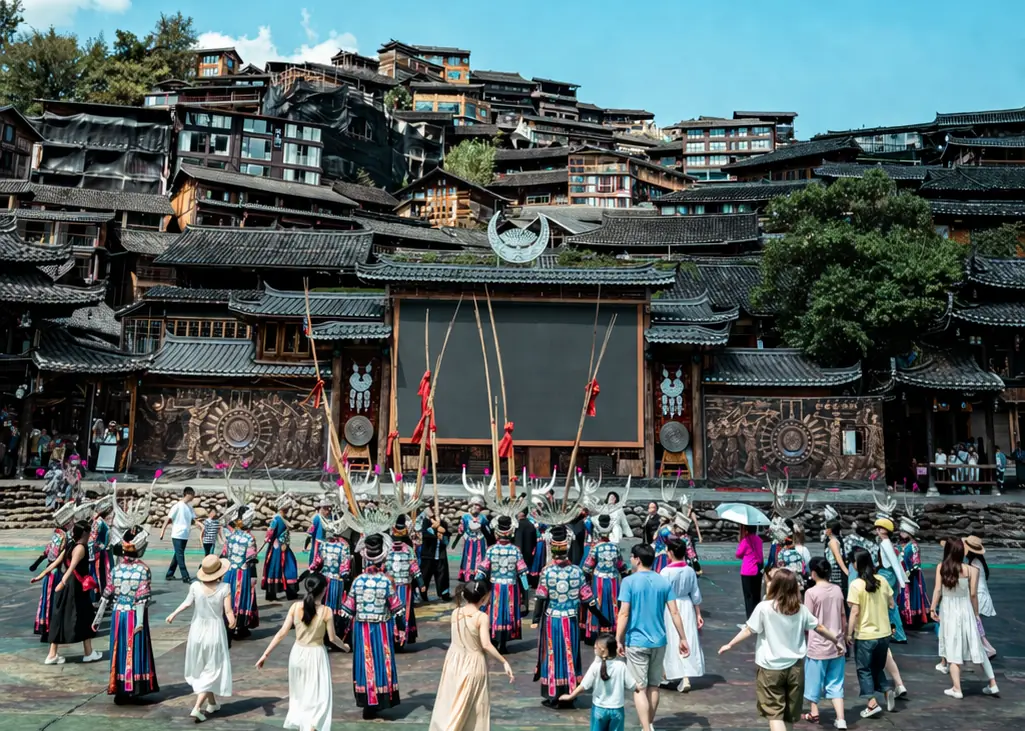
Audience participation can happen when a Lusheng program includes an open dance segment.
How to Join the Dance Circle
Watch one full phrase before stepping in
When performers invite the audience, the useful pattern is simple: follow the person in front, keep the circle moving, clap on the visible beat, and leave space for costume and instruments. Front-row visitors are easier to invite, but participation is never guaranteed.
Until the suspension is lifted, treat this section as preparation for a future operating session rather than a promise that the dance circle will run.
Give the drums physical space
Close-range percussion can feel much louder than it sounds in a video. If you are noise-sensitive, watch from the rear edge of the square and carry earplugs; do not stand beside the drum only for a photograph.
Long-Table Banquet: A Performance You Eat
The long-table banquet (长桌宴) combines food, greeting songs, and group toasts. Restaurant versions vary in scale and menu, while the very long outdoor tables seen at festivals or major group events are not an everyday guarantee.
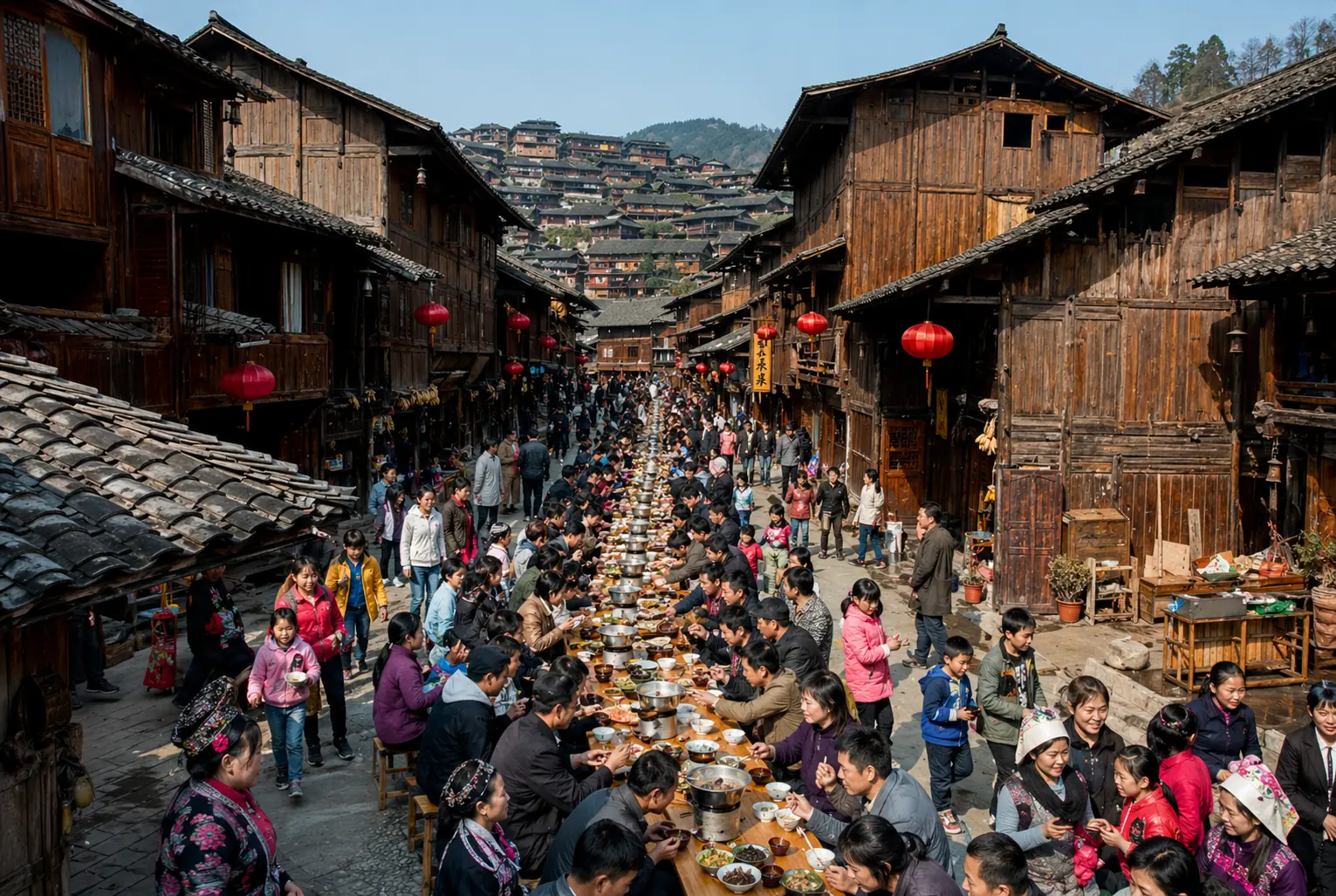
A long-table meal may combine sour fish soup, shared dishes, songs, and toasts; the exact format depends on the venue.
Food is only one layer
Choose the meal for its social pace, not for a fixed menu photograph.
Common dishes include sour fish soup (酸汤鱼), cured pork (腊肉), sticky rice, and local side dishes, but kitchens and set menus differ. Song-and-meal interaction is part of the modern visitor experience as well as a continuation of Miao hospitality traditions.
Flowing Wine from the Mountains (高山流水)
Hosts may pour rice wine through a descending line of pots so it reaches the guest like a small waterfall. The image is dramatic; the practical rule is simple: agree before the pour starts, take only what you want, and raise an open hand to stop.
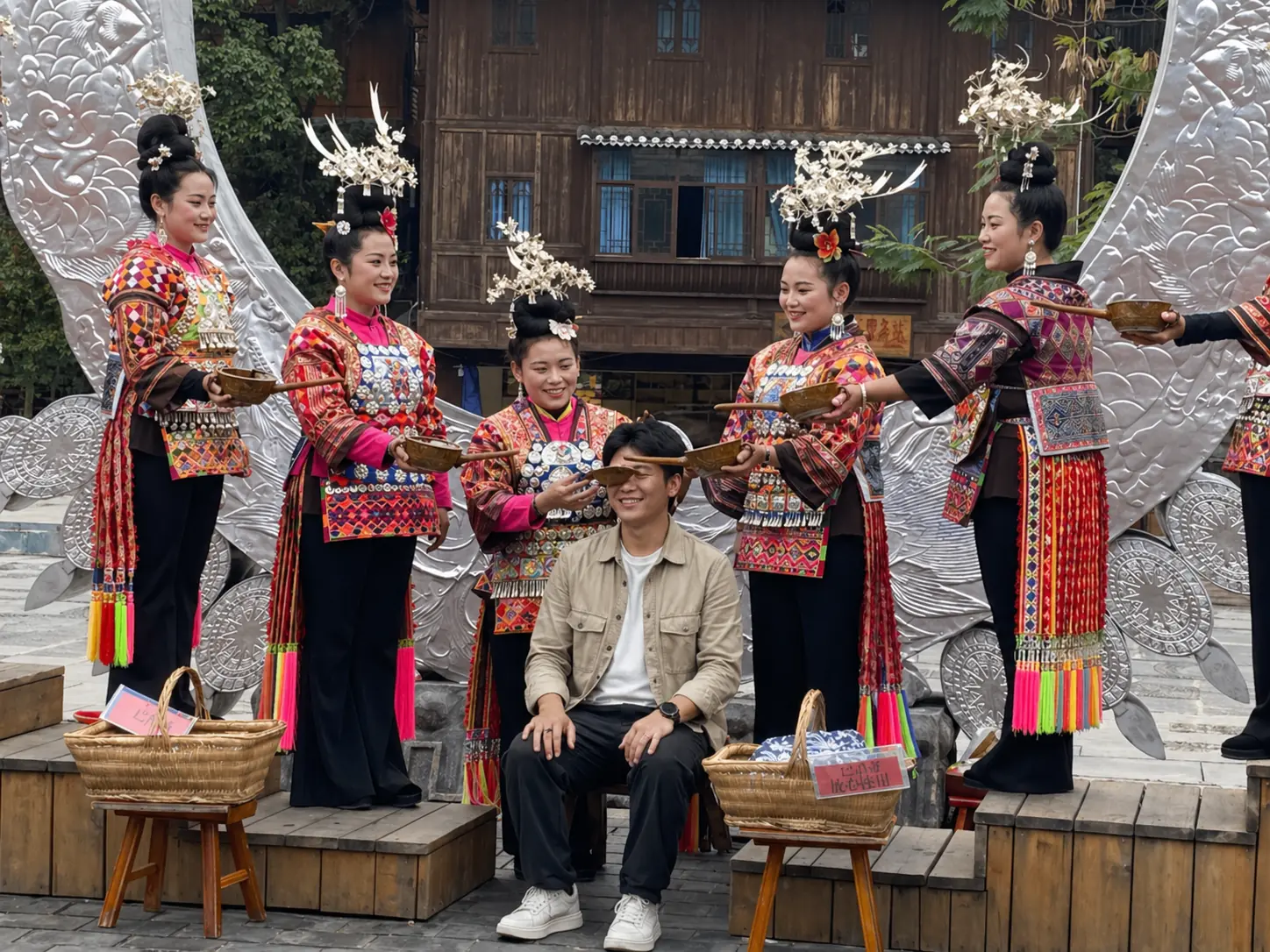
The cascading-pot toast is theatrical, but visitors can decline the alcohol.
Lunch Set
Calmer conversation · easier pacing
Recent products start around ¥68, while larger menus cost more. Ask whether songs or toasts are part of the lunch you are choosing.
Dinner Set
More atmosphere · more noise
Use ¥68-128 per person as a rough planning range, not a fixed tariff. Confirm dishes, alcohol, and performance format before paying.
Festival Table
Longest setting · least predictable
Large outdoor tables are date-specific community or event scenes. Do not assume a normal restaurant booking recreates them.
Beautiful Xijiang: Four Acts of Miao History
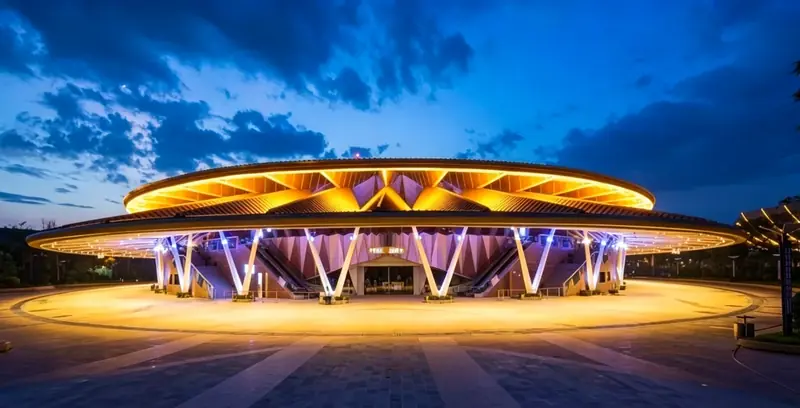
Beautiful Xijiang (美丽西江) is a separately ticketed song-and-dance production at the Beautiful Xijiang performance field inside the scenic area. The current notice posts a 20:30-21:30 slot, about 60 minutes, and official descriptions organize the production around four themes.
- Born from Maple(枫木化蝶)- Butterfly Mother and the creation story
- Migration and Ritual(迁徙祭祀)- migration memory, drums, and ceremony
- Old Customs(千古习俗)- festivals, courtship, hospitality, and community life
- Splendid Miao Homeland(苗乡锦绣)- dress, song, dance, and contemporary celebration

Beautiful Xijiang uses costume, dance, and stage lighting to compress creation stories, migration memory, and festival life into one evening program.
Schedule & tickets
Three programs now need three different decisions
Qing Ding Xijiang · Tao Hua Dai (情定西江·讨花带)
11:00-11:55 · resumed
Separate ticket; recent marketplace listings start around ¥100. Better if you want a daytime staged program.
Beautiful Xijiang (美丽西江)
20:30-21:30 · resumed
Separate ticket; recent listings start around ¥130. The older ¥120-150 band remains a rough planning guide, not a guaranteed price.
Original-ecology Lusheng program
14:00-15:00 · suspended
The latest located notice pauses this free square program; no later recovery notice was found.
Is it worth the extra ticket?
Choose Beautiful Xijiang if you want one coherent stage interpretation of Miao myths, migration, ritual, dress, and dance. Choose Qing Ding for a daytime slot. If your priority is the village night view, the paid show is optional; do not treat an unconfirmed free square program as the substitute.
The July notices changed quickly
The paid day and night shows were suspended for venue works and then officially resumed from 22 July 2026. The free Lusheng Square program has a separate suspension notice. Check the operator's homepage or call 400-153-8866 shortly before travel and again on arrival.
Spontaneous Music on Bridges and Alleys
Some of Xijiang's most memorable music is not a scheduled show. It appears beside working craft benches, in teaching spaces, or on a bridge when someone decides to play.
Wind-Rain Bridges
Best for an unplanned pause
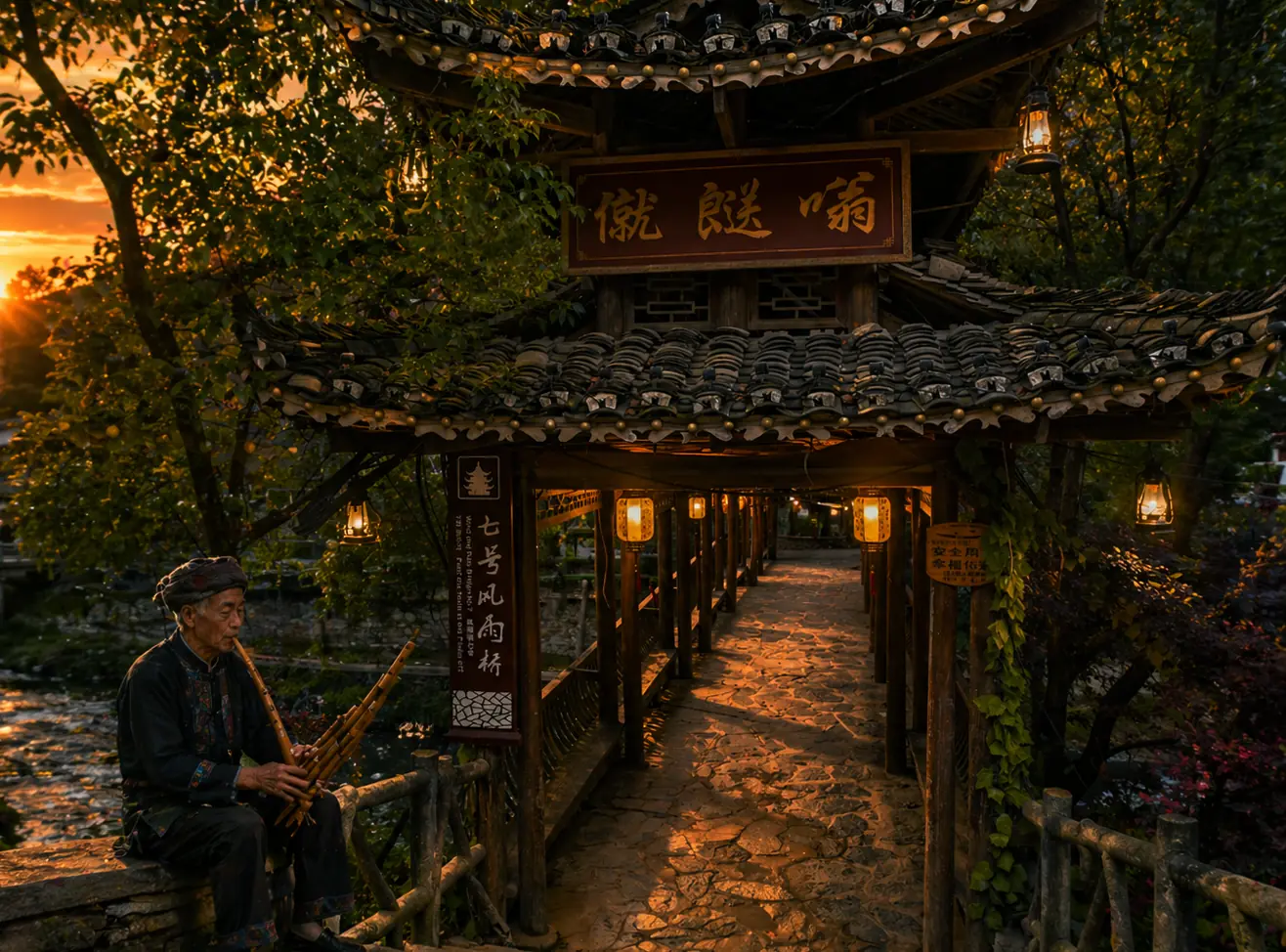
Several covered wind-rain bridges cross the river through the core village. You may hear a lusheng, erhu, or singing at dusk, but this is daily life rather than a published performance. Pause without surrounding the player or blocking residents.
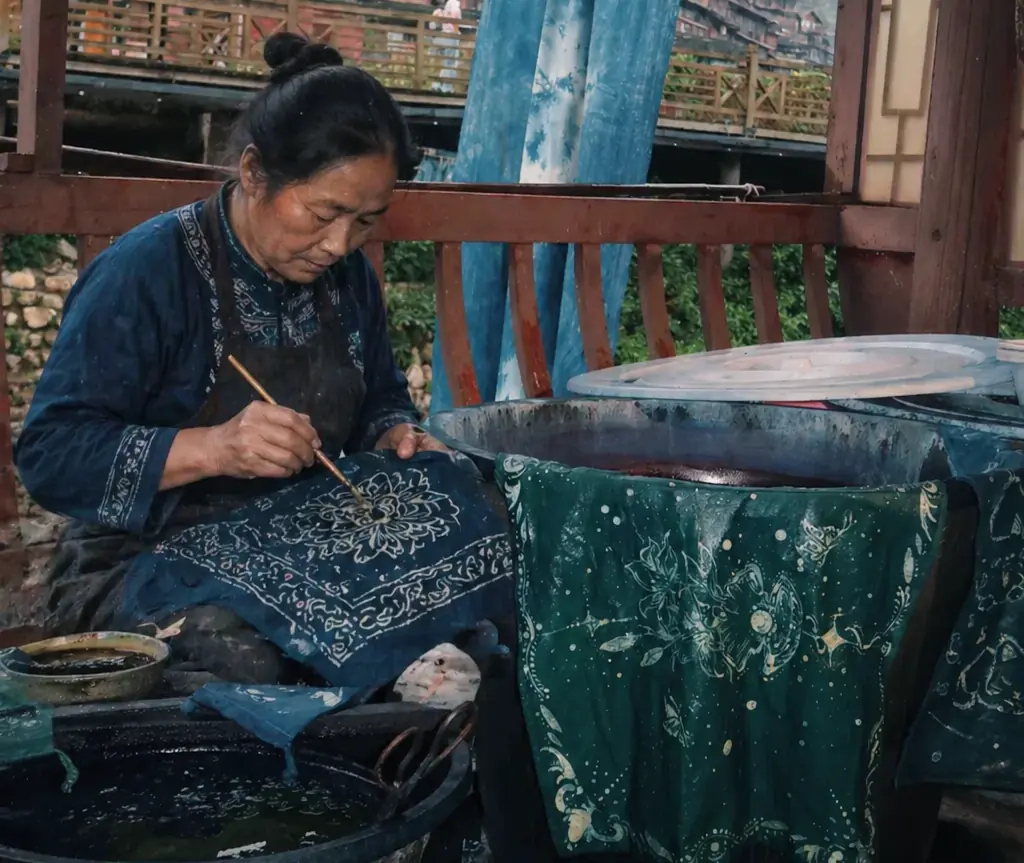
Gagegu Alley (嘎歌古巷) contains batik, embroidery, silver-working, tea, and ancient-song learning points. Miao Ancient Songs are oral literature and a national intangible-heritage project in designated Guizhou communities; a particular drop-in performance is never guaranteed.
Yedong Village is the lower-key extension
Walk toward Yedong Village (也东寨) when the main lane feels crowded. Older timber houses, narrower paths, and working doorways create better odds of hearing ordinary conversation or informal singing, but treat residents' homes as homes and ask before close photography.
Miao Culture That Makes the Shows Matter
The stage makes more sense when you recognize three threads: creation stories carried through song, migration remembered as oral tradition, and silver worn as family and ceremonial memory.
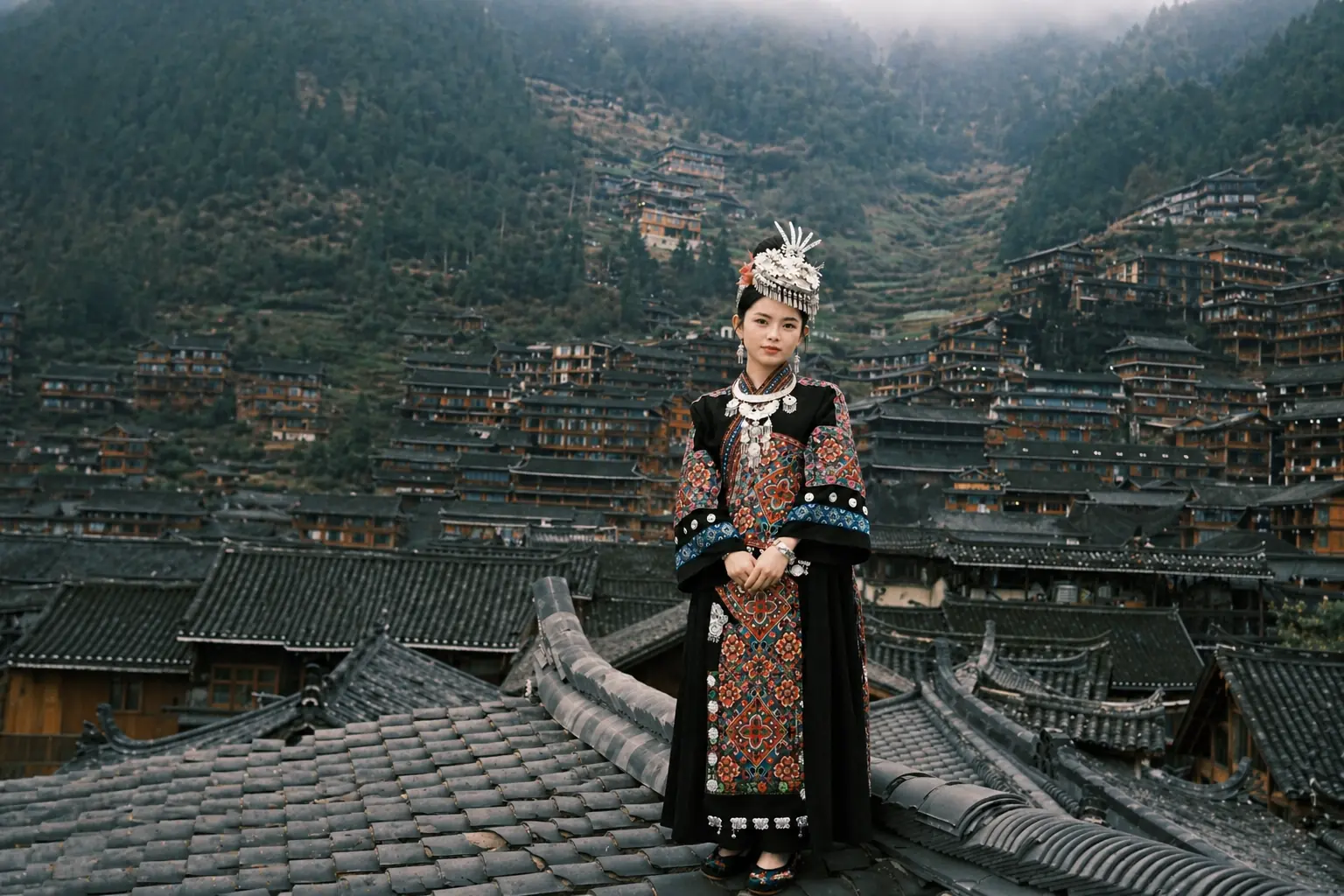
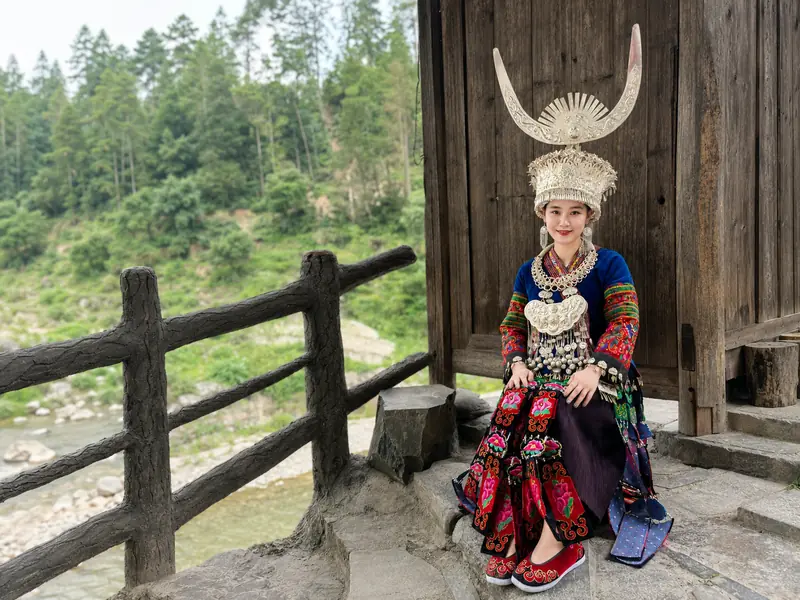
Silver catches the eye first; its family, craft, and ritual meanings make the costume more than stage decoration.
Read the costume before counting its shine
Silver is portable wealth, inherited craft, ceremonial identity, and a surface for remembered motifs.
A full ceremonial set is physically heavy, but weight varies too much for a universal kilogram claim. In Gagegu Alley, silversmiths (银匠) hammer butterflies, birds, flowers, and other motifs into pieces meant to move and sound with the body.
🦋Butterfly Mother
In an important Miao creation tradition, life begins with a maple and Butterfly Mother, whose eggs give rise to beings including the ancestor Jiang Yang (姜央). Beautiful Xijiang uses this oral story as its opening frame.
↘Migration as Oral Memory
Songs and legends connect Chiyou (蚩尤), repeated southward movement, and settlement in the mountains. Read this as oral tradition and collective memory, not as a single settled documentary chronology.
银Silver Memory
Dress, embroidery, silver, and song all carry history in different ways. The useful insight is not that one medium replaces writing, but that family and community memory survives through several practiced forms.
Miao Ancient Songs (苗族古歌) are a first-batch national intangible cultural heritage project in named Guizhou communities. Their oral transmission helps explain why listening spaces and living practitioners matter as much as a polished stage production.
Timing, Tickets, and Best Viewing Spots
¥90
Scenic admission
¥20
Vehicle ticket · current 24-hour rule
22 Jul 2026
Latest show-status check
Performance Schedule at a Glance
Tickets
Seasons and Viewing Spots
Choose dates for the right reason
Miao New Year: commonly falls around the tenth lunar month, often October-November, but use the year's official program.
Eating New Festival: follows local agricultural decisions; a 2022 Xijiang program fell in July, not a fixed annual Gregorian date.
Sisters' Meal Festival: a major regional festival especially associated with places such as Taijiang; do not assume extra Xijiang shows without a local notice.
Position by performance type
North Gate: stand to either side of the processional line, not in its center.
Lusheng Square: front positions suit future participation; rear and upper edges give a clearer overview and less drum impact.
Paid performance field: choose a seat for the full-stage pattern rather than only costume close-ups, and arrive early enough to locate the correct entrance.
The Gucang cycle is not an annual show season
Xijiang sources describe Gucang Festival (鼓藏节) as a local 13-year ancestor-ritual cycle, with the latest program located in 2022. Do not convert that cycle into an annual timetable or promise a specific next date without a new community notice.
Getting to Xijiang's Main Performance Square
The official north-side visitor route is more reliable than the old instruction to follow a generic main street. Use the vehicle between the large and small North Gate stops, then walk the signed core lane through the village sights to the museum and Lusheng Square.
Follow the official north-route markers below; signs and crowd controls on the day take priority.
- Dabeimen Vehicle Point(大北门乘车点)- board at the signed fixed stop after the North Gate welcome area
- Xiaobeimen(小北门)- leave the vehicle and enter the core village lanes
- Core Lane(核心景区)- Silver-Collar Square, Bridge 4, the post office, Gucang Road, and Qigu Square
- Xijiang Miao Museum(西江苗族博物馆)- the key landmark immediately before the square
- Lusheng Square(芦笙场)- open-air performance space near the museum
The paid field is not beyond Lusheng Square on a simple straight line
Official orientation material places the Beautiful Xijiang performance field between Bridges 3 and 4. Treat it as a separate destination in your map app or ask staff, rather than adding an unverified five-minute extension after the square.
Kaili South to Xijiang
Direct coach when the current service is operating
Official visitor guidance confirms coaches from Kaili South. Allow roughly 1-1.5 hours with traffic; current marketplace listings start around ¥35, but verify the operator, departure point, and day-of-service price.
Guiyang via Kaili South
Rail first · road transfer second
Guiyang North to Kaili South commonly takes about 35-45 minutes on current high-speed services. Check 12306 for the exact train and fare, then connect to the current Xijiang coach or a driver.
For the complete transport guide, including rail, coaches, and private-driver trade-offs, see our Xijiang Miao Village visitor's guide.
Show this screen to your driver · 出示给司机看
请带我去西江千户苗寨大北门
Please take me to the North Gate of Xijiang Thousand Miao Village.
Show this if your driver or hotel staff does not recognize the English name.
Insider Tips for the Full Experience
- Wear a quiet, solid color for portraits. Black, navy, or another plain background helps silver and embroidered clothing read clearly without competing with it.
- Say no to alcohol before the pour starts. You do not need to touch the cup to your lips. A clear refusal is better than an ambiguous gesture.
- Do not wait at Lusheng Square on an old schedule. The latest free-program notice is a suspension; look for a recovery notice first.
- Use the front only when you want interaction. If a future Lusheng session invites participation, front positions make an invitation more likely; the rear is calmer and quieter.
- Confirm the banquet product, not only the table. Ask about dishes, song or toast interaction, alcohol, group sharing, and the exact per-person price.
- Separate regional festivals from Xijiang programs. Use the village operator's dated notice before planning extra shows around Miao New Year, Eating New, or Sisters' Meal.
- Carry earplugs if percussion is difficult for you. The open square can still produce strong low-frequency sound near the drums.
Xijiang Performance Questions Travelers Ask Most
The scenic admission is ¥90. The North Gate welcome is a free activity when operating, while Qing Ding Xijiang and Beautiful Xijiang need separate tickets. The latest free original-ecology Lusheng Square program is suspended. Recent listings show the daytime paid show from about ¥100 and the night show from about ¥130; long-table banquet products commonly begin around ¥68 and vary by venue and menu.
Sources checked for this guide
- Xijiang official notice · paid-show recovery from 22 July 2026: current times and resumed status for Qing Ding Xijiang and Beautiful Xijiang
- Xijiang official notice · Lusheng Square program suspension: 14:00-15:00 original-ecology program status from 18 July 2026
- Xijiang official ticket notice: ¥90 admission and ¥20 vehicle price framework
- Xijiang official visitor and route notice: North-side route, official ticket channels, passport handling, coaches, and hotline
- Xijiang official Beautiful Xijiang description: four-part program structure and cultural themes
- Xijiang official Gagegu and culture page: Gagegu craft points, show setting, and cultural descriptions
- Guizhou Provincial People's Congress cultural article: oral transmission and national-heritage context for Miao Ancient Songs
- National Ethnic Affairs Commission heritage register: first-batch national intangible-heritage entry for Miao Ancient Songs
- Qunar live product listing cross-check: recent starting prices for the paid shows, banquet, and Kaili transport; marketplace prices remain dynamic
Beyond Xijiang: More Miao and Dong Culture
Xijiang is a useful introduction, not a complete picture of southeastern Guizhou. Dong Grand Song around Zhaoxing, village-based craft traditions, and smaller Miao communities each use different relationships between performance, ritual, tourism, and daily life.
Allowing three to five days for the wider region is a reasonable editorial starting point. Use current transport and festival notices to decide how many stops fit without turning every cultural encounter into a timed attraction.
© gochinafreely.com — Original guide by Go China Freely.