Daytime Hours & Tickets
The 6:45 opening is temporary through October 7, 2026. Regular March–October opening is 7:30 outside that notice; ticket seasons use different month boundaries.
Plan the Visit
Five Centuries of Water and Ink
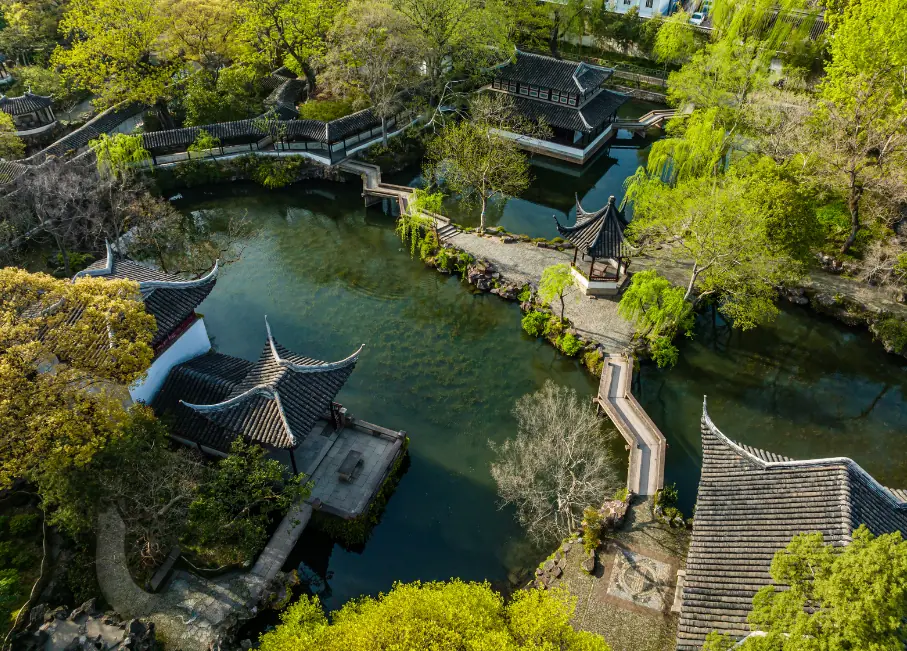
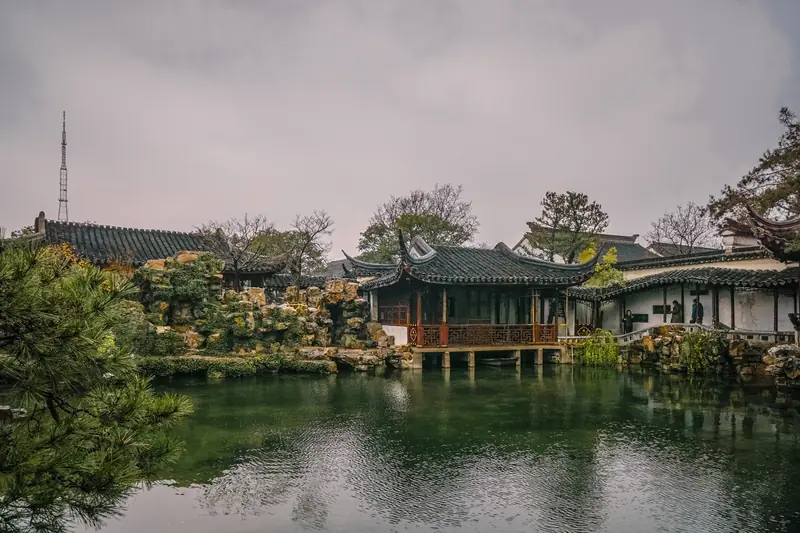
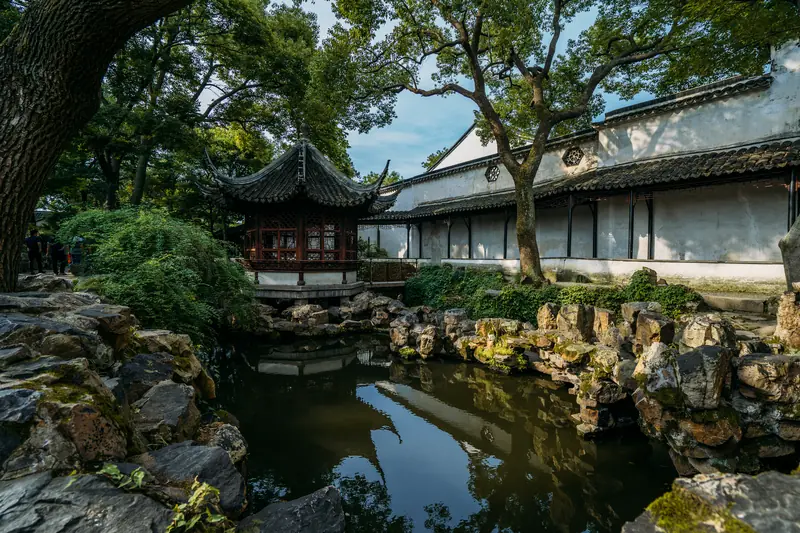
Read the water first. Across almost 52,000 square meters, ponds organize the pavilions, terraces, bridges and framed views like brushstrokes on a scroll. The garden is not a checklist of isolated buildings: paths and openings repeatedly turn you back toward water.
Read the visit in three movements. An open East Garden leads to the water-centered Central Garden and then the tighter, more architectural West Garden. Plan 2–3 hours for the highlights, with an early start to reduce crowd friction and enough buffer if you are pairing the visit with Suzhou Museum next door.
1509 · the name
Ming censor 王献臣 (Wang Xianchen) began developing the former Dahong Temple site after a bruising political career. With painter 文徵明 (Wen Zhengming) involved in the design, the garden took 16 years to complete. Wang drew the self-deprecating name from 潘岳 (Pan Yue): watering a garden and selling vegetables as a humble form of governance.
1997 · the status
The garden entered UNESCO's first group of Classical Gardens of Suzhou. It is also named among China's Four Great Gardens with Suzhou's Lingering Garden, Beijing's Summer Palace and Chengde's Mountain Resort. Its ideal is “man-made yet appearing natural” (虽由人作,宛自天开).
Five centuries · the layers
Later owners repeatedly divided and remodeled the estate. That layered history explains why the open East Garden and intimate Qing-era West corridors feel separated by centuries of design thinking rather than one unified master plan.
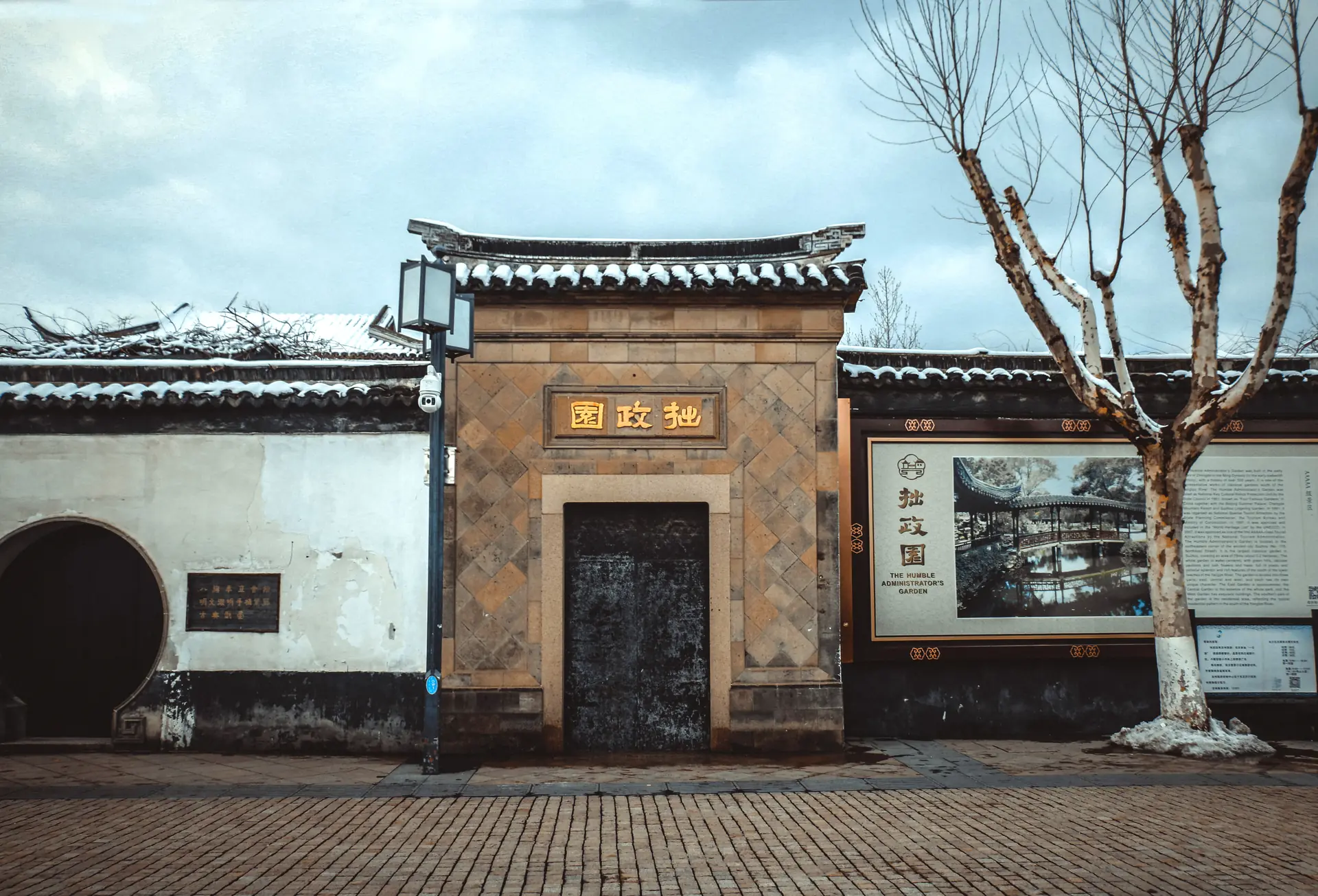
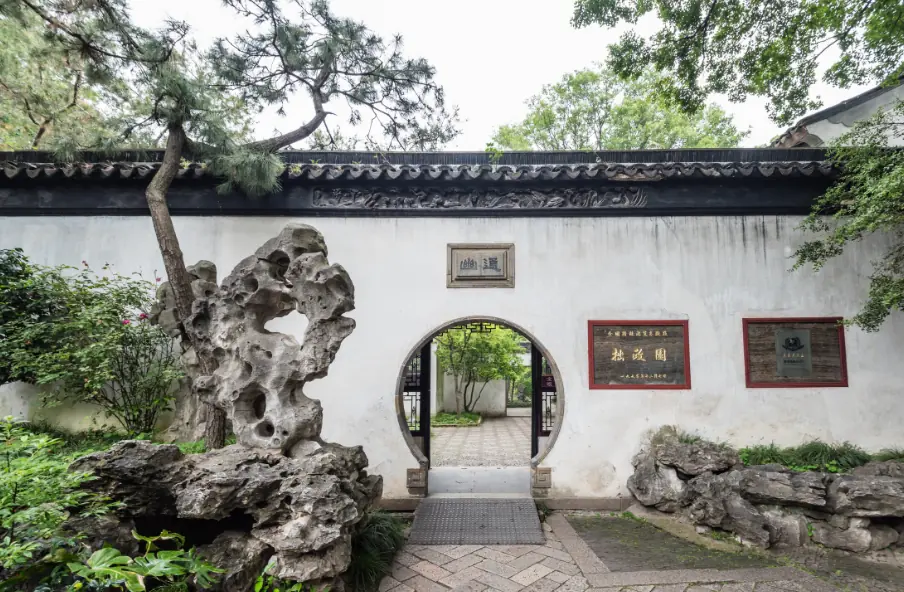
The modest threshold is intentional. Where Beijing's Summer Palace presents imperial scale, this garden is intimate and cerebral, designed for contemplation rather than spectacle. The south-gate lane is all whitewashed walls and dark tiles; only after entry do three garden zones, dozens of pavilions and changing water views unfold.
One Garden, Three Worlds
This is not a single unified design. East, Central and West each have a different density and personality, so the best visit allocates time deliberately rather than treating every named building equally.
East Garden: Open and Spacious
The oldest zone is closest in spirit to Wang Xianchen's open, nature-forward vision. It is the largest section but has the lowest density of major sights.
Arrival pair · Orchid Snow Hall and Lotus Pavilion
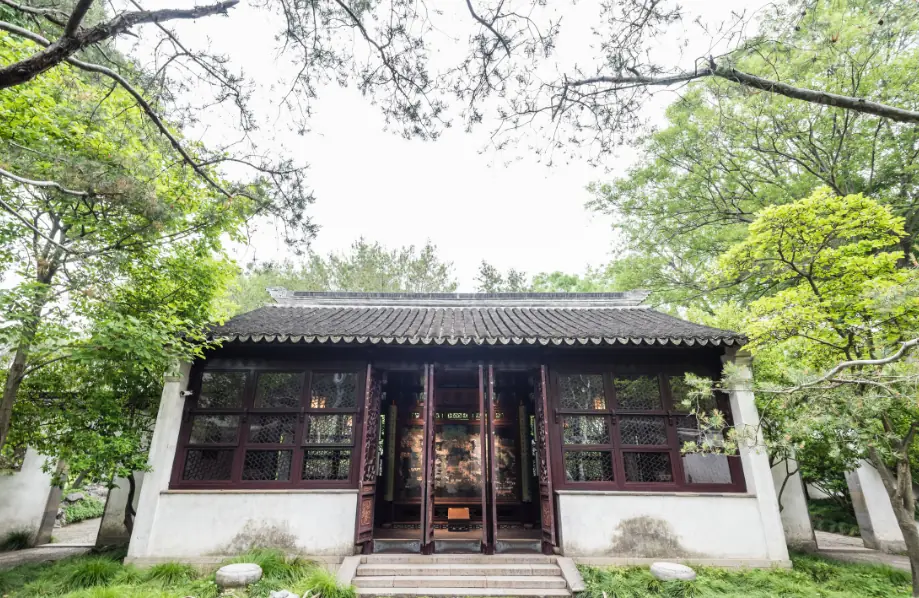
- 兰雪堂 (Orchid Snow Hall) — The entrance hall takes its name from a Li Bai verse. Its large lacquer screen depicts the whole garden layout, making it the best orientation point before you start walking.
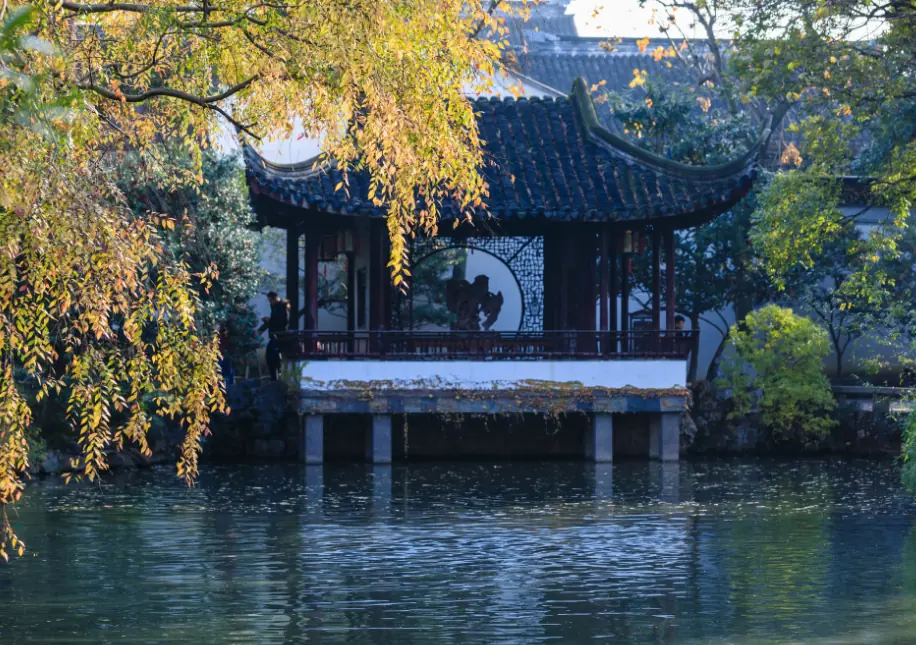
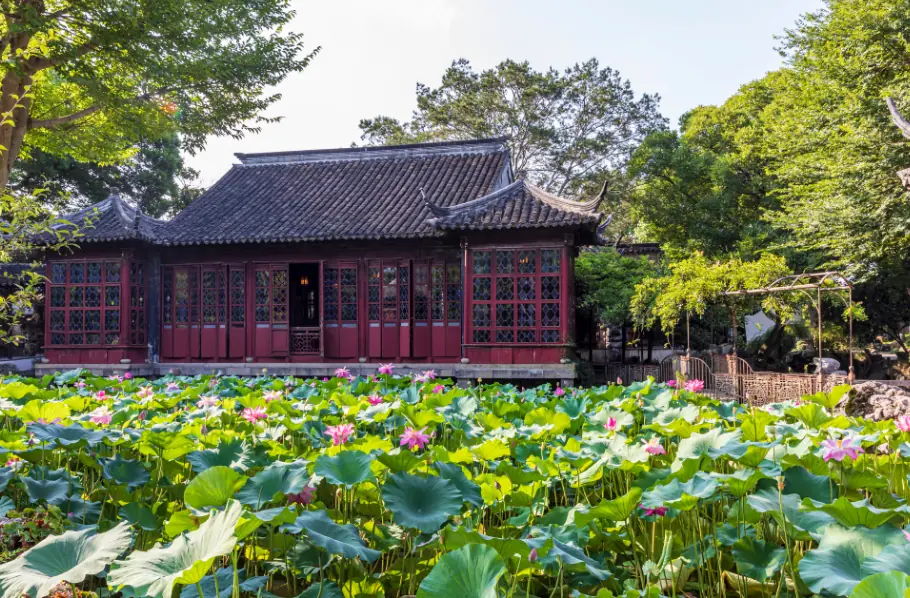
- 芙蓉榭 (Lotus Pavilion) — Half the structure extends over the water. Sit on the bench in summer and the pavilion can feel as if it is floating above the lotus pond.
Rock and spring pair · Heavenly Spring and Cloud-Gathering Peak
- 天泉亭 (Heavenly Spring Pavilion) — An octagonal pavilion shelters an old well associated with the monastery that once occupied this site; the water remains visible inside.
- 缀云峰 (Cloud-Gathering Peak) — The East Garden's largest Taihu-rock composition demonstrates the prized qualities of these stones: thinness, perforation, transparency and wrinkled texture. Literati compared such rocks to “the bones of the earth.”
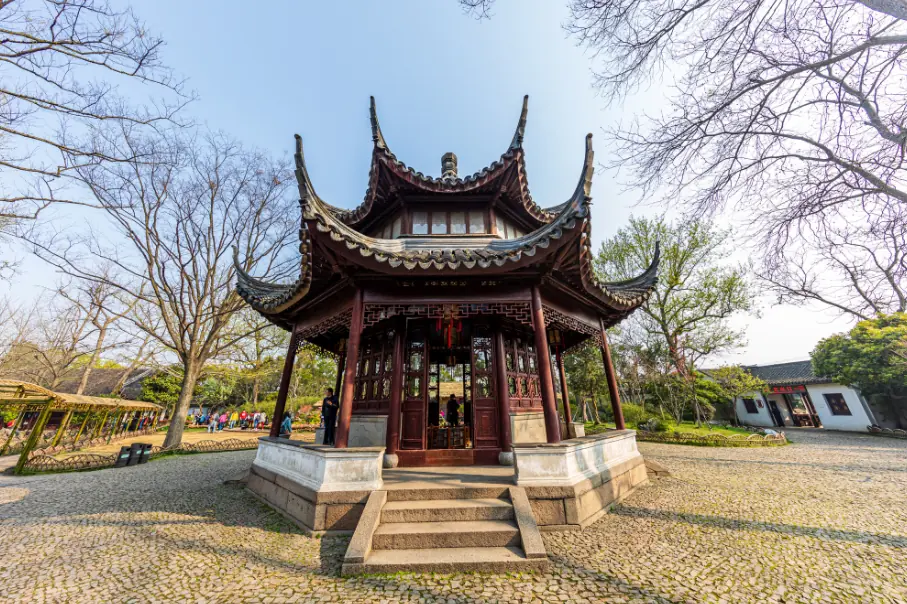
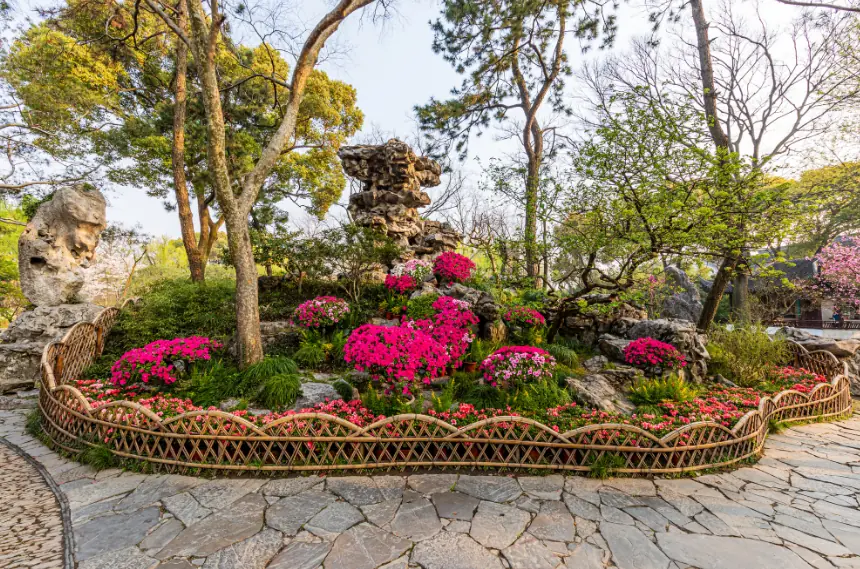
Exit anchor · 秫香馆 (Fragrant Grain Hall). The hall was originally associated with the scent of rice flowers and now functions as a teahouse where you may be able to pause with biluochun tea.
If you have under an hour, move efficiently through the East Garden and save attention for the Central Garden. With a relaxed early start, stay longer: this open zone is often at its calmest near opening.
Central Garden: The Masterpiece
This is the garden's water-centered core and the source of its most recognizable compositions. The route works best as four linked visual groups rather than a race between labels.
The central stage · Hall of Distant Fragrance and Little Flying Rainbow
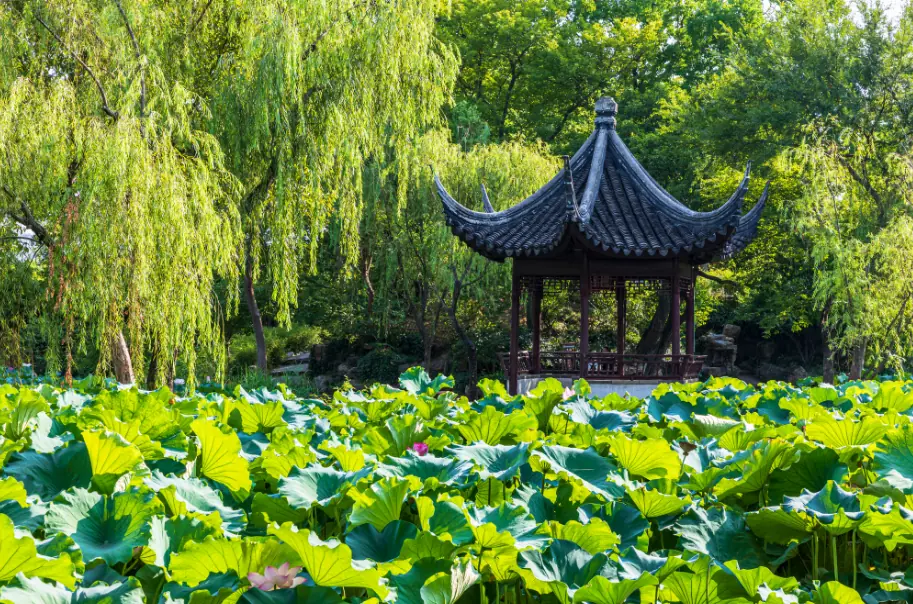
- 远香堂 (Hall of Distant Fragrance) — The soul of the Central Garden. Lattice windows open views on every side, creating a panorama of water, lotus and distant pavilions. Its name recalls Zhou Dunyi's essay “On the Love of Lotus” and the idea of fragrance carrying from afar.
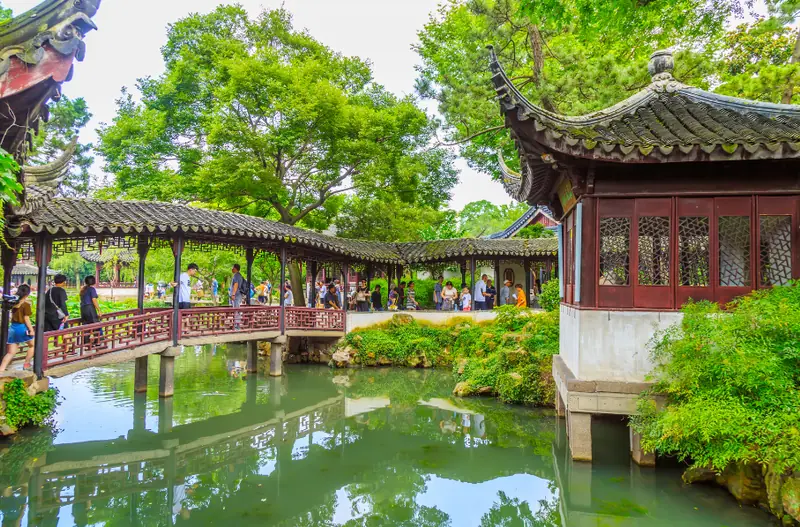
- 小飞虹 (Little Flying Rainbow) — A covered corridor bridge whose arch and reflection can form a circle in still water. It is the garden's most recognizable photo composition; the calmest reflections are usually soon after opening.

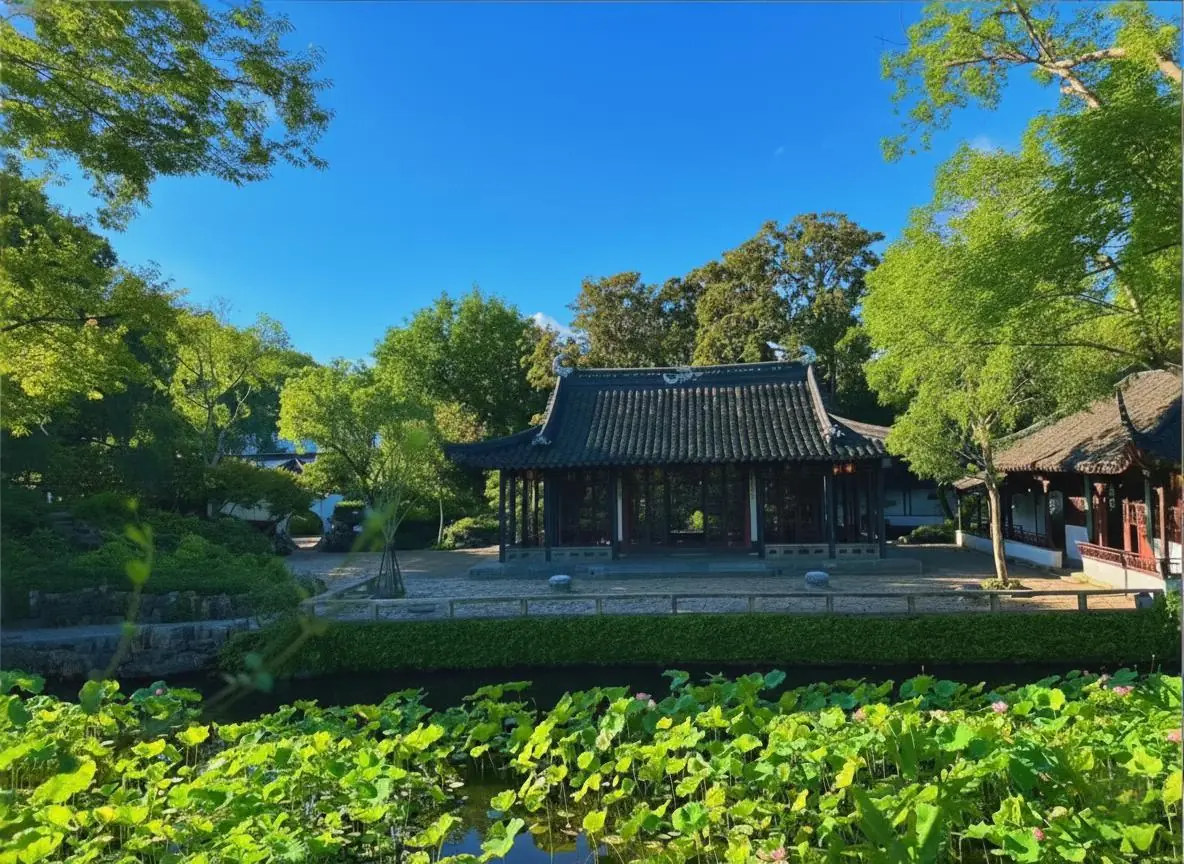
Island and panorama · Lotus Breeze and Fragrant Snow
- 荷风四面亭 (Lotus Breeze Pavilion) — A small pavilion open on four sides at the center of the water. In lotus season, the name becomes literal as breeze moves across the ponds.
- 雪香云蔚亭 (Fragrant Snow and Colorful Clouds Pavilion) — A strong place to understand how the Hall of Distant Fragrance, Little Flying Rainbow and Lotus Breeze Pavilion are composed in one field of view.
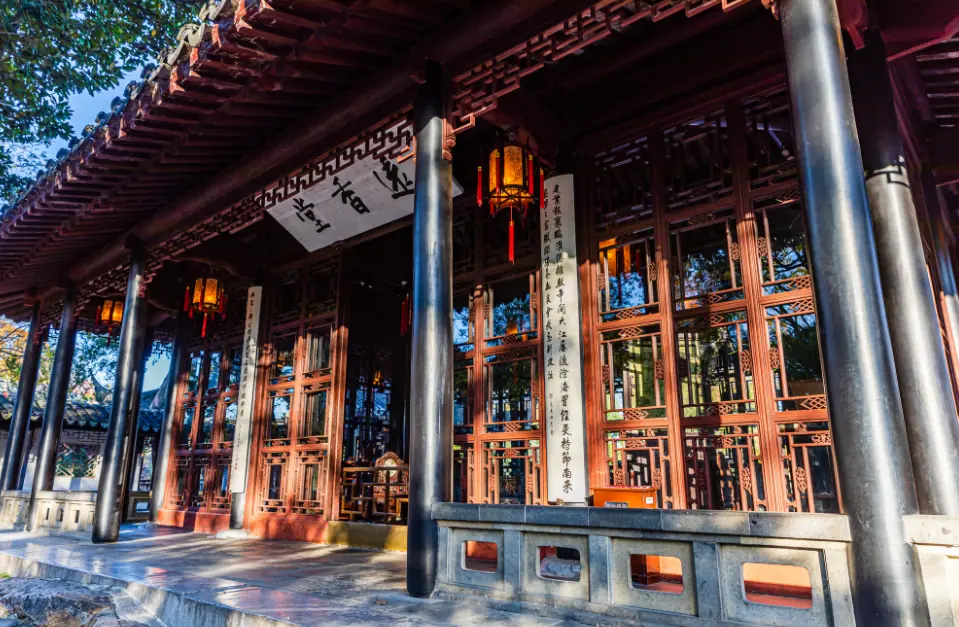
Framed seasons and a moored boat · Parasol Trees, Bamboo and Fragrant Isle
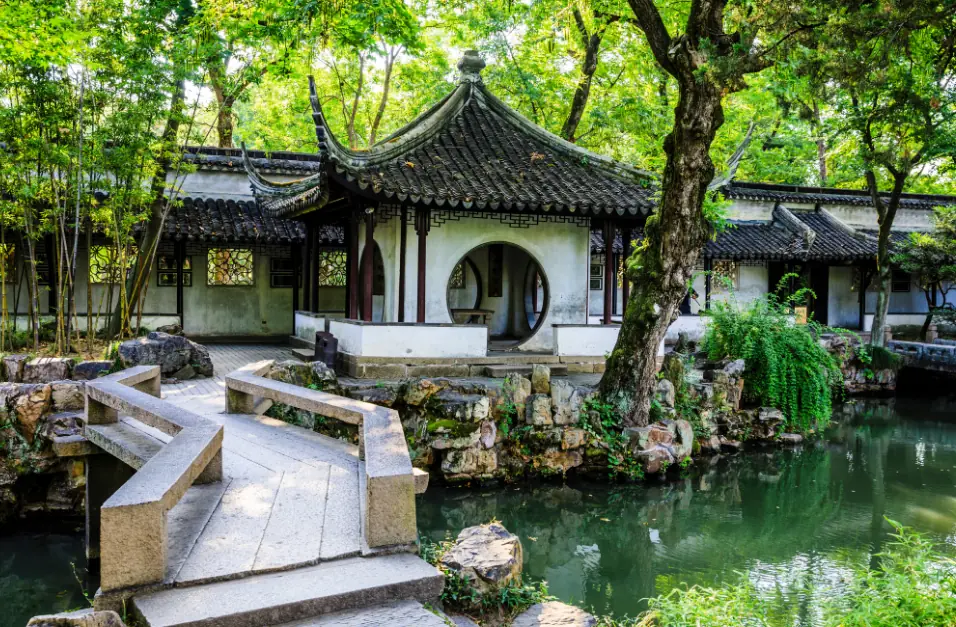
- 梧竹幽居 (Secluded Pavilion of Parasol Trees and Bamboo) — Circular moon gates frame different seasonal scenes. Turn through the pavilion rather than taking one photo and moving on; each opening changes the composition.
- 香洲 (Fragrant Isle) — A stone building shaped like a moored boat, most legible from across the water. Its literary associations reinforce the garden's habit of turning architecture into metaphor.
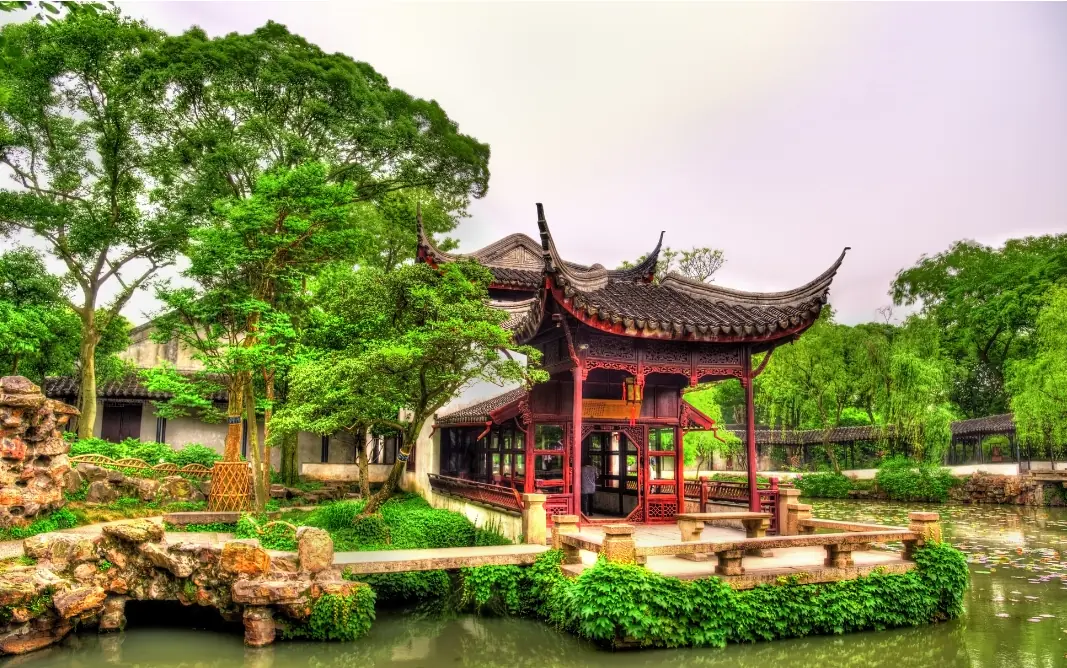
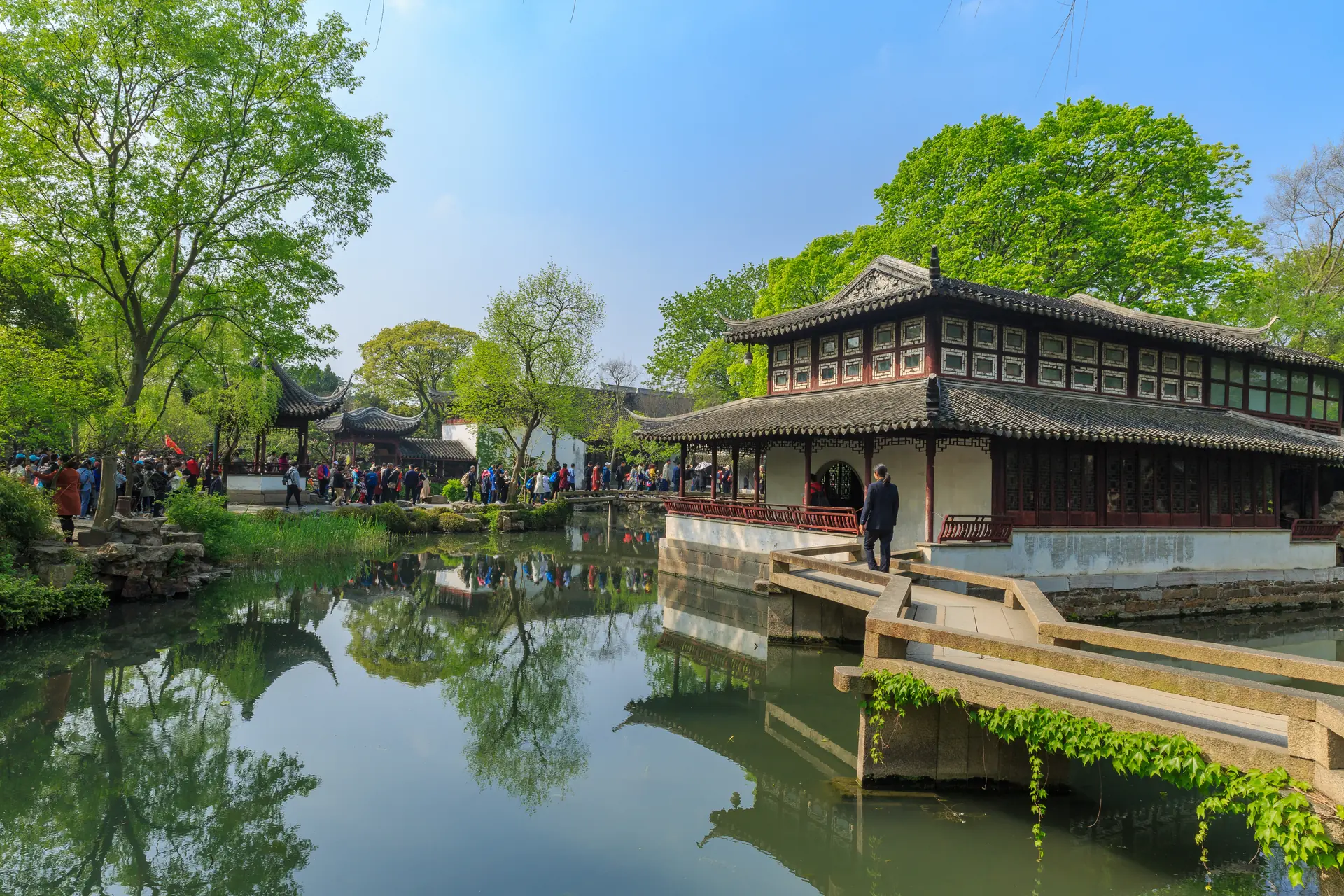
见山楼 (Mountain-in-View Tower) stands at the water's edge. From the upper level, look through the trees for 北寺塔 (North Temple Pagoda) beyond the garden walls — a textbook example of borrowed scenery (借景), where a distant landmark is recruited into the garden's own composition.
West Garden: Winding and Intimate
The West Garden feels tighter and more architectural: narrower waterways, denser planting and corridors that turn repeatedly. If the Central Garden is a large ink landscape, the West feels closer to a detailed flower-and-bird painting.
Blue-glass rooms · Mandarin Ducks and Reflected Image
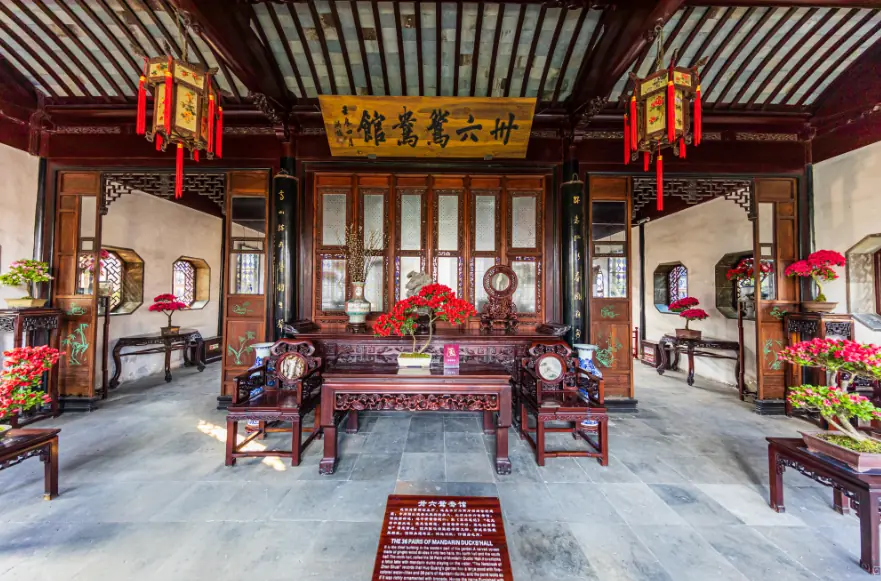
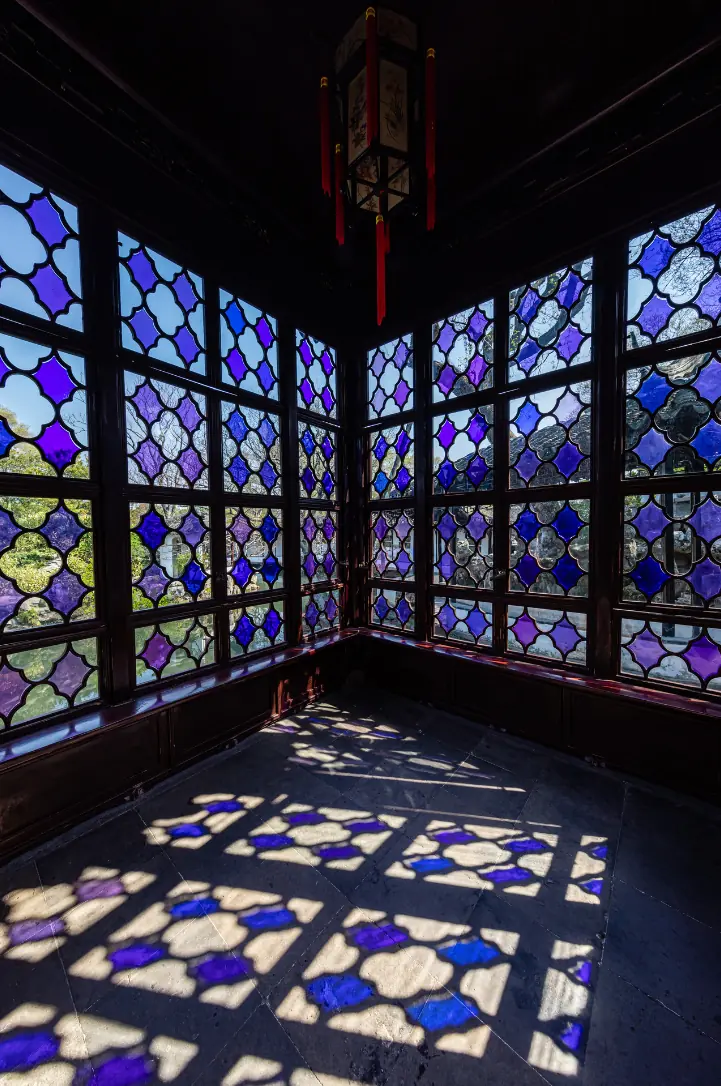
- 卅六鸳鸯馆 (Thirty-Six Mandarin Ducks Hall) — A screen divides the building into northern and southern rooms. Blue glass filters the daylight into a cool tone, one of the interior's most memorable details.
- 倒影楼 (Reflected Image Tower) — A two-story pavilion connected to the hall and placed at the water's edge so architecture and reflection read together.
Two ways to listen · With Whom Shall I Sit and the rain pavilions
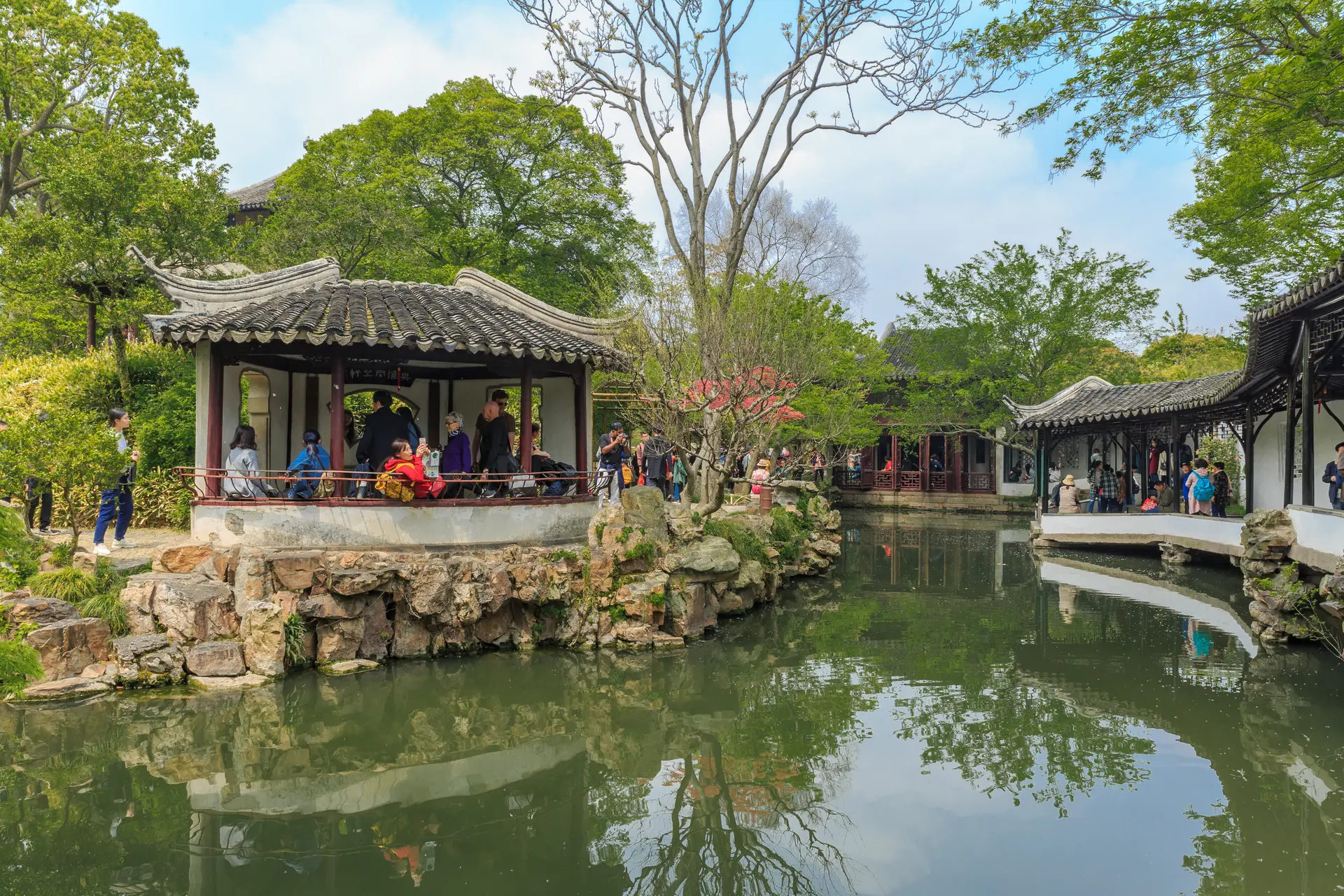
- 与谁同坐轩 (With Whom Shall I Sit? Pavilion) — Named for Su Shi's lyric about sitting with the moon and breeze. The fan-shaped pavilion is best understood from the opposite bank, where the silhouette and fan-shaped furniture align.
- 听雨轩 (Listening to Rain Pavilion) — Banana and bamboo plantings create different sounds when rain hits their leaves. On a wet day, stop instead of rushing through and listen for the contrast.
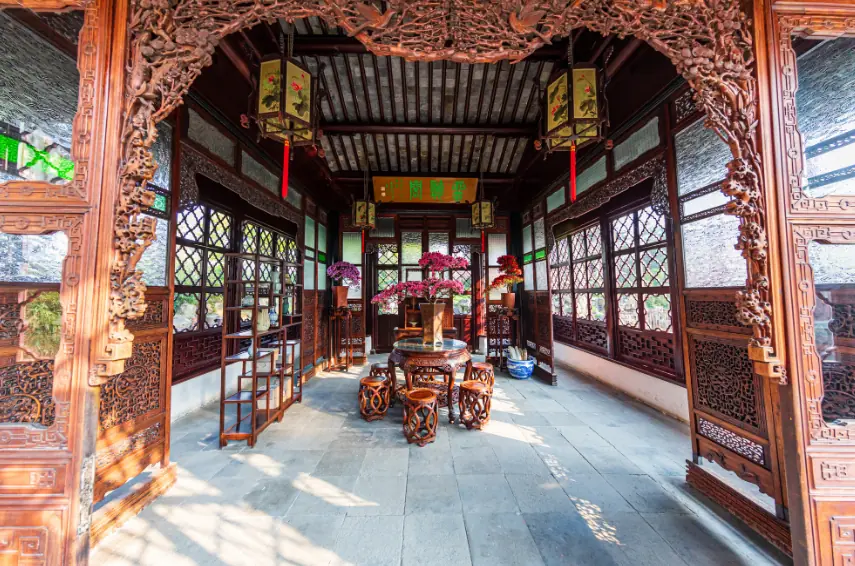
Quiet exit pair · Lingering-Listen and the Bonsai Garden
留听阁 (Lingering-Listen Pavilion) is tucked near the end of a winding path. Its name recalls Li Shangyin's line about leaving withered lotus in place to hear the rain. 盆景园 (Bonsai Garden) on the north side presents miniature landscapes from several Chinese traditions; some specimens are described as centuries old. Allow about 15 minutes if the craft interests you.
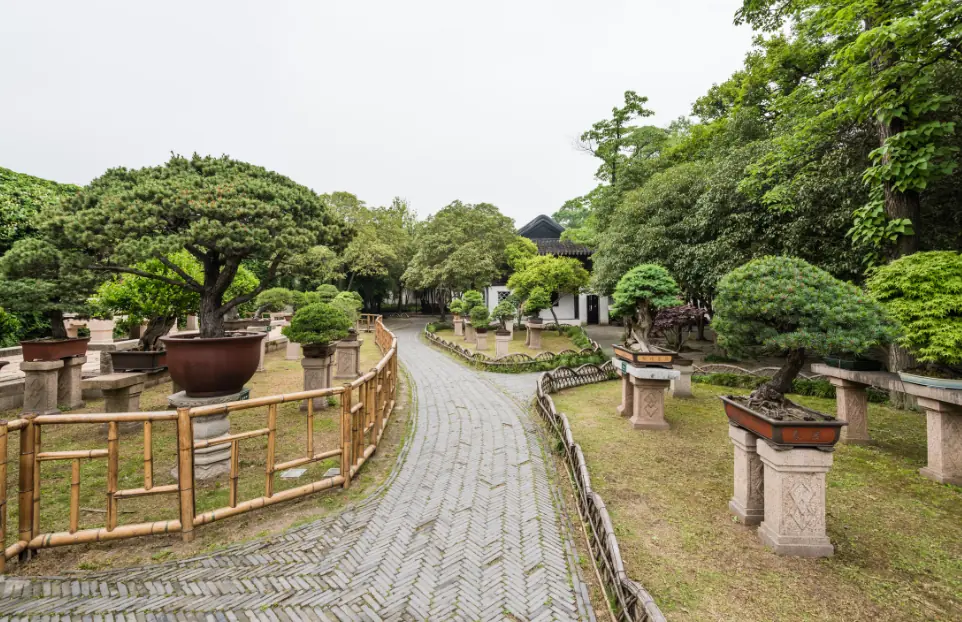
Use the Bonsai Garden as a deliberate final pause. The scale shifts from large ponds and buildings to carefully trained miniature landscapes before you leave the main garden sequence.
Seasonal Highlights and Festivals
Choose the season for landscape character first, then treat flower exhibitions and evening programs as date-sensitive bonuses. Annual dates change, so verify the current garden calendar before building a trip around a named event.
🌸Spring (Mar – May)
Azaleas and fresh foliage make spring one of the easiest seasons for a first visit. The garden commonly schedules an azalea display from late March into spring, but dates and varieties are announced annually. Temperatures around 15–25°C are often comfortable.
🪷Summer (Jun – Aug)
Lotus fills the Central Garden water, with July usually the strongest bloom period. Flowers are most open in the morning. Expect heat above 35°C and mosquitoes around the water; carry repellent and use the early hours.
🍂Autumn (Sep – Nov)
Cooler weather, chrysanthemums, ginkgo and maple color make autumn very popular. Avoid October 1–7 if possible: National Day week brings the heaviest crowd pressure.
❄️Winter (Dec – Feb)
Winter has fewer visitors and no reliable flower calendar, but bare branches reveal architecture and rockwork. Snow is uncommon; if it arrives, the white walls and dark tiles become especially photogenic. Tickets use the ¥70 off-peak rate.
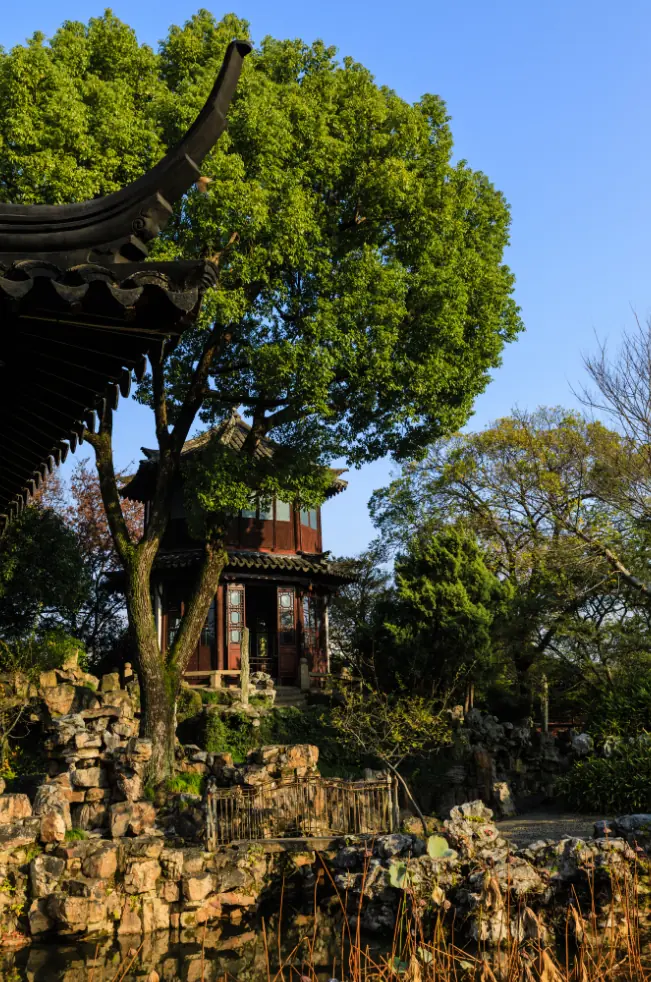
Fucui Pavilion (浮翠阁) rises above the canopy, one of the few elevated points where rooflines and treetops layer across the garden. Spring and summer foliage frames it most densely, but the architecture remains useful for reading the site's vertical composition in any season.
Evening programs change by notice
The official schedule currently lists the immersive evening program 拙政问雅 from Tuesday to Sunday, 18:30–22:00, with ticket checks ending at 21:00. Treat this as a separate, date-sensitive product and confirm the current notice before buying or traveling for it.
Three Routes Through the Garden
Choose one route before entering. The routes share many landmarks, but each uses a different pace and stopping logic.
Classic Route (2–3 Hours)
A complete circuit covering the highlights of all three gardens:
- Orchid Snow Hall(兰雪堂)- 5 min · panoramic screen
- East Garden Loop(天泉亭 → 芙蓉榭)- 15 min
- Hall of Distant Fragrance(远香堂)- 10 min · sit for 360° view
- Little Flying Rainbow(小飞虹)- 5 min · photos
- Lotus Breeze Pavilion(荷风四面亭)- 5 min
- Fragrant Snow Pavilion(雪香云蔚亭)- 5 min · panorama
- Mountain-in-View Tower(见山楼)- 5 min · borrowed pagoda
- Mandarin Ducks Hall(卅六鸳鸯馆)- 10 min · blue windows
- Reflected Image Tower(倒影楼)- 5 min
- With Whom Shall I Sit?(与谁同坐轩)- 5 min
- Listening to Rain(听雨轩)- 5 min → exit
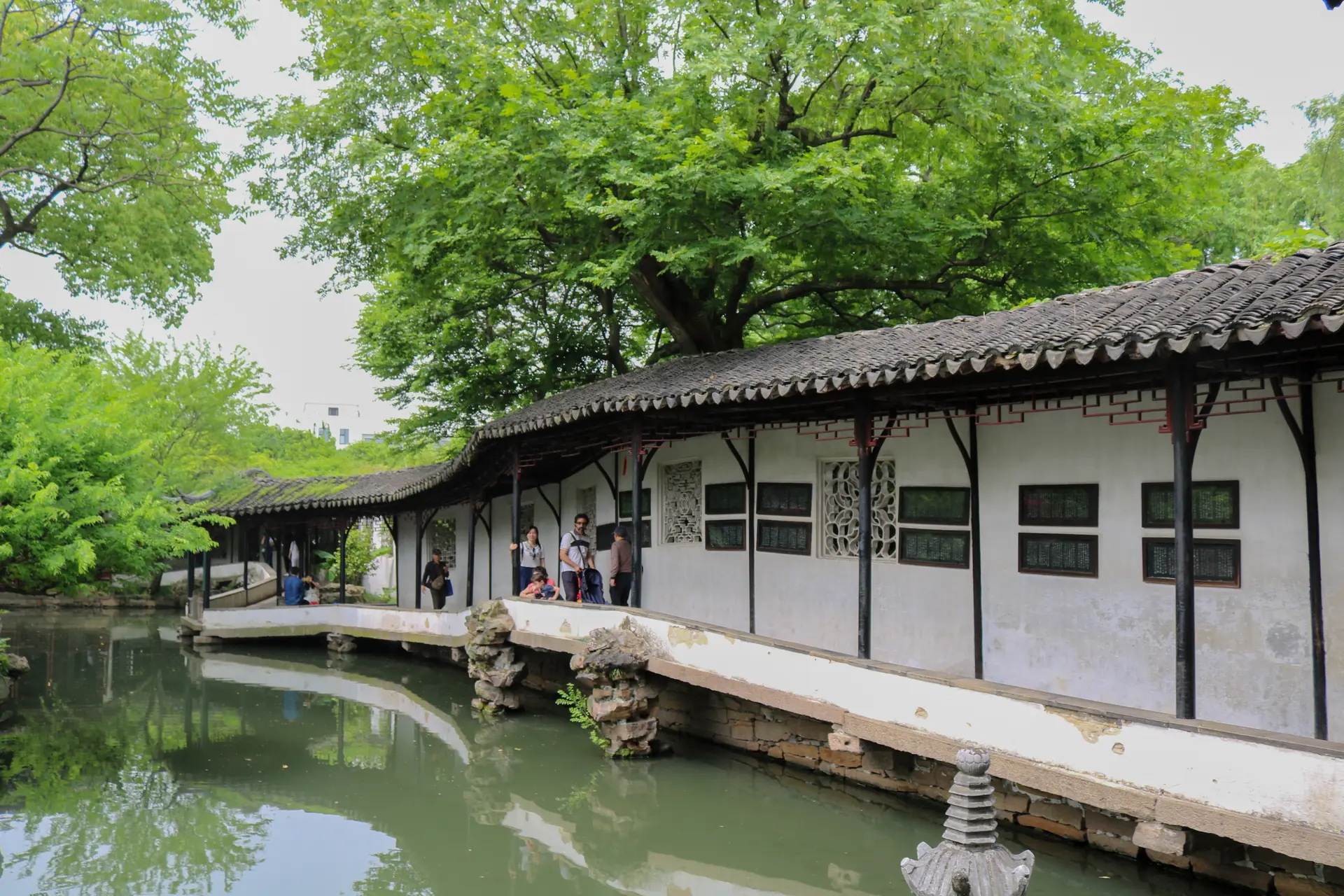
Classic-route rhythm. Covered corridors are not dead travel time. Slow down where the path turns beside water: each bend is designed to reveal the next pavilion gradually rather than all at once.
Highlights Express (1–1.5 Hours)
Short on time? Move quickly through most of the East Garden and concentrate on the Central and West cores:
- Orchid Snow Hall(兰雪堂)- 3 min
- Hall of Distant Fragrance(远香堂)- Central Garden core
- Little Flying Rainbow(小飞虹)
- Lotus Breeze Pavilion(荷风四面亭)
- Mountain-in-View Tower(见山楼)
- Mandarin Ducks Hall(卅六鸳鸯馆)
- With Whom Shall I Sit?(与谁同坐轩)- → exit
Photography Route (Current 6:45 AM Opening)
Use real clock times because light and group arrivals determine the sequence. These times follow the temporary June 19–October 7, 2026 opening; after that period, shift the route to the opening time in the latest official notice.
- Little Flying Rainbow(小飞虹)- Calmest water, sharpest reflections
- Distant Fragrance Lotus Pond(远香堂)- Summer only
- Mountain-in-View Tower(见山楼)- Upper level for borrowed-scenery pagoda view
- With Whom Shall I Sit?(与谁同坐轩)- Early side-light on the fan pavilion
- Wrap Up- Group arrivals increase and light hardens
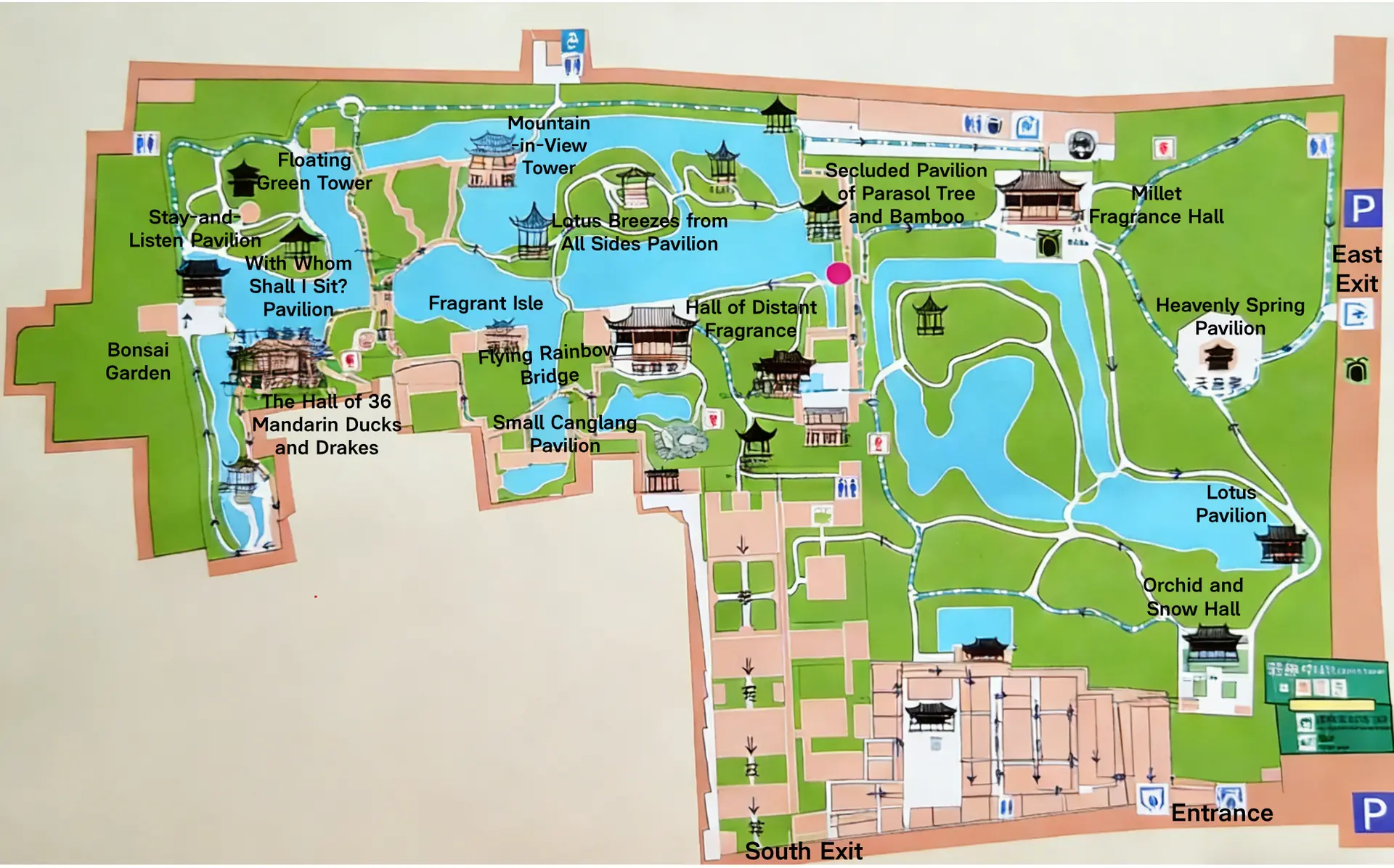
Use this map with any route. It shows the East–Central–West progression and helps you recover if a one-way corridor or crowded path nudges you away from the ideal sequence.
What Most Tourists Miss
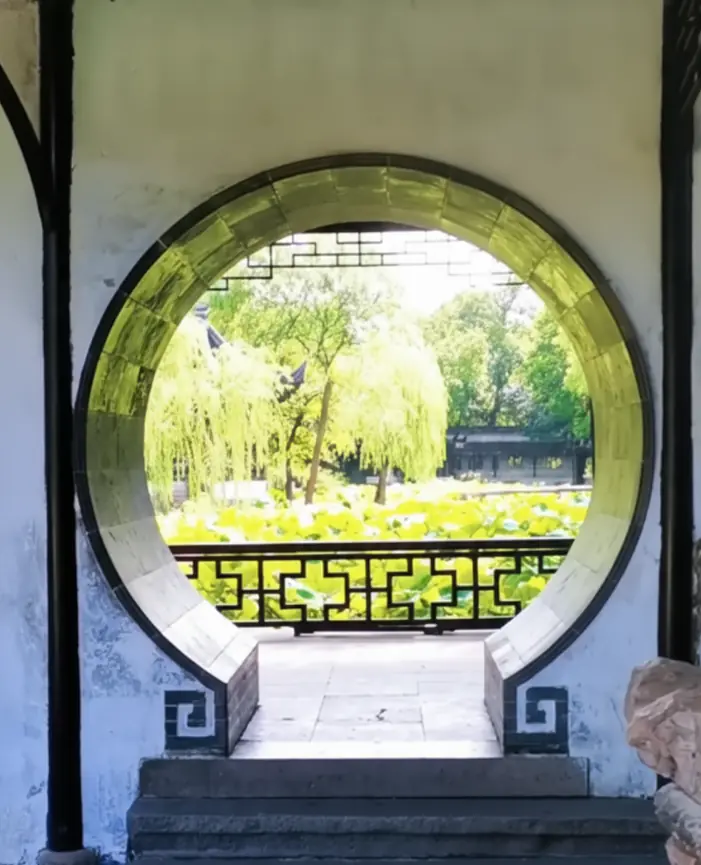
Stop collecting pavilions and start watching the frame. The named buildings matter, but the garden's real intelligence lies in how walls, windows, rocks and paths control what you see — and when you see it.
The Four Design “Magic Tricks”
Chinese classical gardens are not random arrangements of trees and rocks. They are precise systems for controlling depth, suspense and scale. Once you recognize these four techniques, the whole visit changes:
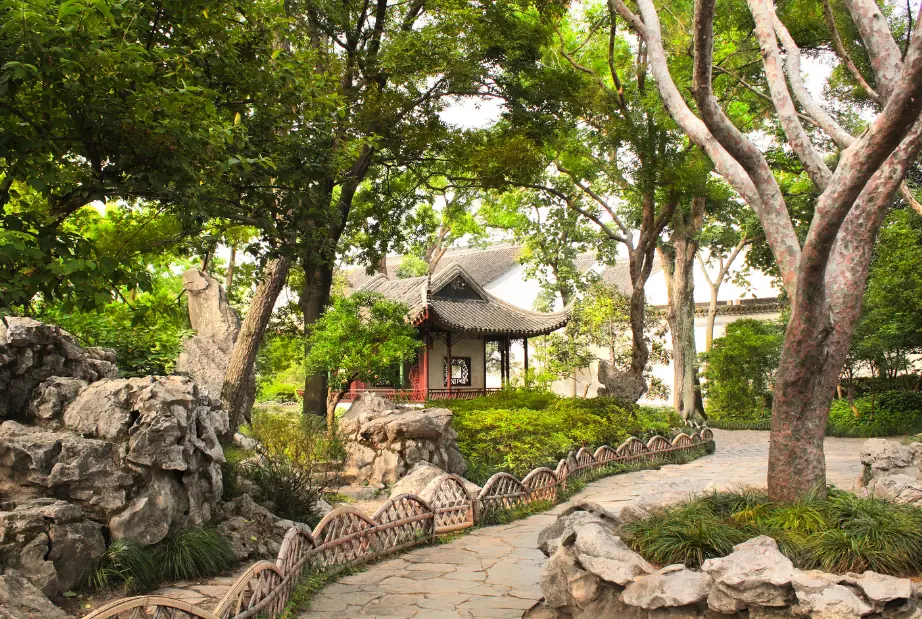
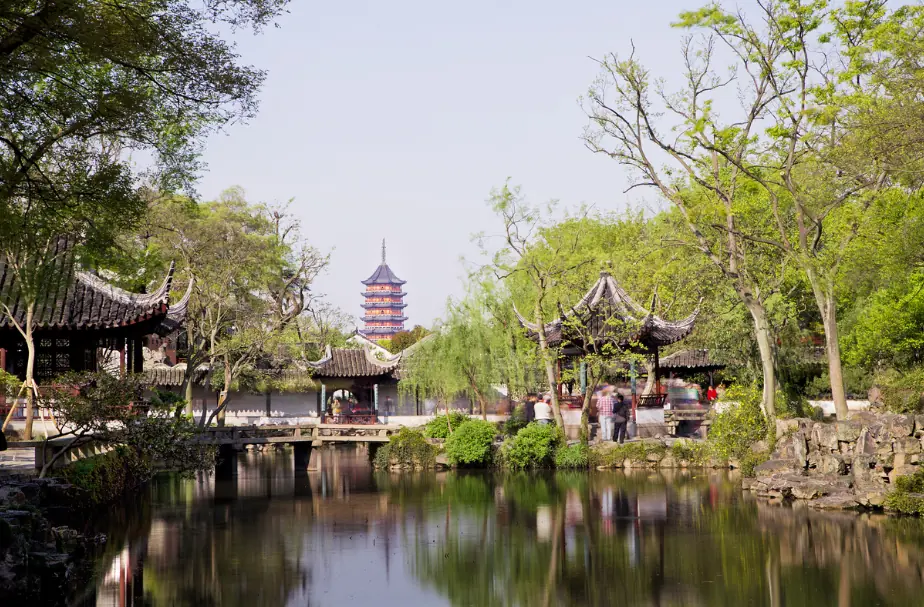
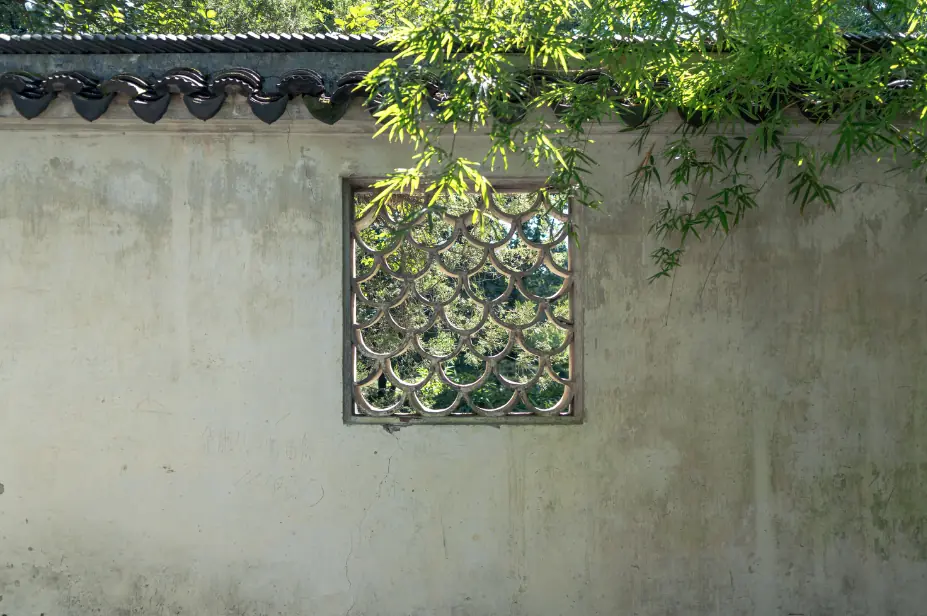
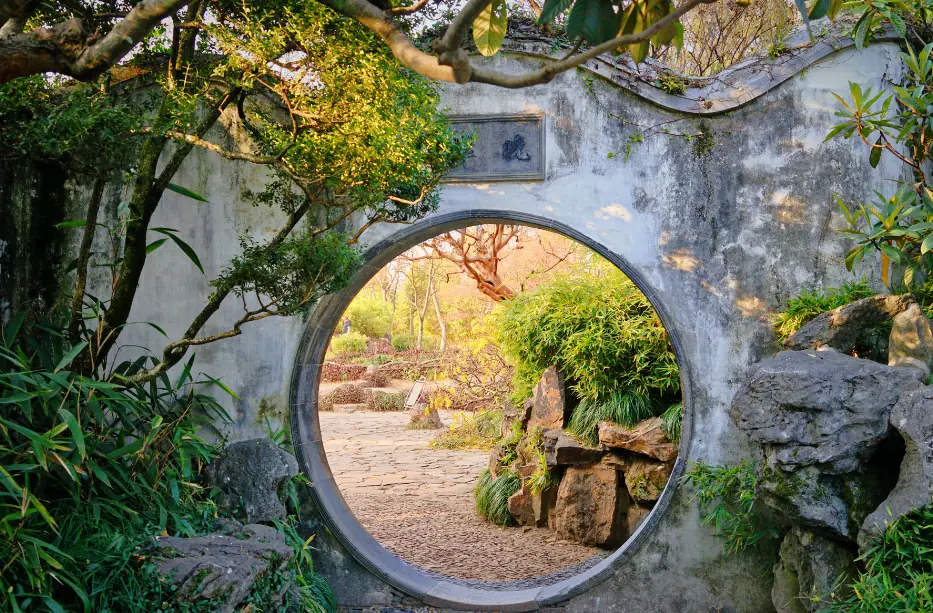
Look for the second layer. Blocking walls make you turn before a scene opens; the borrowed view from Mountain-in-View Tower brings North Temple Pagoda beyond the wall, while the Hall of Distant Fragrance keeps an open southern sky in its composition. Lattice windows act as filters, and circular, fan-shaped, octagonal and vase-shaped openings act as frames — the winding West Garden corridors are the best place to compare them in sequence. Older descriptions sometimes add a fixed Tiger Hill Pagoda sightline from the West Garden, but the official materials checked for this update do not establish that view, so do not plan the route around it.
Look Down at Your Feet
Most visitors look only at architecture and water. The paths form a hand-laid mosaic gallery of black and white pebbles arranged as vases, cranes, bats and flowers. In Chinese symbolism, the word for bat echoes the word for blessing. Glance down as you move between major views; the ground often carries a second layer of auspicious meaning.
Beating the Crowds
During the current early-opening period, weekday mornings from 6:45–8:15 give the best chance of quiet photography. After October 7, use the first 90 minutes after the opening time in the latest official notice. Group arrivals increase later in the morning, especially around the Central Garden. Weekends reward arriving for opening. A late-afternoon visit can also feel calmer, but protect the winter 16:30 last-entry cutoff and the time needed to cross all three zones. The photography route above gives the most time-sensitive sequence.
Audio Guides and Tours
Three interpretation choices remain useful:
- Entrance audio guide — Ask about current language options and price on arrival; devices may auto-trigger at named stops.
- Human guide — Group and language availability varies. Confirm the current service and fee at the official desk rather than relying on an old fixed price.
- Self-guided — The “苏州园林旅游” platform can provide basic maps and interpretation; verify current English support before depending on it as your only guide.
Pairing with Other Suzhou Gardens
Optional extension. Suzhou has nine UNESCO-listed classical gardens, and the Humble Administrator's Garden is the largest. With a full day, pair it with 留园 (Lingering Garden), a short cross-town ride rather than a same-block walk: this garden excels at water composition, while the Lingering Garden is celebrated for architecture and rockery. If you have already visited here, use our Lion Grove & Master of the Nets Garden guide to compare two much smaller but equally refined spaces.
Suzhou Museum Next Door
The garden and 苏州博物馆 (Suzhou Museum) share a wall. Turn left from the garden's south gate and the museum entrance is about two minutes away. Chinese-American architect 贝聿铭 (I. M. Pei) designed the 2006 building as a late-career work: white walls and dark rooflines translate Jiangnan forms into modern geometry, while the courtyard water and abstract rockery answer the garden next door.
Museum essentials
- Admission: Free, but the main museum uses full timed reservation.
- Booking: Reserve through the official website, official WeChat account or “苏州博物馆全预约” mini-program up to seven days ahead, including the booking date. Carry the original passport or ID used for the reservation.
- Normal hours: Tuesday–Sunday 9:00–17:00, last entry 16:00; normally closed Monday except announced holiday arrangements.
- Visit time: Allow 1–1.5 hours.
Choose the order that matches your priority
Museum first · protect the reservation
Arrive for a 9:00 museum slot, finish around 10:00–10:30, then enter the garden. This avoids backtracking and respects the museum's timed flow, although the garden will already be busier.
Garden first · protect quiet photos
During the current early-opening period, enter the garden at 6:45, exit around 8:45, and walk to a museum slot reserved for later that morning. After October 7, shift this plan to the opening time in the latest official notice. This is the stronger sequence for reflections and empty paths.
Book the two places separately. A garden ticket does not create museum admission, and the museum's free reservation does not include the garden.
Optional Extension: Pingjiang Road Historic District
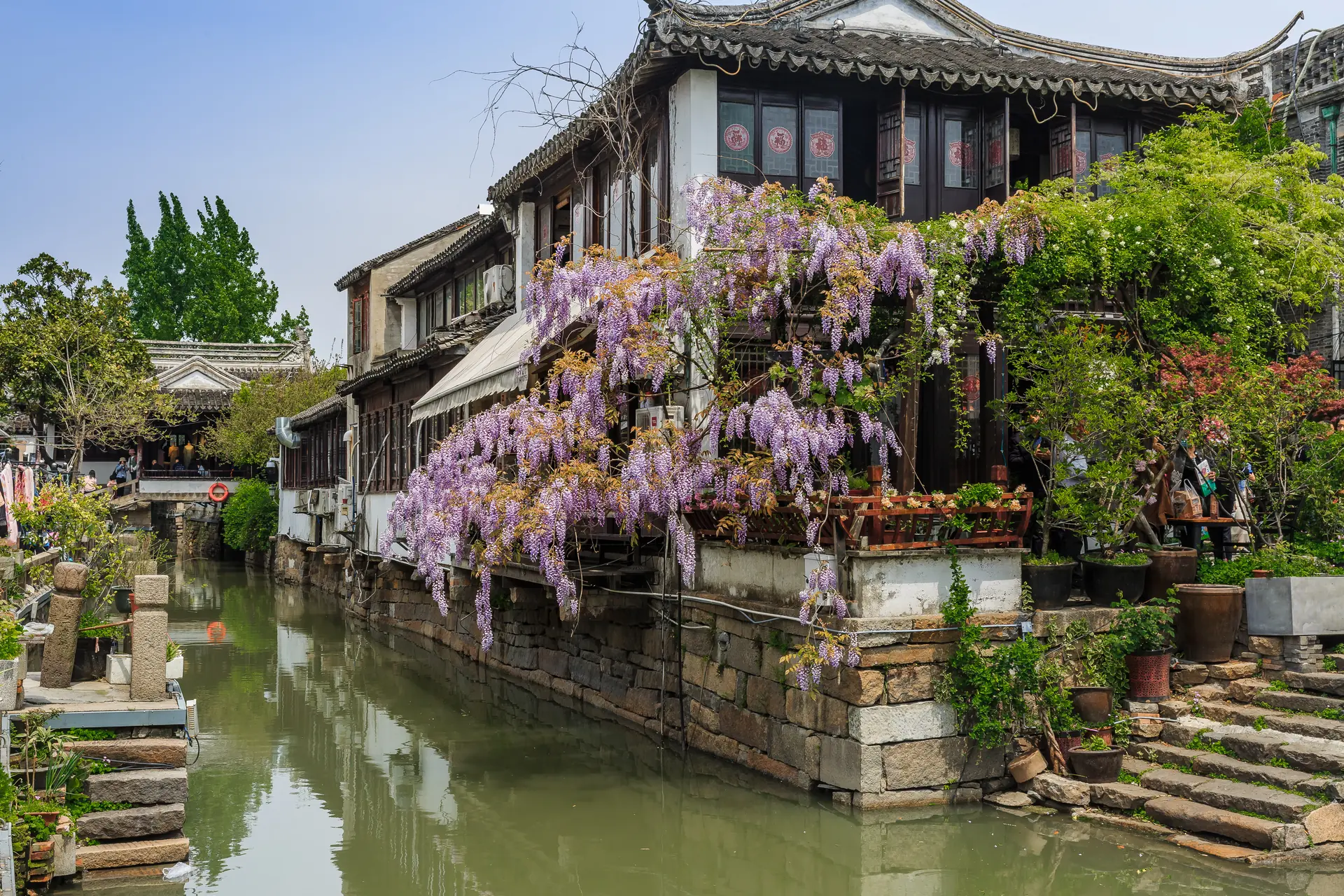
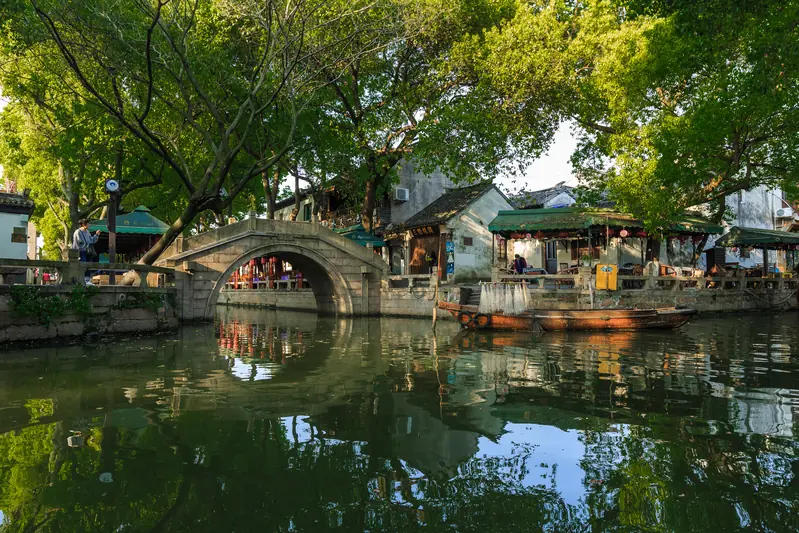
From the garden or museum, walk about 10 minutes to Pingjiang Road (平江路) (Google | Amap), a canal-side historic street with flagstone paths, whitewashed walls, dark-tiled roofs and stone bridges. It works best as a post-lunch extension rather than part of the museum task.
Use it as the low-pressure finish: canal views, teahouses, small shops and snacks after the more concentrated museum-and-garden morning.
While you are in the area, look for Suzhou's signature 松鼠桂鱼 (squirrel-shaped mandarin fish), a quick bowl of 苏式汤面 (Suzhou-style soup noodles), and 桂花糕 (osmanthus cake).
Squirrel-Shaped Mandarin Fish
松鼠桂鱼

Suzhou's signature dish: a scored, deep-fried whole fish curled into a dramatic shape and finished with sweet-and-sour sauce. Compare menus before ordering because portion size and price vary.
Suzhou-Style Soup Noodles
苏式汤面
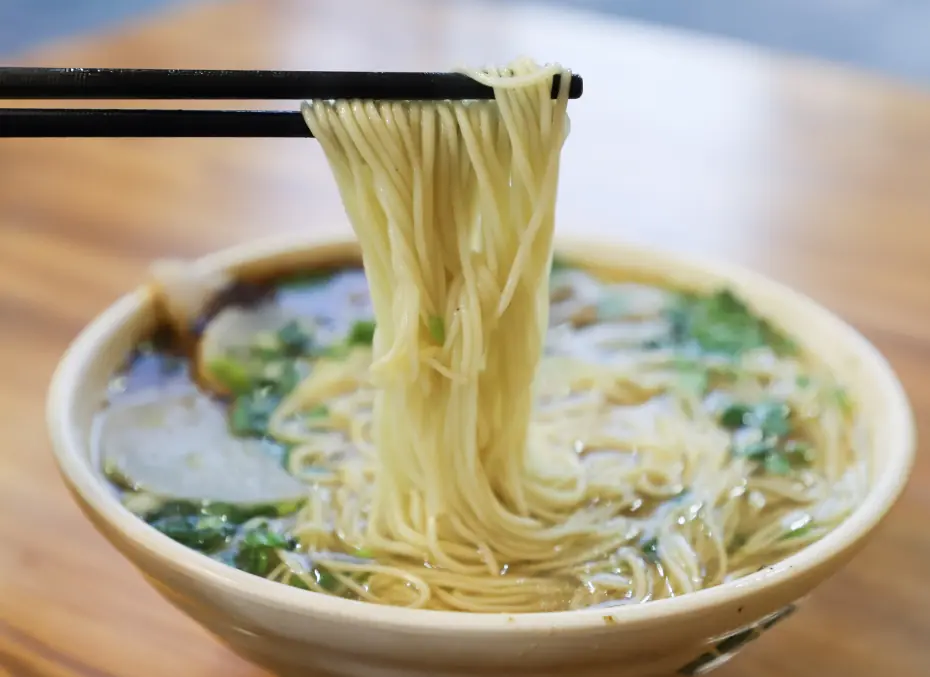
A light broth with fine noodles and a choice of toppings. It is the easiest quick lunch between the garden, museum and canal walk.
Osmanthus Cake
桂花糕
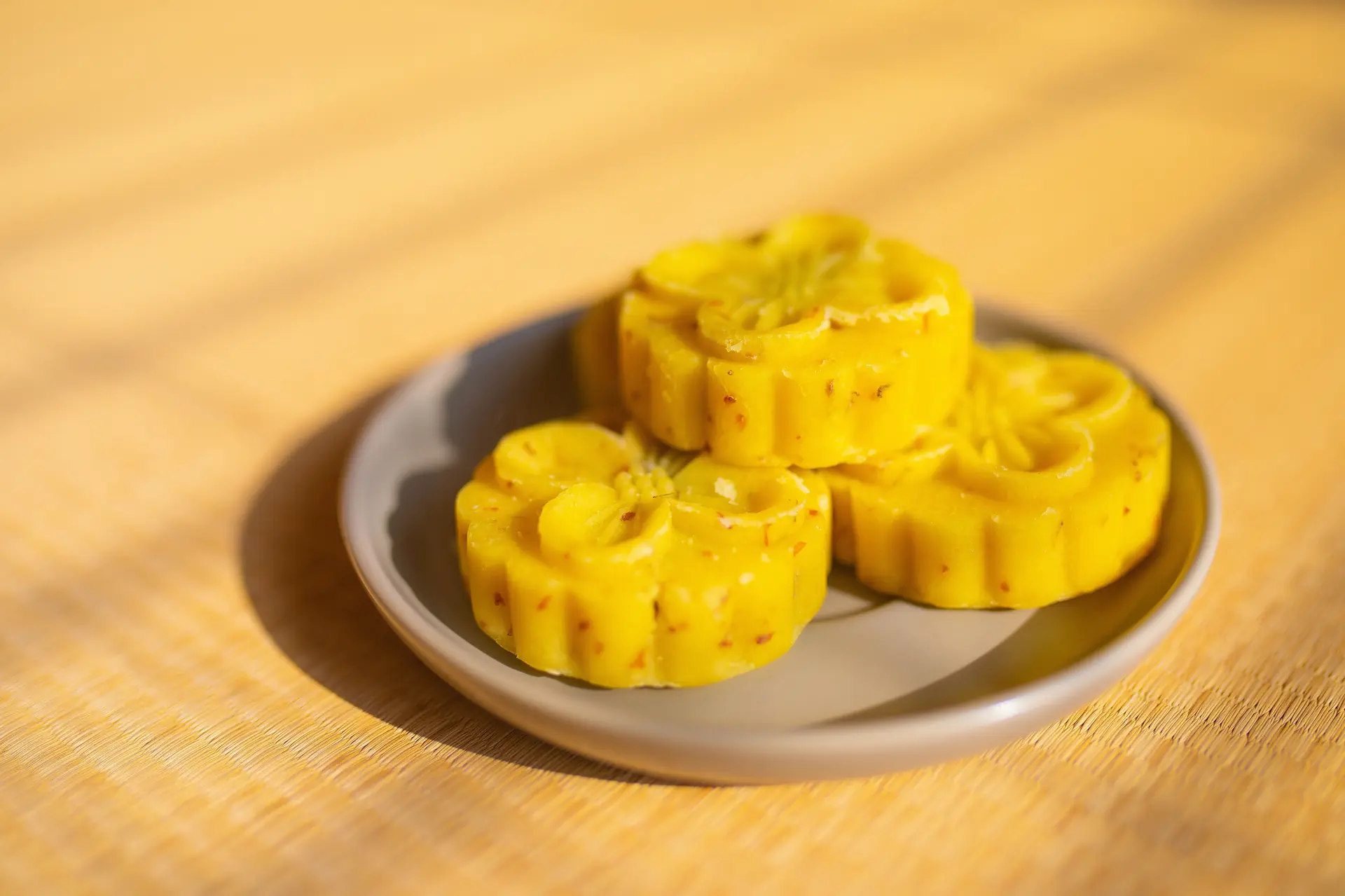
A soft rice cake scented with osmanthus flowers. Buy a small portion from a busy vendor and treat it as a snack, not a full meal.
Tickets, Hours, and Booking
Cost · ticket-season calendar
Ticket Prices
Ticket seasons do not use the same month boundaries as opening hours. Check the month first, then apply the relevant concession.
¥80
Peak
April, May and July–October
¥70
Off-peak
January–March, June and November–December
Half price: Eligible minors and full-time students with valid original ID; check the current policy.
Free: Children aged 6 or below, or height 1.4 m or below, and visitors aged 70+, subject to the required proof and guardian conditions.
Other groups: Check the official concessions page and required documents. Rules for ages 60–69 vary by residency and attraction category.
Time · opening-hour calendar
Opening Hours
Current temporary period · June 19 – October 7, 2026
6:45–17:30 · last entry 17:00
The earlier opening is temporary. Recheck the official notice for visits after October 7.
Regular March 1 – October 31 schedule
7:30–17:30 · last entry 17:00
November 1 – February 28/29
7:30–17:00 · last entry 16:30
Major-holiday periods: Qingming, May Day, Mid-Autumn and National Day schedules are usually extended to 18:00, with last entry usually at 17:30.
拙政问雅 evening program: Currently Tuesday–Sunday, 18:30–22:00; last ticket check at 21:00.
Holiday and evening arrangements are announced separately. Check the official notice for the exact date you plan to visit.
Reservation · identity · gate
How to Book and Enter
Reserve online 1–7 days before every visit in the current notice period
The June 19–October 7 notice requires all visitors to complete real-name timed reservation through the online platform before arrival. Use the official “苏州园林旅游” website or WeChat channel and carry the original registered ID for entry.
Booking window. The current notice requires booking 1–7 days ahead; popular dates can fill quickly.
Passport entry. Use the same passport or ID details for purchase and gate verification, and carry the original document.
Foreign-card or app trouble. Use the official support channel before your visit. On-site help may assist with documents or payment, but it does not replace the current advance online-reservation requirement.
Separate reservations. The garden ticket does not include Suzhou Museum or the Taiping Heavenly Kingdom Loyal King's Mansion.
Getting to the Garden
Metro · best default
Suzhou Metro Line 6 stops at 拙政园苏博站 (Humble Administrator's Garden & Suzhou Museum Station). Use Exit 1 or 3 and allow about five minutes on foot to the south gate.
Bus · useful from the old city
Routes 游1, 游2, 游5, 40, 202, 313, 529 and others have served stops around “拙政园.” Routes change, so confirm the live stop in your map app; the final walk is usually only a few minutes.
Driving · least convenient
Old-town parking is limited and traffic controls can change. If driving, check current restrictions and consider the 东汇公园换乘停车场 (Donghui Park transfer lot) before continuing on foot or by shuttle.
From Shanghai
Use Suzhou Station, then transfer to Line 6
High-speed trains from Shanghai Station or Hongqiao usually take about 25–30 minutes to Suzhou Station. Second-class fares are dynamic, often around ¥30–46; check Railway 12306 for the current train and price.
From Suzhou Station, use Metro Line 4 and transfer to Line 6, or take a taxi. Suzhou North Station is roughly 15 km from the garden and is usually less convenient for this old-city cluster.
If taking a taxi from Suzhou Railway Station, show the driver:
Show this screen to your driver · 出示给司机看
你好,请带我去拙政园南门,谢谢。
Hello, please take me to the south gate of Humble Administrator's Garden, thank you.
From Suzhou Station, allow roughly 15 minutes in light traffic. Metro Line 4 with a transfer to Line 6 avoids road congestion.
Practical Tips
- Wear comfortable flat shoes. The entire garden uses stone paving, thresholds and uneven steps.
- Bring insect repellent in summer. Water and dense greenery mean persistent mosquitoes.
- Compare provenance before buying silk. If material quality matters, ask for clear labeling and receipts or use an established museum or specialist retail channel.
- Carry water. Do not assume there will be a drinking fountain exactly when you need one; in-garden kiosks can cost more than shops outside.
- Do not automatically cancel for rain. Mist, wet stone and dripping banana leaves reveal a different side of the garden; bring an umbrella and watch slippery steps.
- Ask the visitor center about luggage storage. Free storage is offered as a visitor service, but confirm the current counter and capacity on arrival.
Frequently Asked Questions
A full visit covering all three garden zones takes 2–3 hours. Central and West highlights take about 1–1.5 hours. Add Suzhou Museum and the pair becomes a strong half-day.
Sources checked for this guide
- Suzhou Municipal Government: June 19, 2026 Humble Administrator Garden notice: temporary June 19–October 7 06:45 opening and mandatory 1–7-day online reservation checked July 14, 2026
- Suzhou Development and Reform Commission: Humble Administrator Garden profile: 16-year construction period and complete Four Great Gardens list checked July 14, 2026
- Suzhou Garden Bureau: Humble Administrator Garden profile: 1509 origin, later changes and 1997 inscription checked July 14, 2026
- Suzhou Garden Bureau: opening hours: regular daytime, holiday and current evening-program hours checked July 14, 2026
- Suzhou Garden Bureau: ticket prices: ¥80/¥70 and official ticket-season months checked July 14, 2026
- Suzhou Garden Bureau: concession policy: child and senior eligibility framework checked July 14, 2026
- Suzhou Municipal Government: reservation policy: real-name reservation status cross-check
- Suzhou Municipal Government: foreign-visitor ticket support: general on-site machines and staffed assistance context, superseded where the current notice requires advance online reservation
- Suzhou Municipal Government: 2026 garden visitor services: current payment and luggage-service context
- Suzhou Municipal Government: 2026 Suzhou Museum reservation notice: full timed reservation, seven-day window and passport entry
- UNESCO World Heritage Centre: Classical Gardens of Suzhou: nine-garden property and heritage context
- UNESCO nomination evaluation: garden scale and historical context cross-check
Beyond This Guide
The Humble Administrator's Garden anchors a Suzhou visit, but the city's garden world runs far deeper: nine UNESCO-listed gardens, canal-side historic districts, and a silk-and-tea culture that rewards slow exploration.
Continue planning Suzhou
- Lion Grove & Master of the Nets Garden guide — compare two smaller classical gardens with very different spatial ideas
- Suzhou city guide — connect the gardens with museums, canals and onward transport
- Best Things to Do in Suzhou — balance classical gardens, silk heritage, and Pingjiang or Shantang canal walks
© gochinafreely.com — Original guide by Go China Freely.