Season & Tickets
Good to Know
A Tang Dynasty Poem Brought to Life
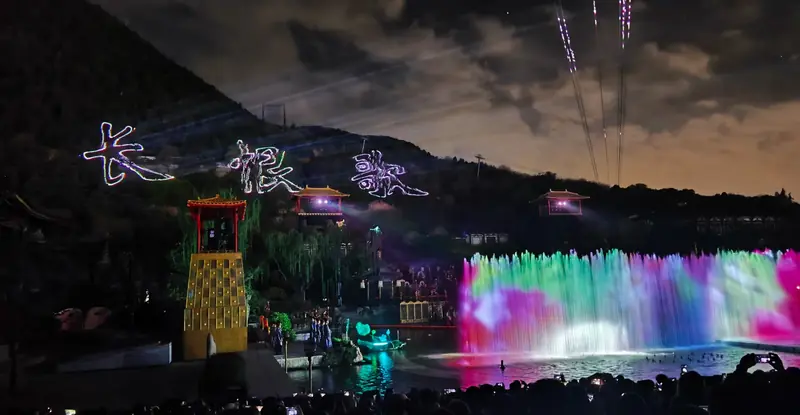
Inside Huaqing Palace (华清宫), beside the Tang royal hot springs and beneath Mount Li (骊山), a large ensemble turns Bai Juyi's tragic poem into ten scenes of dance, water, flame and projection. The production runs for about 70 minutes and uses Nine Dragon Lake (九龙湖) as its stage.

Nine Dragon Lake becomes the stage; the real palace and Mount Li complete the setting.
The site matters because the drama is not projected onto a generic theater. Emperor Xuanzong (唐玄宗) and Yang Yuhuan — later known as Yang Guifei (杨贵妃) — are associated with Huaqing's imperial hot-spring court, while the surrounding palace walls and mountain remain visible throughout the performance.
The tragedy
When the An Lushan Rebellion (安史之乱) drove the court from Chang'an, soldiers forced Xuanzong to order Yang Guifei's death at Mawei Slope (马嵬坡). Bai Juyi (白居易) later gave the loss its enduring poetic form.
The real setting
The lake, palace architecture and Mount Li are not decorative references: they are the physical stage, side walls and mountain backdrop seen by the audience.
The production
Public performances began in the mid-2000s. Current authoritative coverage describes ten scenes, about 70 minutes and roughly 200 performers.
Its reputation comes from this fit between story and place. The effects are spectacular, but the stronger impression is that the palace itself seems to remember the poem.
Ten Scenes, from Love Song to Eternal Parting
The operator presents the drama as a prelude plus nine acts: ten scenes in all, running for about 70 minutes. The five groups below keep the emotional arc visible without turning the section into a wall of equal cards.
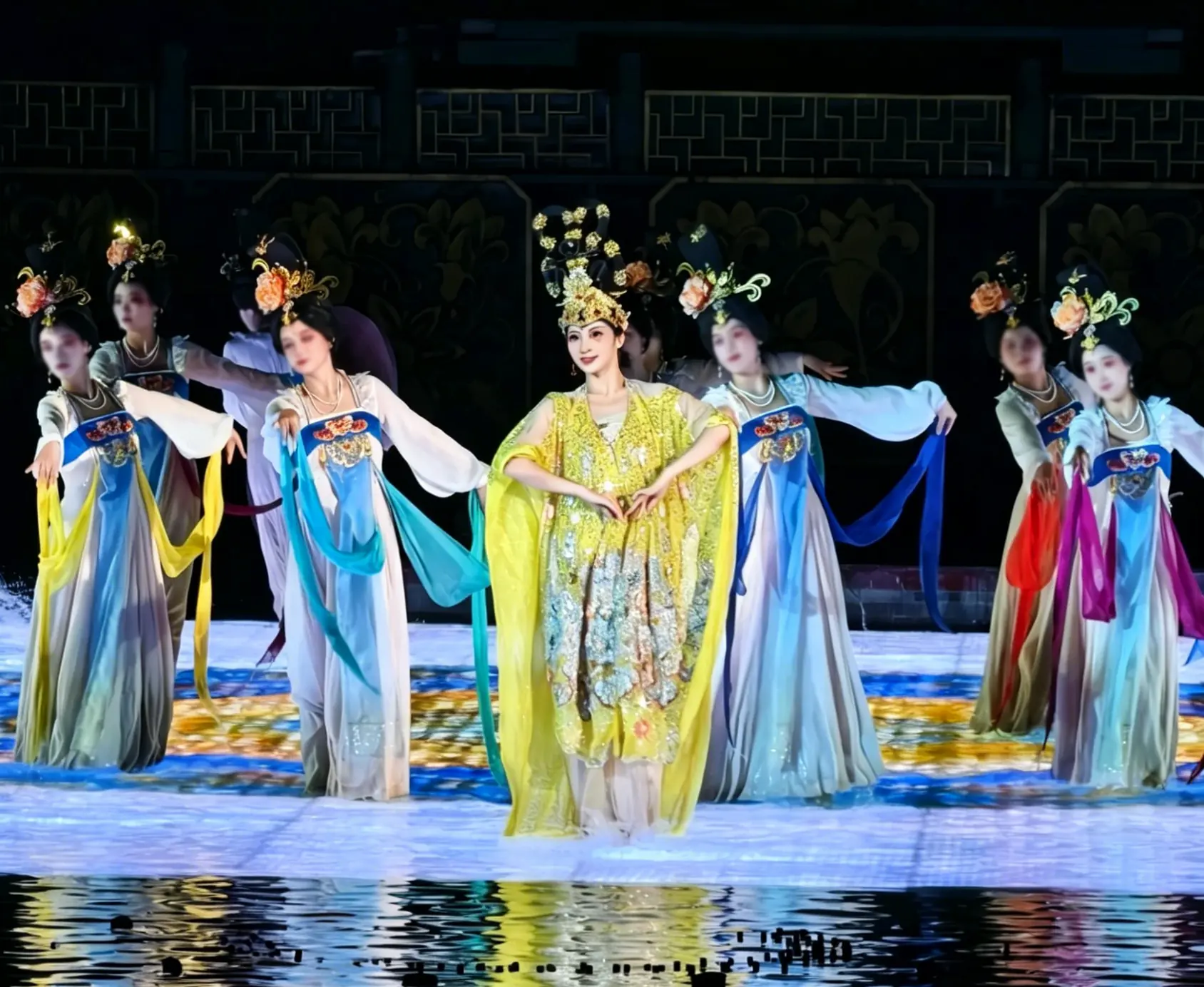
Prelude and Act 1 — Yang Yuhuan enters the palace world as the love story begins.
Entry · Prelude + Act 1
"A Girl in the Yang Family Comes of Age" introduces Yang Yuhuan in flowing court dance. "One Day Chosen to Stand Beside the Emperor" then narrows the ensemble into the first encounter between Yang and Emperor Xuanzong.
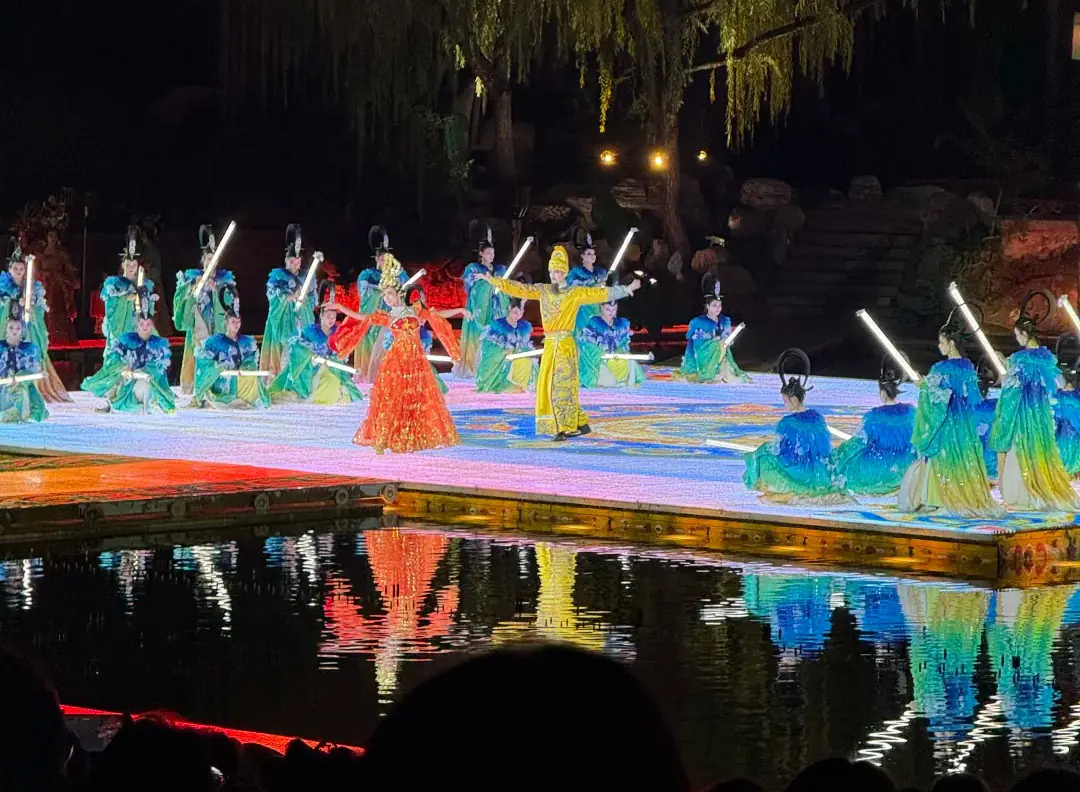
The moonlit vow scene — Xuanzong and Yang Guifei dance on water as they pledge eternal love
Intimacy · Acts 2-3
"Midnight Whispers When No One Is Near" places the pair alone in blue moonlight and reflections. "Spring Chill, a Bath Bestowed at Huaqing Pool" follows with mist, water curtains and fountains around Yang Guifei's bathing silhouette.
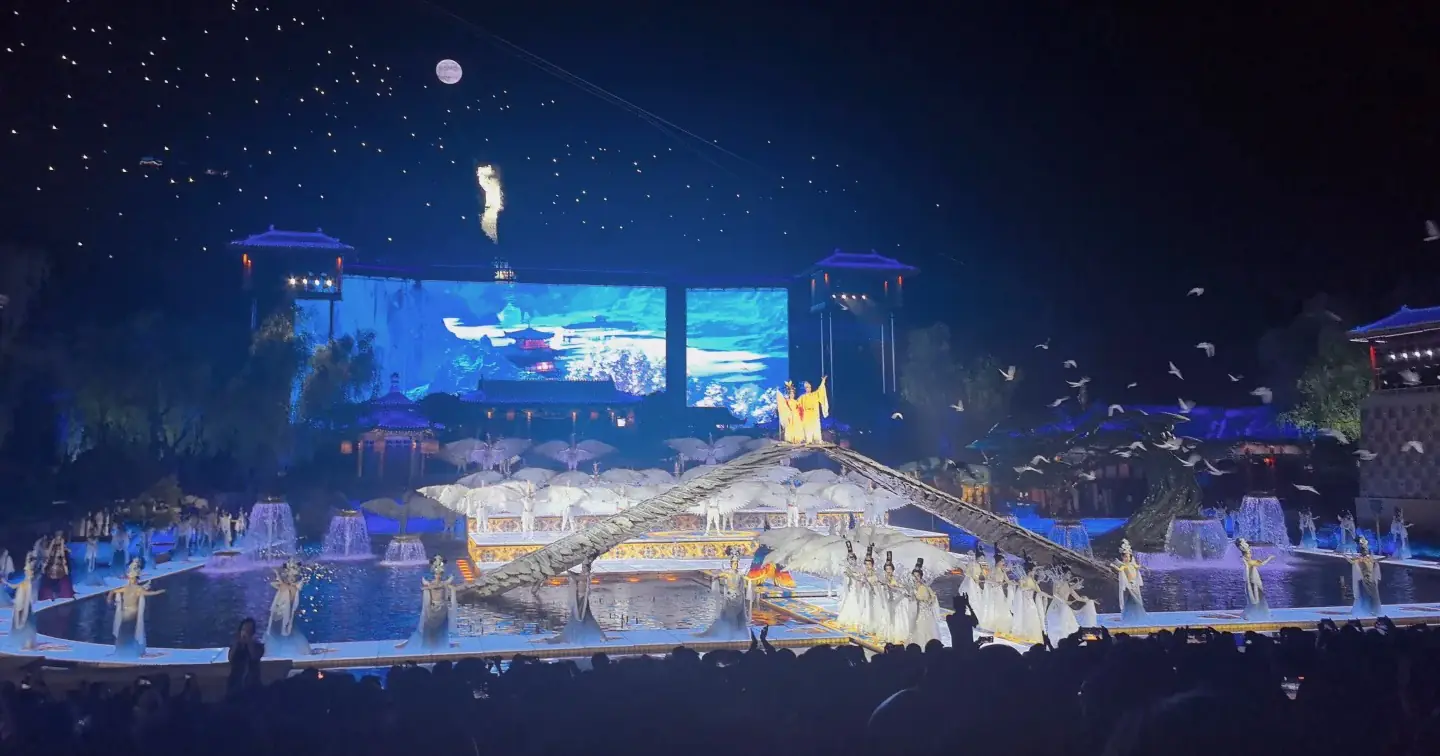
Acts 4-6 — palace towers, banquet and music expand the story into a full Tang court spectacle.
Prosperity · Acts 4-6
"The Li Palace Towers High into Blue Clouds" opens the production to its broadest court tableau. "After the Jade Tower Banquet, Drunk on Spring" shifts to banquet and private pleasure, before "Celestial Music Drifting Everywhere" fills Mount Li with music and a field of star-like lights.
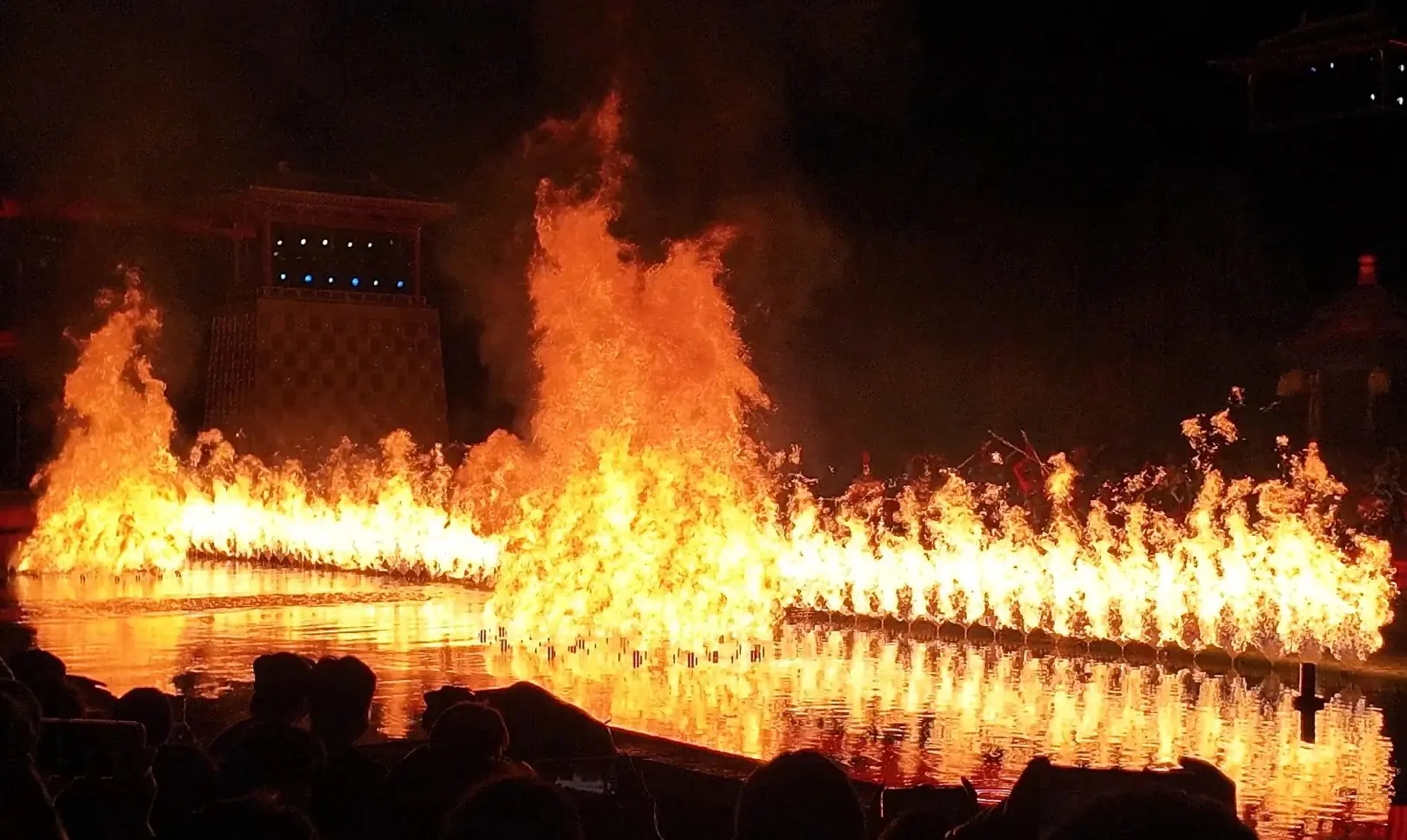
Acts 7-8 — war drums and fire break the court world apart before the Mawei Slope tragedy.
Rupture · Acts 7-8
"War Drums from Yuyang Shake the Earth" turns music into battle: fire crosses the lake and the mountain becomes smoke and conflict. "Hairpins Scattered on the Ground, No One to Pick Them Up" reduces that chaos to the forced death of Yang Guifei at Mawei Slope.
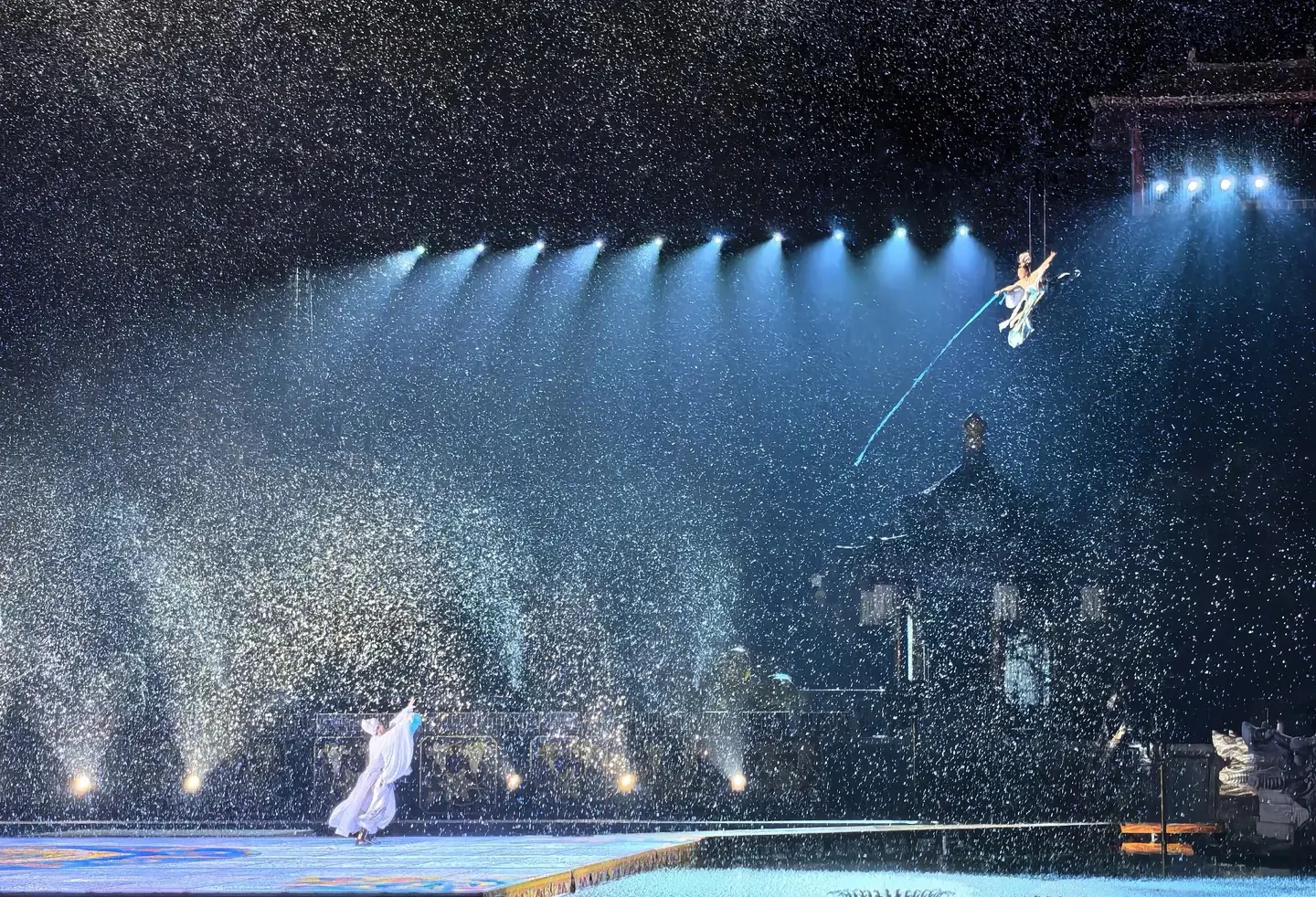
Act 9 — the human tragedy resolves as a celestial reunion above the darkened lake.
Release · Act 9
"Meeting Again Between Heaven and Earth" lifts Yang Guifei into the night sky while Xuanzong remains below. The finale returns the story to Bai Juyi's central idea: political history ends, but longing continues beyond it.
Water, Fire, and a Mountain Screen
The technical achievement is not one isolated trick. Lake, stage, fountains, fire, mountain projection and aerial rigging are timed as one continuous landscape, so each change advances the story rather than pausing it.
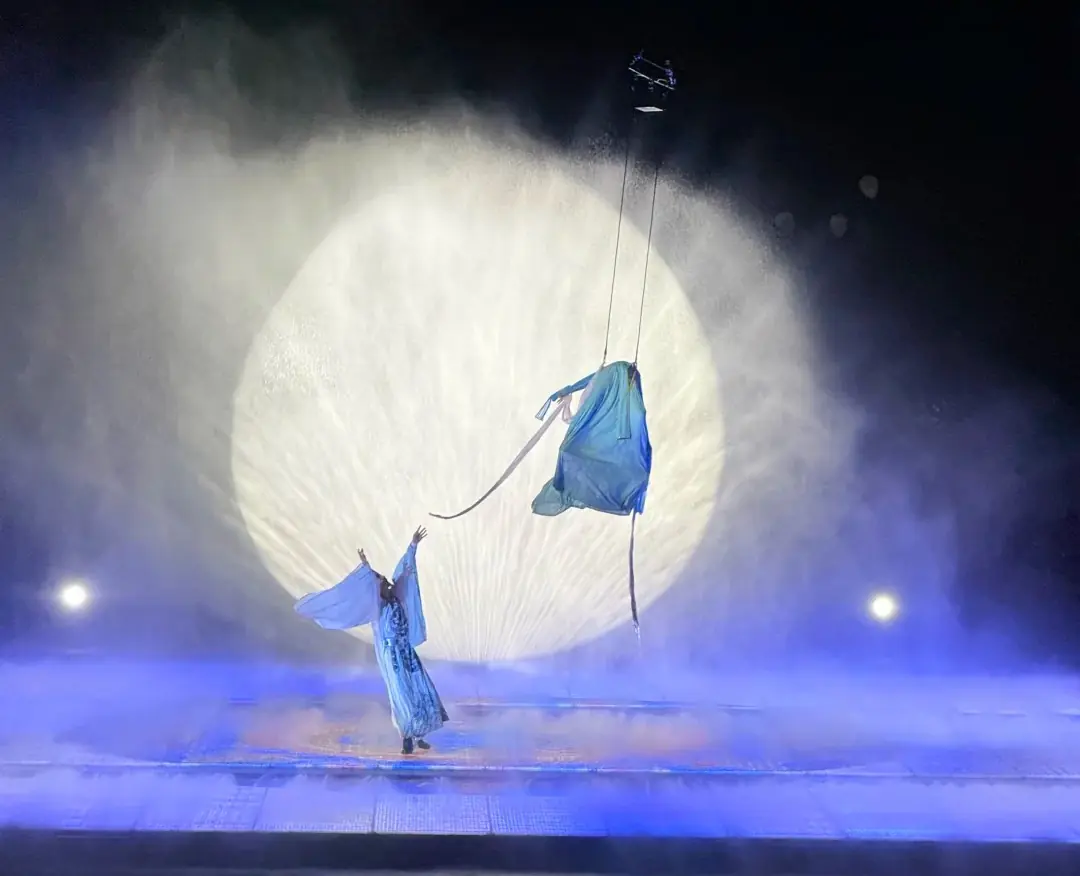
Concealed moving platforms and fountains let the lake change shape between scenes.
Moving lake stage
Concealed platforms rise, sink and separate, allowing dancers to appear from the water and the playing area to change between intimate and ensemble scenes.
Fire on water
During the rebellion, flame effects cross the lake while fountains continue around them. This is the only row that carries risk-red because it represents real fire.
Mountain projection
Projection and LED scenery extend Chang'an, battle and sky imagery onto Mount Li. The operator describes a further visual upgrade in 2024.
Star field and moon
Small points of light spread through the mountain and trees while a moon effect gives the quiet love scenes and finale their scale.
Aerial finale
Wire-supported movement lifts Yang Guifei above the lake, turning the final reunion into a vertical composition between earth and sky.
Seat Zones and Which to Pick
The auditorium curves around Nine Dragon Lake. Use the table to identify the zone first, then choose from the three practical positions below; exact inventory and pricing still belong to your dated listing.
Snapshot checked against recent listings in July 2026. Not every date uses the same session labels or price ladder; verify the selected product before paying.
Best value
Center A · ¥368-388
Our default frontal balance of water stage, mountain and price.
On a budget
East/West A · ¥268-298
Accept the side angle and choose nearer the center edge when possible.
Premium comparison
VIP C · ¥558-588
Compare this first for a closer position; verify every listed inclusion.
Tickets and How to Book
Build the purchase around the dated session, not around an old timetable. The product page is the source of truth for its time, zone, entry document and cancellation cut-off.
Price and children
Recent listings show ¥238-988 across seven zones. Some allow a child under 1.3 metres without a separate seat; confirm your product's child rule.
Official channels
Use the verified Huaqing Palace Scenic Area (华清宫景区) WeChat account/mini program or the operator's Douyin, Taobao and Fliggy channels. Jinyang Gate (津阳门) handles foreign-document exchange.
English-language fallback
Use Trip.com(affiliate link · may earn commission, no extra cost) for an English flow, then match its date, session and zone to the operator listing.
Release window and caps
Ten-day windows, morning releases and caps have applied on specific dates, not forever. Check when your date opens and its current order limit.
Real-name entry
The traveller, ticket and purchase document must match. Foreign-passport holders may need a paper or e-seat credential from Jinyang Gate.
Changes, refunds and weather
Read the attached terms before checkout. Show-date cut-offs can be strict; weather handling follows that product and the operator's notice.
Choose the seat and the return together
Center inventory tightens on busy dates, but the wrong late session creates a bigger problem than a side seat. Check both the available zone and your after-show transport before you pay.
Showtimes and Best Season
Start with the operator's live calendar. The times below are the current visitor guide's typical pattern, not a promise for a particular night.
Normally Mar-late Oct
Typical times: 20:10, 21:35, 23:00, 00:25. Choose the return method before a late session.
Normally Dec-late Feb
Typical times: 18:30, 19:55, 21:20, 22:45. Check the dated format, setup and inclusions.
Up to four sessions may run. Inventory and transport change quickly, so use the dated operator listing.
Each performance is about 70 minutes. Seasonal opening dates and session times can move, so recheck the official Huaqing Palace notice on the day of travel.
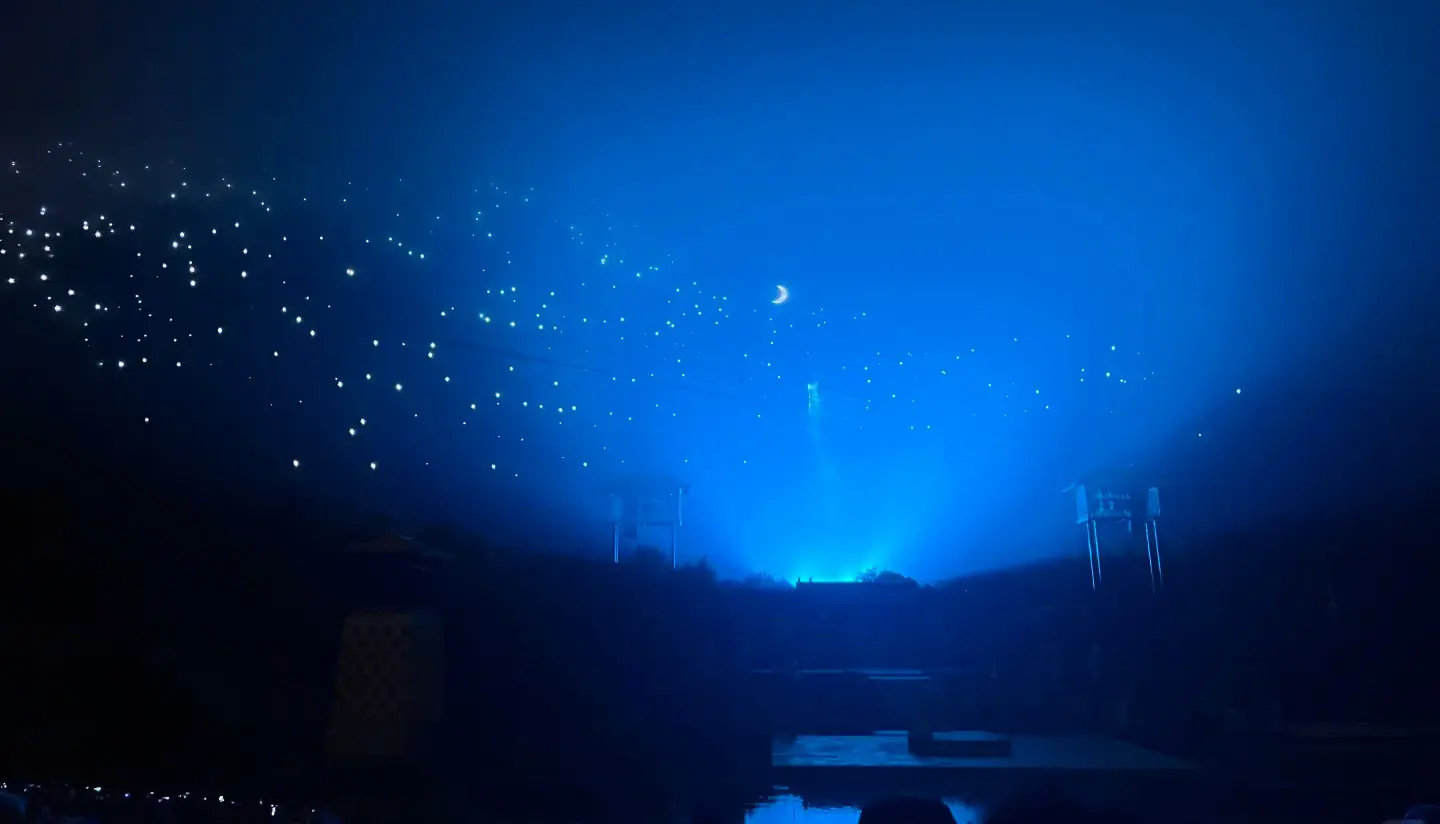
A fully dark sky gives the mountain lighting and lake reflections their strongest contrast.
Choose by darkness and return
An earlier session is easiest for transport. A later one may offer a darker sky, but it should be paired with a confirmed taxi, ride-hailing pickup or Lintong overnight plan rather than an assumed last train.
The useful question is not “which show number is best?” but “which dated session gives you the seat, darkness and return plan you can actually execute?”
Spring to early summer
Often the easiest balance of an outdoor production and manageable evening weather; carry a light layer and rain protection.
July and August
Expect heat, larger holiday crowds and tighter central-seat inventory.
September and October
Good outdoor-show conditions, with especially high demand around the October 1-7 National Day holiday.
Winter dates
Treat the winter production as a different seasonal format and verify the exact product instead of assuming it reproduces the classic lake staging.
Combine with Huaqing Palace and the Terracotta Warriors
The evening performance fits naturally after the Terracotta Warriors Museum (兵马俑) (Google | Amap) and Huaqing Palace (华清宫) (Google | Amap) because all three are in Lintong District. The sequence is simple; the exact showtime and return are the parts that need discipline.
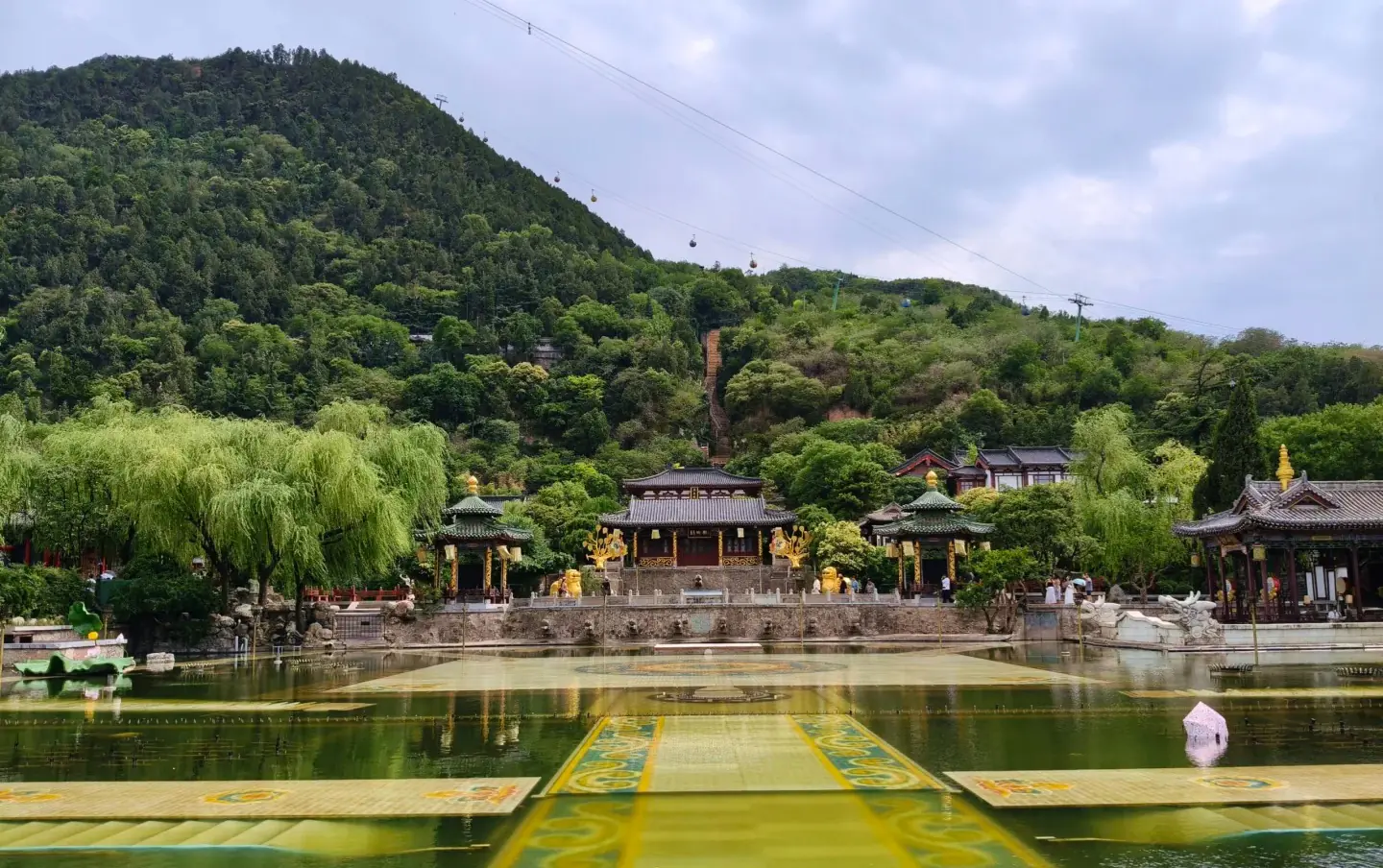
See the palace in daylight first; after dark, the same mountain-and-water setting becomes the stage.
Daylight to performance
Use the morning for the museum, move to Huaqing Palace after lunch, then leave a real dinner and entry buffer before the show. This gives the evening production historical and physical context without forcing a rushed palace visit.
Use this as a timing framework, then replace the show marker with the time printed on your ticket.
- Depart central Xi'an- Use a prechecked public-transport route, taxi or private car
- Terracotta Warriors Museum(兵马俑)- Keep roughly three hours for the pits and exhibits
- Lunch and transfer- Eat in Lintong, then move to Huaqing Palace
- Huaqing Palace daytime visit(华清宫)- Hot-spring history, palace grounds and Mount Li views
- Dinner, rest and ticket check- Keep a buffer for credential exchange and entry
- Song of Everlasting Sorrow(长恨歌)- Use the dated operator listing; the show runs about 70 minutes
- Return or stay in Lintong- Follow the transport plan chosen before booking
Tickets remain separate
A standard show-only ticket does not automatically include the daytime palace visit. The palace full-price ticket has recently been listed around ¥120, but check the current official rate and any bundle wording on your product.
Transfer inside Lintong
The museum and Huaqing Palace need a short road transfer. Taxi or ride-hailing is the most flexible; if you prefer a bus, check the current route in Amap or at the stop rather than relying on an old route number.
Getting There and Back
Venue: Song of Everlasting Sorrow, inside Huaqing Palace, No. 3 Huaqing Road (华清路3号), Lintong District, Xi'an (Google | Amap).
From central Xi'an
Metro Line 9
Ride to Huaqingchi (华清池) (Google | Amap), then follow current station signs toward Huaqing Palace and allow time for the final walk. Recheck any temporary station-exit changes on the day.
Current public bus
Bus routes and departure points have changed over time. Check Amap for the live route from your actual starting point instead of relying on legacy 914/915/Tourist Line 5 instructions.
Taxi or ride-hailing
The venue is about 30 kilometres east of central Xi'an. Road time and fare vary with traffic, pickup point, tolls and demand; use the app quote as the actionable figure.
Self-drive
Navigate to the official Huaqing Palace parking area and check the current operating hours and fee before leaving the car for a late session.
Getting Back — The Real Challenge
The show ends late, and some listed sessions run well beyond a useful metro return. Confirm the current Line 9 timetable or a non-metro plan before you book.
Metro
Works only when your ticketed end time, exit walk and official last-train time leave a safe buffer. Do not plan on a sprint.
Operator or venue transport
If a current session listing offers a return shuttle, verify its destination, price and boarding point before purchase; old fixed-fare references are unreliable.
Taxi or ride-hailing
Keep the Chinese venue name and pickup pin ready. App quotes and waits rise when several sessions release at once.
Stay in Lintong
The calmest choice for a very late session. Confirm that the hotel is genuinely walkable or arrange the short transfer directly.
Tips Most Visitors Learn Too Late
The detailed facts live in the ticket, schedule and transport sections above. Use this final pass as a short pre-booking checklist.
Before booking
- Compare Center A first. It is our default balance of frontal view and price, but use the current zone map and listing.
- Pair palace and show deliberately. Daytime context adds value; it also needs a separate ticket unless your product states that it is a bundle.
On show night
- Protect the return. Confirm the current last train, valid shuttle product, taxi plan or Lintong stay before choosing the session.
- Do not worry about fluent Chinese. Dance, music and staging carry the main arc, though a short story summary makes the details easier to follow.
Season choice
- Read the day's weather terms. Light-rain operation, protective gear and cancellation/refund handling are date- and product-specific.
- Treat winter as a different version. Verify its exact format and choose it knowingly rather than assuming it reproduces the classic outdoor lake staging.
Frequently Asked Questions
Check your ticketed end time against the current official Line 9 timetable before booking. If the margin is not comfortable, use a currently listed operator shuttle whose destination you have verified, arrange taxi or ride-hailing, or stay in Lintong. Do not rely on old fixed last-train, shuttle-fare or taxi-fare figures.
Primary references for this update
- Huaqing Palace visitor guide checked for the classic and winter operating windows, typical session pattern and official sales channels.: Huaqing Palace visitor guide
- Huaqing Palace show introduction checked for the official Prelude plus Acts 1-9 scene sequence.: Official show introduction
- Huaqing Palace entry guide checked for real-name matching and foreign-document credential exchange at Jinyang Gate.: Official e-seat and entry guide
- Huaqing Palace booking/contact page checked for the venue address and operator booking routes.: Official booking and contact page
- Shaanxi government and People's Daily reporting checked for the ten-scene, roughly 70-minute production, mid-2000s performance history and winter-version context.: Shaanxi government report and People's Daily report
- Xi'an Metro operator pages checked for Line 9 service and current-timetable handoff; recent live listings were used only as a dated price and child-policy cross-check.: Xi'an Metro service site and Recent Trip.com listing cross-check
Beyond This Guide
Use this guide for the Lintong performance day. For the next planning layer, connect it to the Terracotta Warriors, Xi'an's city-wall evening, the Muslim Quarter or the Giant Wild Goose Pagoda according to your available days.
For another landscape performance, compare Impression Lijiang at Jade Dragon Snow Mountain or Impression Liu Sanjie on the Li River.
© gochinafreely.com — Original guide by Go China Freely.